
Automated 80G Tax Receipt System: 2026 NGO Guide
A comprehensive engineering blueprint for Indian non-profits automating Section 80G tax receipt generation. Eliminate manual billing bottlenecks, validate donor PAN in real time via regex, deliver digitally stamped PDF receipts via WhatsApp Business API within seconds of payment, and synchronize automatically with Income Tax Form 10BD ledgers in 2026.
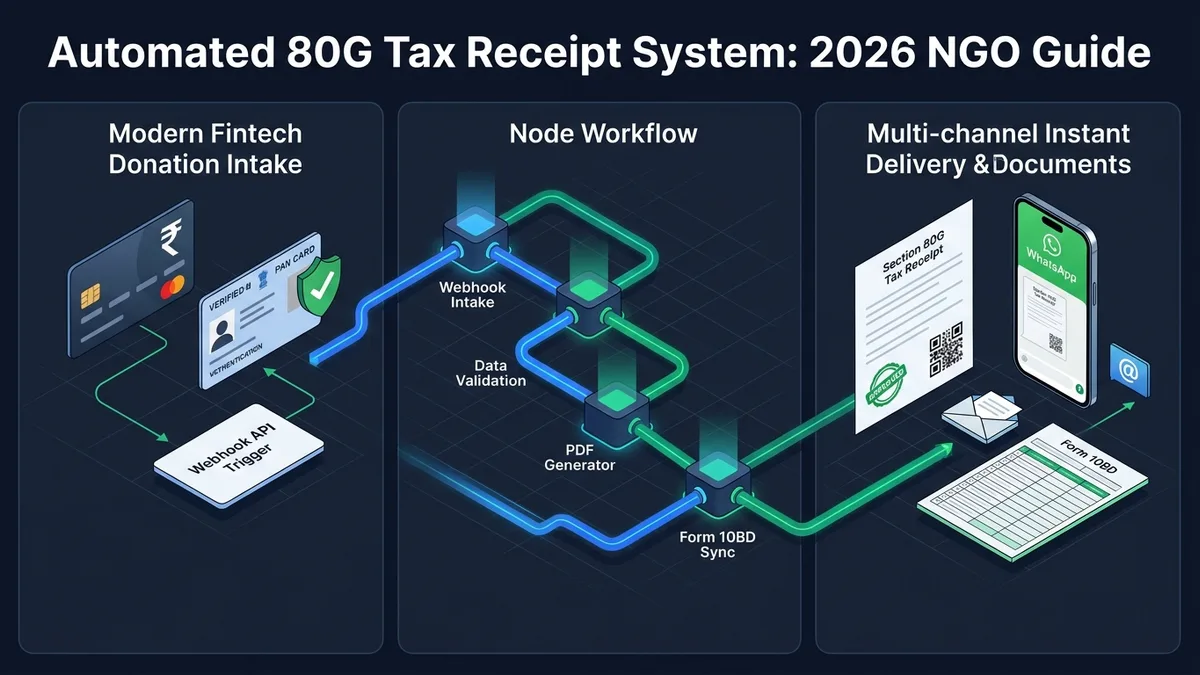
1. The 80G Receipt Headache: Why Manual Invoicing Paralyzes NGOs
For Indian charitable trusts, societies, and Section 8 companies, processing donor tax receipts manually is among the most tedious and error-prone operational bottlenecks. During peak fundraising campaigns or festive seasons, an NGO may receive hundreds of donations in a single week.
When receipts are created manually in Microsoft Word or Excel, administrative staff spend hours typing donor names, copy-pasting ten-digit PANs, formatting serial numbers, exporting individual PDFs, and emailing them one by one. Typographical errors in donor PANs lead to severe donor frustration during tax filing season when donations fail to appear in their Annual Information Statement (AIS) on the Income Tax portal.
The Modern Standard: Donors expect digital immediacy. When a supporter contributes ₹5,000 on their smartphone via UPI, receiving an official Section 80G tax receipt on WhatsApp within twenty seconds cements credibility and triggers repeat giving.
2. Statutory Mandates: Rule 18AB, Form 10BD, and Donor Identification
Under the Finance Act reforms, an 80G receipt is no longer a simple casual acknowledgment. To maintain statutory validity, it must comply with strict legal parameters:
- Unique Registration Number (URN): The receipt must display the organization 16-character 80G URN issued by the Income Tax Department, alongside the order date and validity period.
- Mandatory Donor Identification: Under Rule 18AB, donations claiming 80G deduction must capture the donor PAN or Aadhaar. If neither is available, alternative government IDs (Passport, Voter ID, Driving License) must be recorded.
- Sequential Numbering: Receipt serial numbers must follow a strictly uninterrupted chronological sequence per financial year (for example,
W4C/2026-27/0001). - Form 10BD Reconciliation: All details captured on the receipt must match the annual Form 10BD electronic return filed on the Income Tax e-filing portal before May 31.
3. Architecture of a Modern Zero-Touch 80G Automation System
An automated 80G receipt pipeline operates without human intervention through an event-driven microservice architecture:
- Donation Event Trigger: The payment gateway (Razorpay, Cashfree, or UPI Autopay) detects successful payment capture and dispatches an HTTP POST webhook payload to your secure endpoint.
- Payload Validation & Sanitization: The automation engine verifies the webhook HMAC signature, extracts donor metadata (Name, Mobile, Email, Address, PAN, Amount, Payment ID), and validates PAN structure.
- Atomic Ledger Entry: The transaction is committed to a central database ledger, auto-incrementing the sequential fiscal year receipt number.
- Dynamic PDF Generation: A headless PDF renderer populates an official HTML/CSS template with transaction particulars, generates a dynamic verification QR code, applies a digital signature stamp, and compresses the PDF.
- Instant Dispatch: The generated PDF is uploaded to encrypted cloud storage and delivered simultaneously via WhatsApp Cloud API and transactional email.
4. Real-Time Donor PAN Structure and Checksum Verification
Preventing flawed PAN submissions at the point of donation is vital. An Indian Permanent Account Number adheres to a strict alphanumeric format:
^[A-Z]{3}[PCHFATBLJG][A-Z][0-9]{4}[A-Z]$
The fourth character designates the entity status: P for Individual, C for Company, H for HUF, A for Association of Persons, T for Trust, and F for Firm. The fifth character represents the first letter of the donor surname. Enforcing regex pattern matching directly on your website donation form ensures donors cannot submit invalid strings like ABCDE1234F, eliminating eighty percent of downstream Form 10BD filing rejections.
5. PDF Generation: Designing Compliant, Digitally Stamped 80G Certificates
The visual certificate must look pristine and instill institutional confidence. Key architectural elements include:
- Official Header: Legal NGO name, Registered Office Address, Registration Number, PAN, and prominent 80G URN and 12A URN numbers.
- Dual Amount Representation: Donation amount printed in both numerical figures (₹5,000.00) and words (“Rupees Five Thousand Only”) to prevent ambiguity.
- Dynamic Verification QR Code: A scannable QR code encoding the unique receipt URL on your website, allowing tax auditors or donors to verify authenticity instantly.
- Digital Signature Stamp: High-resolution PNG stamp of the authorized trustee signature alongside a disclaimer: “This is a computer-generated tax receipt; no physical signature is required under IT Act guidelines.”
6. Instant Delivery via WhatsApp Business Cloud API and Transactional Email
Email open rates in India linger below twenty percent. WhatsApp messages, however, command open rates exceeding ninety-six percent.
By integrating Meta official WhatsApp Business Cloud API, your automation pipeline delivers a pre-approved utility template message within seconds of payment:
“Dear Suresh Sharma, thank you for your generous contribution of ₹5,000 to Web4cause Foundation! Your Section 80G Tax Exemption Receipt (No. W4C/2026-27/0412) is attached below. Your donation will be reported in Form 10BD for your annual AIS tax credit.”
A simultaneous transactional email is dispatched via high-deliverability SMTP services (Amazon SES or Postmark) with the PDF attached, ensuring complete multi-channel archiving.
7. Building the Automation Pipeline with Open-Source Self-Hosted n8n
Commercial integration platforms like Zapier become prohibitively expensive for non-profits as donation volume increases, charging per-task fees.
Self-hosted n8n provides an open-source, sovereign alternative that runs on a modest $6/month Linux Virtual Private Server. With zero recurring per-task licensing fees, an NGO can process unlimited donations, generate hundreds of thousands of receipts, and maintain complete custody of donor financial data on sovereign Indian cloud servers.
8. Synchronizing the Annual Form 10BD Electronic Filing Ledger
The true administrative power of an automated system culminates on May 31 during annual tax filing:
Every automated transaction is formatted to match the Income Tax Department Form 10BD CSV schema:
- Col 1: Pre-acknowledgment Number (Auto-generated serial)
- Col 2: ID Code (1 for PAN, 2 for Aadhaar)
- Col 3: Unique Registration Number of donor
- Col 4: Section Code (Section 80G)
- Col 5: Donor Legal Name and Address
- Col 6: Donation Type (Corpus, Specific Grant, or General Donation)
- Col 7: Mode of Receipt (Electronic, Cheque, or Cash)
- Col 8: Total Amount Received in INR
9. Processing Offline Cheques, NEFT Transfers, and Section 80G Cash Limits
Not all donations occur via online web forms. Donors frequently deposit cheques or initiate direct NEFT/RTGS bank transfers.
An automated system accommodates offline donations through a password-protected internal admin portal. When the finance officer inputs the offline donation details (Cheque/UTR number, Date, Donor PAN, Amount), the system hooks into the identical PDF rendering and WhatsApp delivery pipeline, ensuring offline gifts receive the exact same professional treatment.
Statutory Cash Limit Warning: Under Section 80G(5D) of the Income Tax Act, any donation exceeding ₹2,000 made in cash is ineligible for 80G tax deductions. The system must automatically flag cash entries over ₹2,000 and prevent issuing 80G exemption certificates for excess cash donations.
10. Frequently Asked Questions (FAQs)
1. Can an NGO issue an 80G receipt without the donor PAN?
An NGO can accept a general donation without PAN (provided it is non-cash up to limits), but it cannot issue a valid Section 80G tax-exemption receipt. Without PAN or Aadhaar, the donation cannot be reported in Form 10BD, meaning the donor cannot claim tax deductions.
2. What is the penalty for failing to file Form 10BD on time?
Under Section 234G of the Income Tax Act, non-profits that fail to submit Form 10BD by May 31 face a mandatory late fee penalty of ₹200 per day of default. Additionally, assessing officers may levy penalties between ₹10,000 and ₹1,00,000 under Section 271K.
3. Is WhatsApp Business API free for Indian non-profits?
Meta provides 1,000 free service conversations per month. For outbound utility messages (such as automated receipts), Meta charges a nominal per-message fee (approximately 30 to 45 paise per message in India). Using self-hosted n8n connects directly to the Cloud API without third-party aggregator markups.
4. Does an automated receipt require a physical ink signature?
No. Under the Information Technology Act, 2000 and standard electronic commerce practices in India, computer-generated digital receipts carrying an image of the authorized signature and an explicit statement that no physical signature is required are legally valid.
5. What happens if a donor makes an error in their PAN?
If an incorrect PAN passes initial validation and is reported in Form 10BD, the non-profit can file a Correction Statement on the Income Tax e-filing portal to amend the donor identification details without cancelling the transaction.