
Google for Nonprofits in India: 2026 Guide
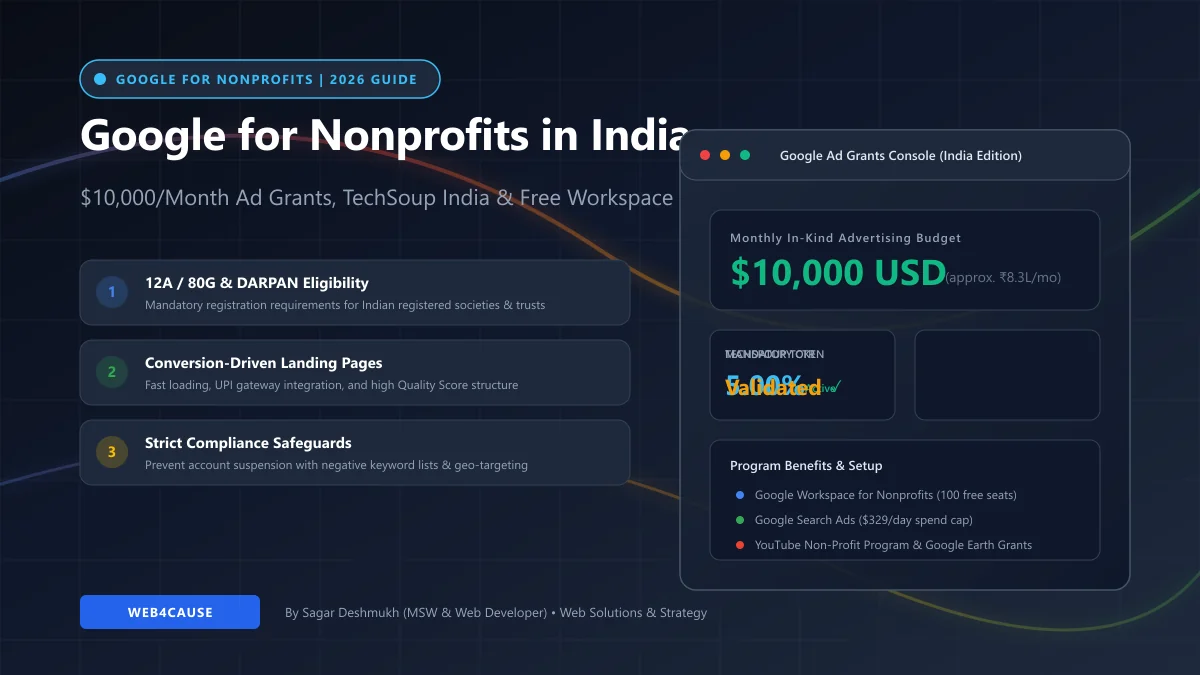
A comprehensive operational blueprint for Indian non-profits, charitable trusts, and Section 8 institutions seeking to unlock Google for Nonprofits. Master TechSoup India validation token workflows, activate $10,000 per month (over ₹8,30,000/month) in Google Ad Grants, deploy free enterprise Google Workspace, and maintain strict 5 percent Click-Through Rate compliance in 2026.
1. What is Google for Nonprofits: Enterprise Tech at Zero Cost
Google for Nonprofits is an international philanthropic program that equips eligible charitable organizations with enterprise-grade technology tools, marketing credits, and cloud productivity software at zero cost. For Indian non-profit organizations operating on constrained budgets, gaining access to this ecosystem represents an extraordinary operational upgrade.
Instead of using generic free Gmail addresses (such as [email protected]), non-profits obtain free business-grade Google Workspace accounts with custom domain emails ([email protected]), 30 GB of cloud storage per user, high-security video conferencing via Google Meet, and shared administrative drives. Furthermore, the program unlocks Google Ad Grants, YouTube Non-Profit Giving tools, and Google Maps Platform API credits.
Financial Magnitude: The Google Ad Grants allocation provides up to $10,000 USD every month in search advertising credits. Converted to Indian currency, this equates to roughly ₹8,30,000 per month, or approximately one crore rupees annually in non-dilutive marketing capital dedicated to recruiting donors and volunteers.
2. Google Ad Grants: Unlocking $10,000/Month in Search Advertising
Google Ad Grants places text advertisements on Google Search result pages when users query social causes, NGO initiatives, and donation opportunities.
Key operational mechanics of Ad Grants include:
- Daily Spending Cap: The $10,000 monthly allowance translates to an automated daily budget limit of approximately $329 USD across all active campaigns.
- Search Network Exclusivity: Ads appear strictly on the Google Search Network beneath or above organic search results. The grant does not support Google Display Network banner ads or YouTube video ads.
- Text-Only Ads: Ads utilize responsive search ad formats containing up to fifteen headlines and four descriptions that dynamically optimize for user query relevance.
- Maximize Conversions Bidding: While standard manual Cost-Per-Click (CPC) bidding is capped at $2.00, utilizing automated smart bidding strategies (such as Maximize Conversions or Target CPA) unlocks dynamic bidding, allowing ads to compete effectively for high-intent keywords.
3. Eligibility Criteria: 12A, 80G, Darpan, and Legal Structures in India
To qualify for Google for Nonprofits in India, an organization must satisfy rigorous statutory benchmarks:
- Recognized Legal Status: Registered as a Public Charitable Trust under the Indian Trusts Act / state trusts acts, a Registered Society under the Societies Registration Act, 1860, or a Section 8 Company under the Companies Act, 2013.
- Income Tax 12A / 12AB Registration: Active registration under Section 12A / 12AB of the Income Tax Act, 1961 establishing charitable purpose.
- NITI Aayog NGO Darpan Registration: An active Unique Darpan ID confirming institutional transparency.
- Commercial and Academic Ineligibility: Government entities, public sector undertakings, hospitals, healthcare clinics, and formal schools or universities are ineligible for Google for Nonprofits (educational institutions should apply for Google for Education instead).
- Active, Secured Website: An operational non-profit website hosted on a custom domain with valid SSL encryption (HTTPS), substantial original content, and transparent mission descriptions.
4. The TechSoup India (BigTech) Validation Token Workflow
Google does not directly verify non-profit legal documents. Instead, Google partners with TechSoup Global (operated in India as BigTech by the NASSCOM Foundation) to conduct statutory due diligence.
The validation procedure entails:
- Registering on the BigTech India portal (
bigtech.in) using organizational credentials. - Uploading scanned registration deeds, NGO PAN card, 12A registration orders, and annual audited accounts.
- Receiving manual approval from BigTech analysts (typically within five to ten business days).
- Generating a unique TechSoup Validation Token (formatted as
123a4567@YourNGOName) that is copy-pasted into the Google for Nonprofits enrollment portal.
5. Google Workspace for Nonprofits: Free Professional Custom Email and Cloud Drive
Once Google for Nonprofits account approval is confirmed, the first immediate product to activate is Google Workspace for Nonprofits:
Professional Custom Email
Create custom Gmail addresses for all staff and trustees (e.g., [email protected]). Increases corporate CSR pitching credibility by eliminating amateur commercial email handles.
Shared Cloud Storage
Each user receives 30 GB of Google Drive cloud storage. Shared Team Drives ensure program case files, beneficiary records, and grant proposals remain institutional property even if staff resign.
Google Meet Security
Conduct secure video meetings with up to 100 participants with digital encryption, screen sharing, and interactive whiteboards for remote field coordination.
Admin Access Control
Centralized administrative console enforcing two-factor authentication (2FA) and device management, safeguarding organization data under the DPDP Act 2023.
6. Campaign Architecture: High-Intent Keyword Targeting and Geo-Fencing
Structuring an effective Google Ad Grants campaign requires organizing keywords into focused, high-intent ad groups:
- Donation-Intent Keywords: Target terms like “donate to child education NGO”, “sponsor rural girl schooling India”, or “80G tax saving donations online”. Direct these searchers to streamlined, high-speed mobile donation landing pages.
- Advocacy & Educational Keywords: Target information-seeking queries related to your cause, such as “malnutrition symptoms in rural children” or “how to report child labour India”, establishing thought leadership and capturing newsletter subscribers.
- Volunteer Mobilization Keywords: Target localized queries like “weekend NGO volunteering Mumbai” or “teach underprivileged children Pune”.
- Precise Geo-Fencing: Restrict ad delivery strictly to geographical regions where your programs operate or where domestic donors reside (e.g., tier-1 urban metros including Mumbai, Delhi NCR, Bengaluru, Hyderabad, and Pune).
7. Maintaining Strict Compliance: The Mandatory 5% CTR Account Rule
Google enforces stringent quality standards on Ad Grants accounts to prevent spam and irrelevant traffic. The most famous compliance rule is the Mandatory 5% Click-Through Rate (CTR):
The 5% CTR Mandate: Your Ad Grants account must maintain an overall monthly Click-Through Rate of at least five percent. If the account falls below 5% CTR for two consecutive months, Google automatically suspends the account until compliance fixes are completed.
Other vital compliance mandates:
- No Single-Word Keywords: Generic single words like “charity”, “donate”, or “news” are strictly prohibited. Keywords must consist of two or more words.
- Quality Score Threshold: Keywords with a Quality Score of 1 or 2 must be paused or removed immediately.
- Account Structure Rules: The account must contain at least two active ad groups per campaign, each containing tightly themed keywords and at least two active responsive search ads.
- Active Conversion Tracking: The account must have Google Analytics 4 (GA4) conversion tracking configured, tracking meaningful events like completed donations or volunteer form submissions.
8. Landing Page UX: Converting Free Ad Grant Clicks into Paying Donors
Securing thousands of free visitors from Google search ads is meaningless if your website fails to convert them. High-converting non-profit landing pages adhere to disciplined user experience design:
- Immediate Relevance: The landing page headline must directly reflect the ad text clicked by the user. If the ad promised child nutrition support, the landing page must immediately feature nutrition impact metrics.
- Mobile Sub-Second Speed: Over 85% of ad grant clicks in India originate from mobile devices. The landing page must achieve a Core Web Vitals LCP under 1.5 seconds.
- Instant 80G Assurance: Display prominent badges indicating “50% Tax Exemption under Section 80G” and “Instant WhatsApp PDF Receipt Delivery”.
- One-Tap UPI Checkout: Embed seamless UPI intent links (Google Pay, PhonePe, Paytm) that open directly in the donor smartphone payment app.
9. YouTube Nonprofit Program and Google Maps Platform API Credits
Beyond Search Ads and Workspace, Google for Nonprofits provides additional high-value tools:
- YouTube Nonprofit Program: Unlocks dedicated YouTube Giving features, allowing viewers to donate directly during live streams or video premieres with zero platform transaction fees. Link external website donation pages directly inside video cards.
- Google Maps Platform Credits: Eligible non-profits receive $250 USD per month in additional Google Maps Platform API credits. This allows organizations to build interactive field impact maps showing schools built, water wells drilled, or healthcare clinic locations across rural India.
10. Frequently Asked Questions (FAQs)
1. Is Google Ad Grants truly free, or does the NGO have to pay later?
Google Ad Grants is an entirely in-kind philanthropic grant. The organization is never charged, and no credit card billing information is required during activation. Unused daily ad credits do not accumulate and simply expire at midnight.
2. How long does the entire Google for Nonprofits approval process take?
Obtaining TechSoup India (BigTech) validation typically takes five to ten business days. Once the validation token is submitted to Google, approval is generally granted within three business days. Setting up and activating the Ad Grants account requires an additional three to five days.
3. What happens if our Google Ad Grants account is suspended for low CTR?
Suspensions for falling below the 5% CTR threshold are temporary. You can audit the account, pause underperforming keywords with low click-through rates, implement negative keywords, write higher-relevance ad copy, and submit an electronic reactivation request through the Ad Grants compliance form.
4. Can an NGO use Google Ad Grants to promote commercial services or merchandise?
No. In compliance with Ad Grants policy, all advertised landing pages must describe the non-profit mission, public welfare initiatives, donation appeals, or volunteer recruitment. Commercial e-commerce activities or advertising third-party products triggers immediate permanent termination.
5. Does an NGO require an active FCRA registration to apply for Google for Nonprofits?
No. Google for Nonprofits and Google Ad Grants are considered domestic in-kind software and technology provisions, not foreign financial contributions. FCRA registration is not required; only active Section 12A/12AB registration and TechSoup India validation are needed.