
Social Case Work Method in India: 2026 Guide
A definitive clinical and operational practice manual for professional social workers in India. Master Helen Harris Perlman 4Ps problem-solving framework, apply Felix Biestek seven relationship principles in complex sociocultural contexts, construct diagnostic genograms, maintain verbatim process recordings, and execute institutional interventions across medical, psychiatric, family court, and child welfare settings in 2026.
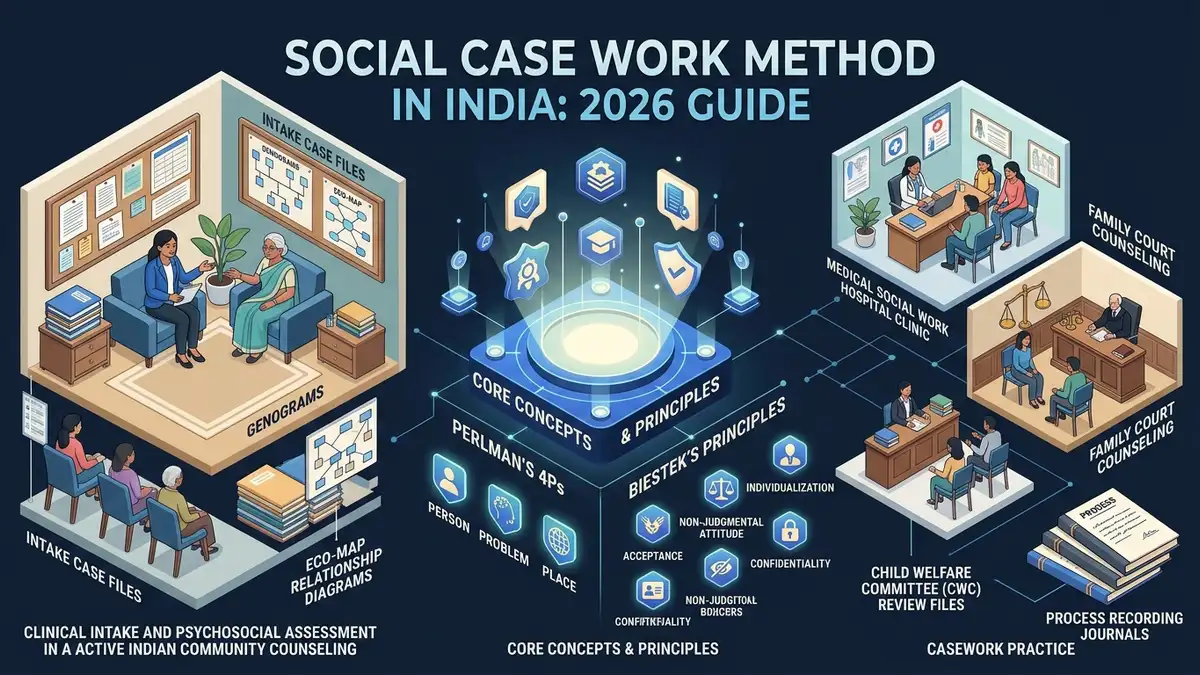
2. Helen Harris Perlman’s 4Ps: Person, Problem, Place, and Process
Formulated by Helen Harris Perlman in 1957, the Problem-Solving Model identifies four fundamental components that constitute the nucleus of every case work intervention:
1. The Person
A man, woman, or child whose social performance is impaired. The worker views the person holistically with biological, psychological, and social dimensions, possessing inherent dignity and innate potential for growth.
2. The Problem
A condition of psychosocial stress, maladjustment, economic destitution, disability, or marital breakdown that overwhelms the client current coping mechanisms and requires external intervention.
3. The Place
The social agency (hospital, NGO, family counselling centre, child welfare home, or correctional facility) whose statutory mandate, policies, and resources define the boundaries of helping.
4. The Process
The systematic, therapeutic interpersonal relationship established between worker and client that engages the client cognitive, emotional, and practical efforts toward problem resolution.
3. Felix Biestek’s 7 Core Principles of the Helping Relationship
In 1957, Felix P. Biestek articulated seven dynamic ethical principles that govern the casework relationship. In India, practicing these principles requires nuanced cultural adaptability:
| Biestek Principle | Clinical Meaning | Application in Indian Field Practice |
|---|---|---|
| 1. Individualization | Recognizing each client unique qualities rather than treating them as a case type | Avoiding stereotyping clients based on regional, caste, religious, or linguistic backgrounds |
| 2. Purposeful Expression of Feelings | Allowing the client to freely vent negative emotions, sorrow, and frustration | Creating a safe space for marginalized women or adolescents who face suppression at home |
| 3. Controlled Emotional Involvement | Maintaining professional empathy without succumbing to over-identification or pity | Preventing worker burnout when handling traumatic child abuse or severe domestic violence |
| 4. Acceptance | Acknowledging the client dignity despite undesirable traits or unconventional choices | Working unconditionally with HIV patients, commercial sex workers, or incarcerated undertrials |
| 5. Non-judgmental Attitude | Refraining from assigning blame or moral guilt for the problem condition | Avoiding moralizing in adolescent substance abuse cases or inter-caste marital disputes |
| 6. Client Self-Determination | Respecting the client sovereign right to choose their life decisions | Empowering women to make informed marital or livelihood choices rather than deciding for them |
| 7. Confidentiality | Protecting client private disclosures from unauthorized exposure | Safeguarding psychiatric disclosures and HIV status against inquisitive village relatives |
4. The 4-Stage Casework Cycle: Intake, Study, Diagnosis, and Treatment
Professional case work progresses through four interconnected, iterative phases:
- Intake and Psycho-Social Study: Initial face-to-face rapport building. The worker gathers factual biographical data, history of the presenting complaint, family structure, medical records, and school/work reports while evaluating client motivation.
- Social Diagnosis (Assessment): Formulating a professional appraisal of the causes, nature, and severity of the problem. Modern diagnosis categorizes assessment into Clinical (individual personality dynamics), Etiological (root historical causes), and Evaluative (current coping resources).
- Treatment Intervention: Executing planned action. Interventions include Direct Treatment (counseling, catharsis, reassurance, clarification) and Environmental Modification (mobilizing financial relief, school admissions, hospital waivers, shelter placement).
- Evaluation and Termination: Assessing whether treatment goals have been met, helping the client transition away from worker dependency, and conducting scheduled follow-up visits.
5. Diagnostic Assessment Tools: Genograms, Eco-Maps, and Home Visits
Visual diagnostic instruments bridge the gap between abstract psychological theory and grassroots reality:
- The Genogram: A three-generation pictorial diagram mapping family lineage, marriages, divorces, deceased members, chronic illnesses, mental disorders, and conflict patterns. In Indian joint families, genograms quickly reveal subtle authority figures and matriarchal power balances.
- The Eco-Map: A relational diagram depicting the client family connections with external ecological systems (local panchayat, self-help groups, money lenders, hospitals, schools, police). It highlights whether an environmental relationship is nurturing, stressful, or severed.
- The Home Visit: An indispensable assessment method in India. Visiting a client residence provides firsthand verification of living conditions, neighborhood sanitation, economic destitution, and intra-familial non-verbal behavior that rarely surfaces in agency office interviews.
6. Verbatim Process Recording vs Summary Recording in Fieldwork
Accurate documentation distinguishes professional clinical social work from informal social welfare:
The Gold Standard of Training: Verbatim Process Recording documents the interview dialogue word for word (“Worker said…”, “Client responded…”), capturing non-verbal cues, emotional pauses, defensive reactions, and the worker own subjective feelings. It is the primary tool used in MSW supervisory conferences to identify unconscious counter-transference.
In contrast, Summary Recording is used for official agency files, hospital discharge summaries, and court submissions. It synthesizes sessions into concise headings: Identifying Information, Presenting Problem, Diagnostic Formulation, Interventions Undertaken, and Next Action Steps.
7. Institutional Practice Settings: Hospitals, Family Courts, CWCs & Schools
In India, social case workers operate across a spectrum of specialized settings:
Medical & Psychiatric Social Work
Government civil hospitals, cancer institutes, and mental health centers. Workers help patients overcome denial, coordinate poverty concessions (Ayushman Bharat, MJPJAY), and formulate post-discharge rehabilitation plans.
Family Counselling Centres (FCC)
Attached to Family Courts and police stations. Workers mediate marital disputes, assess domestic violence under the PWDVA Act, and facilitate amicable conciliation or child custody arrangements.
Child Welfare Committees (CWC)
Under the Juvenile Justice (Care and Protection of Children) Act. Workers prepare Social Investigation Reports (SIR) for children in conflict with law or in need of care and protection.
School Social Work
Addressing chronic school absenteeism, learning disabilities, bullying, and mental health distress among students through integrated student-teacher-parent counseling.
8. Ethical Dilemmas: Confidentiality vs Family Collectivism in India
Western casework literature assumes a strictly confidential dyadic relationship between client and worker. However, Indian practitioners frequently encounter ethical dilemmas where family members demand disclosure of the client confidential conversations:
For example, when counseling a young unmarried female client experiencing reproductive health challenges or trauma, parents or in-laws often insist on attending sessions and dictating outcomes. The skilled Indian case worker navigates this by establishing clear boundaries with the family, validating their protective intentions while fiercely guarding the client personal space and right to self-determination.
9. Supervisory Conferences: Field Mentorship for MSW Scholars
Supervisory conferences are the cornerstone of social work pedagogy. Conducted weekly between the student caseworker and the agency fieldwork supervisor, these one-hour sessions serve educational, administrative, and supportive functions:
- Reviewing submitted verbatim process records line by line to correct leading questions and premature advice giving.
- Deconstructing student anxiety, hostility, or excessive emotional attachment to vulnerable clients.
- Aligning therapeutic case goals with statutory legal requirements and agency resources.
10. Frequently Asked Questions (FAQs)
1. What is the fundamental difference between Social Case Work and Counselling?
While counselling focuses primarily on psychological introspection, cognitive restructuring, and emotional coping, Social Case Work combines psychological counselling with direct environmental modification, mobilizing tangible socioeconomic resources, welfare schemes, and institutional support.
2. Can Social Case Work be practiced with involuntary clients?
Yes. In institutional settings like juvenile observation homes, correctional prisons, and court-mandated family counselling, clients rarely seek help voluntarily. The worker builds initial rapport by clarifying institutional boundaries, validating frustration, and discovering mutual areas where the client genuinely desires relief.
3. What should a case worker do when client choices violate cultural norms?
The worker upholds the principle of Non-judgmental Attitude and Client Self-Determination, provided the client choice is legally sound and does not endanger self or others. The worker role is not to enforce community conformity, but to help the client understand the practical consequences of their choices.
4. When should a case worker breach confidentiality?
Confidentiality is not absolute. A worker is ethically and legally obligated to breach confidentiality in situations involving imminent risk of suicide, physical harm to others, child sexual abuse (mandatory reporting under the POCSO Act), or direct orders issued by a competent court of law.
5. How many active cases should an MSW student carry during concurrent placement?
MSW fieldwork guidelines typically recommend that a student manage two to three in-depth casework interventions concurrently. This manageable volume allows the trainee to conduct detailed psychosocial studies, home visits, genogram mapping, and weekly verbatim process recording without compromising intervention depth.