
UGC NET Social Work Exam Guide: 2026 Prep Plan
A definitive national examination roadmap for Master of Social Work (MSW) scholars and practitioners preparing for the National Eligibility Test (NET) and State Eligibility Test (SET) in Social Work (Subject Code 10). Master the ten unit syllabus breakdown, high-scoring Paper 1 research frameworks, previous year question trends, and Junior Research Fellowship (JRF) career trajectories in 2026.
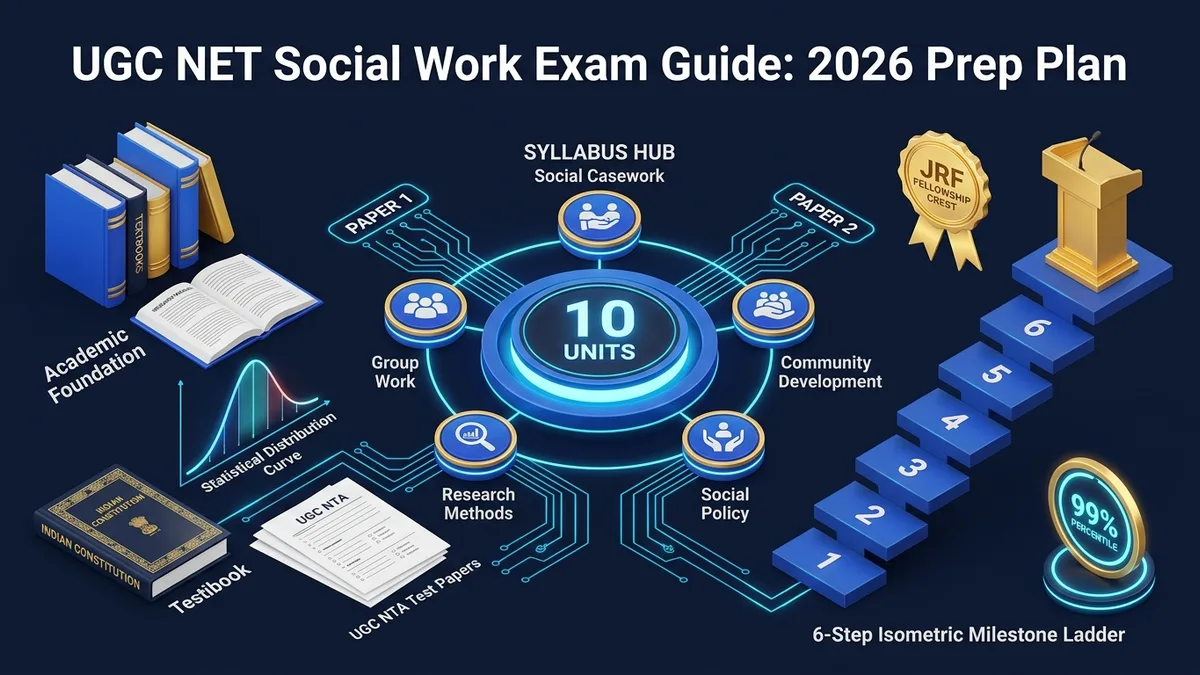
1. Why UGC NET & JRF Social Work Is a High-Value Credential
For postgraduates holding a Master of Social Work (MSW) or MA in Social Work degree in India, qualifying the National Eligibility Test (UGC NET) or State Eligibility Test (SET) in Social Work (Subject Code 10) represents far more than an academic benchmark. It serves as the primary statutory qualification mandated by the University Grants Commission for appointment as an Assistant Professor in colleges and universities across India.
Furthermore, candidates securing the prestigious Junior Research Fellowship (JRF) unlock guaranteed central government financial fellowships exceeding thirty-seven thousand rupees per month (plus House Rent Allowance) for five years during doctoral research. In the development sector, clearing NET signals advanced methodological discipline, making qualified professionals prime candidates for monitoring and evaluation leads, CSR policy analysts, and institutional think tank researchers.
Strategic Reality: Thousands of MSW graduates write UGC NET every cycle, but only the top six percent qualify for Assistant Professorship, and less than one percent secure JRF. Success demands a scientific, topic-weighted study strategy rather than passive textbook reading.
2. NTA Examination Pattern, Marking Scheme & Cutoff Trends
The National Testing Agency (NTA) conducts UGC NET as a single three-hour computer-based test (CBT) without breaks between papers.
| Exam Component | Paper 1 (General Teaching & Research) | Paper 2 (Social Work Code 10) |
|---|---|---|
| Total Questions | 50 Multiple Choice Questions (Compulsory) | 100 Multiple Choice Questions (Compulsory) |
| Total Marks | 100 Marks (2 marks per correct answer) | 200 Marks (2 marks per correct answer) |
| Negative Marking | None (0 marks deducted for incorrect answers) | None (0 marks deducted for incorrect answers) |
| Competitive Benchmark | Aim for 35+ correct questions (70+ marks) | Aim for 65+ correct questions (130+ marks) |
| Target JRF Aggregate | 200+ out of 300 Marks (66.6%+) across both papers | |
3. Detailed Teardown of the 10-Unit Paper 2 Social Work Syllabus
The official syllabus for UGC NET Social Work is organized into ten distinct units. Strategic preparation requires prioritizing high-weightage conceptual areas:
- Unit 1: Nature and Development of Social Work: Historical evolution in UK, USA, and India; social reform movements; professional ethics; NASW code; core values and human rights.
- Unit 2: Society, Human Behavior and Communities: Sociological concepts (social stratification, caste, family, socialization); psychological theories (Freud, Erikson, Piaget, Skinner); community dynamics.
- Unit 3: Social Work with Individuals and Groups: Social Case Work principles (Biestek 7 principles, Perlman 4Ps); intake and psycho-social diagnosis; Social Group Work models, group dynamics, stages of group development.
- Unit 4: Social Work with Communities and Social Action: Community Organization models (Rothman three models); community development approaches; Social Action strategies (Saul Alinsky, Paulo Freire, Mahatma Gandhi).
- Unit 5: Research in Social Work: Quantitative and qualitative research; sampling designs; hypothesis formulation; measurement scales; descriptive and inferential statistics; participatory research (PRA).
- Unit 6: Administration, Welfare and Development Services: Social welfare administration; POSDCORB; NGO registration (Trust, Society, Section 8); NITI Aayog Darpan; project formulation and LFA.
- Unit 7: Social Policy, Planning and Social Development: Constitutional provisions (Fundamental Rights, Directive Principles); Five-Year Plans to NITI Aayog; social development indices (HDI, GDI, MPI); Sustainable Development Goals (SDGs).
- Unit 8: Indian Constitution, Social Justice, Human Rights and Legislation: Key social legislation (JJ Act, POCSO Act, PWD Act, DV Act, SC/ST Prevention of Atrocities Act, Senior Citizens Act).
- Unit 9: Areas of Social Work Practice I: Medical and psychiatric social work; DSM and ICD classifications; mental health legislation; school social work; family and child welfare.
- Unit 10: Areas of Social Work Practice II: Industrial social work; labour welfare; HRM; environmental social work; correctional social work and criminal justice administration.
4. Scoring 75+ in Paper 1: General Teaching and Research Aptitude
Paper 1 is universally recognized as the decider for JRF qualification. While many social work candidates score between 55 and 62 marks, pushing your score to 75+ creates an insurmountable competitive cushion.
Focus on the high-conversion predictable sections:
- Teaching & Research Aptitude (20 Marks): Directly overlaps with MSW coursework. Focus on levels of teaching (Memory, Understanding, Reflective), research ethics, and experimental designs.
- Reading Comprehension (10 Marks): 100 percent accurate marks obtainable by practicing two passages weekly under timed conditions.
- Information & Communication Technology (10 Marks): Memorize digital initiatives in higher education (SWAYAM, NPTEL, DigiLocker, Shodhganga) and basic computer networking terms.
- People, Development and Environment (10 Marks): Master international climate conventions (Kyoto, Paris, Montreal Protocols), National Action Plan on Climate Change (NAPCC), and SDG targets.
5. Mastering Social Work Methods, Theories, and Indian Constitutional Law
NTA question papers increasingly emphasize chronological sequence questions, matching columns (books to authors), and assertion-reasoning formulations.
Examiner Focus Area: Never memorize legislation in isolation. Create a chronological reference matrix containing: Year of Enactment, Key Amending Years, Section Defining Offences, and Statutory Redressal Bodies (for example, CWC under JJ Act, DLSA under Legal Services Authorities Act).
Pay meticulous attention to Unit 3 and Unit 4 theorists. Expect questions pairing Helen Harris Perlman (Problem Solving Model), Felix Biestek (Casework Principles), Grace Coyle and Gisela Konopka (Group Work), and Jack Rothman (Locality Development, Social Planning, Social Action).
6. The Strategic 6-Month Study Roadmap for Working Professionals
Most MSW candidates balance full-time field responsibilities, NGO employment, or final-semester dissertations. This structured six-month schedule requires three hours of daily focused study:
Months 1 and 2: Foundation & Core Methods
Master Unit 1, Unit 2, Unit 3, and Unit 4. Synthesize primary notes on casework, group work, community organization, and sociological theories. Complete Paper 1 Teaching Aptitude.
Months 3 and 4: Research, Admin & Policy
Deep dive into Unit 5 (Social Work Research) and Unit 6 (Administration). Build thorough command over Paper 1 Research Aptitude, Higher Education, and ICT modules.
Month 5: Legislation & Practice Domains
Consolidate Unit 7, Unit 8, Unit 9, and Unit 10. Memorize statutory acts, constitutional articles, mental health policies, and environmental frameworks.
Month 6: PYQs, Mocks & Timed Simulations
Solve past 10 examination cycles (2018 to 2025). Take full 3-hour computer-based mock tests twice weekly to fine-tune pacing and cognitive endurance.
7. Curated Reference Bibliography and Academic Literature
Avoid commercial guidebooks with aggregated generic notes. Rely on standard foundational literature:
- Social Work History & Philosophy: Introduction to Social Work by Sanjay Bhattacharya; History and Philosophy of Social Work in India by A.R. Wadia.
- Social Case Work: Social Casework: A Problem-solving Process by Helen Harris Perlman; The Casework Relationship by Felix Biestek.
- Social Group Work: Social Group Work: Principles and Practices by Harleigh B. Trecker; Social Group Work: A Helping Process by Gisela Konopka.
- Community Organization: Community Organization: Theory, Principles and Practice by Murray G. Ross; Strategies of Community Intervention by Jack Rothman.
- Social Work Research: Social Research Methods by Alan Bryman; Methods in Social Research by Goode and Hatt.
- Social Welfare Administration: Social Welfare Administration in India by D. Paul Chowdhry.
- Paper 1 General Aptitude: UGC NET/SET Paper 1 by KVS Madaan (Pearson).
8. Reverse-Engineering Previous Years Question (PYQ) Papers
Top percentile scorers do not merely solve PYQs to check their final score; they reverse-engineer every question stem and distractor option.
When reviewing a multiple-choice question with four author options, research the three incorrect options alongside the correct one. NTA examiners frequently recycle concepts from previous years wrong options into following years core questions. Maintaining a personal error-log notebook containing verified factual corrections ensures you never miss repeated questions.
9. JRF Monthly Stipends, PhD Admissions, and Academic Pay Scales
Qualifying UGC NET and JRF opens elite professional avenues in India:
- JRF Fellowship Financials: ₹37,000 per month for the first two years (Junior Research Fellow), upgradable to ₹42,000 per month for the subsequent three years (Senior Research Fellow), alongside an annual contingency grant and HRA (8% to 27% based on city tier).
- Assistant Professor Pay Scales: University and government degree college appointments enter at Academic Level 10 of the 7th Central Pay Commission, with starting basic pay of ₹57,700, yielding total gross monthly emoluments of ₹85,000 to ₹1,10,000 depending on location.
- CSR and Think Tank Senior Roles: Leading corporate CSR foundations and policy research think tanks (CPR, NITI Aayog fellowships, TISS projects) prefer NET-qualified candidates for senior program officer and research associate posts starting at ₹6,00,000 to ₹12,00,000 per annum.
10. Frequently Asked Questions (FAQs)
1. Can final-year MSW students appear for UGC NET Social Work?
Yes. Candidates enrolled in their final semester or awaiting MSW results can appear provisionally. They must complete their degree with at least 55 percent marks (50 percent for OBC-NCL, SC, ST, PwD) within two years of the NET result declaration.
2. What is the upper age limit for UGC NET JRF in Social Work?
The upper age limit for Junior Research Fellowship is 30 years as of the first day of the exam month. A relaxation of up to 5 years is granted to OBC-NCL, SC, ST, PwD, women applicants, and candidates holding an LLM degree. There is no upper age limit for Assistant Professorship eligibility.
3. Is there negative marking in UGC NET Social Work?
No. UGC NET does not deduct marks for incorrect answers. Candidates should strategically attempt all 150 questions across Paper 1 and Paper 2.
4. What is the difference between UGC NET and State Eligibility Test (SET)?
UGC NET qualifies candidates for Assistant Professorship across all central and state universities in India, while SET (such as MH SET in Maharashtra or KSET in Karnataka) is valid for lectureship only within that specific state. SET exams do not award JRF fellowships.
5. How many hours of daily preparation are required to clear JRF?
Consistent daily study of three to four hours over five to six months is typically sufficient for candidates with solid MSW fundamentals. The key emphasis must be on PYQ solving, conceptual clarity on social theories, and daily Paper 1 practice.