
How Indian non-profit organizations, charitable trusts, and social enterprises can eliminate administrative overhead, automate instant 80G tax receipts, synchronize donor CRMs, and prepare Form 10BD statements using self-hosted, open-source n8n workflows in 2026.
1. The Administrative Overhead Burden on Indian NGOs
In most Indian grassroot non-profits, dedicated program officers and social workers spend over 30 to 50 hours every month trapped in repetitive clerical tasks: downloading payment gateway transaction spreadsheets, manually creating Word documents for 80G tax deduction receipts, attaching PDFs to individual Gmail drafts, and sending manual WhatsApp messages to donors.
This operational friction introduces serious consequences:
- Delayed Tax Receipts: Donors who contribute online expect instant confirmation. Waiting 2 to 4 weeks for an 80G certificate damages donor trust and discourages recurring donations.
- Data Entry Errors: Manually typing donor PAN numbers and contribution amounts into spreadsheets inevitably leads to typos, causing severe discrepancies during annual Form 10BD electronic filing with the Income Tax Department.
- Staff Burnout: Professional social workers trained in community mobilization and grassroots fieldwork end up spending valuable daytime hours doing clerical data entry rather than driving social impact.
By implementing modern open-source automation, organizations can eliminate 95% of these manual touchpoints, delivering instant gratitude to donors while maintaining flawless compliance.
2. Why n8n? Self-Hosted Open-Source vs Proprietary Zapier/Make
Commercial integration platforms like Zapier and Make.com are popular, but for Indian non-profits operating with tight overhead budgets, they pose significant limitations:
| Feature / Comparison | Self-Hosted n8n (Community) | Zapier | Make.com (Integromat) |
|---|---|---|---|
| Pricing Structure | 100% Free / Self-hosted on your existing VPS | Starts at $29.99/mo; costs explode as donor volume grows | Starts at $10.59/mo; limited operations per tier |
| Execution Limits | Unlimited workflows & triggers | Strict task limits (e.g., 750 tasks/month) | 10,000 operations/month limit |
| Data Sovereignty (DPDP Act) | Data stays on your secure Indian server | Data processed on US cloud multi-tenant clusters | Data routed through foreign data centers |
| Indian Payment Gateway Support | Direct webhooks from Razorpay, Cashfree, PayU | Requires custom Webhook triggers (paid tier) | Webhook support available with configuration |
Because n8n is fair-code licensed and can run on any entry-level virtual server, an NGO can process tens of thousands of donor interactions per month for less than ?400 in total hosting costs.
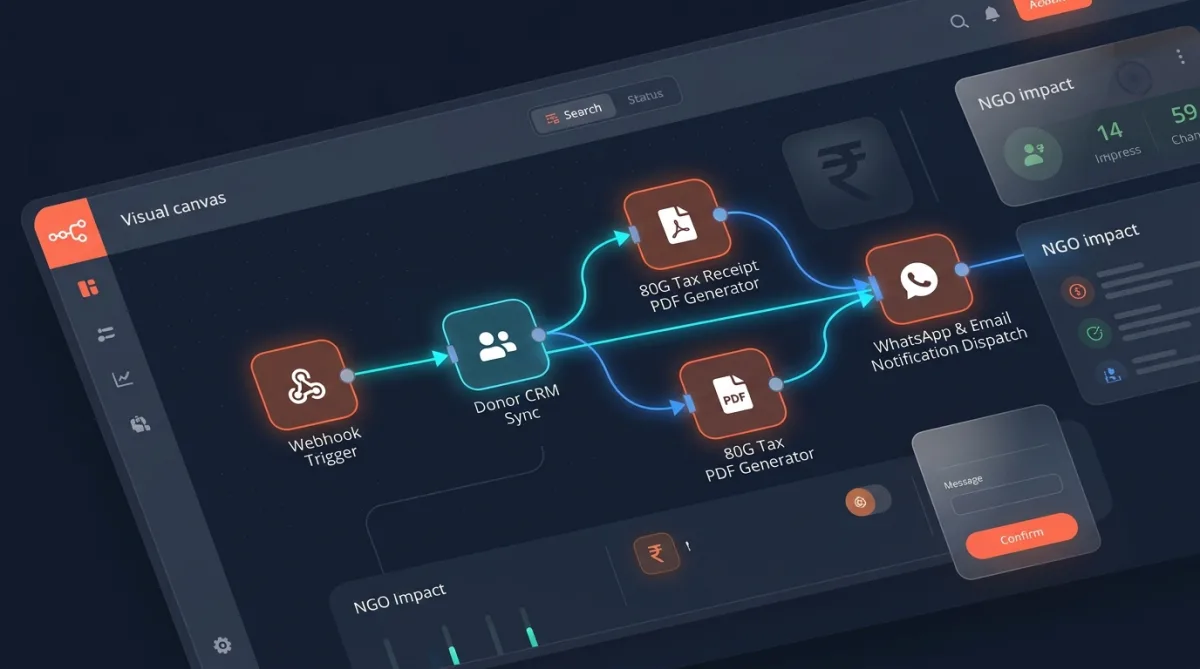
3. Core Architecture: Automated 80G Receipt & WhatsApp Delivery
Here is the architectural sequence of the industry-standard Web4cause automated 80G receipt pipeline:
↓ (HTTP POST: payment.captured event)
[n8n Webhook Node: Verify HMAC Signature]
↓ (Valid Payload)
[n8n Code Node: Format Currency, Validate PAN, Generate Sequential Serial No.]
↓
[n8n HTML Node: Compile Official 80G Receipt Template with QR Code]
↓
[Gotenberg / Puppeteer Node: Render High-Resolution PDF]
↓
[AWS S3 / Google Drive Node: Archive Receipt PDF]
↓ (Simultaneous Parallel Branches)
└→ [SMTP/Postmark Node: Email Donor PDF Receipt with Tax Advisory]
└→ [WhatsApp Business API Node: Send Instant PDF Receipt via WhatsApp]
└→ [Google Sheets / CRM Node: Log Verified Transaction for Form 10BD]
Key Elements of the 80G Receipt Template:
- Sequential Receipt Serial Number: Generated automatically in format
W4C/2026-27/00842for auditing compliance. - Organization Credentials: Trust/Society registration number, 80G Unique Registration Number (URN), 12A approval date, and NITI Aayog NGO Darpan ID.
- Donor Tax Identifiers: Verified Permanent Account Number (PAN), full legal name, and postal address (statutory under Section 80G(5)(vi)).
- Dynamic Verification QR Code: Direct scan code allowing auditors or donors to verify transaction authenticity on the NGO’s transparency registry.
For more architectural insights, review our blueprint on NGO Website Design in India.
4. Donor CRM & Google Sheets Real-Time Synchronization
A major failure point in non-profit data management is fragmented donor records scattered across payment gateway dashboards, bank passbooks, and isolated campaign forms.
Using n8n, every successful contribution automatically updates a unified donor profile across your internal tools:
- New vs. Recurring Donor Detection: n8n matches incoming transactions against existing donor emails and PAN numbers. If the donor has given previously, their lifetime giving amount and contribution frequency increment automatically.
- Tiered Gratitude Triggers: High-ticket contributions (e.g., above ?25,000) trigger an automated instant Slack/Telegram notification to the Executive Director, enabling personalized follow-up calls within 24 hours.
- Syncing with Open-Source CRMs: Automatically create or update donor records in open-source systems such as CiviCRM, ERPNext, or a structured Google Sheet with zero manual data entry.
5. Automating Annual Form 10BD Filing & PAN Reconciliations
Under Section 271K of the Income Tax Act, non-profit institutions that fail to file their annual statement of donations in Form 10BD by May 31st face hefty recurring penalty fees of ?200 per day for every day of delay.
Traditionally, preparing this statement involves weeks of frantic manual reconciliation by external chartered accountants. With n8n running in the background, every transaction is pre-validated and formatted in real-time:
Automated Form 10BD Pre-Validation Rules in n8n:
- Regex PAN Validation: Automatically validates that incoming PAN values match standard format (
[A-Z]{5}[0-9]{4}[A-Z]{1}) before logging. - Donation Type Classification: Tags each contribution correctly as Corpus, Specific Program, or General Donation according to the campaign selected.
- Mode of Payment Tagging: Categorizes payments as Electronic (UPI/NetBanking/Cards) or Cheque, auto-populating transaction reference numbers.
- 1-Click CSV Export: At the close of the financial year, the non-profit can download a clean, pre-validated CSV that uploads directly into the Income Tax Department’s official utility portal without errors.
6. Setting Up Self-Hosted n8n on a Lean ?400/Month Cloud VPS
You do not need an enterprise server infrastructure to run production n8n workflows. A basic virtual private server (1 vCPU, 2GB RAM) on providers like DigitalOcean, Hetzner, or AWS Lightsail (costing roughly ?350-?500/month) is more than sufficient for processing thousands of daily workflows.
Recommended Production Docker Compose Stack:
version: '3.8'

services:
  n8n:
    image: docker.n8n.io/n8nio/n8n:latest
    restart: always
    ports:
      - "127.0.0.1:5678:5678"
    environment:
      - N8N_HOST=automation.yourngo.org
      - N8N_PORT=5678
      - N8N_PROTOCOL=https
      - NODE_ENV=production
      - WEBHOOK_URL=https://automation.yourngo.org/
      - GENERIC_TIMEZONE=Asia/Kolkata
    volumes:
      - n8n_data:/home/node/.n8n

volumes:
  n8n_data:
    external: true
Secured behind an Nginx reverse proxy with automated Let’s Encrypt SSL certificates, this setup ensures high availability, zero license fees, and enterprise-grade reliability.
7. DPDP Act 2023 Compliance & Data Security Guidelines
When automating donor pipelines, organizations must maintain rigorous adherence to India’s Digital Personal Data Protection (DPDP) Act 2023:
- Data Minimization: Collect only data legally required for 80G and Form 10BD compliance. Never store raw credit card numbers or banking passwords.
- Encrypted Payload Transmission: Ensure all webhooks from payment gateways are validated using cryptographic HMAC secrets to prevent unauthorized spoofing attacks.
- Role-Based Access: Restrict n8n dashboard access to authorized administrators using strong two-factor authentication (2FA).
- Donor Data Retention Policy: Retain financial records strictly for statutory tax auditing periods (typically 7-8 years), establishing automated deletion workflows for obsolete contact form queries.
Learn more about security safeguards in our guide on NGO Website Architecture for Donor Trust.
8. Frequently Asked Questions (FAQs)
Q1: Can n8n send WhatsApp receipts automatically without paying third-party fees?
n8n itself is free and open-source, but sending automated messages via the official WhatsApp Business Platform requires an approved Meta Cloud API account or a BSP (such as Gupshup or Twilio). Meta offers a free monthly tier of 1,000 service conversations for non-profits, making receipt delivery virtually free for small to mid-sized organizations.
Q2: What happens if our payment gateway webhook fails or our server is down?
Both Razorpay and Cashfree feature automated webhook retry mechanisms that re-send undelivered transaction events up to 24 hours. Additionally, n8n supports scheduled reconciliation workflows that query the payment gateway REST API once daily to detect and process any missed transactions.
Q3: Do we need a developer on staff to manage n8n workflows daily?
No. Once the initial workflow logic is properly architected, tested, and deployed by a technical specialist, n8n operates completely autonomously in the background. Non-technical staff simply review the auto-populated Google Sheets or CRM records as donations arrive.
Q4: Can n8n integrate with our existing WordPress or Elementor website?
Absolutely. n8n connects effortlessly with WordPress through native REST API nodes and webhook plugins, enabling instant triggers whenever campaign forms, volunteer applications, or donation buttons are engaged.