
An in-depth, engineering and compliance blueprint for Indian non-profit organizations, charitable trusts, societies, and Section 8 companies seeking to establish institutional credibility, mobilize domestic and CSR funding, automate instant 80G tax receipt pipelines, and protect beneficiary dignity in 2026.
1. The Digital Imperative for Indian Non-Profits in 2026
In India’s rapidly maturing social development sector, a non-profit organization’s website is no longer merely a passive digital brochure or a token annual report container. Today, it functions as the central operating hub for institutional credibility, retail donor mobilization, CSR partnership validation, and volunteer recruitment.
Indian philanthropy has undergone a seismic transformation over the past five years. Driven by ubiquitous Unified Payments Interface (UPI) penetration, stricter Ministry of Corporate Affairs (MCA) oversight on corporate social responsibility grants, and enhanced scrutiny by the Income Tax Department, prospective donors and grantmakers demand instant transparency before committing capital.
When high-net-worth individuals (HNIs), retail micro-donors, or CSR committees evaluate your NGO, your website is the very first audit touchpoint. A sluggish, non-compliant, or outdated website immediately introduces friction, raises red flags regarding organizational governance, and leads to high drop-off rates on donation pages. To thrive, non-profits must treat their digital presence as critical social infrastructure.
At Web4cause, where we combine grassroots Master of Social Work (MSW) field experience with modern full-stack web engineering, we have documented that Indian NGOs upgrading from legacy brochure templates to compliant, high-speed architectures experience up to a 240% increase in verified retail contributions and substantially faster CSR onboarding cycles.
2. Statutory Credibility Pillars: Darpan, 12A, 80G & Form 10BD
The single greatest hurdle to online fundraising in India is donor skepticism. Donors constantly ask: “Is this organization legitimately registered? Will my contribution actually qualify for tax exemption? Will my personal data be misused?”
To eliminate this hesitation instantly, every non-profit website architecture must incorporate an unmistakable Statutory Transparency Hub prominently accessible in the primary navigation and footer. This section must transparently display and verify the following credentials:
Essential Statutory Disclosures Checklist
- NITI Aayog NGO Darpan Registration: Display your unique Darpan ID alongside a direct verification link to the official NITI Aayog NGO Darpan Portal. Corporate grantmakers verify this before releasing CSR funding.
- Section 12A & 80G Approval Orders: Prominently display your Unique Registration Number (URN) issued by the Central Board of Direct Taxes (CBDT), approval validity dates, and downloadable copies of your 80G registration certificates.
- Form CSR-1 Registration: For organizations eligible to implement corporate CSR initiatives, showcase your MCA Registration Number under Section 135 of the Companies Act 2013. Read our detailed guide on CSR Funding for Indian NGOs.
- Form 10BD Compliance Notice: Explicitly inform donors that under Income Tax regulations, capturing their Permanent Account Number (PAN) and postal address is statutory mandatory for filing annual Form 10BD statements and ensuring their tax deduction certificates appear in their AIS (Annual Information Statement) / 26AS.
- FCRA Transparency (If Applicable): If registered under the Foreign Contribution Regulation Act, provide a dedicated public archive displaying quarterly foreign donation receipt disclosures as required by the Ministry of Home Affairs (MHA).
- Audited Financials & Annual Reports: Provide at least the past 3 fiscal years of audited balance sheets, auditor notes, and comprehensive impact reports in lightweight, downloadable PDF formats.
By centralizing these governance credentials into a dedicated transparency page, you convert cold visitors into confident institutional supporters within seconds.
3. Engineering the High-Converting Donation & Automated 80G Engine
A fatal design mistake made by many non-profits is treating their donation process as a generic e-commerce checkout. Donating is an emotional, values-driven decision that is extremely vulnerable to friction. If a visitor is redirected through multiple slow pages or forced to create an account with a password, checkout abandonments skyrocket above 70%.
The High-Converting Donation Architecture Blueprint:
- Pre-Set Impact Tiers: Replace empty donation boxes with tangible outcome-driven amounts (e.g., “?1,500 sponsors textbooks for 2 rural girls”, “?5,000 supports nutritional care for 5 malnourished infants”). Always allow a custom amount input as well.
- Frictionless Single-Step Data Capture: Collect only essential fields on a single, clean screen: Full Name, Email Address, Mobile Number, PAN Number (clearly marked as mandatory for 80G tax claims), and Postal Address (required by Form 10BD rules).
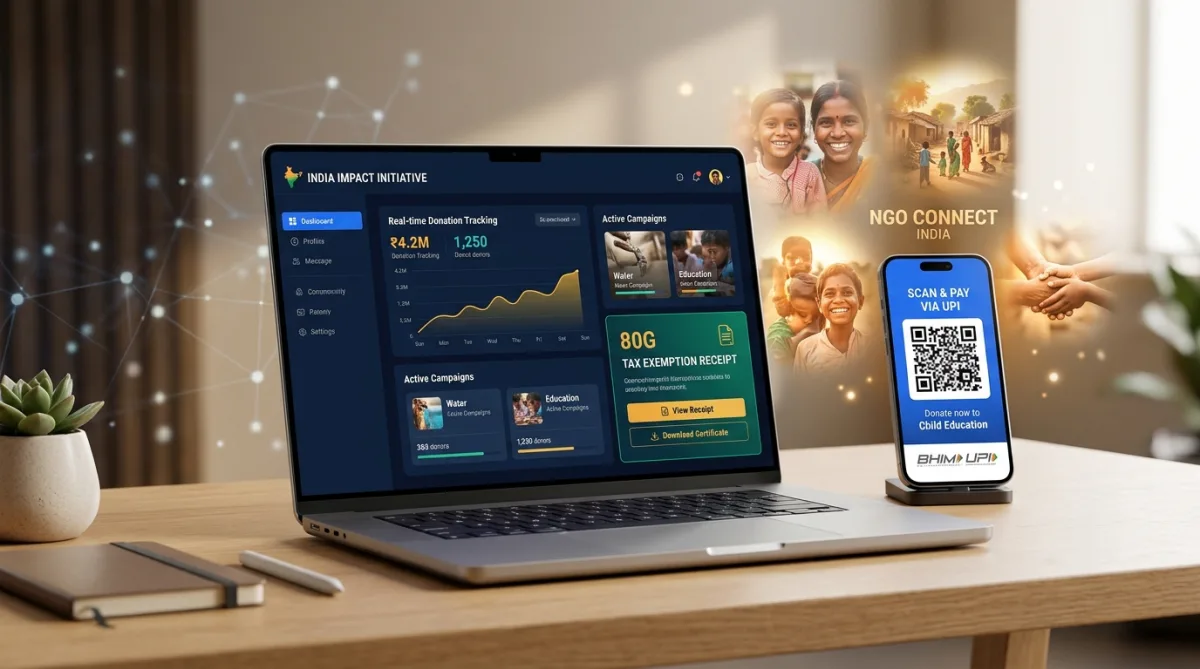
- Direct UPI Intent & Dynamic QR Codes: Over 78% of retail digital donations in India occur via UPI (Google Pay, PhonePe, Paytm, BHIM). Your donation flow must support one-click UPI Intent on mobile devices and dynamic, auto-expiring on-screen QR codes on desktop monitors.
- Automated Instant 80G Tax Receipt Pipeline: In 2026, donors expect their official tax receipt immediately in their inbox-not 4 weeks later via postal mail. By integrating automated webhook triggers with workflows like open-source n8n automation for NGOs, your system can automatically generate a tamper-proof, digitally signed PDF receipt with serial numbers, organizational seal, and PAN validation, dispatching it via WhatsApp and email within 30 seconds of transaction completion.
4. Indian Payment Gateways Compared for Non-Profits
Selecting the right payment aggregator is critical for operational cash flow, international giving, and platform transaction costs. Below is an objective technical comparison of the three leading payment gateways for registered Indian NGOs:
| Feature / Criteria | Razorpay | Cashfree Payments | PayU India |
|---|---|---|---|
| NGO Special MDR Pricing | Available upon submitting 12A/80G documents (~1.5% – 1.8% + GST) | Competitive non-profit tier available via account manager | Standard ~2% rate; custom rates for large charitable institutions |
| UPI Autopay (Recurring Giving) | Industry-leading UPI Subscriptions API & mandate management | Robust UPI Autopay support with auto-retry mechanisms | Supported via PayU Subscriptions module |
| FCRA International Payments | Supported via international cards (requires valid FCRA certificate & separate approval) | Multi-currency processing available for verified FCRA accounts | International credit card processing supported with strict risk checks |
| Webhook Reliability & Speed | Extremely fast (sub-second payload delivery for instant 80G triggers) | High reliability with configurable webhook retries | Stable webhooks, standard server callback architectures |
| WordPress / Elementor Integration | Native plugins, custom JS embeds, and seamless REST API bindings | WooCommerce & custom REST API integrations supported | Official WordPress plugins and checkout redirects |
For most Indian grassroot organizations and state-level trusts, Razorpay remains our top recommendation due to its superior UPI Intent mobile UX, effortless webhook automation, and well-documented developer APIs.
5. Mobile-First UX Architecture & Bandwidth Optimization
Field data from tier-2 and tier-3 Indian districts reveals that over 85% of traffic to social sector websites originates from mobile devices operating on 4G networks. If your website takes longer than 3 seconds to load on a mid-range smartphone, potential donors and partners bounce before reading your mission.
Technical Performance Guidelines for Indian NGOs:
- Modern Next-Gen Image Formats: Convert all heavy JPEG and PNG campaign banners into next-gen
WebPorAVIFformats, achieving 60-80% file size reductions without compromising visual clarity. - Aggressive Asset Caching & LiteSpeed Optimization: Implement server-level object and page caching (such as LiteSpeed Cache with Cloudflare edge caching) to serve static pages in under 800 milliseconds across India.
- Sticky Mobile Action Bar: Implement a clean, non-intrusive sticky bottom navigation bar on mobile viewports featuring two clear actions: “Donate Now (80G)” and “WhatsApp Support”. This single UX enhancement typically raises mobile conversion rates by 35%.
- WCAG 2.1 Web Accessibility: Ensure color contrast ratios meet AA standards (at least 4.5:1 for body copy), use descriptive
alttags for screen readers, and provide font enlargement controls for elderly patrons and differently-abled community members. Read more in our guide on NGO Website Architecture for Donor Trust.
6. Ethical Beneficiary Storytelling & DPDP Act 2023 Compliance
Social work ethics demand that non-profit communication empowers marginalized communities rather than commodifying their hardship for sensationalist fundraising. As Master of Social Work professionals, we emphasize rights-based, dignity-first storytelling across all digital touchpoints.
Legal Notice: India’s Digital Personal Data Protection (DPDP) Act 2023
Non-profits are legally classified as Data Fiduciaries under the DPDP Act. Publishing unconsented photographs, biometric information, precise GPS coordinates, medical records, or identifiable information of beneficiaries (particularly children, HIV patients, or victims of gender-based violence) exposes organizations to severe penalties up to ?250 Crores.
Four Rules for Ethical Beneficiary Publishing:
- Informed Consent First: Never publish a beneficiary profile without documented, signed, or audio-recorded informed consent in their native regional language, clearly stating how the photograph and story will be distributed online.
- Protect Child Identity: Never publish children’s real names, school names, or residential street addresses. Where necessary, use pseudonyms (explicitly noted as: “Name changed to protect identity”) and avoid displaying distressing imagery.
- Asset-Framed Narratives: Highlight beneficiary agency, skills, leadership, and aspirations rather than depicting them solely as helpless victims awaiting charity. Learn more in our Community Mobilization in Social Work Guide.
- Granular Donor Privacy Policies: Clearly explain to donors how their PAN, email, and transaction histories are stored, encrypted, and processed exclusively for statutory Form 10BD submissions without third-party commercial sharing.
7. Technology Selection: WordPress & Elementor vs. Custom Coding
A recurring dilemma faced by NGO leadership is choosing the appropriate technology stack. Should the organization build a custom web app from scratch, adopt a proprietary SaaS non-profit builder, or deploy an open-source CMS like WordPress?
Below is our comparative assessment based on 10+ years of social sector deployments:
1. Open-Source WordPress + Lightweight Builders (Recommended)
Verdict: Optimal for 90% of NGOs. WordPress powers over 43% of the web and guarantees 100% data ownership with zero vendor lock-in. When configured with clean themes (such as Hello Elementor) and lightweight custom CSS, it provides non-technical NGO staff with the autonomy to publish campaign updates, press releases, and annual reports without paying costly hourly developer fees. Furthermore, native integration with Indian payment gateways (Razorpay/Cashfree) and CRM tools is unmatched.
2. Proprietary SaaS Builders (Wix, Squarespace, Shopify)
Verdict: Not Recommended for Scaled Indian NGOs. While easy to set up initially, proprietary platforms lock your data inside their ecosystems, impose recurring US-dollar subscription costs that increase annually, and offer limited native support for Indian statutory compliance (such as automated 80G receipt PDF generation and Form 10BD structured data exports).
3. Pure Custom Coding (Node.js / Laravel / Python Django)
Verdict: Suitable Only for Complex Portals with Dedicated Engineering Teams. Pure custom code allows limitless architectural flexibility, but requires permanent in-house full-stack engineers to maintain security patches, update content, and fix server issues. For non-profits with lean overhead budgets, custom code often turns into unmaintained technical debt once the initial volunteer or developer departs.
8. 10-Point Technical Pre-Launch Checklist for NGO Websites
Before launching or relaunching your non-profit website, verify that your development team has completed every item on this pre-launch checklist:
- SSL / HTTPS Encryption: Full end-to-end TLS 1.3 certificate enabled to secure sensitive donor financial details and contact forms.
- Automated Off-Site Backups: Nightly encrypted backups stored in independent cloud storage (such as AWS S3 or Google Cloud Storage) with 1-click restore testing.
- Form 10BD Data Export Pipeline: Validated database tables or CRM fields capturing donor PAN, full address, donation mode, and transaction references for hassle-free annual tax filing.
- Email Domain Authentication: Configured
SPF,DKIM, andDMARCrecords on your organizational domain to guarantee donor receipts and newsletters do not land in spam folders. - Statutory Verification Links: Working outbound links to NITI Aayog NGO Darpan and Income Tax verification registers.
- Schema.org Non-Profit Structured Data: Embedded
NGO/NonprofitOrganizationJSON-LD schema markup for Google Search rich snippets. - Automated 80G PDF Engine: Tested receipt generation verifying that serial numbers increment correctly and donor PAN is clearly printed.
- Search Engine Verification: XML sitemaps submitted to Google Search Console and Bing Webmaster Tools.
- LiteSpeed / Server Caching: Core Web Vitals passing with Largest Contentful Paint (LCP) under 2.5 seconds on mobile 4G.
- Legal Documentation: Updated Privacy Policy (DPDP Act compliant), Terms of Use, Donation Refund Policy, and 80G Tax Exemption Disclaimers.
9. Frequently Asked Questions (FAQs)
Q1: Is capturing donor PAN mandatory for every online donation in India?
Yes, if the donor wishes to claim a tax deduction under Section 80G of the Income Tax Act. Under Central Board of Direct Taxes (CBDT) guidelines, non-profits must submit an annual electronic statement in Form 10BD detailing donor PAN, address, and contribution amounts. Without a verified PAN, the donation is classified as an anonymous donation under Section 115BBC, which can attract tax liabilities for the NGO if anonymous receipts exceed statutory thresholds.
Q2: Can our NGO accept foreign donations directly through Razorpay or Cashfree?
Only if your organization possesses a valid, active FCRA (Foreign Contribution Regulation Act) registration from the Ministry of Home Affairs, and your payment gateway account is explicitly linked to your designated SBI New Delhi Main Branch FCRA bank account. Accepting international contributions into a standard domestic NGO account is a severe statutory violation under Indian law.
Q3: How much does professional NGO website development cost in India?
Pricing varies depending on complexity. A compliant, high-speed foundational website with automated Razorpay integration, 80G receipt delivery, and transparency pages typically ranges between ?18,000 to ?45,000. Larger foundations requiring multi-lingual support, volunteer portals, custom CRM synchronization, and donor dashboards range from ?60,000 to ?1,50,000. Review our transparent, social-sector-subsidized options on our NGO Website Pricing Page.
Q4: How does automated 80G receipt delivery work technically?
When a donor completes a payment, the payment gateway fires an encrypted HTTP webhook payload containing transaction details to a secure processing server or workflow automation engine (such as open-source n8n). The engine extracts donor details, validates the PAN format, assigns the next sequential 80G receipt serial number, injects the data into an approved HTML template, compiles it into a lightweight PDF with organizational seals, and automatically delivers it via WhatsApp Business API and transactional email within seconds.
Q5: How often should an NGO website undergo technical and compliance audits?
At a minimum, quarterly reviews should be conducted to verify payment gateway webhook integrity, plugin security updates, and broken links. Statutory documents (such as newly filed annual reports, updated 80G registration renewals, and Darpan filings) must be refreshed annually as soon as audits are finalized by your chartered accountant.