
80G and 12A Registration for NGOs in India: Complete 2026 Guide
A comprehensive statutory and operational blueprint for Indian non-profit trusts, societies, and Section 8 companies. Learn how to secure and renew Section 12AB tax-exempt status, obtain Section 80G donor deduction approval, file Form 10A and Form 10AB, and master annual Form 10BD electronic statement compliance in 2026.
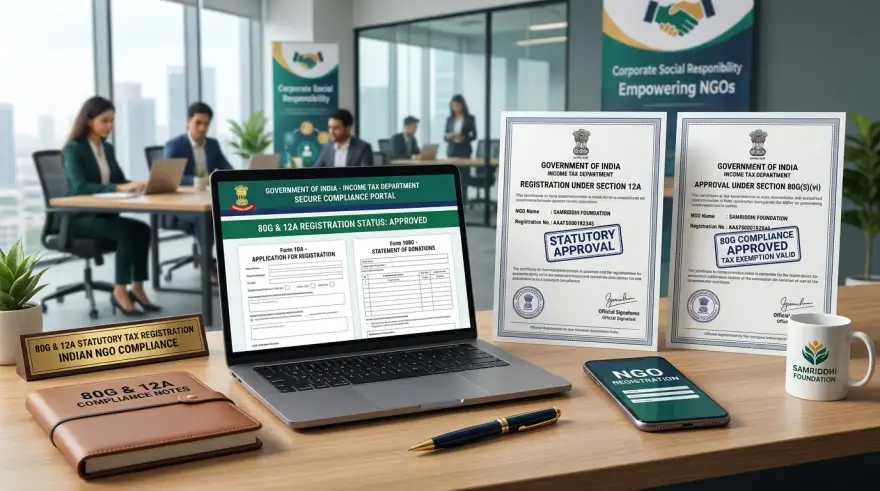
1. The Dual Engine of Non-Profit Credibility: 12A vs 80G Explained
In the Indian development ecosystem, obtaining legal entity registration: whether as a Public Charitable Trust under the Bombay Public Trusts Act, a Society under the Societies Registration Act 1860, or a Section 8 Company under the Companies Act 2013: is merely the starting point. Real financial viability and fundraising capability rely upon two critical tax certifications issued by the Income Tax Department:
Section 12A / 12AB (Tax Exemption)
Protects the NGO: Without Section 12AB registration, your non-profit is taxed as an Association of Persons (AOP) at standard commercial tax rates (up to 30% plus surcharges) on all gross receipts and donations. 12AB renders your organizational income 100% tax-exempt, provided 85% is applied toward charitable objects.
Section 80G (Donor Tax Deduction)
Incentivizes the Donor: Section 80G allows individual taxpayers and corporate donors to deduct 50% of their eligible donation value from their taxable gross total income. Corporate CSR committees rarely grant funds to organizations lacking valid 80G approval.
2. The Modern CBDT Registration Regime: Section 12AB Overview
Following historical amendments enacted through the Finance Acts, the Central Board of Direct Taxes (CBDT) retired perpetual tax exemptions. All charitable institutions operate under the restructured Section 12AB framework, which mandates periodic re-validation and issues a standardized 16-character alphanumeric Unique Registration Number (URN).
This regime digitized the entire lifecycle: applications, queries, personal hearings, and final approval orders occur exclusively through the electronic portal of the Income Tax Department.
3. Provisional (Form 10A) vs Regular 5-Year (Form 10AB) Approvals
One of the most frequent points of confusion for grassroot founders is navigating the two-tier approval structure:
| Approval Type | Filing Form | Validity Window | Crucial Filing Deadline |
|---|---|---|---|
| Provisional Registration | Form 10A | 3 Assessment Years (AY) | At least 1 month prior to commencement of the relevant fiscal year. |
| Regular 5-Year Registration | Form 10AB | 5 Assessment Years (AY) | At least 6 months prior to expiry of provisional registration, OR within 6 months of commencing activities. |
Critical Warning on Form 10AB Deadlines:
If your organization possesses provisional registration and has already initiated field activities or received contributions, failure to submit Form 10AB within the statutory 6-month window forfeits tax-exempt status, triggering severe accretion tax liabilities under Section 115TD.
4. Step-by-Step E-Filing Procedure on the Income Tax Portal
All filings are processed through the official Income Tax portal (incometax.gov.in) using the Digital Signature Certificate (DSC) of the registered Principal Trustee or Director:
- Portal Login: Access your NGO profile using your organizational PAN and password.
- Navigate to Income Tax Forms: Go to e-File > Income Tax Forms > File Income Tax Forms and select Form 10A (for new/provisional) or Form 10AB (for regular renewal).
- Select Section Code: Choose Code 01 for Section 12AB (Section 12A(1)(ac)(i) to (vi)) and Section 80G(5).
- Upload Statutory Dossier: Attach certified PDF copies of your trust deed/MOA, registration certificate, NITI Aayog Darpan credentials, and past 3 fiscal years audited balance sheets (with Form 10B/10BB audit reports).
- Verification & Submission: Digitally sign using a Class 3 DSC. The system generates an immediate acknowledgement with an electronic filing reference number.
5. Comprehensive Statutory Documentation & Audit Checklist
- Constitutional Documents: Certified Trust Deed, Society MOA & Rules, or Section 8 Certificate of Incorporation with Articles of Association (AOA).
- NITI Aayog Darpan Registration: Active Darpan URN and profile printout (required for CSR validation).
- KYC of Key Office Bearers: Self-attested PAN cards, Aadhaar cards, and DIN/Director coordinates of all trustees, governing body members, and authorized signatories.
- Audited Financial Statements: Balance Sheets, Income & Expenditure accounts, Receipt & Payment accounts, along with Chartered Accountant Audit Reports in Form 10B / Form 10BB.
- Detailed Note on Past Activities: Illustrated program reports, beneficiary impact numbers, geo-tagged photographs, and press clippings demonstrating genuine charitable work.
- Proof of Office Premises: Registered Rent Agreement / Ownership Deed along with recent electricity bill or municipal tax receipt.
6. Mastering Annual Form 10BD Filing & Donor PAN Verification
Under Rule 18AB of the Income Tax Rules 1962, every institution approved under Section 80G must electronically file an annual Statement of Donations in Form 10BD on or before May 31st following the close of each financial year.
Crucially, the Income Tax Department cross-verifies Form 10BD with individual donor tax returns:
- Mandatory PAN Capture: Donations received without a valid donor PAN cannot be processed in Form 10BD, meaning donors will not see the tax exemption reflected in their Annual Information Statement (AIS) / Form 26AS.
- Issuance of Form 10BE: After filing Form 10BD, the NGO must download system-generated Form 10BE Certificate of Donation and provide it to donors as their final legal proof of tax deduction.
- Daily Late Filing Fees: Failure to submit Form 10BD by May 31 incurs a statutory penalty of ₹200 per day under Section 234G, in addition to potential penalties under Section 271K ranging from ₹10,000 to ₹1,00,000.
Learn how to automate this entire workflow using our guide on n8n Workflow Automation for NGOs.
7. Common Cancellation Triggers under Section 12AB(4)
The Principal Commissioner of Income Tax (PCIT) holds statutory powers to cancel 12AB and 80G registrations upon discovering “specified violations”:
- Commercial Activity Exceeding 20%: If receipts from ancillary business activities exceed 20% of total revenue under the proviso to Section 2(15).
- Private Benefit to Trustees: Siphoning funds or paying inflated compensation to trustees or related persons in violation of Section 13(1)(c).
- Religious Bias: Applying funds for the benefit of a specific religious community or caste in contravention of Section 80G(5)(iii).
- Non-Compliance with Other Laws: Revocation of FCRA license or failure to maintain local municipal/state licenses required for operations.
8. Showcasing 12A/80G Disclosures on Your NGO Website
Transparent public disclosure is the single most effective way to turn cold visitors into recurring contributors. When prospective donors visit your website, display:
- Your 16-digit 12AB and 80G URNs directly in the website footer.
- Downloadable, high-speed PDF copies of your official CBDT registration certificates.
- A clear statement informing donors that PAN is mandatory for 80G tax claims and Form 10BD filing.
See our complete architectural blueprint in NGO Website Architecture for Donor Trust.
9. Frequently Asked Questions (FAQs)
Q1: Can a newly incorporated NGO apply for 12A and 80G immediately?
Yes. Under the current regime, brand-new organizations can apply for Provisional Registration (valid for 3 years) under Form 10A even before commencing activities. Once operations begin, they must transition to regular 5-year registration via Form 10AB within 6 months.
Q2: What is the maximum cash donation eligible for Section 80G deduction?
Under Section 80G(5D), tax deductions are not allowed for cash donations exceeding ₹2,000. All donations above ₹2,000 must be made via electronic banking channels (UPI, NEFT, RTGS, Credit/Debit cards).
Q3: Is Darpan registration mandatory along with 12A and 80G?
While 12A and 80G are Income Tax approvals, NITI Aayog NGO Darpan registration is mandatory to apply for Central/State government grants and Corporate Social Responsibility (CSR) funding under Section 135.