
A comprehensive field guide to community mobilization for Master of Social Work (MSW) practitioners, grassroots NGO workers, and development professionals. Master Participatory Rural Appraisal (PRA) tools, stakeholder mapping, village committee formation, and digital field mobilization in 2026.
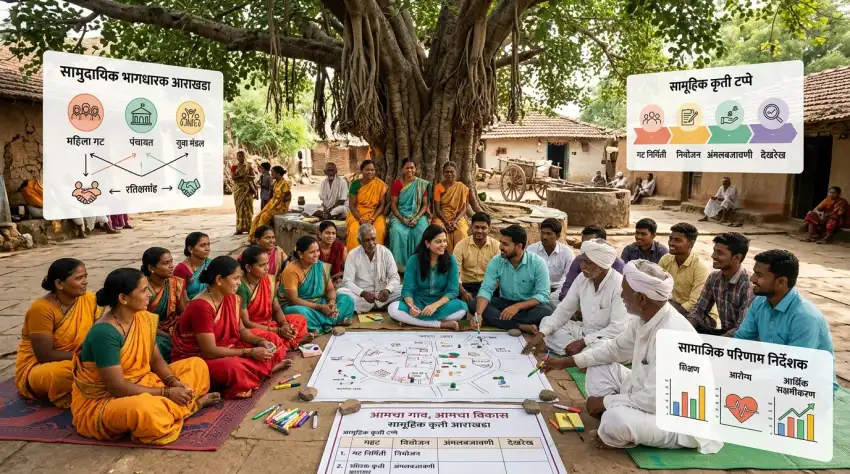
1. What is Community Mobilization in Professional Social Work?
Community mobilization is the foundational method of macro social work practice wherein community members come together to identify their shared challenges, analyze underlying systemic causes, mobilize local and external resources, and execute collective action to achieve sustainable social change.
In the Indian development context-characterized by intricate caste dynamics, gender disparities, economic vulnerabilities, and regional nuances-community mobilization is not a top-down delivery of charity. As social work pioneer Paulo Freire articulated in Pedagogy of the Oppressed, genuine development occurs through conscientization: enabling communities to perceive their social reality critically and become the authors of their own liberation.
Whether organizing drought-prone farmers in rural Maharashtra for collective water harvesting, mobilizing women into Self-Help Groups (SHGs) in peri-urban slums, or advocating for tribal forest rights, community mobilization bridges individual agency with collective democratic power.
2. Theoretical Foundations: Rothman’s 3 Models of Community Organization
Every successful field intervention requires a rigorous conceptual framework. Social work scholar Jack Rothman defined three primary models of community organization, which Indian non-profits apply across different field scenarios:
1. Locality Development Model
Focuses on broad community participation, self-help, and local leadership development. The social worker acts as an enabler and facilitator, helping village residents build consensus to construct community check dams, sanitation facilities, or pre-school Anganwadi centers.
2. Social Planning Model
A data-driven, technical approach to solving complex social problems (e.g., child malnutrition, public health crises, or municipal waste management). The social worker acts as an expert analyst designing structured intervention programs with measurable KPIs.
3. Social Action Model
Applied when marginalized groups confront institutional injustice, systemic discrimination, or denial of statutory rights. Emphasizes rights-based advocacy, collective mobilization, legal petitioning, and peaceful democratic protest under constitutional frameworks.
3. The Participatory Rural Appraisal (PRA) Toolkit
Developed by Robert Chambers, Participatory Rural Appraisal (PRA) is an empowering methodology that enables rural and marginalized communities to express, enhance, share, and analyze their knowledge of life and conditions.
Essential PRA Tools for Grassroots Fieldwork:
- Social Mapping: Facilitating village residents to draw a physical map of their hamlet on the ground using rangoli powder or chalk, identifying household clusters, social castes, school access, and marginalized habitations.
- Resource Mapping: Documenting communal natural capital: community water bodies, grazing commons, agricultural land patterns, and primary health infrastructure.
- Transect Walks: A systematic walk across the village boundary accompanied by community elders, observing soil erosion, water drainage, housing conditions, and agricultural techniques.
- Seasonal Calendars: Graphing monthly cycles of rainfall, crop harvesting, seasonal labor migration, infectious disease outbreaks, and periods of severe cash deficit.
- Venn / Chapati Diagrams: Drawing circles of varying sizes to map institutional relationships, identifying which government departments, local banks, panchayats, and NGOs have high influence and trust within the community.
4. 7-Step Field Implementation Framework for Grassroots Action
Grassroots mobilization follows a disciplined, sequential process developed across decades of social sector fieldwork:
- Community Entry & Rapport Building: Establishing mutual respect, meeting traditional and elected leaders (Gram Panchayat Sarpanch, village elders, youth club presidents), and living/interacting transparently without imposing external agendas.
- Participatory Needs Assessment: Utilizing PRA tools and focus group discussions (FGDs) to allow community members to define their own priority problems.
- Formation of Community-Based Organizations (CBOs): Establishing democratic village development committees, water user associations, or women’s collectives with transparent decision-making.
- Resource Mobilization: Mapping internal community assets (labor, local materials, community land) alongside external governmental schemes (MGNREGA, Jal Jeevan Mission, NABARD) and corporate CSR grants.
- Action Implementation: Executing the community action plan with active community co-ownership and public labor contributions (Shramdaan).
- Participatory Monitoring & Social Audits: Conducting open Gram Sabha meetings where project expenditures and milestones are publicly audited by community members.
- Sustainable Phase-Out & Exit: Handing over full operational and financial control of created infrastructure to local committees to ensure permanent sustainability.
5. Mobilizing Vulnerable Collectives: Women SHGs & Tribal Communities
Mobilizing historically disenfranchised populations requires specialized social work sensitivities:
- Women Self-Help Groups (SHGs): Move beyond micro-credit into socio-political empowerment. SHG federations become formidable voices against domestic violence, alcohol abuse, and for female political representation in local Panchayats.
- Indigenous & Tribal (Adivasi) Communities: Respect indigenous cultural autonomy, forest governance traditions, and traditional Gram Sabhas under the Panchayats (Extension to Scheduled Areas) Act (PESA 1996) and the Forest Rights Act (FRA 2006).
- Unorganized Urban Workers: Organizing domestic workers, waste pickers, and street vendors into informal mutual-aid cooperatives and social security registration drives under the e-Shram portal.
6. Digital Empowerment: Mobile Surveys, KoboToolbox & WhatsApp
Modern social workers leverage open-source digital technologies to amplify community mobilization:
- Offline Mobile Field Surveys: Using open-source tools like KoboToolbox or ODK (Open Data Kit) to collect baseline health and livelihood data on Android smartphones without internet connectivity in remote tribal forests.
- Community WhatsApp Networks: Establishing broadcast channels and interactive WhatsApp bots to share weather forecasts, market mandi prices, government welfare scheme updates, and vaccination camp alerts.
- Automating Field Reports: Connecting mobile survey submissions directly to organizational dashboards using open-source n8n automation workflows.
7. Ethical Principles, Power Dynamics & Sustainability
The social worker must constantly remain vigilant against common field pitfalls:
- Elite Capture: Ensuring that dominant caste elders or political contractors do not hijack community committees, guaranteeing reserved representation for Dalit, tribal, and female community members.
- Avoiding Dependency Syndrome: Never creating an operational model where the community becomes permanently reliant on the NGO for basic maintenance of local assets.
- Informed Consent & Dignity: Adhering strictly to beneficiary privacy under the DPDP Act 2023. Review our standards in NGO Website Architecture for Donor Trust.
8. Frequently Asked Questions (FAQs)
Q1: How long does effective community mobilization typically take in a rural village?
Building genuine trust, completing PRA exercises, and establishing functioning Community-Based Organizations typically requires 3 to 6 months of consistent, grounded field presence. Rushing this stage to meet arbitrary donor deadlines almost always leads to project failure once external funding concludes.
Q2: What is the primary difference between community development and community mobilization?
Community development is the overarching outcome: improving socio-economic conditions, health, and education. Community mobilization is the participatory process and methodology by which the community organizes itself to achieve that development autonomously.
Q3: How do you handle internal caste or political conflicts within a community?
By focusing initially on universal, non-controversial community priorities-such as clean drinking water for children or cattle vaccination-where all factions share an immediate stake. Through shared success on neutral ground, social workers build cross-community dialogue before addressing deeply entrenched systemic divides.