
Donation Management System for NGOs in India: 2026 Guide
An architectural and operational masterclass for Indian non-profits, charitable trusts, and Section 8 institutions. Learn how to replace fragile spreadsheets with a Donation Management System (DMS) that orchestrates multi-gateway payment rails, automates instant Section 80G tax receipts, validates donor PANs for Form 10BD compliance, enables UPI AutoPay recurring donations, and protects donor privacy under the Digital Personal Data Protection Act 2023.
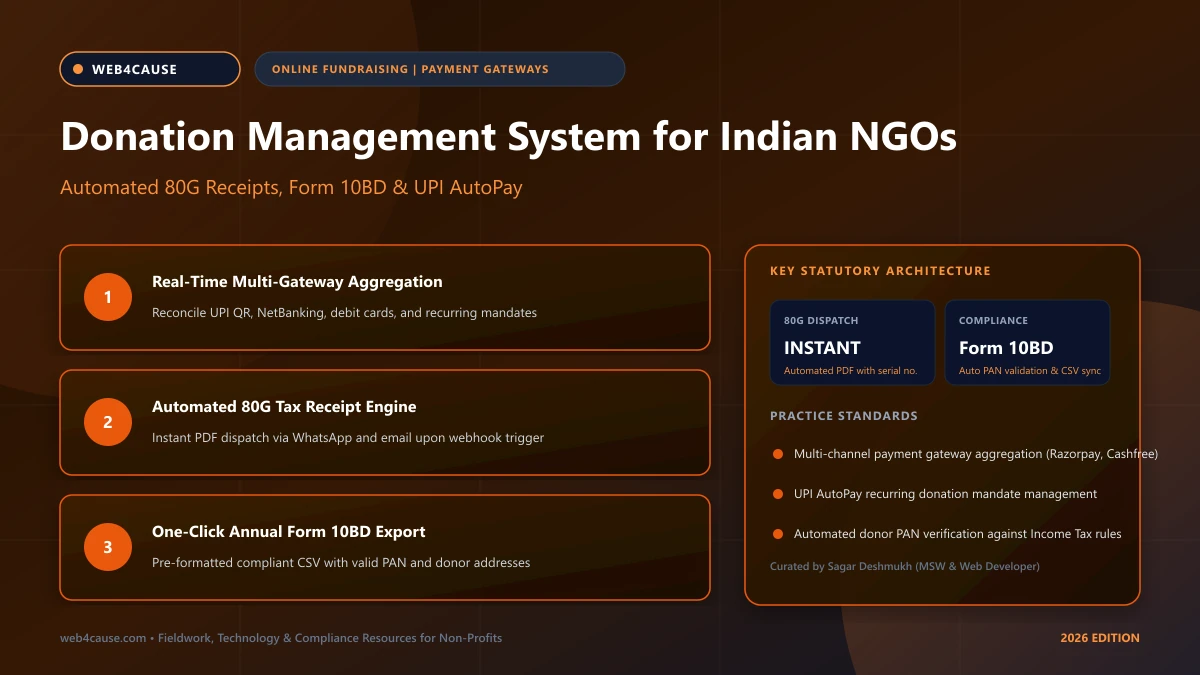
1. The Spreadsheet Trap: Why Manual Donation Tracking Fails Indian Non-Profits
Across thousands of charitable trusts, societies, and Section 8 institutions in India, fundraising records remain trapped in manual Google Sheets, disjointed payment aggregator dashboards, and paper counterfoils. When an organization collects fifty gifts annually, an Excel sheet appears harmless. However, once digital campaigns expand, manual data management turns into an operational crisis.
The primary flaw of spreadsheet tracking is concurrency breakdown. Multiple team members update unversioned files simultaneously. Donor phone numbers get truncated, offline NEFT bank credits sit unmapped in suspense ledgers, and typo-ridden PAN numbers go unnoticed until tax audit season.
The Attrition Multiplier: Insights from our analysis of donor retention strategies for Indian NGOs reveal that over 70 percent of first-time givers never contribute again. Delayed acknowledgement is the number one cause of churn. When a supporter donates online and waits weeks for a receipt, trust evaporates.
Statutory risks compound this friction. Under mandates enforced by the Directorate of Income Tax (Systems), registered charities must submit the annual Statement of Donations in Form 10BD by May 31. Capturing corrupted PANs or missing donor addresses causes portal upload rejections. Under Section 234G of the Income Tax Act 1961, late filing triggers a mandatory fee of Rs 200 per day, alongside discretionary penalties between Rs 10,000 and Rs 1,00,000 under Section 271K. A dedicated Donation Management System eliminates this vulnerability by automating ingestion, validation, and reporting within a unified framework.
2. Modern Donation Management System (DMS) Architecture and Relational Data Model
A robust DMS is not a mere checkout form. It is an enterprise transactional engine structured into distinct tiers: a Presentation Layer handling mobile-first checkouts, a Gateway Aggregation Layer routing payments, an Event Broker verifying webhook signatures, a Relational Ledger ensuring ACID compliance, a Headless Document Engine generating stamped PDFs, an Outbound Notification Broker for WhatsApp and email delivery, and a Statutory Reporting Engine exporting Form 10BD CSVs.
To prevent orphan records and maintain strict audit trails, the system requires a normalized relational database schema:
CREATE TABLE donors (
    id BIGSERIAL PRIMARY KEY,
    donor_uuid UUID NOT NULL UNIQUE DEFAULT gen_random_uuid(),
    full_name VARCHAR(255) NOT NULL,
    email VARCHAR(255) NOT NULL,
    phone_number VARCHAR(20) NOT NULL,
    pan_number VARCHAR(10),
    pan_entity_type VARCHAR(20),
    address_line1 VARCHAR(255) NOT NULL,
    city VARCHAR(100) NOT NULL,
    state VARCHAR(100) NOT NULL,
    postal_code VARCHAR(10) NOT NULL,
    country VARCHAR(100) NOT NULL DEFAULT 'India',
    dpdp_consent_obtained BOOLEAN NOT NULL DEFAULT FALSE,
    created_at TIMESTAMP WITH TIME ZONE NOT NULL DEFAULT NOW()
);

CREATE TABLE donations (
    id BIGSERIAL PRIMARY KEY,
    donor_id BIGINT NOT NULL REFERENCES donors(id) ON DELETE RESTRICT,
    gateway_name VARCHAR(50) NOT NULL,
    gateway_payment_id VARCHAR(100) NOT NULL UNIQUE,
    payment_method VARCHAR(50) NOT NULL,
    gross_amount DECIMAL(12, 2) NOT NULL,
    gateway_fee DECIMAL(10, 2) NOT NULL DEFAULT 0.00,
    net_amount DECIMAL(12, 2) NOT NULL,
    campaign_slug VARCHAR(100) NOT NULL,
    donation_purpose VARCHAR(100) NOT NULL,
    is_corpus_donation BOOLEAN NOT NULL DEFAULT FALSE,
    payment_status VARCHAR(30) NOT NULL,
    created_at TIMESTAMP WITH TIME ZONE NOT NULL DEFAULT NOW()
);

CREATE TABLE tax_receipts (
    id BIGSERIAL PRIMARY KEY,
    donation_id BIGINT NOT NULL UNIQUE REFERENCES donations(id) ON DELETE RESTRICT,
    receipt_number VARCHAR(50) NOT NULL UNIQUE,
    financial_year VARCHAR(10) NOT NULL,
    receipt_pdf_url TEXT NOT NULL,
    verification_hash VARCHAR(64) NOT NULL,
    whatsapp_dispatched_at TIMESTAMP WITH TIME ZONE,
    created_at TIMESTAMP WITH TIME ZONE NOT NULL DEFAULT NOW()
);

CREATE INDEX idx_donors_pan ON donors(pan_number);
CREATE INDEX idx_receipts_fy ON tax_receipts(financial_year);
This schema guarantees that every transaction maps to a verified donor profile, locks receipt serials per financial year, and prevents duplicate processing when payment gateways retry webhook dispatches.
3. Multi-Rail Payment Ingestion: Gateways, Dynamic UPI QR, Bank Transfers, and AutoPay
Indian donors contribute through varied payment rails. Relying on a single gateway creates single-point operational vulnerabilities. A mature DMS aggregates leading Indian processors such as Razorpay and Cashfree Payments, supported by PayU or Stripe for overseas cross-border donations, as outlined in our manual on NGO payment gateway integration in India.
Dynamic UPI QR Codes vs Static UPI Posters
Publishing static Google Pay or PhonePe QR codes on brochures or websites causes severe accounting headaches. Static QR payments arrive with unhelpful bank narrations like UPI/CR/519420842/RAMESH/SBIN. Crucial donor identifiers (postal address, email, and 10-character PAN) are absent. Consequently, the NGO cannot issue an 80G receipt or report the donation in Form 10BD. Worse, under Section 115BBC of the Income Tax Act 1961, unattributed contributions risk being classified as anonymous donations, taxed at a flat 30 percent penalty rate.
A modern DMS eliminates this by generating session-specific Dynamic UPI Intent QR codes adhering to standards set by the National Payments Corporation of India (NPCI). The system embeds the exact donation amount and a unique transaction reference in the QR code. When the donor scans the code via BHIM, Google Pay, or Paytm, the payment webhook instantly maps the settlement back to the donor session.
Virtual Account Numbers (VAN) for Direct Bank Transfers
For corporate CSR grants and High-Net-Worth Individuals (HNIs) transferring funds via NEFT or RTGS, the DMS provisions unique Virtual Account Numbers linked to the NGO primary bank account. When a corporate wire settles, the banking partner fires an immediate webhook notification, enabling the DMS to identify the contributor, log the grant against the respective project, and issue an official tax certificate automatically.
Recurring Sustainers via UPI AutoPay
Predictable monthly giving fuels sustainable interventions. While credit card recurring mandates suffer from high churn due to expiration dates and Reserve Bank of India tokenization friction, UPI AutoPay for NGO recurring donations in India operates directly on the donor primary savings account. Mandate retention exceeds 92 percent over twelve months, and recurring debits execute without requiring OTP friction, delivering monthly renewal success rates above 85 percent.
4. Pre-Transaction Donor PAN Validation and Form 10BD Statutory Preparedness
Under Section 80G(5)(viii) and Rule 18AB of the Income Tax Rules, issuing tax exemption receipts requires verified donor identification. Fixing corrupted records retroactively at the close of the financial year is impractical. A resilient DMS enforces front-end pre-transaction validation before payment authorization occurs.
The Indian PAN adheres to an immutable 10-character alphanumeric structure: five uppercase alphabets, four digits, and one check alphabet. The 4th character denotes entity status (such as P for Individual, C for Company, H for HUF, T for Trust), while the 5th character matches the donor legal surname initial.
function validateDonorPAN(panInput, donorLastName) {
    if (!panInput || typeof panInput !== 'string') {
        return { isValid: false, reason: 'PAN is mandatory for Section 80G receipt' };
    }

    const cleanPAN = panInput.trim().toUpperCase();
    const panRegex = /^[A-Z]{5}[0-9]{4}[A-Z]{1}$/;

    if (!panRegex.test(cleanPAN)) {
        return { isValid: false, reason: 'PAN must be exactly 10 alphanumeric characters (e.g. ABCDE1234F)' };
    }

    const validEntities = {
        'P': 'Individual',
        'C': 'Company',
        'H': 'HUF',
        'F': 'Firm',
        'A': 'AOP',
        'T': 'Trust'
    };

    const fourthChar = cleanPAN.charAt(3);
    if (!validEntities[fourthChar]) {
        return { isValid: false, reason: 'Entity code in PAN is unrecognized' };
    }

    if (fourthChar === 'P' && donorLastName && donorLastName.trim().length > 0) {
        const expectedInitial = donorLastName.trim().toUpperCase().charAt(0);
        if (cleanPAN.charAt(4) !== expectedInitial) {
            return {
                isValid: false,
                reason: 'Surname initial does not match the 5th character of the PAN'
            };
        }
    }

    return { isValid: true, pan: cleanPAN, entityType: validEntities[fourthChar] };
}
Validating data prior to checkout ensures seamless synchronization with the Form 10BD filing workflow. The table below outlines how DMS records map into statutory compliance fields:
| Form 10BD Field | Internal DMS Attribute | Statutory Format | Validation Rule |
|---|---|---|---|
| Pre Acknowledgement Number | donations.id |
Sequential Integer | Unique per financial year |
| Unique Identification Number | donors.pan_number |
10-Character String | Pre-transaction regex verified |
| Donor Legal Name | donors.full_name |
Text String | Verified against PAN database |
| Address & PIN Code | donors.address + postal_code |
Postal address + 6-digit PIN | Mandatory for Form 10BD CSV filing |
| Donation Type | donations.is_corpus |
Corpus, Specific Grant, General | Corpus requires written donor letter |
| Mode of Receipt | donations.payment_method |
Electronic, Cheque, Cash | Cash capped at Rs 2,000 for 80G relief |
5. Zero-Touch Real-Time Section 80G Receipt Engine and Automated Dispatch
Manual invoicing exhausts non-profit administrative capacity. As explored in our technical guide on the automated 80G tax receipt system for NGOs in India, modern architectures deploy zero-touch serverless pipelines. Within fifteen seconds of payment settlement, the engine generates an official, tamper-proof PDF receipt and dispatches it via email and WhatsApp.
Mandatory Statutory Components of an 80G Tax Receipt
- Full registered name, physical address, and Darpan ID registered on NGO Darpan.
- Section 80G Approval Unique Registration Number (URN), date of issuance, and the statutory clause confirming perpetuality under the Finance Act.
- Section 12A / 12AB Registration Number and entity PAN.
- Sequential, unbroken receipt serial number locked to the financial year (e.g.,
W4C/2026-27/80G/004218). - Donor full legal name, permanent address, contact number, and verified 10-character PAN.
- Contribution amount represented in both numeric digits and full English words.
- Transaction reference identifiers: Payment gateway payment ID, bank reference number, and payment timestamp.
- Cryptographic X.509 digital signature or verifiable QR seal linking to a public verification endpoint.
High-volume organizations utilize headless serverless rendering via Chromium (Puppeteer) on AWS Lambda to compile print-ready vector PDFs in under 1.5 seconds. For grassroots trusts, Google Apps Script template merging provides a zero-cost serverless alternative. Rendered documents are archived in encrypted private cloud storage, with dispatch workers delivering PDF attachments via transactional email services (Amazon SES or Postmark) within seconds.
6. Event-Driven Webhook Pipelines, Resilience Engineering, and WhatsApp Delivery
Legacy donation forms rely on synchronous browser redirects, which fail when supporters close mobile browsers prematurely. Modern systems employ asynchronous server-to-server webhooks. When a payment captures, the gateway server issues an HTTP POST event directly to the non-profit listener.
Resilient webhook processing demands cryptographic signature validation, idempotency caching, and queue isolation:
const express = require('express');
const crypto = require('crypto');
const router = express.Router();

router.post('/webhooks/payment-captured', express.raw({ type: 'application/json' }), async (req, res) => {
    const signature = req.headers['x-razorpay-signature'];
    const webhookSecret = process.env.GATEWAY_WEBHOOK_SECRET;

    if (!signature || !webhookSecret) {
        return res.status(401).json({ error: 'Missing security credentials' });
    }

    const expectedSignature = crypto
        .createHmac('sha256', webhookSecret)
        .update(req.body)
        .digest('hex');

    if (expectedSignature !== signature) {
        return res.status(403).json({ error: 'Cryptographic signature mismatch' });
    }

    const event = JSON.parse(req.body.toString());
    if (event.event !== 'payment.captured') {
        return res.status(200).json({ status: 'Ignored non-capture event' });
    }

    const paymentId = event.payload.payment.entity.id;

    try {
        const isDuplicate = await checkIdempotencyKey(paymentId);
        if (isDuplicate) {
            return res.status(200).json({ status: 'Event already processed' });
        }

        await enqueueDonationProcessingJob({
            paymentId: paymentId,
            amount: event.payload.payment.entity.amount / 100,
            email: event.payload.payment.entity.email,
            contact: event.payload.payment.entity.contact,
            notes: event.payload.payment.entity.notes
        });

        return res.status(200).json({ status: 'Job queued successfully' });
    } catch (err) {
        console.error('Webhook processing failure:', err);
        return res.status(500).json({ error: 'Internal queue failure' });
    }
});
Instant WhatsApp Delivery via Meta Cloud API
While email open rates hover around 20 percent in India, WhatsApp messages achieve open rates exceeding 90 percent within minutes. Connecting the DMS to the Meta WhatsApp Cloud API or Business Solution Providers (such as WATI or Interakt) allows queue workers to deliver pre-approved Utility Templates instantly. The template shares the donor name, contribution sum, and a secure download link for the official 80G tax receipt. Organizations can automate this logic with zero license costs using n8n workflow automation for NGOs.
7. Advanced Donor Segmentation, RFM Modeling, and Lifetime Supporter Nurturing
Treating an occasional Rs 500 donor identically to a Rs 1,00,000 corporate patron or an uninterrupted monthly sustainer damages retention. A modern DMS leverages RFM (Recency, Frequency, Monetary) Segmentation tailored for Indian development work:
Identifies active supporters (given in past 90 days), cooling contributors (91 to 180 days), and lapsed donors (beyond 365 days), triggering timely re-engagement outreach.
Distinguishes one-time emergency relief donors from monthly UPI AutoPay sustainers and annual festive patrons, adapting communication tone accordingly.
Segments giving into Retail Donors (under Rs 5,000), Mid-Level Champions (Rs 5,001 to Rs 50,000), Major Patrons (Rs 50,001 to Rs 5,00,000), and Corporate CSR Grants (above Rs 5,00,000).
Automated 90-Day Impact Nurture Sequences
Rather than reaching out only when requesting funds, leading charities deploy automated lifecycle journeys. Following Day 0 receipt delivery, Day 7 delivers a grassroots beneficiary story based on participatory rural appraisal (PRA) techniques. Day 30 shares verifiable operational milestone metrics without financial asks. Day 60 invites donors to a virtual project briefing, and Day 90 gently invites one-time givers to establish recurring UPI AutoPay support. By integrating campaign attribution tags, leadership tracks Cost Per Acquisition across Google Ad Grants and field campaigns organized through community mobilization in social work.
8. Open-Source vs Proprietary SaaS: ERPNext, CiviCRM, WordPress, and Commercial Portals
When upgrading beyond spreadsheets, trustees must choose between proprietary subscription platforms, commercial crowdfunding aggregators, or self-hosted open-source software. Below is a strategic comparison across core operational metrics:
| Platform Stack | Software Cost | Platform Cut | Data Sovereignty | Form 10BD Export | WhatsApp Integration | Ideal Non-Profit Scale |
|---|---|---|---|---|---|---|
| ERPNext Non-Profit | Zero (Open source) | 0% (Direct gateway only) | 100% Owned on private VPS | Native Indian app support | Direct API via webhooks | Medium to large trusts, Section 8 entities |
| CiviCRM (Self-Hosted) | Zero (Open source) | 0% (Direct gateway only) | 100% Owned on private server | Custom report required | Via webhooks or extensions | Advocacy groups, grant makers |
| WordPress + Gateway (Web4cause) | Zero (Open source) | 0% (Direct gateway only) | 100% Owned in MySQL database | Automated 1-click CSV | Native Meta Cloud API hook | Growing Indian non-profits |
| Donorbox / GiveWP (Proprietary) | $139 to $399 monthly | 1.5% to 2.9% surcharge | Vendor cloud locked | Manual Excel formatting | Third-party paid tools | International NGOs in USD |
| Crowdfunding Portals (Ketto, Milaap) | Zero upfront setup | 3% to 8% platform fee + GST | Portal controls donor data | Periodic manual exports | Controlled by portal | Emergency relief appeals |
Three-Year Total Cost of Ownership (TCO)
For an Indian NGO raising Rs 50 Lakhs annually across 2,000 donors: A crowdfunding portal taking a 5 percent cut plus GST consumes Rs 8,85,000 over three years while retaining donor ownership. Proprietary SaaS platforms cost over Rs 6,45,000 in recurring subscriptions and transaction surcharges. Conversely, a self-hosted open-source DMS built according to Web4cause specifications incurs zero software subscriptions and zero commission cuts, requiring only standard gateway interchange and basic VPS hosting. Over three years, the charity saves over Rs 5,50,000 in operational overhead, preserving donor capital for mission execution.
9. Data Security, Role-Based Access Control, and DPDP Act 2023 Statutory Compliance
Historically, non-profits circulated donor spreadsheets across unencrypted email threads. Under the Digital Personal Data Protection Act 2023 (DPDP Act), charitable trusts operate as Data Fiduciaries. The Data Protection Board of India holds authority to levy penalties reaching Rs 250 Crores for significant personal data breaches.
Four Pillars of DPDP Compliance for Non-Profits
- Notice and Granular Consent: Donation checkouts must provide unbundled opt-in checkboxes, separating tax processing consent from marketing newsletters.
- Consent Logging: The DMS must log the exact timestamp, donor IP address, and privacy terms consented to as an immutable record.
- AES-256 Storage Encryption: Sensitive donor identifiers, including PAN numbers and residential addresses, must be encrypted at rest using AES-256 and transmitted over TLS 1.3.
- Right to Erasure vs Statutory Retention: The system must separate marketing records (erasable upon request) from tax ledgers (which must be retained for seven years under Section 44AA of the Income Tax Act).
To prevent internal data leaks, the DMS enforces Role-Based Access Control (RBAC). Field volunteers view aggregated campaign totals without accessing personal records. Fundraisers view donor names and contact tiers with masked PANs (e.g., XXXXX1234F). Accounts staff access unmasked PANs strictly for 80G receipting and Form 10BD filing, while executive trustees monitor system audit logs tracking every CSV download and database modification.
10. Frequently Asked Questions (FAQs)
1. What is the fundamental difference between a basic payment gateway checkout and a full Donation Management System?
A basic payment gateway checkout is simply a technical conduit that transfers money from a donor bank account to the non-profit current account, providing nothing more than a raw transaction ID. In contrast, a full Donation Management System orchestrates the complete donor lifecycle: it enforces pre-transaction PAN validation under Income Tax rules, logs donor addresses, assigns sequential 80G receipt numbers, compiles digitally signed PDF tax certificates, delivers receipts via WhatsApp within fifteen seconds, tracks recurring UPI AutoPay mandates, maintains RFM donor segmentation, and generates error-free Form 10BD CSV reports for annual compliance.
2. How does an automated Donation Management System eliminate Form 10BD e-filing rejections?
Manual Form 10BD filings fail because human entry introduces typos into 10-character PANs, mixes up entity codes, or forgets to collect complete donor postal addresses with 6-digit PIN codes. An automated DMS eliminates these errors at the point of capture: front-end algorithms validate PAN regex syntax, match the 5th character against the donor surname, and reject incomplete addresses before payment authorization occurs. At financial year-end, the system exports a pre-validated CSV that matches the Directorate of Income Tax (Systems) schema with 100 percent fidelity, eliminating Section 234G late fees.
3. Can an Indian non-profit deploy an enterprise DMS without paying expensive monthly SaaS subscriptions?
Yes. By utilizing open-source platforms such as ERPNext Non-Profit, CiviCRM, or a custom WordPress architecture paired with self-hosted n8n workflow engines, non-profits eliminate recurring software license fees entirely. The organization pays only standard gateway processing charges (typically 1.8 to 2 percent directly to Razorpay or Cashfree) and basic VPS server hosting. Over a three-year window, this approach saves growing charities between Rs 3,50,000 and Rs 6,50,000 in software overhead, while guaranteeing absolute data ownership and DPDP Act compliance.
4. Why is UPI AutoPay significantly more effective for recurring donations than credit card mandates in India?
Credit card recurring mandates suffer from severe attrition in India due to plastic card expirations, stolen cards, and strict Reserve Bank of India tokenization rules. In contrast, UPI AutoPay operates directly on the donor primary savings account via NPCI rails. Because underlying bank accounts remain stable for years, mandate retention exceeds 92 percent over twelve months. Furthermore, once authorized, subsequent monthly debits process automatically without requiring OTP authentication, sustaining monthly recurring success rates above 85 percent.
5. What statutory information must appear on an automated Section 80G tax receipt to ensure legal validity?
To be legally valid under Section 80G of the Income Tax Act 1961, the receipt must state: the NGO registered name, physical address, and Darpan ID; the Section 80G Approval Unique Registration Number (URN), date of order, and perpetual validity statement; the Section 12A / 12AB registration number; the NGO PAN; an unbroken, sequential receipt number for the current financial year; the donor full legal name, complete address, and verified 10-character PAN; the exact donation amount in figures and words; the payment mode and transaction reference identifier; and an authorized digital signature or verifiable cryptographic QR code.
6. How does the Digital Personal Data Protection Act 2023 (DPDP Act) impact non-profit donor management?
The DPDP Act classifies non-profits as Data Fiduciaries responsible for safeguarding donor personal data under penalty of up to Rs 250 Crores for significant breaches. Non-profits can no longer circulate unencrypted donor spreadsheets across personal email accounts. Organizations must obtain explicit, unbundled consent during checkout, log consent timestamps, implement AES-256 encryption at rest, restrict staff access using strict Role-Based Access Control (RBAC), and maintain detailed audit trails showing every user who views or exports donor records.