
Mobile Data Collection for NGOs in India: Complete 2026 Guide
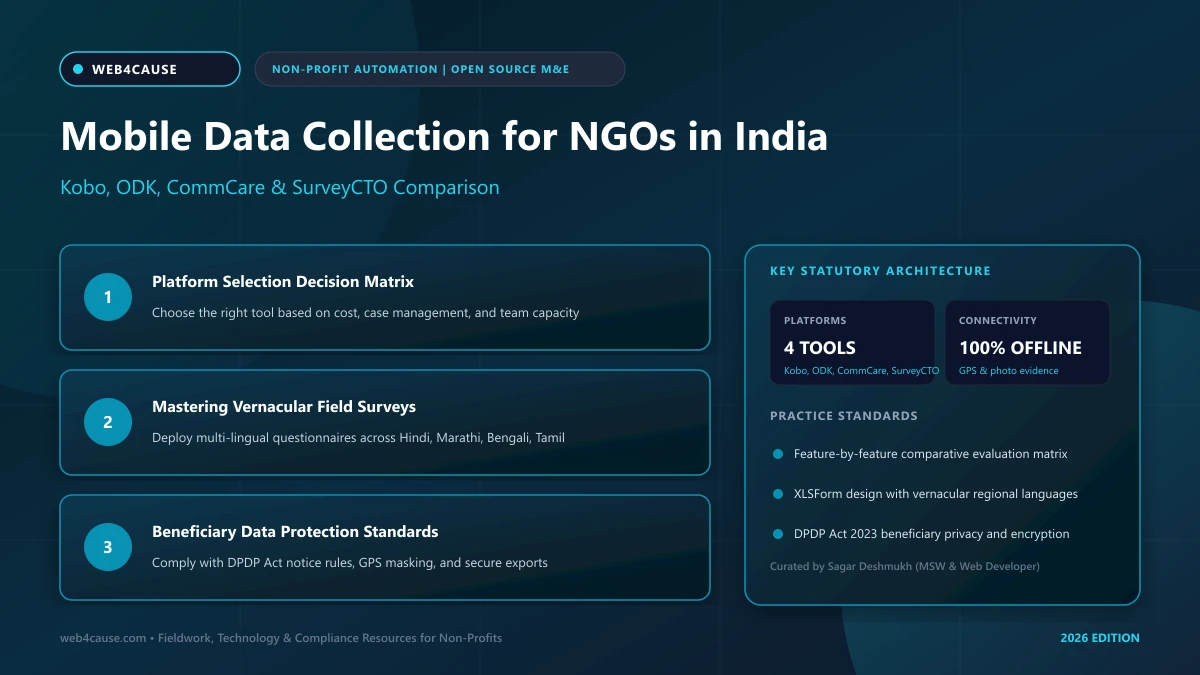
Transform grassroots monitoring, baseline evaluations, and CSR impact assessments across rural India. Master the leading mobile data collection platforms: KoboToolbox, ODK Central, CommCare, and SurveyCTO. Learn how to engineer multi-lingual XLSForms with Local Government Directory geography, enforce DPDP Act 2023 compliance, maintain high satellite GPS accuracy in zero-connectivity hamlets, and automate live reporting dashboards using n8n and PostgreSQL.
1. The Digital M&E Landscape for Indian Non-Profits
For decades, grassroots civil society organizations across India depended exclusively on paper questionnaires, physical registers, and clipboards to track social change. In remote tribal belts such as Melghat and Nandurbar in Maharashtra, Bastar in Chhattisgarh, and Kalahandi in Odisha, paper-based baseline surveys introduced crippling operational friction. Physical records suffered water damage during heavy monsoon rains, became lost during transit across unpaved forest paths, and produced widespread data entry errors caused by illegible handwriting.
Even more damaging was the reporting latency. Paper forms gathered by community mobilizers routinely languished in taluka project offices for two to four months before temporary data entry operators could transfer them into spreadsheets. By the time a project director received the consolidated figures, the agricultural season had transitioned, malnutrition episodes had peaked, and crucial opportunities for field course-correction had passed.
Today, the institutional landscape has shifted fundamentally. Corporate Social Responsibility (CSR) donors governed by the Ministry of Corporate Affairs under Section 135 of the Companies Act 2013 and the CSR Amendment Rules mandate independent, verifiable impact assessments for substantial grant programs. Furthermore, the launch of the Social Stock Exchange under the Securities and Exchange Board of India (SEBI) requires formal adherence to Social Audit Standards (SAS 100 through SAS 1600). These standards demand tamper-evident, disaggregated, geo-tagged telemetry confirming that social interventions actually reached the intended vulnerable populations.
Modern mobile data collection platforms bridge this structural divide. By equipping social workers and community volunteers with offline-first Android applications, non-profits capture satellite coordinates, photo documentation, audio testimonials, and complex socio-economic indicators in hamlets with absolutely zero cellular connectivity. When coupled with participatory field methodologies like Participatory Rural Appraisal (PRA) Techniques in India and structured Community Mobilization in Social Work, digital enumeration converts routine data gathering into an empowering, transparent community dialogue.
Field Practicum Note: Technology must reinforce human empathy, never replace it. In marginalized tribal habitations, introducing digital tablets without prior orientation can provoke suspicion among village elders. Social work professionals conduct Gram Sabha orientations, transect walks, and community mappings before administering digital questionnaires, explaining explicitly how the gathered evidence secures public entitlements and community welfare.
2. The Big Four Platforms: KoboToolbox, ODK, CommCare, and SurveyCTO
Indian civil society organizations operate across diverse programmatic domains, ranging from short-term disaster relief drives to multi-year longitudinal public health interventions. Selecting the appropriate digital survey infrastructure requires evaluating technical capacity, budget constraints, case tracking complexity, and data sovereignty requirements. Four prominent platforms dominate the development sector:
A. KoboToolbox: Open-Source Agility and Rapid Grassroots Rollout
Originally engineered by the Harvard Humanitarian Initiative and supported by the United Nations Office for the Coordination of Humanitarian Affairs (UN OCHA), KoboToolbox is an AGPLv3 open-source suite designed for rapid humanitarian response and social research. The platform pairs an intuitive web-based visual form builder with comprehensive support for the standardized XLSForm standard.
Field enumerators collect data using the dedicated KoboCollect Android app or offline Enketo web forms in mobile browsers. For Indian non-profits, KoboToolbox represents the most accessible entry point: the managed public cloud cluster offers up to 10,000 free survey submissions and 5 GB of media storage per month for verified civil society organizations. For deep-dive architectural instructions, explore our companion manual on KoboToolbox for NGOs in India.
B. ODK (Open Data Kit): The Enterprise Standard for Custom Self-Hosting
Open Data Kit (ODK) is the foundational, industry-standard open-source engine upon which much of the modern mobile collection ecosystem is constructed. Developed initially at the University of Washington with backing from Google.org and the Bill & Melinda Gates Foundation, ODK provides an enterprise server backend known as ODK Central.
ODK Central is built upon modern Node.js and PostgreSQL architecture, deployed effortlessly via Docker on private cloud virtual private servers (VPS). Unlike lightweight form builders, ODK excels at complex field logistics: it features native Entity-Based Data Collection, allowing enumerators to create, update, and follow beneficiary entities offline across multiple forms. Organizations seeking total data residency within Indian geographic borders (AWS Mumbai or DigitalOcean Bangalore) frequently deploy self-hosted ODK Central to maintain uncompromised sovereignty over vulnerable beneficiary records.
C. CommCare: Longitudinal Case Management and Decision Support
Engineered by Dimagi, CommCare is purpose-built for longitudinal case management rather than standalone, cross-sectional surveys. While tools like KoboToolbox record isolated household encounters, CommCare tracks an individual beneficiary over months or years across recurring visits.
CommCare is the gold standard for maternal and child health programs (tracking an expectant mother through antenatal checkups, institutional delivery, and child immunizations), tuberculosis treatment adherence, and Self-Help Group (SHG) financial credit tracking. Crucially, CommCare embeds offline decision-support algorithms directly into the handset: when a field health worker records a high blood pressure reading or acute nutritional deficit, the app prompts immediate clinical guidance and emergency referral protocols.
D. SurveyCTO: Institutional Research Rigor and Fraud Prevention
Engineered by Dobility, SurveyCTO is a proprietary cloud platform built specifically for development economics researchers, randomized controlled trials (RCTs), and institutional evaluation firms like J-PAL, IDinsight, and large CSR foundations.
SurveyCTO is renowned for automated quality control and anti-fraud telemetry. It executes background audio audits (recording brief ambient audio snippets during question delivery to verify genuine human interaction), monitors hardware sensors (accelerometer, screen brightness, physical movement), and conducts automated statistical outlier analysis to flag enumerators who rush through questionnaires or falsify responses from hotel rooms. While it involves monthly subscription costs, organizations managing multi-crore CSR evaluations find its audit security indispensable.
3. Master Comparative Feature and Pricing Matrix
The following matrix contrasts technical architectures, operational pricing, offline functionality, and administrative capabilities across the four leading mobile data collection platforms for Indian non-profits:
| Evaluation Parameter | KoboToolbox | ODK (Central) | CommCare | SurveyCTO |
|---|---|---|---|---|
| Software License | Open Source (AGPLv3) | Open Source (Apache 2.0) | Open Source core, SaaS platform | Proprietary Commercial SaaS |
| Hosting & Data Residency | Managed Cloud (EU/US) or Self-Hosted Docker | Self-Hosted Indian VPS (AWS Mumbai) or ODK Cloud | Managed Dimagi Cloud (US/India clusters available) | Managed Google Cloud clusters (Global / regional) |
| Pricing Structure (INR) | Free (10k submissions/mo); Self-hosted: approx. 1,500 INR/mo VPS | Free open-source software; Self-hosted VPS: 2,000 to 4,000 INR/mo | Community Free Tier (limited); Paid tiers: approx. 8,000 to 35,000 INR/mo | Paid subscription: starting approx. 20,000 INR/mo per survey server |
| Longitudinal Case Tracking | Basic (via parent/child CSV lookups) | Moderate (ODK Entities support offline updates) | Exceptional (Advanced Case Management & Case Sharing) | Moderate (Server dataset publishing & preloading) |
| Automated Fraud Detection | Basic audit log (time spent per question screen) | Audit logs, GPS tracking per screen change | Worker performance reports, GPS check-ins | Best in Class (Audio audits, sensor checks, speed alerts) |
| Offline Reliability | High (Android KoboCollect & Enketo web) | Very High (ODK Collect is extremely battle-tested) | Very High (Native Android app with local SQLite) | High (SurveyCTO Collect Android/iOS) |
| XLSForm Standard Support | Full support + visual builder | Gold standard reference implementation | Proprietary form builder + custom XML format | Full XLSForm support + proprietary field extensions |
| API & Webhook Ecosystem | REST API v2, native webhooks to n8n/Zapier | OData feeds, REST API, Webhooks, Python client | REST API, Data forwarding, Zapier, Webhooks | REST API, Webhooks, Google Sheets integration |
| Ideal Use Case in India | Grassroots baseline surveys, relief distribution, annual M&E | Large-scale institutional surveys, self-hosted data pipelines | Frontline health workers, SHG tracking, ongoing social cases | Academic RCTs, CSR compliance audits, fraud-sensitive studies |
For most grassroots non-profits operating on modest administrative budgets, KoboToolbox and self-hosted ODK Central offer the highest return on investment. They deliver zero software licensing fees, eliminate vendor lock-in, and provide complete compatibility with Open Source Software for NGOs in India.
4. XLSForm Standard Mastery: Multilingual Questionnaires and Skip Logic
While visual drag-and-drop form builders are suitable for simple questionnaires, production-grade social surveys require authoring forms in Excel via the XLSForm specification. An XLSForm file is a workbook containing three dedicated worksheets:
- survey: Specifies question types, technical variable names, question labels, conditional skip logic (relevant), calculations, and input constraints.
- choices: Declares the selectable answer options for single-select (select_one) and multi-select (select_multiple) questions, linking option values to translated text labels.
- settings: Defines form-level metadata, including the form title, unique form_id, versioning string (e.g., 2026103101), and default presentation language.
Authoring Multilingual Surveys for Diverse Indian States
India is a linguistic mosaic. Enumerators working across state borders or inter-district tribal belts must toggle seamlessly between languages without administrative friction. XLSForm supports multiple languages through column naming syntax: label::Language (code) and hint::Language (code).
| type | name | label::English (en) | label::Hindi (hi) | label::Marathi (mr) | relevant |
|---|---|---|---|---|---|
| select_one yes_no | owns_land | Does the household own agricultural land? | क्या परिवार के पास कृषि भूमि है? | कुटुंबाकडे शेतजमीन आहे का? | |
| decimal | land_acres | Total land holding in acres: | कुल कृषि भूमि (एकड़ में): | एकूण शेतजमीन (एकर मध्ये): | ${owns_land} = ‘yes’ |
| select_multiple irrigation | water_source | Primary irrigation water source: | सिंचाई का मुख्य स्रोत: | सिंचनाचा मुख्य स्त्रोत: | ${owns_land} = ‘yes’ |
In KoboCollect or ODK Collect, the field surveyor taps the settings icon to switch between English, Hindi, Marathi, Bengali, or Tamil instantly. The user interface updates every question label, hint, and dropdown choice without requiring form reloads or internet connectivity.
Complex Skip Logic (Relevant) and Calculated Variables
Field questionnaires must dynamically adapt to respondent context. If an enumerator indicates that a farmer lacks irrigation infrastructure, questions evaluating drip irrigation subsidies must remain hidden. In XLSForm, this is handled through the relevant column using XPath syntax:
- Single Condition:
${irrigation_available} = 'yes' - Compound Logic:
${farmer_category} = 'small_marginal' and ${land_acres} < 2.5 - Multiple Choice Inspection:
selected(${water_source}, 'borewell')
Calculated variables (calculate type) execute background mathematical operations without displaying prompts to the user. For instance, calculating respondent age from date of birth (${dob}) to determine child eligibility for Integrated Child Development Services (ICDS):
5. Cascading Geography: Mapping India Local Government Directory (LGD) Codes
A major source of data contamination in Indian baseline surveys is free-text administrative entry. When field enumerators manually type village names, the same habitation appears under dozens of phonetically inconsistent spellings (such as “Chincholi”, “Chinchwali”, or “Chincholi Bk”). This prevents programmatic joining with Census data or GIS layers.
The solution is adopting official codes from the Local Government Directory (LGD) published by the Ministry of Panchayati Raj. By structuring a multi-tier cascading dropdown (State > District > Sub-District/Taluka > Gram Panchayat > Revenue Village), the survey restricts selectable choices based on prior selections.
XLSForm Implementation: The Survey Worksheet
| type | name | label | choice_filter |
|---|---|---|---|
| select_one state_list | state_code | Select State: | |
| select_one district_list | district_code | Select District: | state_fk = ${state_code} |
| select_one taluka_list | taluka_code | Select Block / Taluka: | district_fk = ${district_code} |
| select_one village_list | village_code | Select Revenue Village: | taluka_fk = ${taluka_code} |
XLSForm Implementation: The Choices Worksheet
| list_name | name (LGD Code) | label | state_fk | district_fk | taluka_fk |
|---|---|---|---|---|---|
| state_list | 27 | Maharashtra | |||
| district_list | 471 | Amravati | 27 | ||
| taluka_list | 3978 | Dharni | 471 | ||
| village_list | 531892 | Chikhaldara | 3978 |
For extensive geographic catalogs covering thousands of villages, avoid embedding massive choice lists directly into the main form. Instead, utilize external CSV lookups via the select_one_from_file villages.csv syntax, ensuring instant form rendering on entry-level Android devices.
6. Field Validation: Indian Mobile Numbers, Masked Aadhaar, and Biometrics
Data cleanliness begins on the mobile handset. The most efficient time to prevent errors is while the enumerator is seated in front of the community member. In XLSForm, this is governed by the constraint column paired with clear, local language explanations in constraint_message.
Essential Regex Patterns for Indian Social Surveys
-
10-Digit Indian Mobile Number: Enforces standard telecommunications formatting starting with 6, 7, 8, or 9:
regex(., '^[6-9][0-9]{9}$')
Constraint Message: “Please enter a valid 10-digit Indian mobile number starting with 6, 7, 8, or 9.” -
Masked Aadhaar Number (Last 4 Digits Only): In compliance with UIDAI regulations and the DPDP Act 2023, non-profits must never store raw 12-digit Aadhaar numbers on unencrypted field tablets. Restrict collection to the final 4 digits:
regex(., '^[0-9]{4}$')
Constraint Message: “Enter only the final 4 digits of the beneficiary Aadhaar card.” -
Voter ID (EPIC Number): Enforces the 3-letter alphanumeric prefix followed by 7 numeric digits:
regex(., '^[A-Z]{3}[0-9]{7}$')
Constraint Message: “Enter valid Voter ID format (3 capital letters followed by 7 digits, e.g., ABC1234567).” - Panchayat Job Card (MGNREGA ID): State-specific alphanumeric codes verifying employment guarantee scheme beneficiaries.
Statutory Compliance Warning: Capturing biometric fingerprints or high-resolution facial scans requires explicit statutory clearance and specialized hardware encrypted to STQC levels. Unauthorized biometric extraction by private non-profit entities violates Aadhaar Act regulations. Always opt for government-issued card IDs combined with photo self-declarations.
7. Field Hardware Selection, Offline GPS Precision, and Media Optimization
Deploying mobile surveys across rural India involves harsh environmental realities: searing summer heat exceeding 42 degrees Celsius in Vidarbha, extreme humidity in coastal Odisha, zero electricity grids for nocturnal recharging, and pervasive dust. Hardware selection directly governs survey completion rates.
Recommended Android Hardware Specifications
- Operating System: Android 11, 12, 13, or 14 with guaranteed security updates.
- Memory & Storage: Minimum 4 GB RAM and 64 GB internal storage to buffer hundreds of cached surveys and spatial map tiles.
- Battery Capacity: Minimum 5,000 mAh to 6,000 mAh, ensuring 10 hours of active screen and continuous GPS operation without power bank dependency.
- Display Brightness: Minimum 450 to 500 nits peak luminance for outdoor screen legibility under direct afternoon sunlight.
- Protection: Heavy-duty silicone shock bumpers and pre-applied tempered glass protectors.
Optimizing Offline GPS Precision in Zero-Connectivity Forests
In urban centers, smartphones acquire positioning within seconds by utilizing Assisted GPS (A-GPS), which downloads satellite orbital data (ephemeris) over 4G/5G cellular towers. In deep rural forests, cellular reception is non-existent; the device must calculate coordinates directly from satellite constellations: GPS (USA), GLONASS (Russia), Galileo (Europe), and NavIC (India).
This standalone calculation is known as a “cold start” and can take 2 to 5 minutes to achieve acceptable horizontal accuracy. To prevent enumerators from recording inaccurate locations (often 100+ meters off-target), configure an accuracy threshold in the XLSForm body:accuracyThreshold parameter:
With this parameter enforced, KoboCollect and ODK Collect will refuse to record the coordinate until the satellite triangulation achieves precision tighter than 10 meters, guaranteeing pristine spatial mapping for CSR auditors.
Image and Media Compression Optimization
Modern budget smartphones feature 50-megapixel camera sensors that generate raw image files between 8 MB and 14 MB each. When a baseline survey captures five photographs per household (such as the farmer holding a land title, farm pond construction, livestock health, and roof condition), a single submission reaches 60 MB. When fifty field enumerators upload daily surveys over intermittent 2G or 3G networks, sync queues fail completely.
Configure client-side image compression directly in the XLSForm parameters column:
The mobile app automatically scales the photograph down to a maximum dimension of 1024 pixels before saving, reducing file sizes from 10 MB to under 200 KB while preserving sufficient optical clarity for asset verification and CSR reporting.
8. Automated Pipeline Integration: REST APIs, Webhooks, and n8n Workflows
Collecting field data is only half the battle; the real organizational value emerges when submissions trigger immediate downstream operational actions. Rather than relying on staff to manually export CSV files every Friday afternoon, modern non-profits deploy event-driven webhook architectures using n8n Workflow Automation for NGOs.
The End-to-End Field Data Pipeline Architecture
- Field Capture: Enumerator submits cached surveys in KoboCollect or ODK Collect upon reaching mobile reception.
- Server Event: KoboToolbox / ODK Central triggers an instant HTTP POST webhook containing the complete JSON survey record.
- n8n Ingestion Engine: Self-hosted n8n receives the webhook, verifies the authorization header, parses beneficiary demographics, formats dates, and normalizes phone numbers.
- Database Storage: Clean records are upserted into a PostgreSQL database with PostGIS spatial geometry for GIS mapping.
- Operational Action: n8n triggers an automated WhatsApp acknowledgment to the farmer, updates Google Sheets for block coordinators, and flags urgent clinical alerts to doctors.
PostgreSQL Production Schema for Socio-Economic Surveys
Deploying a robust relational database ensures that survey data remains structured, auditable, and easily queryable by business intelligence dashboards:
id SERIAL PRIMARY KEY,
submission_uuid UUID UNIQUE NOT NULL,
form_version VARCHAR(32) NOT NULL,
enumerator_id VARCHAR(64) NOT NULL,
submission_timestamp TIMESTAMPTZ NOT NULL,
state_lgd_code INTEGER NOT NULL,
district_lgd_code INTEGER NOT NULL,
taluka_lgd_code INTEGER NOT NULL,
village_lgd_code INTEGER NOT NULL,
beneficiary_name VARCHAR(255) NOT NULL,
beneficiary_phone VARCHAR(15),
masked_aadhaar VARCHAR(4),
land_holding_acres NUMERIC(6, 2),
irrigation_access BOOLEAN DEFAULT FALSE,
gps_latitude NUMERIC(10, 7),
gps_longitude NUMERIC(10, 7),
gps_altitude NUMERIC(8, 2),
gps_accuracy_meters NUMERIC(6, 2),
verification_status VARCHAR(32) DEFAULT ‘pending’,
raw_payload JSONB,
created_at TIMESTAMPTZ DEFAULT NOW()
);
CREATE INDEX idx_household_village ON field_household_surveys (village_lgd_code);
CREATE INDEX idx_household_verification ON field_household_surveys (verification_status);
9. Real-Time Impact Dashboards for Board Trustees and CSR Grantmakers
Data collected from rural hamlets creates true institutional leverage when transformed into visual narrative intelligence. Corporate CSR committees and foundation boards rarely examine raw tabular records; they require intuitive visual metrics confirming accountability, return on social investment, and geographical reach.
Structuring Three-Tier M&E Telemetry
| Telemetry Layer | Key Performance Indicators (KPIs) | Primary Audience |
|---|---|---|
| 1. Operational Activity | Daily surveys completed, active enumerator count, average survey duration, GPS cluster spread | Field Coordinators & M&E Officers |
| 2. Programmatic Outputs | Farmers enrolled, drip kits distributed, soil health cards generated, check dams measured | Project Directors & Program Heads |
| 3. Social Outcomes & Impact | Crop yield increase percentage, household debt reduction, female SHG credit turnover, malnutrition decline | Trustees, CSR Committees & Donors |
Connecting PostgreSQL directly to Microsoft PowerBI or Google Looker Studio enables non-profits to publish automated, interactive dashboards. A GIS choropleth map dynamically colors each Gram Panchayat based on project coverage density. Disaggregated charts instantly break down beneficiaries by gender, land-holding size, and caste categories without requiring a single manual formula in Excel.
10. Beneficiary Data Privacy and DPDP Act 2023 Statutory Compliance
The enactment of the Digital Personal Data Protection Act 2023 (DPDP Act) by the Ministry of Electronics and Information Technology fundamentally transformed the legal duties of non-profit entities in India. Under the DPDP framework, non-profit trusts, societies, and Section 8 companies collecting field data are legally classified as “Data Fiduciaries”, while rural beneficiaries are recognized as “Data Principals”.
Four Non-Negotiable Compliance Imperatives for Non-Profits
-
Notice and Informed Digital Consent: Beneficiaries must be presented with an explicit, easily intelligible consent notice in their regional mother tongue (one of the 22 languages in the Eighth Schedule of the Indian Constitution). In XLSForm, implement a mandatory consent screen before question delivery. For non-literate community members, capture an audio recording of verbal consent using the
audioquestion type, paired with a digital signature widget on the mobile touchscreen. - Principle of Data Minimization: Gather solely the data elements strictly necessary to execute the social intervention. Gathering caste particulars, political opinions, or complete biometric credentials without programmatic justification violates statutory provisions.
- Granular Role-Based Access Control (RBAC): Field enumerators must possess submit-only rights. Once an enumerator transmits a household questionnaire, the record must be cleared from the handset, preventing temporary surveyors from browsing or copying sensitive neighborhood records. Server access must be compartmentalized between field supervisors, M&E officers, and system administrators.
- End-to-End Survey Encryption: ODK Central and KoboToolbox support public-key cryptography (RSA-2048). By uploading an organizational public encryption key into form settings, the mobile application encrypts every completed submission on the device before storage. Records cannot be decrypted until downloaded onto an authorized, air-gapped organizational computer holding the private key, ensuring cloud administrators cannot access sensitive beneficiary records.
11. Step-by-Step Field Pilot Implementation Roadmap
Rolling out a mobile data collection initiative across fifty villages without adequate pilot testing is a recipe for operational failure. Web4cause recommends a disciplined four-week implementation blueprint:
Week 1: Survey Logic Engineering & LGD Integration
Author the master XLSForm workbook. Validate syntax on online XLSForm checkers. Integrate Census LGD codes for all target villages. Configure regex constraints for 10-digit mobile numbers and masked Aadhaar. Review translated strings with local field supervisors to eliminate awkward phrasing.
Week 2: Enumerator Training & Field Ethics Workshop
Assemble community mobilizers and field enumerators for a hands-on two-day practical workshop. Configure Android devices via QR code scanning. Conduct role-playing simulations focusing on informed consent, handling respondent hesitation, taking clear photo evidence, and waiting for satellite GPS stabilization.
Week 3: Supervised Field Pilot in 2 Control Villages
Execute 30 to 50 trial surveys in two representative hamlets. M&E managers accompany enumerators to evaluate questionnaire flow, identify confusing skip logic, measure battery drain, and test synchronization speeds over low-bandwidth mobile networks. Refine the form to version 2.0 based on field findings.
Week 4: Full Deployment & Live Telemetry Activation
Distribute the finalized form version to all field handsets. Activate n8n webhook listeners, stream clean survey data into PostgreSQL, and connect live Looker Studio or PowerBI dashboards for real-time monitoring by program leadership and CSR grantmakers.
12. Frequently Asked Questions (FAQs)
1. What is the fundamental difference between KoboToolbox and ODK Central for an Indian grassroots NGO?
KoboToolbox is built on top of the ODK standard and provides a managed cloud environment with an easy visual form builder, generous free tiers (10,000 monthly submissions), and quick deployment, making it ideal for grassroots organizations without in-house technical staff. ODK Central is an enterprise, developer-centric backend that requires self-hosting via Docker on a cloud server or paid ODK Cloud subscriptions. ODK Central provides superior API control, native Entity-Based offline case management, and seamless deployment on Indian cloud VPS servers (AWS Mumbai) for strict data sovereignty.
2. Is CommCare necessary for standard socio-economic surveys, or is it primarily for healthcare?
CommCare is specifically designed for longitudinal case tracking where frontline community workers (such as ASHA health workers, ANMs, or Self-Help Group animators) visit the same beneficiary multiple times over an extended period. If your NGO is conducting cross-sectional baseline surveys, relief distributions, or annual evaluations, KoboToolbox or ODK Central is significantly faster to deploy and more cost-effective. Choose CommCare only when you require multi-visit beneficiary records, case sharing across workers, or in-app clinical decision support.
3. Can field enumerators collect survey data in remote forest areas with zero cellular connectivity?
Yes. KoboCollect, ODK Collect, and CommCare are built from the ground up on an offline-first architecture. Blank survey forms and offline map tiles are downloaded while connected to office Wi-Fi. In the field, enumerators record responses, capture satellite GPS coordinates, and take compressed photos without requiring any cellular signal or SIM card. Once the field worker returns to network coverage or the project office, all cached survey records are synchronized in batch to the central database.
4. How does our NGO comply with the Indian DPDP Act 2023 during rural household surveys?
To comply with the Digital Personal Data Protection Act 2023, non-profits must enforce five key technical controls: first, provide informed digital consent notices in local Scheduled Eighth languages (including audio consent for non-literate respondents); second, practice strict data minimization by avoiding unnecessary identifiers; third, never collect or store raw 12-digit Aadhaar numbers (capture only masked last 4 digits); fourth, restrict field enumerators to submit-only permissions so they cannot view previously submitted household records; and fifth, deploy form-level public-key encryption so data is encrypted on the device before transmission.
5. How do we prevent enumerators from submitting fake surveys from their homes or tea stalls?
Combating survey fraud requires a combination of automated software safeguards and supervisory oversight. Implement mandatory satellite GPS capture with strict horizontal accuracy thresholds (body:accuracyThreshold=10) that refuse to save coordinates beyond 10-meter precision. Enable automated audit logging metadata to record the exact duration spent on each question screen, instantly flagging unrealistically fast submissions. Mandate geo-tagged photo assets of the surveyed asset or household. For high-stakes institutional research, SurveyCTO adds background audio audits and sensor tracking to guarantee authenticity.
6. Can mobile survey submissions automatically trigger WhatsApp confirmation messages to beneficiaries?
Yes. By connecting KoboToolbox or ODK Central webhooks to a self-hosted n8n automation engine, every completed survey triggers an instant JSON payload. The n8n workflow parses the beneficiary mobile number, validates that it conforms to standard 10-digit Indian telecommunications rules, and calls the official Meta WhatsApp Business Cloud API or an SMS gateway (such as Gupshup or Twilio). The beneficiary immediately receives an automated digital receipt in their regional language confirming their enrollment in the program.