
Open Source Software for NGOs in India: 2026 Tech Guide
An actionable technical and financial guide for Indian charitable trusts, societies, and Section 8 non-profits seeking complete digital sovereignty. Discover how self-hosted open-source software stacks (WordPress, n8n, KoboToolbox, Baserow, and ERPNext) eliminate crippling proprietary SaaS subscription bills, guarantee 100% data ownership under the DPDP Act 2023, and operate smoothly on an affordable Linux cloud server.
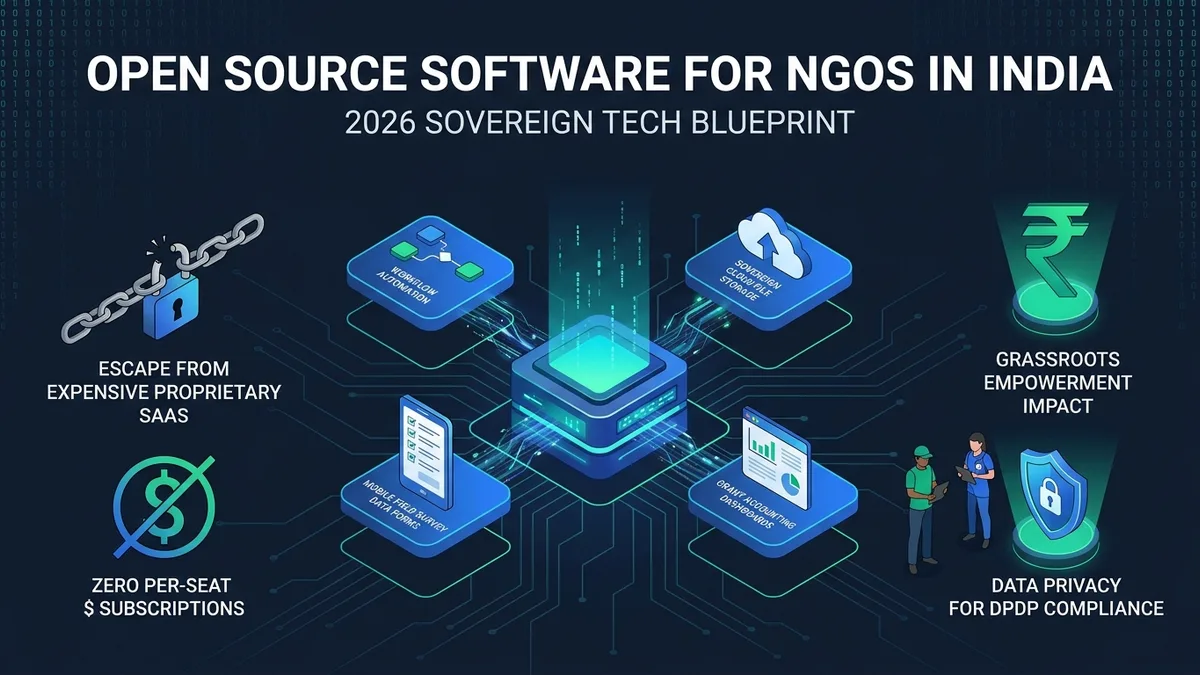
1. The Proprietary SaaS Trap: Why Indian NGOs Face Recurring License Debt
In recent years, enterprise software vendors have heavily marketed proprietary cloud platforms to the non-profit sector. Many Indian charities initially adopted commercial Software-as-a-Service (SaaS) products lured by introductory discounts, free trial tiers, or introductory grant credits. However, within twelve to eighteen months, these organizations confront a brutal commercial reality known as the proprietary SaaS trap.
As non-profit programs expand, add new field coordinators, and record thousands of beneficiary interactions, per-user monthly licensing fees compound exponentially. A mid-sized non-profit employing twenty staff members can easily face annual software renewal costs exceeding ₹4,00,000 to ₹8,00,000 INR for standard CRM, form builder, and automation tools. For organizations funded through competitive project grants and public donations, spending substantial programmatic capital on foreign software licenses directly reduces the resources delivered to vulnerable communities.
Even more perilous than financial drain is vendor lock-in. When donor funding fluctuates or a specific grant terminates, an organization that cannot sustain recurring subscription fees faces sudden account deactivation. Exporting complex relational histories, case notes, and financial audits from closed proprietary ecosystems is deliberately difficult, leaving charities at severe risk of losing vital institutional memory.
The Statutory Funding Constraint in India
Under Indian regulatory guidelines for Corporate Social Responsibility (CSR) and institutional funding, administrative overhead is strictly capped (frequently below 5% of total grant budgets under Section 135 rules). Inflated software subscription fees rapidly exceed permissible administrative thresholds, triggering compliance scrutiny from corporate audit committees.
2. Sovereign Technology: 100% Data Ownership & DPDP Act 2023 Compliance
The term Sovereign Technology refers to an organizational architecture where the institution maintains exclusive, unmediated ownership and control over its digital infrastructure, operational code, and database records. In the context of Indian civil society, software sovereignty is no longer merely a philosophical preference; it is a critical legal and ethical requirement.
With the passage of the Digital Personal Data Protection (DPDP) Act 2023, non-profit institutions act as legal Data Fiduciaries. Non-profits collect highly sensitive personal information, including rural health records, domestic violence casework documentation, child adoption details, and donor Permanent Account Numbers (PANs). Storing this confidential data on overseas multi-tenant proprietary cloud servers introduces substantial compliance liabilities:
- Data Residency & Jurisdiction: The DPDP Act empowers regulatory bodies to restrict cross-border transfers of personal data to foreign jurisdictions. Self-hosting your tools on sovereign cloud servers located in Mumbai, Pune, or Bangalore guarantees full local data residency.
- Granular Role-Based Access: Proprietary tools often restrict fine-grained user permissions to expensive enterprise tiers. Open-source platforms enable unlimited role configurations, ensuring field volunteers only access the specific information required for their fieldwork.
- Audit Readiness for FCRA & Income Tax: Under Section 80G, 12A, and Foreign Contribution Regulation Act (FCRA) rules, authorities can demand unredacted server logs and historical ledgers. Complete database ownership allows instant generation of cryptographic database dumps without vendor intervention.
3. Web & Publishing Layer: WordPress Core & Custom Architecture
The foundation of any non-profit digital ecosystem is its public-facing web platform. Proprietary site builders (such as Wix, Squarespace, or proprietary agency CMS platforms) charge ongoing monthly fees and severely restrict programmatic API access.
WordPress remains the global champion of open-source publishing, powering over 43% of the world wide web. When engineered cleanly without bloated multi-purpose themes, WordPress serves as an enterprise-grade web engine for non-profits:
- Full REST API Capability: Native endpoints allow seamless two-way data synchronization with mobile field apps, payment gateways, and external reporting dashboards. Explore our architectural blueprints in Custom NGO Website Development in India.
- Zero Licensing Fees: WordPress core is 100% free under the GNU General Public License (GPLv2), freeing your capital for community impact.
- Search Engine Dominance: Native support for structured Schema.org microdata, clean semantic HTML, and automated XML sitemaps ensures exceptional organic visibility. Read our complete guide on SEO for NGOs in India.
4. Workflow Automation: Self-Hosted n8n Webhook Pipelines
Commercial integration services like Zapier or Make charge steep tiered pricing based on monthly task executions. A non-profit processing high-volume UPI donations, sending instant WhatsApp updates, and logging field registrations can easily consume tens of thousands of tasks per month, resulting in exorbitant monthly software invoices.
The open-source alternative is n8n (nodal workflow automation). By self-hosting n8n in a lightweight Docker container, an organization unlocks unlimited automated workflows and zero per-execution charges:
High-Impact Non-Profit Workflows Built on n8n
- Instant 80G Receipt Dispatch: Listens for incoming payment webhooks from Razorpay or Cashfree, compiles donor PAN and transaction metadata, generates a branded PDF receipt, and transmits it via WhatsApp and email in under fifteen seconds. See our deep dive in n8n Workflow Automation for NGOs.
- Form 10BD Pre-Filing Ledger: Automatically validates PAN formats using regex and writes every confirmed donation into an annual CBDT-compliant CSV audit table.
- Automated Volunteer Onboarding: Ingests new volunteer applications from your website, creates user records in your database, and sends personalized WhatsApp induction packs. Learn more in Volunteer Management Systems for Indian NGOs.
5. Offline-First Field Data: KoboToolbox & Open Data Kit (ODK)
Field social workers in India regularly operate in tribal belts, agricultural districts, and remote settlements where cellular signals are weak or non-existent. Traditional cloud forms (such as Google Forms or SurveyMonkey) fail immediately in these conditions because they require continuous active internet connections.
The global benchmark for humanitarian and social work field data collection is KoboToolbox and Open Data Kit (ODK):
- 100% Offline Capability: Field caseworkers download forms once to the KoboCollect Android app. They can conduct hundreds of household interviews, capture GPS coordinates, record signatures, and snap verification photos entirely without mobile data.
- Automatic Background Synchronization: As soon as the field worker returns to a local office with Wi-Fi or enters a cellular network area, all completed interviews synchronize safely to your self-hosted server.
- Data Integrity & Validation: Built-in skip logic, mandatory field constraints, and range checks prevent data entry mistakes at the point of collection, eliminating weeks of manual clean-up.
6. Relational Databases & Donor CRM: Baserow & CiviCRM
Most grassroots non-profits rely on fragmented spreadsheets that quickly become corrupted by duplicate records, overwritten formulas, and zero audit trails. While commercial CRMs like Salesforce charge thousands of dollars annually for non-profit add-ons, the open-source ecosystem provides powerful, accessible alternatives:
Baserow: Modern No-Code Database
An open-source alternative to Airtable. Baserow provides an intuitive spreadsheet interface backed by a high-performance PostgreSQL database. Non-profit coordinators can link donor profiles, grant tranches, and volunteer rosters with zero technical coding experience.
CiviCRM: Non-Profit Enterprise Engine
A battle-tested open-source CRM built specifically for civil society institutions. CiviCRM manages complex donor hierarchies, multi-tier recurring contributions, event ticketing, and case management directly integrated into your WordPress installation.
Read our comprehensive comparison of database architectures in Open Source NGO CRM in India.
7. Non-Profit Accounting & Grant Tracking: ERPNext Non-Profit
Traditional single-user desktop accounting packages (like offline Tally) create information bottlenecks. When financial ledgers reside on a single office desktop computer, program coordinators cannot review remaining budget balances, causing accidental over-expenditures and delayed grant utilization certificates.
ERPNext, developed originally in India and backed by a global open-source community, includes a dedicated Non-Profit Domain Module that connects program delivery directly with statutory accounting:
- Grant & Project Cost Centers: Tag every expense voucher and vendor payment to specific institutional grants or CSR project agreements. Program managers can track real-time fund burn rates in real time.
- Audited Donor Ledgers: Generate detailed statement of accounts for individual philanthropists and institutional funding agencies with automated currency conversion for FCRA reporting.
- Statutory Tax Preparedness: Maintain full compliance with Indian Goods and Services Tax (GST), Tax Deducted at Source (TDS), and annual Income Tax return schedules. Learn more in our guide on CSR Funding for NGOs in India.
8. Cloud Hosting Economics: Running Your NGO on a ₹2,500/Month VPS
The greatest misconception surrounding self-hosted open-source software is the assumption that it requires expensive enterprise server infrastructure. In reality, modern containerization tools (such as Docker and Docker Compose) allow a non-profit to run its entire software stack on a single Virtual Private Server (VPS).
By selecting reputable cloud infrastructure providers with physical data centers in India (such as Hetzner, DigitalOcean Bangalore, Linode Mumbai, or Indian cloud hosting providers), non-profits achieve optimal latency and full data sovereignty:
Recommended Hardware Specifications for a Small to Mid-Sized NGO
- Compute Resources: 4 vCPU cores, 8 GB RAM, and 160 GB NVMe SSD storage.
- Estimated Hosting Cost: Approximately ₹2,200 to ₹3,500 INR per month (inclusive of automated daily snapshot backups).
- Workloads Hosted Concurrently: WordPress CMS with LiteSpeed caching, n8n workflow automation engine, Baserow relational database, and KoboToolbox survey backend.
9. Proprietary Commercial SaaS vs. Sovereign Open-Source Stack
Analyze the strategic and operational divergence between commercial proprietary software and a sovereign open-source non-profit architecture:
10. Security Hardening, Automated Backups & Disaster Recovery
Managing self-hosted infrastructure requires disciplined security hygiene. Non-profits handling public donations and vulnerable beneficiary records must implement robust cybersecurity safeguards:
- Automated 3-2-1 Backup Rule: Maintain three copies of all databases, on two distinct media types, with at least one offsite immutable backup stored in an encrypted S3-compatible cloud bucket.
- SSL/TLS Encryption & Reverse Proxies: Enforce HTTPS connections with automated Let’s Encrypt certificates routed through hardened reverse proxies (such as Nginx or Caddy) to mitigate DDoS attacks.
- SSH Key Authentication & Firewall Lockdown: Disable root password logins, enforce cryptographic SSH keys, and configure strict UFW firewalls to block unauthorized server ports.
- Two-Factor Authentication (2FA): Require mandatory time-based one-time password (TOTP) verification for all administrative accounts across WordPress, n8n, and database dashboards.
11. Frequently Asked Questions (FAQs)
Q1: Does open-source software mean our NGO’s data is publicly visible to everyone?
No, absolutely not. Open source means the underlying software code is open for review and modification, which ensures security and eliminates licensing costs. Your organization’s private databases, donor records, beneficiary case histories, and financial ledgers reside exclusively on your secured, encrypted private cloud server and are accessible only by your authorized team members.
Q2: What technical skills are required to maintain a self-hosted open-source stack?
While initial deployment requires professional engineering expertise to configure Linux VPS servers, Docker containers, and automated backup scripts, daily operational management is completely code-free. Tools like WordPress, Baserow, and KoboToolbox feature intuitive graphic interfaces that program managers and social workers can operate comfortably without technical programming skills.
Q3: How does self-hosting help an NGO comply with the DPDP Act 2023?
India’s Digital Personal Data Protection Act requires organizations to maintain strict data minimization, protect personal records from unauthorized access, and ensure local data residency. By self-hosting on Indian cloud infrastructure, non-profits retain complete physical control over sensitive records, enforce role-based access permissions, and avoid unauthorized data sharing by third-party commercial platforms.
Q4: Can we migrate our existing donor data from Excel or commercial CRMs to open-source tools?
Yes. Most commercial platforms and desktop spreadsheets allow standard CSV or JSON exports. Through automated data mapping scripts, historical donor records, past contribution amounts, PAN details, and case histories can be cleaned, deduplicated, and imported into modern open-source databases (like Baserow or CiviCRM) within a few hours.
Q5: How does self-hosted n8n compare to Zapier for non-profit fundraising automation?
Zapier charges substantial monthly fees as your task volume grows, which quickly becomes unaffordable during high-volume donation campaigns. Self-hosted n8n provides an identical visual drag-and-drop workflow builder with zero execution limits, allowing you to run hundreds of thousands of automated webhook tasks (such as instant 80G receipt generation and WhatsApp notifications) without paying a single extra rupee.