
NGO Website Redesign in India: 2026 Strategy Guide
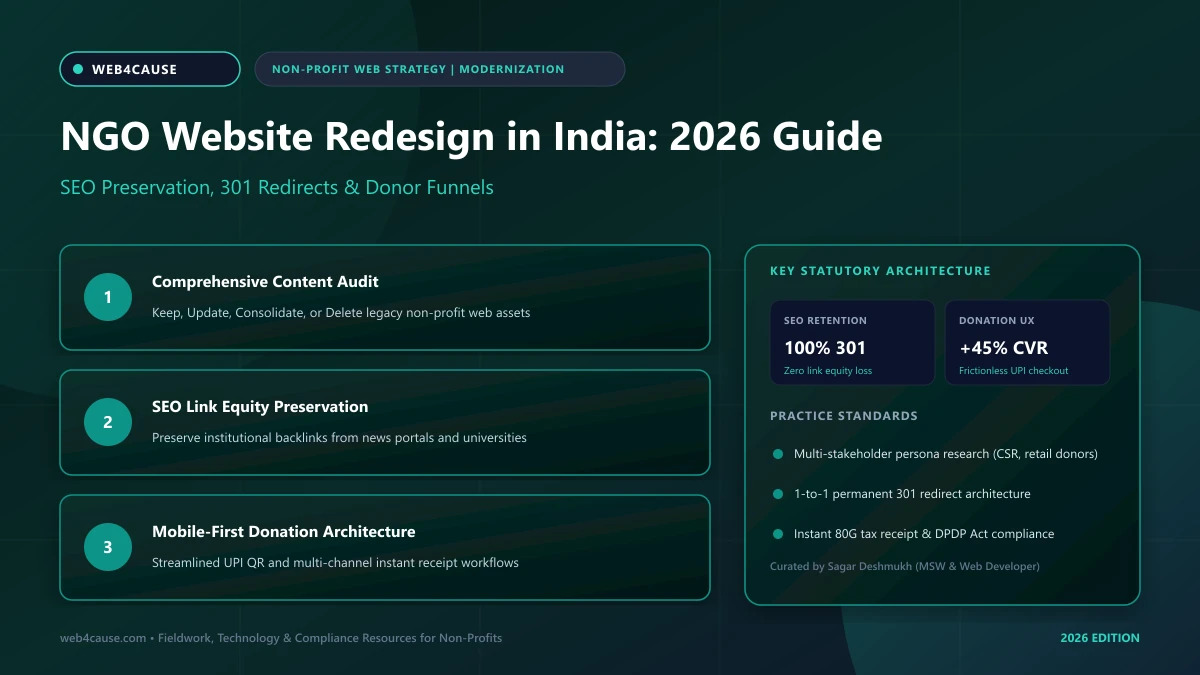
Comprehensive 2026 architectural roadmap for redesigning an Indian NGO website. Discover how charitable trusts, registered societies, and Section 8 non-profits modernize legacy web portals, safeguard organic search rankings through 1-to-1 permanent 301 redirects, satisfy multi-stakeholder expectations from corporate CSR committees to rural beneficiaries, and engineer high-conversion UPI donation checkout funnels with automated 80G tax receipt pipelines.
1. Obsolete NGO Portals: 4 Warning Signs Demanding Immediate Redesign
Across India, thousands of charitable trusts, registered societies, and Section 8 non-profit organizations operate web platforms designed between 2012 and 2018. These legacy portals were engineered for a bygone digital era: large desktop computer screens, mouse pointer navigation, slow landline broadband connections, and physical paper-based administrative documentation. In 2026, relying on these outdated web foundations actively compromises organizational credibility, restricts retail fundraising reach, and creates critical statutory compliance vulnerabilities.
Non-profit executive committees and boards of trustees frequently hesitate to initiate a comprehensive website redesign due to concerns over development expenses, technical complexity, or potential disruptions to ongoing social work programs. However, maintaining an obsolete web portal imposes a continuous, invisible penalty. Organizations suffer from abandoned retail donations, disqualification during corporate CSR due diligence appraisals, and severe frustration among community members attempting to access grassroots services. Recognizing the following four critical warning signs clarifies exactly when an immediate website redesign is essential:
Warning Sign 1: Broken or Sluggish Mobile Experience on Budget Android Devices
India represents an overwhelmingly mobile-first digital ecosystem. More than 78 percent of all web traffic directed toward Indian civil society organizations originates on smartphones. Crucially, in the non-profit sector, visitors do not browse exclusively on high-end flagship devices. A large proportion of your primary audience, including grassroots social workers, student volunteers, local community partners, and regional donors, access your web portal using budget Android smartphones priced under ten thousand rupees (such as Xiaomi Redmi 9A, Realme C-series, or Samsung Galaxy M-series handsets) or JioPhone KaiOS smart feature phones operating on intermittent 4G or 3G mobile connections in Tier 2, Tier 3, and rural panchayat areas.
Legacy non-profit websites constructed with rigid pixel widths, missing viewport meta tags, uncompressed banner imagery, and obsolete render-blocking JavaScript libraries fail completely on these devices. Content renders as tiny illegible text blocks requiring tedious horizontal zooming, layout elements overlap unexpectedly, and buttons fail to register touch taps. According to modern web vitals benchmarks, if a prospective donor or institutional partner cannot read your core program mission within three seconds on a mobile connection, they leave your website permanently. Modern non-profit engineering demands lightweight, responsive layouts adhering to the standards detailed in our comprehensive guide on NGO Website Design in India.
Warning Sign 2: Broken, High-Friction, or Outdated Payment Gateways
The financial sustainability of any non-profit depends heavily on checkout convenience. Obsolete Indian NGO websites consistently suffer from severe donation bottlenecks. Many legacy platforms present nothing more than a static text block displaying the organization’s bank account number, IFSC code, and branch address, accompanied by instructions asking the donor to execute an NEFT or RTGS transfer and email a payment screenshot to an administrative Gmail address. Other legacy portals embed outdated payment gateways that force donors through multi-page forms requiring desktop netbanking passwords, credit card cardholder credentials, or delayed SMS one-time passcodes that fail before completion.
According to data published by the National Payments Corporation of India (NPCI), the Unified Payments Interface (UPI) handles billions of financial transactions every month, comprising over 85 percent of all consumer retail payments across the nation. If your non-profit website lacks native dynamic UPI QR codes and single-tap mobile intent triggers that launch installed apps like PhonePe, Google Pay, or Paytm directly, your donation checkout experiences drop-off rates exceeding 70 percent. Donors eager to support your rural livelihood or education initiatives simply abandon the transaction when confronted with outdated payment friction. Master modern checkout engineering in our technical manual on NGO Payment Gateway Integration in India.
Warning Sign 3: Complete Absence of Automated 80G Tax Receipt Pipelines
In India, individual and corporate philanthropists donate not only out of deep social compassion but also to claim statutory tax deductions under Section 80G of the Income Tax Act, 1961. On obsolete platforms, the donation experience terminates abruptly at a generic payment confirmation screen. Donors must wait days or weeks for an administrative clerk or accountant to review bank statements, verify credits, type donor details into a Microsoft Word template, export a PDF, and manually attach it to an email.
This manual approach inevitably introduces clerical typos in donor names, residential addresses, and Permanent Account Numbers (PAN). These typographical errors result in widespread rejections during the mandatory annual electronic submission of Form 10BD on the Income Tax Department Portal. When an NGO fails to report donor PANs accurately, donors are unable to download their Form 10BE tax deduction certificates, leading to angry complaints, loss of donor trust, and potential regulatory scrutiny. A modern website redesign completely automates this administrative burden: capturing validated PANs at the moment of donation, instantly compiling digitally signed 80G receipts, and logging structured data ready for tax season.
Warning Sign 4: Convoluted Information Architecture and Obsolete Governance Data
Over a decade of organizational activity, legacy websites turn into disorganized digital repositories. Navigation menus become overloaded with deeply nested dropdown tiers that malfunction on touchscreens, dead links lead to empty server directories, and trustees who retired half a decade ago remain listed as current board members. Most critically, audited financial balance sheets, annual activity reports, and statutory governance disclosures are either completely absent or hidden inside broken PDF links.
When corporate CSR appraisal committees, institutional grant evaluators, or state government officials visit an NGO portal to verify statutory credentials, navigational opacity creates immediate suspicion. If an evaluator cannot locate your audited annual return, Section 12A registration order, or NITI Aayog Darpan identifier within two straightforward clicks, your organization gets disqualified from funding consideration.
| Architectural Dimension | Legacy Obsolete Website (2015-2018) | Modern High-Performance Redesign (2026) |
|---|---|---|
| Mobile Performance | Rigid pixel layouts, slow 8s+ load, broken on budget Androids | Fluid responsive grid, sub-1.8s load on 4G, KaiOS compatible |
| Donation Engine | Manual NEFT text or multi-step netbanking forms | Dynamic UPI QR, 1-tap mobile intent (GPay/PhonePe/Paytm) |
| Tax Compliance | Manual receipt typing, unverified PAN, Form 10BD mismatch | Instant regex PAN validation, automated 80G PDF generation |
| Statutory Transparency | Missing CSR-1, outdated balance sheets, hidden FCRA returns | Dedicated statutory hub: 12A, 80G, CSR-1, Darpan, FCRA SBI NDMB |
| Accessibility & Security | No WCAG standards, unencrypted HTTP or weak TLS, vulnerable plugins | WCAG 2.2 AA compliant, DPDP Act notices, automated off-site backups |
2. Multi-Stakeholder Persona Discovery: Designing for Retail Donors, CSR Committees, and Beneficiaries
An Indian non-profit web platform serves a fundamentally different purpose than a standard commercial software portal or direct-to-consumer e-commerce storefront. A commercial site typically targets a single demographic with a uniform sales funnel. In contrast, an Indian non-profit digital ecosystem must simultaneously satisfy four radically different stakeholder groups, each arriving with unique technical constraints, distinct psychological motivations, and diverse informational requirements. A successful redesign balances these four personas harmoniously without cluttering the primary user experience.
Individual Retail Donors
Demographic Profile: Salaried young professionals, tech workers, civic activists, and alumni aged 22 to 50 browsing on mobile devices.
Core Needs: High emotional empathy, transparent proof of grassroots transformation, practical micro-donation tiers (such as Rs 500, Rs 1,200, or Rs 3,000), single-click UPI checkout, and instant automated delivery of an 80G tax deduction receipt to their email and WhatsApp inbox.
Corporate CSR Committees
Demographic Profile: Corporate sustainability heads, company secretaries, and legal compliance auditors governed by Section 135 of the Companies Act, 2013.
Core Needs: Immediate verification of Ministry of Corporate Affairs Form CSR-1 registration, Schedule VII thematic alignment, audited balance sheets for the preceding 3 fiscal years, impact assessment studies, and detailed Board of Trustees profiles.
Institutional Grantmakers
Demographic Profile: International bilateral funding foundations, multilateral agencies, and domestic development banks such as NABARD.
Core Needs: Active Foreign Contribution Regulation Act (FCRA) registration status, proof of designated State Bank of India New Delhi Main Branch account at Sansad Marg, NITI Aayog NGO Darpan Unique ID, and structured Theory of Change documentation with verifiable logframes.
Grassroots Beneficiaries & Field Teams
Demographic Profile: Rural community members, self-help group federations, youth trainees, village health workers, and field mobilizers.
Core Needs: Regional vernacular language support (Hindi, Marathi, Bengali, Tamil, etc.), fast page rendering on low-bandwidth networks, phone contacts, grievance redressal forms, and vocational application details.
The Multi-Audience Navigation Solution: To prevent visual clutter, design your header navigation with primary user pathways: “Our Programs”, “Impact & Stories”, and “Donate” for retail donors, paired with dedicated institutional utility tabs: “CSR Partnerships” and “Governance & Statutory Compliance” in the upper utility bar and footer. Review our blueprint for Donor Retention Strategies for Indian NGOs.
3. Content and Information Architecture Audit: The KUCD Framework for Legacy Assets
A frequent mistake committed by non-profits during a redesign is copying the entire legacy database directly into the new platform. Migrating outdated, redundant, or low-quality content bloats the new system, confuses search engine crawlers, and degrades user experience. Before touching visual design software or code, execute a disciplined content audit using the KUCD Framework: Keep, Update, Consolidate, and Delete.
1. Keep (Evergreen Impact Content)
Preserve core historical pillars: your founding charter, constitutional vision, timeless founder statements, and high-impact beneficiary case studies that demonstrate generational transformation. These assets establish organizational lineage and emotional credibility.
2. Update (Living Program & Governance Data)
Refresh all ongoing developmental initiative pages with updated beneficiary statistics, recent fieldwork photography, and verified milestones. Update governance pages with current Board of Trustees rosters, valid 80G and 12A registration details under Section 12AB of the Income Tax Act, and audited balance sheets for the most recent fiscal years. Review our masterclass on 80G and 12A Registration for NGOs in India.
3. Consolidate (Merge Thin Pages into Authority Pillars)
Legacy websites frequently contain dozens of disconnected short posts: an announcement for a 2017 medical camp, a photo gallery from a 2019 eye clinic, and a short summary of a 2021 vaccination drive. Consolidate these fragmented, thin pages into a single authoritative pillar page: “Comprehensive Rural Community Healthcare Initiatives”. Merging thin content into comprehensive hubs concentrates keyword signals and drastically improves search engine authority.
4. Delete (Prune Outdated and Low-Quality Assets)
Systematically prune dead weight: expired job vacancies from four years ago, obsolete tender notices, duplicate uncaptioned photo albums, and discontinued event sign-up forms. Pruning unvisited pages eliminates crawl waste, allowing Googlebot to focus crawling resources on your primary program and donation pages.
| Legacy Content URL | Original Format | KUCD Decision | Strategic Remediation Action |
|---|---|---|---|
| /about/our-story.html | Static Page | Keep | Retain founding history; polish narrative and add modern typography |
| /tax-exemption-details/ | Blog Post | Update | Update to permanent URL: /compliance/80g-12a/ with Form 10AC/10AD details |
| /camp-2018/, /camp-2019/ | Short Posts | Consolidate | Merge into /programs/health-initiatives/ and 301 redirect old URLs |
| /careers/field-officer-2017/ | Job Posting | Delete | Remove completely; return HTTP 410 Gone or 301 redirect to /careers/ |
4. Preserving Search Engine Rankings (SEO Equity) and 1-to-1 Permanent 301 Redirects
The single most catastrophic failure in non-profit website redesigns is organic search traffic collapse. Non-profit trustees routinely report cases where an organization hired a design agency that produced a visually appealing website, only to witness their organic traffic drop by 80 percent within four weeks of launch. This collapse occurs because the developers modified URL structures without mapping server-level permanent redirects.
Over a decade of operations, your non-profit earns valuable external backlinks: articles in national newspapers like The Hindu, Times of India, or The Indian Express, citations in academic social work research papers, and listings on official state government portals (.gov.in) and apex bodies like NABARD. If your redesign changes /our-projects/rural-health-2019.html to /programs/healthcare/ without a server-level 301 redirect, search engine bots encounter a 404 Not Found error. Consequently, all accumulated backlink authority and search ranking equity vanish.
The 1-to-1 Redirect Rule: Avoid the Lazy Homepage Redirect Trap
A reckless shortcut taken by inexperienced web developers is redirecting all legacy URLs to the homepage using a blanket rule. Never allow this practice. The official Google Search documentation explicitly states that redirecting disparate internal topic pages to the homepage is treated as a “Soft 404”. Search algorithms recognize that a user seeking a specific child nutrition report does not find it on your generic homepage, stripping the destination page of all historical ranking credit.
Every legacy URL with indexed search traffic or external backlinks must map 1-to-1 to its most relevant counterpart on the new website. If a page has been deleted without a direct replacement, map it to its closest parent thematic category. Explore comprehensive optimization strategies in our guide to SEO for NGOs in India.
Production Server Configuration Snippets
Implement 1-to-1 redirects at the web server layer (Apache .htaccess or Nginx configuration block) to execute instantaneous status code 301 responses before application code loads:
RewriteEngine On

# 1-to-1 Direct Page Redirects
Redirect 301 /projects/rural-health-2018.html https://web4cause.com/programs/community-healthcare/
Redirect 301 /donate-now.php https://web4cause.com/donate/
Redirect 301 /tax-exemption-details.html https://web4cause.com/compliance/80g-12a/
Redirect 301 /about-us/board-members.php https://web4cause.com/governance/trustees/
Redirect 301 /news/press-release-2020.html https://web4cause.com/news/

# Ensure HTTPS and Canonical Host Header
RewriteCond %{HTTPS} off
RewriteRule ^(.*)$ https://%{HTTP_HOST}%{REQUEST_URI} [L,R=301]server {
listen 443 ssl http2;
server_name web4cause.com;
# 1-to-1 Permanent Redirect Directives
location = /projects/rural-health-2018.html {
return 301 /programs/community-healthcare/;
}
location = /donate-now.php {
return 301 /donate/;
}
location = /tax-exemption-details.html {
return 301 /compliance/80g-12a/;
}
location = /about-us/board-members.php {
return 301 /governance/trustees/;
}
}5. Modern Tech Stack Evaluation: WordPress vs Custom HTML5/PHP vs Jamstack
Selecting the technical architecture for your redesign requires balancing staff technical capacity, long-term maintenance costs, cybersecurity, and page speed. Indian non-profits rarely possess in-house software engineering departments; updates are typically managed by social workers, program coordinators, or administrative staff. Evaluating the three leading approaches establishes the optimal foundation:
1. Clean Lightweight WordPress (Gutenberg Block Editor)
WordPress powers over 40 percent of the web, making it the most familiar platform for non-profit administrators. In 2026, the modern WordPress approach rejects bloated, multi-layered visual drag-and-drop builders like outdated Elementor bundles or WPBakery. Instead, it relies on a lean custom child theme leveraging the native WordPress Block Editor (Gutenberg), modern PHP 8.3+, and server-level Redis object caching.
Pros: Effortless publishing for non-technical team members, rich multilingual support, and native integrations with Indian payment plugins. Cons: Requires disciplined monthly maintenance, security monitoring, and plugin restraint to avoid database sluggishness.
2. Custom Handcrafted HTML5 and Modular PHP Architecture
For charitable foundations with stable, rarely modified program descriptions and annual reports, custom HTML5 templates with modular server-side PHP includes represent an exceptional, bulletproof option.
Pros: Blisteringly fast page loads under 400 milliseconds, zero WordPress plugin vulnerabilities, virtually impervious to automated CMS bot attacks, and runs reliably on low-cost Linux web hosting. Cons: Updating text or posting field stories requires developer intervention or basic HTML editing skills.
3. Modern Jamstack (Astro, Next.js, or 11ty with Headless CMS)
Jamstack architecture completely decouples the front-end presentation layer from the back-end database. Content is authored via a headless content management system (such as Decap CMS, Strapi, or Sanity), pre-compiled into static HTML, and served directly across global Content Delivery Networks like Cloudflare Pages or Netlify.
Pros: Perfect 100/100 Google Core Web Vitals, zero database to hack, and hosting costs can remain zero rupees on generous CDN free tiers. Cons: Higher upfront engineering costs, complex build pipelines, and publishing workflows that demand training for non-technical social workers.
| Evaluation Factor | Lightweight Block WordPress | Custom HTML5 / PHP Build | Jamstack (Astro / Next.js) |
|---|---|---|---|
| Editorial Ease for Staff | High (Visual Gutenberg) | Low (Developer required) | Moderate (Headless UI) |
| Core Web Vitals Speed | 90+ with Redis caching | 98-100 (Native) | 98-100 (Edge CDN) |
| Security Vulnerability | Moderate (Needs patching) | Very Low (No database) | Zero attack surface |
| Ongoing Maintenance | Monthly core/plugin updates | Near-zero upkeep | Low (Git dependency updates) |
6. Frictionless Fundraising Redesign: Dynamic UPI QR, Instant 80G Receipts, and Form 10BD PAN Capture
The donation checkout flow is the functional engine of your non-profit website. A redesign that merely beautifies banners while leaving the checkout journey cumbersome will fail to increase donations. In 2026, an effective donation funnel integrates three vital technical requirements: instant mobile UPI payment triggers, mandatory real-time PAN validation for Form 10BD reporting, and automated instant 80G tax receipt PDF delivery.
Dynamic UPI QR Codes and Mobile Intent Triggers
Rather than displaying a static, unclickable bank account number, modern checkout components generate dynamic UPI links complying with the NPCI Specification. When a supporter taps a preset donation amount (such as Rs 1,000) on their smartphone, clicking “Donate via UPI” triggers a native URI handler (upi://pay?pa=trustname@bank&pn=Trust%20Name&am=1000&cu=INR) that launches their preferred UPI app directly with the pre-filled amount and trust reference code. On desktop browsers, an interactive QR code renders dynamically for instant camera scanning.
Statutory Form 10BD PAN Validation
Under Section 80G(5)(viii) and Rule 18AB of the Income Tax Rules, every Indian charitable organization must report all donor contributions on Form 10BD by May 31 for the preceding financial year. Crucially, the donor must supply a valid PAN to claim tax benefits. If a donor submits an invalid PAN, the electronic filing fails, and the donor cannot download their certificate of donation (Form 10BE) from their personal tax portal.
Incorporate real-time client-side regex validation for Indian Permanent Account Numbers:
The fourth character in the PAN string represents the entity status: ‘P’ indicates an Individual citizen, ‘C’ a Company, ‘T’ a Trust, ‘F’ a Partnership Firm, ‘H’ a Hindu Undivided Family, and ‘A’ an Association of Persons. Validating this regex dynamically before form submission prevents invalid entries. Learn more in our compliance breakdown on Form 10BD Filing for NGOs in India.
Interactive Donation Checkout Component (HTML5 & JavaScript)
<form id="ngo-donation-checkout" class="w4c-donate-form" style="max-width: 480px; background: #FFFFFF; padding: 24px; border-radius: 12px; border: 1px solid #E2E8F0;">
  <h3 style="margin-top: 0; color: #0F172A; font-size: 20px;">Support Our Rural Education Drive</h3>

  <div style="margin-bottom: 16px;">
    <label style="display: block; font-weight: 600; color: #334155; margin-bottom: 6px;">Select Donation Amount</label>
    <div style="display: flex; gap: 8px;">
      <button type="button" class="amt-btn" data-amt="500" style="flex: 1; padding: 10px; border: 1px solid #CBD5E1; border-radius: 6px; background: #F8FAFC; cursor: pointer;">₹500</button>
      <button type="button" class="amt-btn active" data-amt="1200" style="flex: 1; padding: 10px; border: 1px solid #2563EB; border-radius: 6px; background: #EFF6FF; color: #2563EB; font-weight: 700; cursor: pointer;">₹1,200</button>
      <button type="button" class="amt-btn" data-amt="3000" style="flex: 1; padding: 10px; border: 1px solid #CBD5E1; border-radius: 6px; background: #F8FAFC; cursor: pointer;">₹3,000</button>
    </div>
  </div>

  <div style="margin-bottom: 14px;">
    <label for="donor_pan" style="display: block; font-weight: 600; color: #334155; margin-bottom: 4px;">Permanent Account Number (PAN for 80G)</label>
    <input type="text" id="donor_pan" name="pan" maxlength="10" placeholder="ABCDE1234F" style="width: 100%; padding: 10px; border: 1px solid #CBD5E1; border-radius: 6px; text-transform: uppercase;" required>
    <span id="pan_feedback" style="font-size: 12px; display: block; margin-top: 4px;"></span>
  </div>

  <button type="submit" id="donate_btn" style="width: 100%; padding: 12px; background: #2563EB; color: #FFFFFF; font-weight: 700; border: none; border-radius: 6px; cursor: pointer; font-size: 16px;">Proceed to UPI Payment</button>
</form>

<script>
document.getElementById('donor_pan').addEventListener('input', function(e) {
  var pan = e.target.value.toUpperCase();
  e.target.value = pan;
  var regex = /^[A-Z]{5}[0-9]{4}[A-Z]{1}$/;
  var feedback = document.getElementById('pan_feedback');
  if (pan.length === 10) {
    if (regex.test(pan)) {
      feedback.textContent = 'Valid PAN Format (Form 10BD Eligible)';
      feedback.style.color = '#16A34A';
    } else {
      feedback.textContent = 'Invalid PAN format. Please check characters.';
      feedback.style.color = '#DC2626';
    }
  } else {
    feedback.textContent = 'Enter 10 character alphanumeric PAN';
    feedback.style.color = '#64748B';
  }
});
</script>
When combined with webhook pipelines built using n8n Workflow Automation for NGOs, successful transactions automatically trigger receipt generation, delivering a branded, digitally signed PDF receipt straight to the donor within fifteen seconds. For automated monthly commitments, consider implementing recurring models outlined in our guide on UPI AutoPay for NGO Recurring Donations in India.
7. Statutory Legal Compliance and Security Standards: DPDP Act 2023, FCRA Disclosures, and Trust Seals
An Indian non-profit website redesign is not merely an aesthetic refresh; it is an essential statutory compliance milestone. Civil society organizations operate under intense regulatory scrutiny from the Ministry of Home Affairs, the Ministry of Corporate Affairs, and the Income Tax Department. Overlooking statutory disclosure requirements during your website redesign exposes the Board of Trustees to legal liability and financial penalties.
Digital Personal Data Protection Act, 2023 (DPDP Act)
Enacted by the Parliament of India, the DPDP Act 2023 governs how non-profit organizations collect, process, and store personal digital data. Non-profits collect sensitive donor information: full legal names, PAN cards, phone numbers, personal email addresses, and residential addresses. To comply with DPDP Act mandates, your redesigned website must include:
- Explicit Consent Notice: Unambiguous, unticked consent checkboxes on all donation, contact, and volunteer forms stating the specific purpose of data collection.
- Purpose Limitation: Clear legal guarantees that donor information is utilized strictly for statutory 80G tax receipt issuance, Form 10BD reporting, and institutional updates, and will never be monetized, shared, or transferred to third-party commercial brokers.
- Data Principal Rights & Grievance Officer: A published Privacy Policy identifying the organization’s designated Data Protection Grievance Officer with an official email address and postal address for data deletion or correction requests.
- Vernacular Translation: Providing privacy summaries in regional languages ensuring rural beneficiaries and community mobilizers understand their digital rights under rules guided by the Ministry of Electronics and Information Technology (MeitY).
Mandatory FCRA Website Disclosures
Under the Foreign Contribution Regulation Act (FCRA), 2010, organizations authorized to receive foreign contributions must comply with strict online reporting requirements. The law stipulates that every non-profit receiving foreign funds must publish its quarterly foreign contribution receipts on its official website within 15 days following the conclusion of each financial quarter.
The redesign must feature a dedicated statutory disclosure table displaying donor names, dates, amounts, and specific programmatic purposes. Furthermore, the website must explicitly state that foreign contributions are received exclusively into the designated State Bank of India (SBI) New Delhi Main Branch (NDMB) account at 11 Sansad Marg, New Delhi 110001, safeguarding the organization against regulatory non-compliance.
The Universal Statutory Trust Bar
Establish institutional credibility by integrating a standardized Statutory Trust Bar into your footer and dedicated compliance page, listing verified registration credentials:
Integrate your registration credentials following our guide on NITI Aayog NGO Darpan Registration in India. Ensure accessible interfaces adhere to our manual on Accessible NGO Website Design in India. For detailed institutional governance guidance, consult our deep-dive analysis on NGO Website Security and DPDP Compliance in India.
8. Cross-Device QA, Staging Lockdown, and Safe Launch Checklist
Deploying a redesigned non-profit website without disciplined quality assurance (QA) risks unexpected downtime, payment webhook failures, and broken search engine indices. A structured pre-launch and launch checklist guarantees an uninterrupted transition.
Step 1: Staging Environment Lockdown
During development and content migration, keep your staging subdomain (e.g. staging.yourngo.org) protected from public discovery. Send the HTTP header X-Robots-Tag: noindex, nofollow and configure HTTP Basic Authentication on the web server. This prevents search engines from indexing pre-launch staging content, avoiding duplicate content penalties.
Step 2: Automated 301 Redirect Validation
Before initiating DNS cutover, execute an automated crawl across your legacy URL mapping sheet. Confirm that every legacy URL returns an HTTP 301 status pointing directly to its intended destination, with zero intermediate redirect hops, zero circular loops, and zero unresolved 404 errors.
Step 3: Network Throttling and Real-Device Mobile Auditing
Perform user acceptance testing on actual physical devices: popular Android smartphones running Chrome, Apple devices running Safari, and entry-level feature phones. In browser developer tools, enable the “Slow 3G” network throttling profile to verify that your donation checkout and primary program pages remain readable and interactive within 3 seconds under constrained rural connectivity. Verify compliance with global accessibility criteria codified by the World Wide Web Consortium (W3C).
Step 4: DNS Cutover and Google Search Console Submission
Forty-eight hours prior to launch, reduce your domain DNS Time-To-Live (TTL) to 300 seconds (5 minutes). This ensures global DNS propagation occurs within minutes during cutover rather than taking up to 48 hours. After switching the IP address to the new server, immediately submit your updated XML sitemap to Google Search Console, monitor the Live Coverage dashboard for unexpected 404 errors, and test live end-to-end UPI transactions.
| QA Stage | Audit Checkpoint | Verification Method | Target Benchmark |
|---|---|---|---|
| Pre-Launch | 1-to-1 301 Redirect Mapping | Automated crawler script | 100% legacy URLs mapped, 0 redirect chains |
| Pre-Launch | Payment Gateway Webhook | Live test transaction of ₹10 | Webhook 200 OK, 80G receipt PDF generated |
| Cutover | SSL Certificate & TLS 1.3 | SSL Labs security test | Grade A+ with HSTS enabled |
| Post-Launch | Google Search Console | Submit XML sitemap & check 404s | 0 crawl anomalies, all priority pages indexed |
9. Frequently Asked Questions (FAQs)
1. How often should an Indian non-profit redesign its official website?
Most Indian non-profits should conduct a comprehensive website redesign every three to four years. However, rapid changes in Indian statutory compliance (such as the Digital Personal Data Protection Act 2023, annual Form 10BD income tax filing, and revised FCRA banking rules) and payment technologies (UPI AutoPay and recurring mandates) necessitate ongoing modular upgrades every six to twelve months.
2. How can our NGO redesign its website without losing Google search rankings and organic backlinks?
Preserving search engine rankings requires a complete URL inventory audit and strict 1-to-1 permanent 301 server redirects mapping every legacy URL to its modern equivalent. Never redirect all legacy URLs to the homepage, which Google penalizes as soft 404 errors. Maintain consistent page titles, keep top-performing content, update internal links, and submit your updated XML sitemap directly to Google Search Console immediately following launch.
3. What statutory legal details must be displayed on an Indian NGO website in 2026?
An Indian NGO website must prominently display its Trust or Society Registration Number or Section 8 CIN, Income Tax Section 12A registration under Section 12AB, Section 80G approval number and validity under Section 80G(5), Ministry of Corporate Affairs Form CSR-1 registration number, NITI Aayog NGO Darpan Unique ID, a DPDP Act 2023 compliant privacy policy with a designated Data Grievance Officer, and, if FCRA registered, quarterly foreign contribution receipts alongside designated SBI Sansad Marg branch details.
4. How does an automated donation checkout improve retail fundraising conversion rates?
Automated checkouts replace cumbersome manual NEFT bank transfers with dynamic UPI QR codes and single-tap mobile intent triggers launching Google Pay, PhonePe, or Paytm directly. By validating donor PANs in real time with regex rules and instantly dispatching digitally signed 80G PDF receipts via email and WhatsApp, organizations remove checkout friction and routinely increase retail donation completions by 35 to 60 percent.
5. Which content management platform is best for small to mid-sized Indian NGOs?
For most Indian non-profits, a clean, lightweight WordPress installation utilizing the native Gutenberg Block Editor, a bespoke child theme, and server-level object caching provides the best balance of editorial ease and speed. It allows non-technical social workers and accountants to publish updates without coding. For foundations with static requirements and zero in-house staff, handcrafted HTML5/PHP or Jamstack architectures offer superior security with near-zero ongoing maintenance.
6. What is the typical timeframe and budget for a comprehensive non-profit website redesign in India?
A professional, compliance-ready website redesign typically takes between four and eight weeks. This encompasses content auditing, multi-stakeholder persona mapping, responsive mobile design, UPI payment integration, automated 80G receipt configuration, DPDP compliance review, and 301 redirect validation. Budget requirements vary based on custom development depth, ranging from affordable open-source configurations to enterprise multi-program portals.