
Open Source NGO CRM in India: Complete 2026 Guide
How Indian non-profit organizations, charitable trusts, and community foundations can implement self-hosted, open-source CRM systems to unify donor records, automate instant 80G tax receipts, streamline volunteer mobilization, and comply with India’s DPDP Act 2023 without recurring US-dollar software licensing fees.
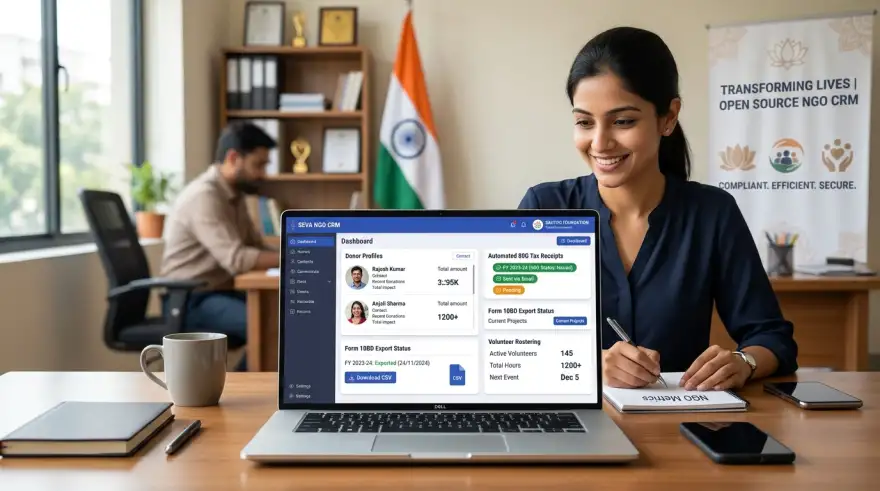
1. The Donor Data Dilemma in Indian Non-Profit Operations
Across India’s non-profit ecosystem, a critical paradox hampers organizational growth. While grassroots social workers excel at community fieldwork, education drives, and rural interventions, their operational back-offices frequently remain fractured across disparate Excel spreadsheets, handwritten registers, and fragmented WhatsApp chats.
When donor data, volunteer rosters, and grant histories are scattered across personal Google Drives and desktop folders, organizations suffer compounding operational crises:
- Donor Churn & Lack of Retention: Donors receive no proactive communication or impact updates beyond a transactional thank-you message, resulting in low repeat donation rates.
- Form 10BD Chaos at Fiscal Year-End: In May of every year, accounting teams panic trying to reconcile missing PAN numbers, unformatted pin codes, and duplicated donor names across multiple bank accounts to satisfy Central Board of Direct Taxes (CBDT) mandates.
- Institutional Knowledge Loss: When key project coordinators or fundraising staff depart the NGO, their personal relationships, volunteer contacts, and communication threads vanish with them.
Deploying a centralized Constituent Relationship Management (CRM) system solves these hurdles by turning unorganized contacts into an institutional data asset.
2. Why Open Source? Eliminating Commercial SaaS Tax on Non-Profits
Many charitable foundations mistakenly assume that the only path to enterprise CRM capabilities is purchasing proprietary SaaS subscriptions like Salesforce Non-Profit Success Pack (NPSP), HubSpot, or Blackbaud. While these platforms market discounted starter licenses, the real total cost of ownership (TCO) quickly spirals out of reach for Indian grassroot organizations:
The Hidden SaaS Trap for Indian Non-Profits:
Proprietary platforms charge in US dollars ($), subject to fluctuating foreign exchange rates and 18% GST. When an NGO scales beyond free contact thresholds, tier upgrades cost ₹50,000 to ₹3,00,000 annually. Crucially, proprietary tools do not offer native compliance with Indian tax statutes: such as instant Section 80G receipt PDF generation, Razorpay webhook listeners, and Income Tax Form 10BD CSV formatting: requiring costly third-party custom connectors.
In contrast, Open-Source Non-Profit CRMs offer compelling strategic advantages:
- Zero Per-User Licensing Fees: Onboard 5, 50, or 500 team members, field social workers, and volunteer leaders without paying additional per-seat monthly subscription penalties.
- Complete Data Sovereignty: Your donor databases, beneficiary case records, and contribution logs reside strictly on servers located within India, satisfying statutory DPDP Act data residency provisions.
- Tailored for Indian Payment Gateways: Seamlessly integrate Razorpay, Cashfree, and PayU payment webhooks via tools like open-source n8n automation for NGOs.
3. Top Open-Source NGO CRMs Compared: CiviCRM vs ERPNext vs Custom Stack
Depending on organizational scale, internal technical capability, and budget, Indian non-profits have three battle-tested open-source pathways:
| Platform | Best Suited For | Hosting Requirement | Indian Compliance Readiness | Learning Curve |
|---|---|---|---|---|
| CiviCRM | Mature non-profits with existing WordPress or Drupal CMS | Standard LAMP VPS (2GB+ RAM) | High (requires custom Indian receipt templates) | Moderate to Steep |
| ERPNext (Non-Profit Module) | Organizations needing unified accounting, grant ledger, inventory & donor CRM | Python/Frappe VPS (4GB+ RAM) | Exceptional (built in India with native GST & Indian accounting) | Moderate |
| WordPress + Custom CRM Schema | Small to medium grassroot trusts wanting simplicity and zero extra servers | Existing WordPress hosting server | 100% customizable via Web4cause micro-modules | Minimal (same interface as website) |
For non-profits seeking an all-in-one operational ecosystem with accounting, inventory, and donor management, ERPNext represents the premier Indian-engineered solution. For teams prioritizing seamless donation forms and fundraising integration on their current website, a WordPress-native CRM integration provides the highest adoption rate among non-technical field workers.
4. Engineering the Automated Section 80G Tax Receipt & Form 10BD Pipeline
A non-profit CRM in India must not function as a passive contact address book. Its primary operational duty is to automate statutory compliance pipelines and eliminate manual clerical toil.
The 4-Stage Automated Receipt Architecture:
- Webhook Ingestion: The moment a donation completes via Razorpay or Cashfree on your website (see our guide on NGO Website Design in India), the gateway dispatches an encrypted webhook payload to your CRM.
- Data Validation & Cleansing: The CRM validates the 10-character alphanumeric PAN format, verifies mandatory postal address and pin code, and checks whether the donor already exists in the master constituent directory.
- Dynamic 80G PDF Generation: The system increments the sequential tax receipt counter, merges donor credentials with trust registration numbers (12A/80G URNs and Darpan ID), stamps the digital signature, and saves the PDF into an encrypted storage bucket.
- Instant Multi-Channel Dispatch: Within 15 seconds, the donor receives the 80G tax deduction certificate via transactional email and WhatsApp Business API, while the donation record is flagged as “Form 10BD Ready”.
5. Volunteer Rostering, Field Hours Tracking & Community Mobilization
Human capital is the lifeblood of social movements. However, managing hundreds of college interns, corporate CSR volunteers, and community youth without dedicated software leads to poor engagement, missed event shifts, and volunteer attrition.
Modern open-source NGO CRMs incorporate dedicated volunteer mobilization modules:
- Skill-Based Tagging: Categorize volunteers based on competencies: such as medical skills, legal aid, social media content creation, field surveying, or regional language translation (Marathi, Hindi, Tamil, Bengali).
- Self-Service Shift Rostering: Allow volunteers to view upcoming field initiatives, disaster relief drives, or tutoring sessions on a mobile-friendly portal and reserve shifts based on their availability.
- Automated Hours Logging & Certification: Track verified field hours and automatically issue personalized, digitally verifiable volunteering certificates upon program completion. Read more on grassroots stakeholder coordination in our guide on Community Mobilization in Social Work.
6. Beneficiary Privacy & India’s DPDP Act 2023 Compliance
Non-profits handle deeply sensitive personal information: medical records of patients in charitable clinics, financial profiles of scholarship applicants, and personal details of domestic violence survivors. Under India’s Digital Personal Data Protection (DPDP) Act 2023, non-profit trusts are legally categorized as Data Fiduciaries and are subject to stringent accountability.
Mandatory DPDP Safeguards in Your CRM:
- Role-Based Access Control (RBAC): Ensure that ground-level volunteers cannot view full PAN numbers, bank details, or sensitive health case notes of beneficiaries. Restrict access strictly by staff seniority and departmental necessity.
- Field-Level Encryption at Rest: Encrypt sensitive constituent fields (Aadhaar references, PAN, banking coordinates) using AES-256 encryption.
- Consent Management Logs: Maintain immutable, timestamped records of signed or audio-recorded beneficiary consent before case study data is accessed by fundraising teams.
7. Step-by-Step Self-Hosting Deployment Blueprint (Docker & Cloud VPS)
Self-hosting an open-source CRM is straightforward and economical when configured using containerized architectures:
- Cloud VPS Selection: Provision an Ubuntu 24.04 LTS virtual private server on an Indian cloud datacenter (DigitalOcean Bangalore, Hetzner, or AWS Mumbai) with 2 vCPUs and 4GB RAM (approx. ₹600 to ₹1,200/month).
- Docker Containerization: Deploy your CRM instance alongside MariaDB/PostgreSQL and Redis caching using Docker Compose, guaranteeing reproducible environments and isolated dependencies.
- Automated SSL & Reverse Proxy: Configure Caddy or Nginx with Let’s Encrypt certificates to enforce modern TLS 1.3 encryption across all dashboard routes.
- Automated Offsite Database Backups: Schedule nightly automated SQL dumps encrypted with GPG and shipped to independent cloud object storage (AWS S3 or Cloudflare R2) with automated 30-day retention policies.
8. 10-Point Technical NGO CRM Pre-Deployment Checklist
- Form 10BD Schema Validation: Verify that export CSV formats match the Income Tax Department’s electronic filing utility specifications.
- Automated Deduplication: Configure fuzzy matching algorithms on mobile number and email to prevent duplicate donor cards.
- WhatsApp API Integration: Connect verified Meta Business API credentials for automated receipt and greeting dispatches.
- Payment Gateway Webhook Tokens: Secure all incoming transaction endpoints with secret signature verification keys.
- Two-Factor Authentication (2FA): Enforce mandatory 2FA on all staff and administrator CRM logins.
- Automated Nightly Backups: Verify that full database snapshots restore successfully in a sandbox testing environment.
- Granular User Permissions: Set strict access control separating financial donation ledgers from program field notes.
- Mobile PWA / Responsive UI: Test that field coordinators can comfortably enter beneficiary notes via 4G mobile devices.
- Privacy Policy Updates: Update organizational privacy notices detailing CRM data storage policies under DPDP Act 2023.
- Staff Onboarding & Training: Conduct interactive staff walkthroughs and document Standard Operating Procedures (SOPs).
9. Frequently Asked Questions (FAQs)
Q1: How much does it cost to run a self-hosted open-source CRM in India?
The ongoing software licensing cost is ₹0. The only infrastructure expense is cloud VPS hosting (typically ₹500 to ₹1,500 per month depending on database size) and transactional email/WhatsApp API credits (approx. ₹200 to ₹600 per month). Compared to proprietary SaaS systems charging upwards of ₹80,000 annually, open-source saves non-profits over 80% in operational technology budgets.
Q2: Can our existing Excel and Google Sheets donor data be imported cleanly?
Yes. Most modern open-source CRMs feature robust CSV import mappers. Data is cleansed to remove duplicates, standardize PAN formats, and align historical donation dates before batch importing into the centralized database.
Q3: How does the CRM assist during annual Form 10BD electronic filing?
Because every online and offline contribution captures donor PAN, address, and donation mode at the moment of giving, the CRM exports a 1-click statutory CSV that directly matches the Income Tax Department’s Form 10BD upload utility, saving chartered accountants dozens of reconciliation hours.