
Rural Financial Inclusion
2026 Manual
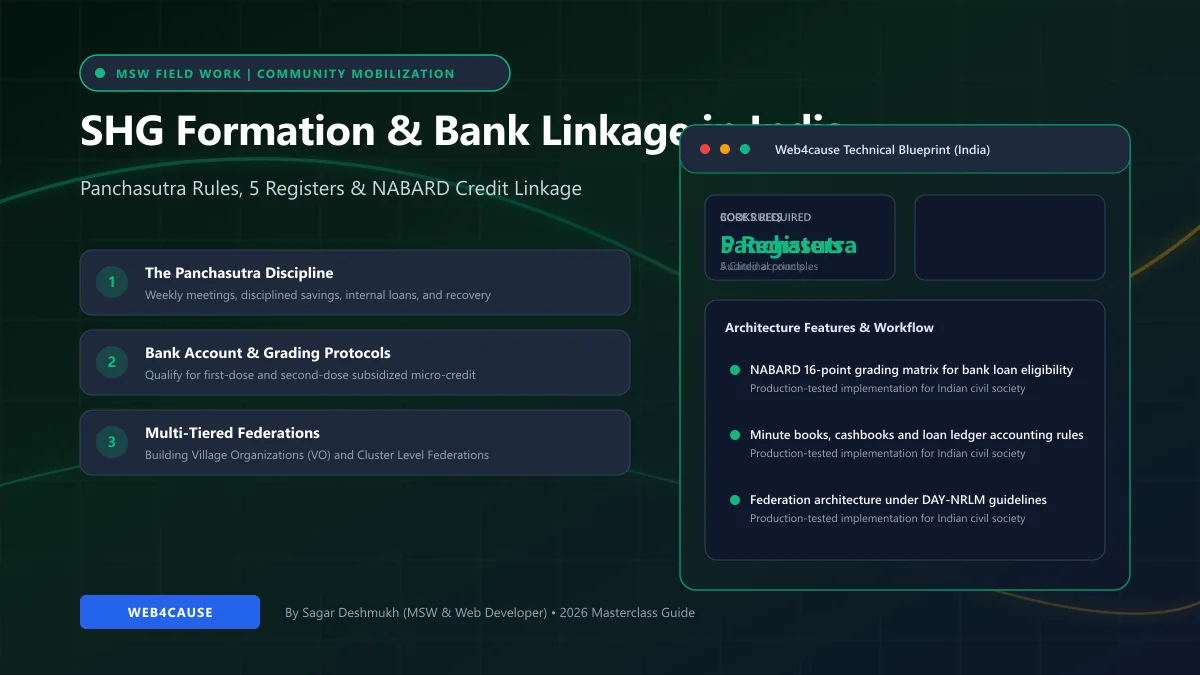
SHG Formation & Bank Linkage: 2026 NGO Guide
•
Published: August 28, 2026
•
Updated: October 31, 2026
•
19 min read
Executive Summary: The Silent Financial Revolution of Rural Women
Across rural and peri-urban India, the Self-Help Group Bank Linkage Programme represents the single largest microfinance and community empowerment movement in global development history. Initiated by the National Bank for Agriculture and Rural Development (NABARD) in 1992, this model has transformed over 12 million informal women collectives into institutional credit champions managing loan portfolios exceeding Rs 1.8 lakh crore with default rates consistently lower than commercial corporate borrowing. For Master of Social Work (MSW) field practitioners, community organizers, and non-profit leaders, mastering the structural mechanics of SHG formation, rigorous Panchasutra governance, financial book-keeping, and credit appraisal is fundamental to building sustainable grassroots self-reliance.
In Indian grassroots social work, community mobilization often begins with poverty alleviation. Yet traditional commercial banking historically excluded the poor because landless rural women lack physical collateral, formal land titles, and verifiable credit scores. The genius of the Indian Self-Help Group (SHG) framework lies in replacing physical collateral with social collateral: mutual trust, collective peer accountability, and shared socio-economic destiny. When combined with methodical participatory mobilization, such as Participatory Rural Appraisal (PRA) techniques and structured community mobilization methods, SHGs evolve from small savings clubs into powerful institutional engines for gender equity, local governance participation, and entrepreneurial emancipation.
This operational manual serves as a complete field handbook for grassroots non-governmental organizations (NGOs), State Rural Livelihoods Missions (SRLMs), and academic researchers. It explores the legal architecture sanctioned by the Reserve Bank of India (RBI), outlines the five cardinal rules of Panchasutra, details the five statutory book-keeping registers, unpacks the NABARD 16-point grading audit, and provides an end-to-end roadmap for unlocking credit windows under the Deendayal Antyodaya Yojana National Rural Livelihoods Mission (DAY-NRLM).
1. Genesis and Legal Architecture of the SHG Movement
To understand the regulatory strength of Self-Help Groups in India, development professionals must examine how an informal group of impoverished women holds statutory legitimacy within the formal banking sector. In 1991, the Dr. P. R. Nayak Committee and NABARD conceived a pilot project to link 500 informal self-help groups with commercial banks. The breakthrough arrived on February 26, 1992, when the Reserve Bank of India issued its historic circular (RPCD.No.Plan.BC.13/PL-09.01/91-92) instructing commercial and cooperative banks to open savings accounts and extend credit to informal, unregistered groups.
Legal Nature: The Informal Unincorporated Association
Under Indian jurisprudence, an SHG is an informal, unregistered voluntary association governed by the mutual consent of its members under the Indian Contract Act, 1872. Unlike trusts, societies, or non-profit companies which require costly legal incorporation, an SHG requires zero statutory registration. The RBI explicitly exempted SHGs from formal registration to avoid legal bureaucracy that historically disenfranchised illiterate rural laborers.
The legal binding force of an SHG rests upon three pillars: first, the unanimously signed group bye-laws (Niyamavali); second, the official Resolution Book authorizing office bearers to operate bank accounts; and third, the Inter-se Agreement, a specialized legal document executed by all members authorizing designated group leaders to borrow on their collective behalf while establishing joint and several liability.
Development practitioners often conflate the Indian SHG model with the Grameen Bank joint liability group (JLG) model developed in Bangladesh. Understanding the difference is vital for MSW field interns and project managers:
External Joint Liability Group (JLG)
A small cluster of 4 to 10 individuals formed primarily to receive external microfinance loans. Capital flows from the lending institution downwards. Members do not pool internal savings first; they serve as mutual loan guarantors for individual commercial debts.
Autonomous Self-Help Group (SHG)
An autonomous community collective of 10 to 20 women building collective equity through internal thrift and peer lending before seeking outside bank debt. The bank lends to the entity as a whole, which retains full sovereignty over internal loan pricing and allocation.
2. Structural Anatomy: Group Composition and Affinity Norms
Successful SHG formation is neither spontaneous nor arbitrary. It requires deliberate social casework, interpersonal assessment, and spatial mapping to identify women bound by authentic socio-economic affinity. Field research demonstrates that groups assembled purely to obtain immediate government subsidies collapse within months, whereas affinity-based groups maintain financial solvency for decades.
A. Group Size Standards and Statutory Exemptions
Under NABARD and DAY-NRLM directives, the optimal group size ranges between 10 to 20 members. A group smaller than 10 members struggles to accumulate sufficient internal corpus to meet member consumption emergencies. Conversely, a group exceeding 20 members loses informal intimacy, increases meeting friction, and violates Section 464 of the Companies Act, 2013, which restricts unregistered commercial partnerships.
Statutory Exemptions: In geographically challenging environments: such as hilly terrains, desert tracts, sparsely populated tribal hamlets (pada or tola), and for groups formed exclusively by persons with disabilities (Divyangjan): the minimum membership requirement is formally relaxed to 5 to 20 members.
B. The Principle of Homogeneity and Poverty Affinity
The golden rule of SHG durability is homogeneity of socio-economic vulnerability. Members must share comparable financial standing, living conditions, and daily struggles. Combining economically prosperous landowning women with landless agricultural laborers creates an immediate power asymmetry. Wealthier members dominate conversations, monopolize credit allocation, and publicly humiliate poorer members during minor repayment hiccups.
Furthermore, facilitators must enforce the non-negotiable rule: strictly one member per household. Enrolling two women from the same family (for example, mother-in-law and daughter-in-law) creates voting cartels, concentrates household debt, and triggers devastating dual defaults during household emergencies.
C. Democratic Leadership and Mandatory Rotation
Every SHG selects three primary office bearers to execute operational tasks:
- Pramukh or Adhyaksha (President): Presides over weekly meetings, facilitates collective consensus, and represents the SHG in village councils and federations.
- Sachiv (Secretary): Manages group correspondence, monitors register accuracy, coordinates with the Community Resource Person (CRP), and coordinates bank visits.
- Koshadhyaksha (Treasurer): Custodian of the cash box during meetings, executes bank deposits and withdrawals, and accounts for every rupee collected.
Mandatory Leadership Rotation: Office bearers must not become permanent overlords. The group bye-laws must stipulate leadership rotation every one to two years. Rotating leadership distributes financial literacy across all members, demystifies banking systems for shy participants, and eliminates the risk of elite capture where one literate woman turns the group into her personal lending agency.
3. The Panchasutra: The Five Cardinal Pillars of Group Discipline
In Indian grassroots microfinance, the Panchasutra represents the five foundational commandments that dictate whether an SHG survives or disintegrates. Both public sector banks and rural livelihood missions use strict adherence to the Panchasutra as the non-negotiable benchmark for institutional credit rating.
4. The Five Mandatory Book-Keeping Registers
Book-keeping is the bedrock of SHG institutional survival. A group that fails to maintain transparent physical ledgers cannot survive bank scrutiny, nor can it prevent internal disputes. NABARD guidelines mandate five separate registers that must be present, updated, and verified at every meeting.
| Register Name | Native Terminology | Core Function & Contents | Update Cadence | Primary Custodian |
|---|---|---|---|---|
| Minute Book | Karyavritta Pustak / Karvai Vahi | Records date, time, venue, quorum, agenda discussions, loan requests approved, interest rates fixed, bank account resolutions, and signatures or thumb impressions of every attendee. | Every Meeting | Sachiv (Secretary) |
| Attendance & Savings Register | Upasthiti va Bachat Nodhvahi | Tracks individual member attendance (P/A), compulsory periodic savings deposited, cumulative individual savings balance, penalties for late arrival, and meeting fines. | Every Meeting | Koshadhyaksha (Treasurer) |
| Cash Book | Rojmel / Rokad Vahi | Records all double-entry cash movements: receipts (savings, loan repayments, interest, penalties, bank withdrawals) on the left debit side; payments (internal loans disbursed, bank deposits, meeting expenses) on the right credit side. Tracks closing cash-in-hand. | Every Transaction / Meeting | Treasurer or Scribe |
| Loan Ledger | Karj Khatevahi | Dedicates individual account pages to each member borrowing from internal savings or bank credit. Tracks loan sanction date, loan purpose, principal sanctioned, monthly installment schedule, interest accrued, principal repaid, interest paid, and outstanding balance. | Every Meeting with Loan Activity | Community Bookkeeper (VLE) |
| Individual Member Passbook | Vyaktigat Passbook | A small handheld passbook retained in the personal custody of each woman member. The bookkeeper enters the member savings deposited, loans received, repayments made, and initialed by the treasurer at the close of every meeting. | Every Meeting | Individual Member |
Field Practice Standard: Resolving the Illiteracy Barrier
In villages where all group members are non-literate, the SHG hires an educated local youth or woman known as the Vidyasakhin or Pustakpalak (Community Scribe). To maintain group sovereignty and prevent the scribe from usurping authority, the scribe is paid a modest fee (typically Rs 50 to Rs 100 per meeting from group common earnings) and is strictly forbidden from touching physical cash or making loan allocation decisions. Every entry must be read aloud in the vernacular dialect before thumb impressions or signatures are affixed.
Verbatim Sample Resolution for Opening an SHG Bank Savings Account
When approaching a commercial bank, Regional Rural Bank (RRB), or cooperative bank, the bank manager requires an officially adopted resolution from the Minute Book. Below is the standard statutory resolution text recognized across Indian banking institutions:
A special meeting of the [Group Name] Mahila Swayam Sahayata Samiti was convened today at [Village Name], Gram Panchayat [Panchayat Name], Taluka [Taluka Name], District [District Name], at [Meeting Venue] under the chairmanship of Smt. [President Name]. A total of [Number] out of [Total Members] members were present, constituting the requisite quorum.
Subject: Opening a Savings Bank Account in the name of the Self-Help Group.
Resolution Unanimously Passed:
1. It is unanimously resolved that our group [Group Name] Mahila Swayam Sahayata Samiti shall open a Savings Bank Account with [Bank Name], Branch [Branch Name].
2. It is further resolved that the following two office bearers are hereby jointly authorized to operate the aforesaid Savings Bank Account on behalf of all members: (a) Smt. [President Name], Adhyaksha, and (b) Smt. [Treasurer Name], Koshadhyaksha.
3. All transactions, withdrawals, deposits, and instruments executed jointly by the aforementioned two authorized signatories shall be legally binding upon each and every member of our group.
4. Smt. [Secretary Name], Sachiv, is hereby authorized to submit certified copies of this resolution, member roster, group bye-laws, and KYC identity documents to the Branch Manager.
[Signatures and Thumb Impressions of All 15 Group Members]
5. NABARD 16-Point Grading Matrix for Credit Linkage
Banks do not disburse credit based on emotional sympathy; they lend against verifiable group discipline and institutional capability. NABARD established a standardized 16-Point Grading Matrix to objectively evaluate whether an informal group is creditworthy.
The assessment occurs across two sequential stages: first, a preliminary screening at 3 months for opening the group Savings Bank Account; and second, a rigorous comprehensive appraisal at 6 months for sanctioning the first-dose bank loan or Cash Credit Limit.
| No. | Assessment Parameter | Max Score | Objective Benchmark Criteria |
|---|---|---|---|
| 1 | Group Size & Composition | 5 | 10 to 20 members (or 5 to 20 in hilly/tribal/disability areas). Homogeneous socio-economic status. Strictly one member per household. |
| 2 | Regularity of Meetings | 10 | Weekly or fortnightly meetings conducted on fixed days without arbitrary cancellations. 100% adherence = 10; 80% to 99% = 7; Below 80% = 0. |
| 3 | Member Attendance Rate | 10 | Average meeting attendance above 90% = 10; 75% to 89% = 7; Below 75% = 2. No proxy attendance by husbands or relatives. |
| 4 | Regularity of Savings | 10 | 100% members deposit fixed compulsory savings during meetings = 10; 80% to 99% consistency = 6; Irregular defaults = 0. |
| 5 | Maintenance of Five Registers | 15 | All five registers (Minute, Attendance/Savings, Cashbook, Loan Ledger, Passbooks) updated concurrently during meetings = 15; Updated post-meeting = 8; Incomplete = 0. |
| 6 | Internal Lending Rotation Ratio | 10 | More than 75% of cumulative corpus rotated internally for loans = 10; 50% to 74% = 6; Below 50% (funds left idle) = 2. |
| 7 | Recovery Rate of Internal Loans | 15 | Recovery rate 95% to 100% = 15; 85% to 94% = 10; 75% to 84% = 5; Below 75% = 0. Non-negotiable credit metric. |
| 8 | Loan Purpose Diversification | 10 | Loans sanctioned across productive livelihood assets (dairy, goatry, seeds) and urgent family consumption = 10; Purely ceremonial non-productive loans = 4. |
| 9 | Rotation of Leadership | 5 | Office bearer rotation plan codified in bye-laws and executed democratically = 5; Perpetual control by same leaders without consent = 1. |
| 10 | Awareness of Bye-laws & Rules | 10 | All members can articulate savings amounts, interest calculations, and penalty rules during oral interview = 10; Only leaders aware = 3. |
| 11 | Cash Handling & Bank Discipline | 10 | Surplus cash deposited in bank within 48 hours of meeting. Cash box secured with dual keys = 10; Excessive cash retained at home = 2. |
| 12 | Passbook Custody & Accuracy | 10 | Individual passbooks retained by members and matching general ledger balances exactly = 10; Passbooks hoarded by group president = 0. |
| 13 | Democratic Decision-Making | 5 | Decisions regarding loan amounts and sanctioning made by unanimous consent or majority vote = 5; Unilateral dictation by president = 0. |
| 14 | Community Action & Social Issues | 10 | Group actively addresses village issues (anti-liquor campaigns, sanitation, girl child schooling, village health nutrition days) = 10; Nil = 2. |
| 15 | Convergence with Gram Panchayat | 5 | Active participation in Gram Sabha meetings and submission of Village Poverty Reduction Plans (VPRP) into GPDP = 5; No linkage = 0. |
| 16 | Digital Literacy & LokOS Adoption | 10 | Group profile and transactions uploaded on Ministry of Rural Development LokOS application or SRLM portal = 10; Purely offline = 4. |
| TOTAL MAXIMUM SCORE: | 150 | Grade A Threshold: 120 marks and above (80% or higher). | |
Grade A (120 to 150 Marks: 80%+)
Bank Ready: Eligible for immediate first-dose Cash Credit Limit (CCL) or term loan linkage. Considered low risk by institutional lenders.
Grade B (98 to 119 Marks: 65% to 79%)
Conditional: Lacks sufficient record maintenance or recovery discipline. Requires 4 to 8 weeks of intensive NGO handholding before re-grading.
Grade C (Below 98 Marks: Under 65%)
Ineligible: Severe operational deficiencies, elite capture, or high default rates. Bank loan rejected. Requires structural group restructuring.
6. DAY-NRLM Institutional Architecture and Financial Injections
The Deendayal Antyodaya Yojana National Rural Livelihoods Mission (DAY-NRLM), administered by the Ministry of Rural Development, provides a multi-layered financial infrastructure designed to catalyze women collectives into commercially viable enterprises. Non-profit workers must understand how public funding streams interlock with commercial bank credit.
Revolving Fund (RF)
Disbursed directly to eligible SHGs operating for at least 3 to 6 months and practicing Panchasutra. Under current NRLM norms, the Revolving Fund amounts to Rs 20,000 to Rs 30,000 per SHG.
Purpose: It is not an individual subsidy; it forms an indelible part of the group permanent internal capital to increase borrowing turnover and absorb early credit risk.
Community Investment Support Fund (CISF)
A substantial corpus provided by the government through the Village Organization (VO) to mature SHGs, providing up to Rs 2.5 Lakhs per SHG (depending on micro-investment plan appraisal).
Terms: Channeled as a perpetual institutional loan from the VO to the SHG at a nominal interest rate (such as 0.5% per month), utilized exclusively for income-generating micro-enterprises.
Vulnerability Reduction Fund (VRF)
A dedicated pool of Rs 1 Lakh to Rs 1.5 Lakhs managed directly at the Village Organization level to address catastrophic risks that force families into bonded debt.
Application: Provides zero or ultra-low interest emergency loans for life-saving medical surgeries, seasonal food starvation buffers during lean pre-harvest months, and natural disaster recovery.
Interest Subvention Architecture: Effective 4% Borrowing Rate
Commercial loans in India carry interest rates ranging from 10% to 14%. Under the DAY-NRLM Interest Subvention Scheme, the central government levels the playing field for rural women through a two-tiered subvention mechanism:
- Base Interest Subvention (Up to Rs 3 Lakhs): All women SHGs receive credit from public sector commercial banks, Regional Rural Banks (RRBs), and cooperative banks at a capped interest rate of 7% per annum. The Ministry of Rural Development reimburses the lending bank for the difference between its actual Priority Sector Lending rate and 7%.
- Prompt Repayment Incentive (Additional 3% Subvention): For groups that maintain flawless financial discipline and repay all scheduled installments on or before the due date, an additional 3% interest subvention is credited directly into the SHG loan account. This brings the net effective annual borrowing cost down to an astonishing 4% per annum.
Statutory Collateral Protection: Rs 20 Lakhs RBI Ceiling
Under the Master Directions issued by the Reserve Bank of India on Priority Sector Lending (FIDD.GSSD.BC.No.09/09.01.003/2021-22), no collateral and no margin money can be demanded for loans up to Rs 10 Lakhs extended to women SHGs. Furthermore, in 2021, the RBI escalated the collateral-free credit limit to Rs 20 Lakhs per SHG, with loans between Rs 10 Lakhs and Rs 20 Lakhs covered under the Credit Guarantee Fund for Micro Units (CGFMU). Bank managers demanding land title deeds, gold, or fixed deposit liens for SHG loans violate direct RBI statutory directives.
7. The Community Institutional Hierarchy: From SHG to Federation
Individual primary Self-Help Groups, while formidable at the neighborhood level, are vulnerable to local patriarchal resistance, money-lender cartels, and supply chain exploitation. The Indian rural livelihoods model resolves this by organizing primary groups into a nested, tiered community institutional architecture.
10 to 20 Women
The foundation of the entire movement. Manages weekly savings, internal micro-lending, peer solidarity, and primary book-keeping at the neighborhood or hamlet level.
10 to 20 SHGs per Village
Federates all SHGs within a revenue village. Governed by an Executive Committee (EC) consisting of two nominated representatives from each member SHG. Administers the Community Investment Support Fund (CISF), manages the Vulnerability Reduction Fund (VRF), grades member SHGs, resolves intractable peer disputes, and interfaces with the Gram Panchayat.
25 to 40 VOs across Panchayats
A formal legal entity (often registered under the Cooperative Societies Act, Mutually Aided Cooperative Societies Act, or Section 8 of the Companies Act). Provides professional financial auditing, recruits and deploys Community Cadres (Bank Sakhis, Krishi Sakhis, Pashu Sakhis), aggregates agricultural produce for bulk market export, and establishes processing enterprises.
BMMU / DMMU / SRLM
State rural livelihoods organizations: such as MAVIM and UMED in Maharashtra, Kudumbashree in Kerala, Jeevika in Bihar, and SERP in Andhra Pradesh: coordinate state-wide policy, channel government budgetary allocations, manage banking tie-ups, and lead statutory monitoring.
8. Step-by-Step Bank Credit Linkage Operational Protocol
For non-profit project executives, MSW students completing their rural practicum, and field coordinators, navigating bank credit linkage requires meticulous execution across distinct operational milestones:
Participatory Identification of the Poor (PIP)
The NGO mobilization team conducts social mapping, well-being ranking, and focus group discussions in marginalized hamlets using Participatory Rural Appraisal methodologies. Women are oriented on collective thrift. An affinity group of 10 to 20 women is formed. The group convenes its inaugural meeting, adopts a distinctive name (e.g., Savitribai Phule Mahila SHG), elects office bearers, and formalizes its bye-laws.
Adopting the Panchasutra & Book-Keeping
The group conducts weekly meetings without fail. Members pool compulsory savings (e.g., Rs 100 per member per month) and record entries across the Five Registers. The community scribe or literate secretary is trained on double-entry cash flow balancing.
Opening the Savings Bank Account
The group passes a formal Minute Book Resolution to open an account with the nearest Commercial Bank, RRB, or DCCB. The office bearers submit the application dossier: certified copy of Resolution, Member Roster, Group Bye-laws, Group Photograph, and KYC documents (Aadhaar cards and PAN cards of President and Treasurer). The bank issues the SHG Savings Passbook.
Antar-Udyog & Micro-Credit Planning
Accumulated savings are fully circulated as internal loans. Members repay on time, demonstrating peer recovery discipline. The group formulates a Micro Credit Plan (MCP) documenting member livelihood aspirations: such as purchasing milch cattle, vermicomposting beds, tailoring machines, or agricultural inputs.
Credit Evaluation & Application Dossier
An accredited Community Resource Person (CRP), NGO coordinator, or Bank Sakhi executes the 16-Point NABARD Grading Matrix. If the group scores 80% or above (Grade A), the group executes the loan application dossier comprising: (1) Loan Resolution passed in the Minute Book, (2) Inter-se Agreement signed by all members, (3) Certified 16-point grading score sheet, and (4) Updated MCP summary.
Cash Credit Limit (CCL) & Loan Dose Escalation
The bank sanctions a revolving Cash Credit Limit (CCL). Institutional credit escalates progressively over four successive loan doses:
- Dose 1 (6 Months): 4 to 8 times the accumulated group corpus, or minimum Rs 1 Lakh to Rs 1.5 Lakhs.
- Dose 2 (18 to 24 Months): Minimum Rs 3 Lakhs to Rs 5 Lakhs (or 10 times corpus), contingent on prompt repayment.
- Dose 3 (36 Months): Minimum Rs 6 Lakhs to Rs 10 Lakhs based on comprehensive Micro Credit Plans.
- Dose 4 (48 Months+): Up to Rs 20 Lakhs collateral-free credit for establishing collective enterprises, producer groups, or village processing centers.
9. Field Realities: Overcoming Elite Capture and Common Pitfalls
While theoretical guidelines appear straightforward, ground-level execution in Indian rural communities is fraught with complex sociological pitfalls. Professional social workers, guided by principles of social casework and community mediation, must proactively counter these operational threats:
1. Elite Capture & Hegemony
The Threat: Literate women belonging to dominant landowning castes corner all sanctioned bank loans, delegating marginal repayments to illiterate lower-caste members.
Mitigation: Strict enforcement of leadership rotation, rotating meeting venues, and confidential oral voting for loan allocations.
2. Male Proxy Domination
The Threat: Husbands and male relatives attend meetings on behalf of women, usurp borrowed funds for speculation, and pressure women during decisions.
Mitigation: Bye-laws must formally ban male attendance inside the meeting circle. Field facilitators must conduct gender sensitization workshops for village elders.
3. Digital Illiteracy & Fraud
The Threat: Inability to decipher passbook transactions leaves members vulnerable to dishonest scribes or banking agents skimming loan funds.
Mitigation: Visual financial literacy, SMS-based transaction alerts, audio confirmation tools, and training local youth as certified Bank Sakhis.
Frequently Asked Questions (FAQ)
Q1: Can a Self-Help Group open a bank account without formal registration under the Societies Registration Act or Indian Trust Act?
Yes. Under Reserve Bank of India circulars and NABARD guidelines originating from the 1992 pilot project and codified in Master Directions on Priority Sector Lending, an SHG is recognized as an informal, unregistered voluntary association. Commercial banks, Regional Rural Banks (RRBs), and District Central Cooperative Banks (DCCBs) are legally mandated to open savings bank accounts for unregistered SHGs upon submission of the group resolution, member roster, bye-laws, and basic KYC documentation of designated office bearers. Formal statutory registration is unnecessary and discouraged because it imposes burdensome legal overhead on grassroots women.
Q2: What is the mandatory operational interval between SHG formation and first-dose bank credit linkage?
Under standard NABARD and DAY-NRLM operational guidelines, an SHG must complete a minimum of 6 months of continuous, verified operation before qualifying for its first-dose bank loan. During the initial 3 months, the group demonstrates weekly meetings, regular internal savings, and opens its savings bank account. Between months 3 and 6, the group conducts active internal lending (Antar-Udyog) and maintains flawless loan recovery. After 6 months, a formal evaluation using the NABARD 16-point grading tool is conducted, and groups scoring 80% or higher (Grade A) become eligible for institutional credit linkage.
Q3: What is the maximum collateral-free loan ceiling for women Self-Help Groups under RBI guidelines?
Under Reserve Bank of India Master Directions on Priority Sector Lending and DAY-NRLM operational circulars, collateral-free credit to women Self-Help Groups is sanctioned up to Rs 20 Lakhs (raised from the earlier limit of Rs 10 Lakhs). For credit up to Rs 10 Lakhs, banks cannot demand any collateral security, third-party personal guarantee, or margin money, nor can they place a lien on member savings deposits. For loans between Rs 10 Lakhs and Rs 20 Lakhs, no physical collateral is required, with the exposure protected under the Credit Guarantee Fund for Micro Units (CGFMU).
Q4: How does the DAY-NRLM Interest Subvention Scheme operate for women SHGs across India?
Under the DAY-NRLM Interest Subvention framework, eligible women SHGs receive bank credit up to Rs 3 Lakhs at a subsidized base interest rate of 7% per annum. In designated intensive districts, the Union Ministry of Rural Development reimburses the lending financial institution for the spread between their benchmark lending rate and 7%. In addition, for all SHGs that maintain prompt, disciplined repayment without overdue installments, an extra subvention of 3% is credited directly into the loan account, bringing the effective borrowing cost down to an unprecedented 4% per annum.
Q5: What is the primary difference between a Cash Credit Limit (CCL) and a Term Loan for an SHG?
A Term Loan is disbursed as a fixed lump sum that must be repaid over a predetermined tenure (typically 24 to 36 months), charging interest on the full sanctioned amount from day one. In contrast, a Cash Credit Limit (CCL) operates as an open revolving credit line valid for 3 to 5 years with annual drawing power reviews. The SHG incurs interest solely on the daily balance actually drawn down. DAY-NRLM strongly mandates CCL facilities because groups can deposit excess internal collections back into the account at any time to slash interest costs while retaining instant liquidity for member emergencies.
Q6: How should social workers and office bearers handle an internal loan default by an SHG member?
In an affinity-based SHG, internal loans rely on social collateral and collective peer solidarity rather than legal coercion. When an installment is missed, group leaders and community mobilizers must first conduct an empathetic home inquiry to determine whether the default is genuine distress (such as catastrophic medical expenditure, crop ruin, or death of an earner) or willful evasion. For distress cases, the group passes a minute resolution to reschedule repayment dates or accesses emergency relief through the Village Organization Vulnerability Reduction Fund (VRF). In willful default scenarios, peer pressure, Village Organization mediation, and community elders are mobilized to maintain financial discipline.
Expert Grassroots Guidance
Need Professional SHG Mobilization or Bank Linkage Advisory?
Executing successful Self-Help Group mobilization, building robust Panchasutra book-keeping systems, and securing seamless bank credit sanctions requires deep grassroots social work experience combined with institutional banking mastery. Sagar Deshmukh combines professional social work field acumen (MSW) with digital systems design to help Indian non-profits, CSR foundations, and community federations establish creditworthy, sustainable women collectives.
Connect directly on LinkedIn: Sagar Deshmukh (MSW & Web Developer) for institutional partnerships, CSR women livelihood projects, and SHG capacity-building workshops.