
Trust vs Society vs Section 8 Company in India: Complete 2026 Guide
An exhaustive comparative legal and institutional blueprint for social entrepreneurs, non-profit founders, and trustees in India. Analyze the statutory frameworks governing Public Charitable Trusts, Societies, and Section 8 Companies, master Ministry of Corporate Affairs (MCA) SPICe+ digital registration, evaluate Section 12AB and 80G tax exemptions, and choose the optimal corporate architecture for securing CSR grants and domestic fundraising in 2026.
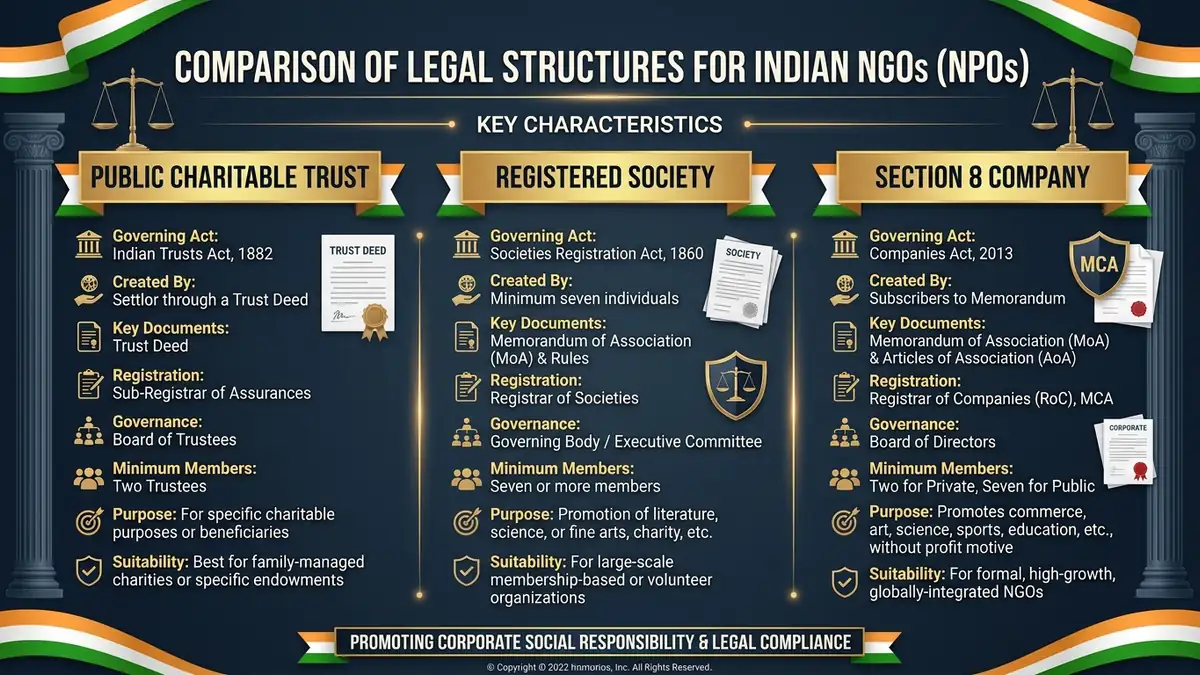
1. The Foundational Dilemma: Choosing the Right Legal Vehicle
In India’s social sector ecosystem, establishing a non-governmental organization (NGO) begins with a pivotal structural choice. Founders must determine whether to register as a Public Charitable Trust, a Registered Society, or a Section 8 Non-Profit Company. While all three legal structures are recognized as non-profit entities capable of obtaining tax exemptions and raising philanthropic donations, their underlying governance acts, regulatory oversight, founding requirements, and operational credibility diverge drastically.
Selecting the wrong entity structure early in your non-profit journey can lead to severe bottlenecks when applying for government grants, receiving Corporate Social Responsibility (CSR) allocations under the Companies Act Section 135, or attempting to scale operations across multiple Indian states. Modern donors, international philanthropies, and corporate CSR committees conduct rigorous legal due diligence before releasing funds, making your initial incorporation vehicle one of your greatest assets or liabilities.
2. Public Charitable Trust: Governance, Act & Registration
A Public Charitable Trust is one of the oldest and most traditional legal forms used for philanthropic purposes in India. While private trusts fall under the Indian Trusts Act of 1882, public charitable trusts are governed either by state-specific public trust legislation: such as the Maharashtra Public Trusts Act, 1950 or the Bombay Public Trusts Act: or by the general principles of common law administered by the local Sub-Registrar of Assurances in states without dedicated trust acts.
Key Characteristics of Public Charitable Trusts:
- Founding Requirements: Requires a minimum of two trustees and one author/settlor who executes the registered Trust Deed.
- Governing Instrument: The registered Trust Deed, which outlines non-negotiable charitable objects, trustee powers, asset management rules, and succession clauses.
- Registration Authority: Executed before the Sub-Registrar of the jurisdiction where the trust’s registered property or office is situated, and registered with the Charity Commissioner in relevant states.
- Management Control: Governed by a Board of Trustees who typically hold lifetime or long tenures. Unlike societies, trusts do not have general voting members, providing founders with tight, centralized control and shielding the institution from hostile takeovers.
Trusts are ideal for family foundations, temples, educational institutions, and grassroots charitable clinics where founders prioritize generational continuity and low statutory maintenance over complex corporate democracy.
3. Registered Society: Democratic Governance & State Regulations
A Society is an association of individuals united by mutual agreement to deliberate, govern, and act cooperatively for charitable, scientific, literary, or social welfare purposes. Societies are governed by the Societies Registration Act, 1860, or respective state amendment acts administered by the Registrar of Societies (often operating under the state Charity Commissioner).
Key Characteristics of Registered Societies:
- Founding Requirements: Minimum of seven individuals (or eight in certain state jurisdictions) subscribed to the Memorandum of Association (MoA).
- Governing Instrument: Memorandum of Association (MoA) setting out primary objectives, paired with the Rules and Regulations detailing internal operational bylaws.
- Democratic Elections: Governed by an elected Managing Committee or Governing Body. Members must hold periodic Annual General Meetings (AGMs) and conduct democratic elections according to their registered bylaws.
- Annual State Filings: Annual filing of audited financial accounts, lists of governing body members, and election proceedings with the district Registrar of Societies.
Societies are well suited for community mobilization programs, resident welfare groups, self-help federations, and sports associations. However, because membership voting can shift leadership during annual elections, societies are susceptible to internal political disputes and leadership deadlocks.
4. Section 8 Company: The Modern Gold Standard for Institutional CSR
A Section 8 Company is registered under Section 8 of the Companies Act, 2013, as a limited liability company established exclusively for promoting commerce, art, science, sports, education, research, social welfare, religion, charity, protection of the environment, or any such objective. Crucially, profits or any other income must be applied solely toward promoting these objects, and no dividend or bonus can ever be paid to shareholders or directors.
Why Section 8 Companies Dominate Modern Social Enterprise:
- Centralized Digital Registration: Processed entirely online through the Ministry of Corporate Affairs (MCA) portal via the unified SPICe+ (INC-32) form, eliminating opaque physical bureaucracy at local sub-registrar offices.
- Pan-India Operating Jurisdiction: Unlike state-level trusts and societies, a Section 8 company possesses immediate nationwide jurisdiction without needing inter-state NOC approvals or duplicate registrations.
- High Corporate Credibility: Governed by corporate accounting standards, independent statutory audit mandates, Ministry disclosures (Forms AOC-4 and MGT-7), and Director Identification Numbers (DIN). Institutional CSR donors overwhelmingly prefer Section 8 structures due to their financial transparency.
- Limited Liability Protection: Directors and promoters enjoy limited liability protection, insulating personal assets from contractual, financial, or operational claims against the company.
5. Comprehensive 10-Point Comparison Matrix
The following comparison matrix breaks down the statutory, operational, and financial dimensions of all three non-profit structures in India:
| Parameter | Public Charitable Trust | Registered Society | Section 8 Company |
|---|---|---|---|
| Governing Act | State Trust Act / Common Law | Societies Registration Act, 1860 | Companies Act, 2013 |
| Regulatory Authority | Charity Commissioner / Sub-Registrar | Registrar of Societies (State) | Ministry of Corporate Affairs (Central) |
| Minimum Members | 2 Trustees | 7 Members (8 in some states) | 2 Directors & 2 Shareholders |
| Charter Document | Trust Deed | MoA and Rules & Regulations | MoA and Articles of Association (AoA) |
| Geographic Jurisdiction | State-bound (Requires NOC to expand) | State-bound (Requires multi-state unit) | Pan-India automatic jurisdiction |
| Corporate Liability | Unlimited personal liability for trustees | Limited to society properties | Strict Limited Liability for directors |
| Online Transparency | Low (Paper records in most states) | Moderate (Varies by district portal) | High (Publicly searchable on MCA V3) |
| CSR Donor Preference | Moderate (Requires extensive audit trail) | Moderate to Low | Highest (Institutional standard) |
| Foreign Contributions (FCRA) | Eligible after 3 years audit proof | Eligible after 3 years audit proof | Eligible after 3 years audit proof |
| Annual Compliance Burden | Low to Moderate | Moderate (AGM filings, list updates) | High (AOC-4, MGT-7, DIR-3 KYC) |
6. CSR Funding Eligibility & Corporate Due Diligence
Under Section 135 of the Companies Act 2013 and the Companies (Corporate Social Responsibility Policy) Rules, commercial enterprises meeting statutory profit thresholds must disburse 2% of their average net profits toward eligible charitable activities. Crucially, companies can implement CSR projects either directly or through an implementing agency.
To qualify as a legitimate CSR implementing partner, any Trust, Society, or Section 8 Company must satisfy three non-negotiable statutory criteria:
- Form CSR-1 Registration: The organization must be registered with the Ministry of Corporate Affairs and hold a verified 11-digit CSR Registration Number. Explore our complete guide on CSR Funding for NGOs in India.
- Three-Year Track Record: Must possess a minimum of three consecutive financial years of audited accounts engaging in philanthropic implementation (unless specifically created by the corporate entity itself).
- Active Section 12AB and 80G Approvals: Valid Unique Registration Numbers (URN) issued by the Central Board of Direct Taxes (CBDT).
While all three vehicles are legally eligible for CSR-1, corporate compliance teams frequently expedite grants to Section 8 Companies because company financials and director track records are verified in real time on the MCA portal, dramatically reducing corporate legal liability during internal board audits.
7. Statutory Tax Registrations: 12AB, 80G & Form 10BD Sync
A common misconception among early-stage non-profit founders is assuming that incorporating an NGO automatically shields donations from taxation. Legal incorporation only provides legal existence; tax exemption requires separate electronic filings with the Income Tax Department:
- Section 12AB Exemption: Exempts the NGO’s surplus income from 30% corporate income tax, provided at least 85% of annual receipts are applied toward charitable purposes in India. Learn the step-by-step electronic filing process in our guide on 80G and 12A Registration for NGOs.
- Section 80G Certificate: Enables retail donors and corporate contributors to claim a 50% tax deduction on eligible donations, functioning as an indispensable conversion incentive.
- Annual Form 10BD Filing: Mandatory statement of donations filed electronically on or before May 31st every financial year. Failure to reconcile donor PAN records with Form 10BD incurs statutory penalties of ₹200 per day under Section 234G.
To streamline this compliance, explore how automated web architecture connects your website payment gateways directly to donor databases in our breakdown of NGO Payment Gateway Integration in India and self-hosted Open Source NGO CRM Systems.
8. Strategic Decision Framework: Which Should You Form?
To make an informed decision for your organization, apply this practical strategic filter based on your funding aspirations, governance style, and operational geography:
Choose a Public Charitable Trust If:
You have a small, cohesive founding group (2-3 trustees), are investing personal or family capital, manage fixed immovable assets (such as schools, land, or medical centers), and want centralized decision-making without the burden of conducting annual elections or complex MCA filings.
Choose a Registered Society If:
You are establishing a community-driven initiative with at least 7 members, prioritize democratic member participation, operate within a single state jurisdiction, and run programs focused on arts, culture, sports, or grassroots advocacy.
Choose a Section 8 Company If:
You plan to scale nationally, mobilize institutional CSR funding from major public and private corporations, seek limited liability protection for your board, desire a 100% paperless digital incorporation process, and value global credibility when applying for multilateral grants or tech accelerators.
9. Frequently Asked Questions (FAQs)
Q1: Can a registered Trust or Society convert into a Section 8 Company in India?
Yes. Under Chapter XXI of the Companies Act 2013 and Section 366, existing registered Societies and Trusts can convert into a Section 8 Non-Profit Company. However, the process requires explicit NOCs from members, public newspaper notices, asset transfers, and approval from the Registrar of Companies (RoC). Most organizations choose instead to incorporate a fresh Section 8 entity and systematically transfer operational projects over a phased transition period.
Q2: What is the typical government fee and timeline for incorporating a Section 8 Company?
Incorporating a Section 8 Company in 2026 takes approximately 10 to 15 working days via the MCA SPICe+ digital portal. The central government has waived ROC incorporation stamp fees for companies with authorized capital up to ₹15 Lakhs, though nominal state stamp duty and professional fees for chartered accountants or company secretaries (typically ₹12,000 to ₹25,000) apply.
Q3: Can trustees or directors in a non-profit receive a monthly salary?
Trustees and directors may receive reasonable remuneration for professional services rendered in their executive capacity (e.g., serving as full-time Chief Executive Officer or Medical Director), provided it is explicitly sanctioned in the Trust Deed or Articles of Association. However, compensation must not exceed prevailing market standards, or it risks violating Section 13(1)(c) of the Income Tax Act, which invalidates 12AB tax exemption status.
Q4: Is NITI Aayog NGO Darpan registration mandatory for all three entities?
Yes. Any Trust, Society, or Section 8 Company seeking central or state government grants, CSR-1 approvals, or FCRA clearances must maintain an active registration on the official NITI Aayog NGO Darpan portal. Registration generates a unique Darpan ID linked to trustee PANs, facilitating inter-ministerial transparency.