
NGO Grant Proposal Writing in India: 2026 Guide
A comprehensive, institutional guide for Indian non-profits, trusts, and Section 8 entities pitching to Corporate Social Responsibility (CSR) foundations and institutional grantmakers. Master baseline problem trees, construct audit-ready Logical Framework Analysis (LFA) matrices, design compliant budgets under the 5% administrative cap, and deploy digital transparency vaults to accelerate board approvals in 2026.
1. The Shifting Indian Grant Landscape: Why Emotional Appeals Fail
For decades, non-profit fundraising in India relied heavily on emotive prose, sentimental narrative appeals, and informal executive relationships. A well-intentioned founder could secure institutional support by sharing passionate stories of grassroots distress accompanied by a basic photo album.
In 2026, that era is entirely over. The enactment of comprehensive statutory frameworks under the Companies Act 2013 (Section 135) and rigorous scrutiny by statutory auditors have permanently transformed grantmaking into a disciplined corporate procurement process. Corporate Social Responsibility (CSR) committees, philanthropic foundations, and multilateral donors no longer evaluate proposals based on sentimental eloquence. Instead, they examine proposals through the rigorous lens of risk management, statutory auditability, measurable social return on investment (SROI), and operational governance.
Grassroots non-profits that submit thirty-page unstructured narrative documents face immediate rejection during preliminary desk reviews. Grant evaluators spend an average of less than four minutes scanning an initial concept note. If your submission lacks clear baseline data, a mathematically balanced Logical Framework Analysis (LFA), and explicit statutory alignment, it is discarded before reaching the boardroom table.
The Reality of Institutional Desk Reviews
Over 78% of CSR grant applications in India are rejected during stage-one administrative screening due to non-compliant budget formats, missing statutory documentation, or vague impact metrics. Writing a winning grant proposal is an engineering exercise in clarity, evidence, and regulatory alignment.
2. Statutory Due Diligence Prerequisites: Darpan, 12AB, 80G & Form CSR-1
Before drafting the first sentence of your project narrative, ensure your organization satisfies all mandatory statutory compliance thresholds. Corporate CSR donors and reputable institutional foundations are legally prohibited from disbursing funds to non-compliant entities.
Every institutional grant proposal dossier must lead with verified statutory documentation:
- MCA Form CSR-1 Registration: Mandatory registration with the Ministry of Corporate Affairs for any entity acting as an implementing agency. The unique CSR-1 Registration Number must be displayed prominently on your proposal cover page.
- NITI Aayog NGO Darpan Unique ID: Required for accessing government grants, public sector undertakings (PSU) CSR allocations, and ministry partnerships. Ensure all trustee details on the Darpan portal match your current board list.
- Section 12AB & 80G Re-Registration: Five-year renewal certificates issued by the Income Tax Department with valid Unique Registration Numbers (URN). Review our comprehensive legal analysis in 80G and 12A Registration for NGOs in India.
- Three Years Audited Financial Statements: Certified audit reports, balance sheets, and schedules prepared by a chartered accountant, demonstrating transparent track record and zero unqualified audit qualifications.
- Annual Form 10BD Compliance: Evidence of on-time electronic donor filing with the Central Board of Direct Taxes, validating institutional accounting discipline.
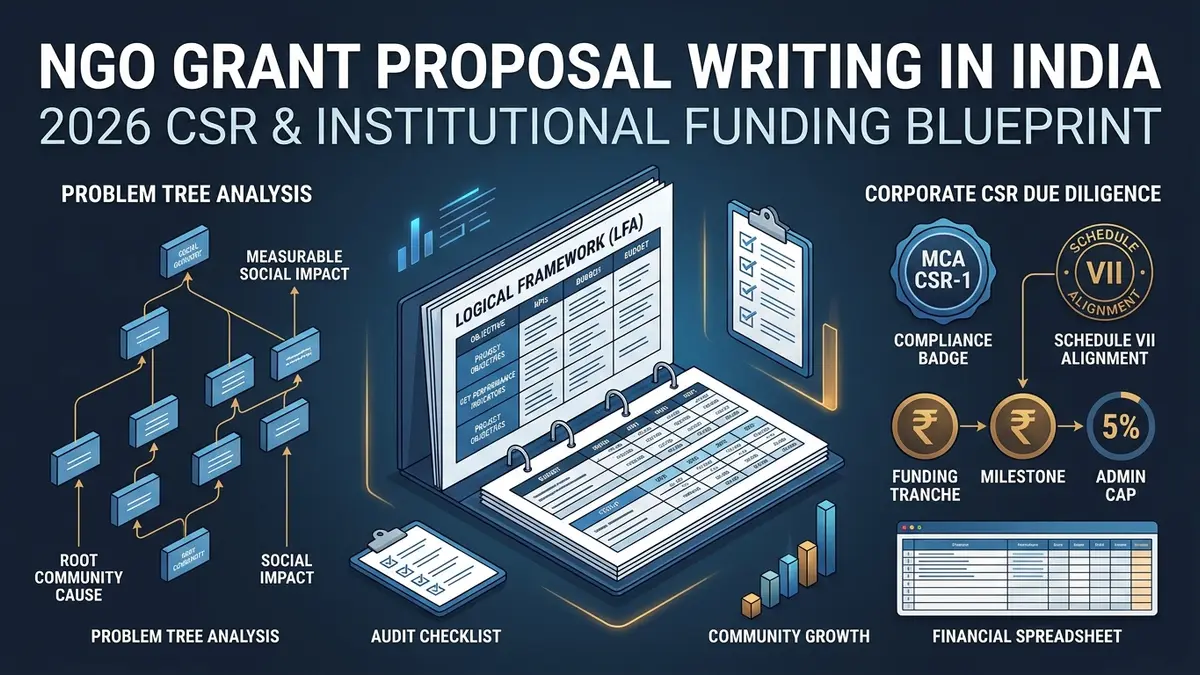
3. The Baseline Problem Tree: Converting Field Realities into Structured Causality
A frequent flaw in amateur grant proposals is treating symptoms as root problems. Stating that children in tribal schools have low exam scores describes an observed symptom, not an actionable structural problem. Institutional funders fund systemic interventions, not temporary band-aids.
Professional grant writers utilize Problem Tree Analysis to establish undeniable causal relationships between community realities and project activities:
1. Roots: Underlying Causes
Deep structural barriers identified through grassroots fieldwork: lack of clean drinking water in schools causing chronic gastrointestinal absenteeism, teacher vacancy rates, and unaddressed micronutrient deficiencies.
2. Trunk: The Core Problem
The specific, bounded challenge your project directly resolves: 42% chronic school absenteeism among adolescent girls across fifteen tribal villages in Palghar district over a nine-month academic cycle.
3. Branches: Observable Effects
Downstream community consequences: early child marriage, reduced female workforce participation, and cyclical intergenerational poverty across targeted talukas.
By mapping your project directly against verified root causes, your proposal establishes credibility with grant review panels. Field baseline data gathered using participatory techniques (as outlined in our operational guide on MSW Field Work Practicum in India) provides the statistical foundation needed to prove your case.
4. Mastering the Logical Framework Analysis (LFA): Objectives, OVIs & MOVs
The Logical Framework Analysis (LFA), or Logframe, is the international gold standard for program design. Developed originally for international development agencies, the Logframe is now required by leading Indian corporate CSR foundations (such as Tata Trusts, Infosys Foundation, and Reliance Foundation).
A high-scoring Logframe consists of a 4×4 matrix establishing an unbroken chain of causality:
5. Audit-Proof Activity-Based Budgeting under the 5% Administrative Cap
Budget formulation is where most promising proposals collapse. Common blunders include submitting vague lump-sum estimates (such as Community Outreach: ₹5,00,000) or inflating administrative salaries.
In Corporate Social Responsibility grantmaking, non-profits must strictly respect the statutory constraint established under Rule 2(1)(d) of the Companies (CSR Policy) Amendment Rules: administrative overheads must not exceed 5% of the total CSR expenditure of the company for the financial year.
Core Rules of Compliant Activity-Based Budgeting
- Unit Cost Itemization: Every expense must specify unit count, frequency, and unit cost (e.g., 3 project coordinators x ₹28,000/month x 12 months = ₹10,08,000).
- Distinguish Program Delivery from Administrative Overhead: Field worker salaries, training materials, and beneficiary transport are direct programmatic expenses, not administrative costs. Only central office rent, audit fees, and senior executive governance overhead fall under the 5% cap.
- Statutory Taxes Included: Explicitly budget for applicable GST, professional taxes, and employee benefit obligations to prevent surprise budget shortfalls during execution.
6. Monitoring, Evaluation, Accountability and Learning (MEAL) Frameworks
Corporate CSR committees are answerable to their corporate boards and statutory regulators. They require continuous proof that sanctioned tranches are generating verified impact. A robust MEAL plan embedded directly in your proposal provides this institutional assurance:
- Baseline vs. Endline Measurements: Clear pre-intervention statistical benchmarks compared against post-intervention evaluations conducted by an independent third-party evaluator.
- Digitized Field Verification: Deployment of offline-first mobile surveys (such as KoboToolbox) capturing geotagged photographic verification of activities, eliminating doubts regarding fictitious reporting. Read our technical guide on Open Source Software for NGOs in India.
- Community Accountability Mechanisms: Formal grievance redressal channels and beneficiary feedback forums, ensuring intervention dignity under the DPDP Act 2023.
7. The Corporate CSR Pitch: Aligning with Schedule VII & ESG Priorities
Companies do not disburse CSR funds at random. Under Section 135 of the Companies Act 2013, all CSR capital must strictly map to authorized thematic areas listed under Schedule VII. Furthermore, listed public companies in India are subject to Business Responsibility and Sustainability Reporting (BRSR) mandates by SEBI, prioritizing projects that boost their Environmental, Social, and Governance (ESG) indices.
To craft an irresistible proposal, explicitly cross-reference your project deliverables against the corporate funder’s priority indices:
- Schedule VII Mapping: Explicitly state whether your intervention addresses Clause (i) Eradicating hunger, poverty, and malnutrition; Clause (ii) Promoting education and vocational skills; Clause (iv) Ensuring environmental sustainability; or Clause (x) Rural development projects. Learn more in our strategic overview of CSR Funding for NGOs in India.
- BRSR Alignment: Highlight how your project data supports the company’s annual BRSR disclosures, particularly regarding community development, gender equality, and sustainable resource management.
- Employee Engagement Integration: Offer structured volunteering days where corporate employees can contribute professional skills, boosting company morale. Explore our frameworks in Volunteer Management Systems for Indian NGOs.
8. The Digital Transparency Vault: Accelerating CSR Committee Sanction
During board review meetings, CSR committee members routinely encounter missing attachments: unreadable scans of 80G certificates, outdated trustee pan cards, or missing Darpan links. These minor administrative delays often postpone funding approvals to the next quarterly board meeting, causing months of lost time.
Web4Cause pioneers the deployment of an online Digital Transparency Vault hosted securely on your organization’s domain:
The Power of a Dedicated Due Diligence Hub
Instead of emailing fragmented 40 MB zip attachments that bounce on corporate mail servers, your proposal dossier provides a single, secure link: web4cause.com/transparency/. Grant evaluators can instantly review high-resolution digital scans of your 12A/80G approvals, Form CSR-1 filing acknowledgment, Darpan certificate, three years audited balance sheets, and a live project dashboard with a single click.
Explore how high-trust web architecture speeds donor decisions in our guide to NGO Website Design in India.
9. Conventional Grant Proposals vs. Web4Cause Institutional Architecture
Review the decisive differences between conventional grant applications and a modern, audit-ready institutional dossier:
10. The 10-Point Pre-Submission Due Diligence Checklist
Before transmitting your formal grant application to a corporate CSR desk or philanthropic trust, verify that every item on this pre-flight checklist is completed:
- CSR-1 Validity: Verified active registration on the MCA portal with matching trust or Section 8 registration details.
- NITI Aayog NGO Darpan Profile: All current board members and pan details synchronized with the Darpan portal.
- Income Tax Form 10AC: Valid 5-year Section 12AB and 80G registration certificates attached.
- 3 Years Audited Financials: CA-certified balance sheets, income & expenditure statements, and notes to accounts.
- Schedule VII Linkage: Explicit citation of the specific Schedule VII sub-clause aligning with project objectives.
- Mathematical Logframe Coherence: Every listed activity directly connects to a measurable output, outcome, and goal indicator.
- Administrative Budget Cap Check: General overhead expenditures confirmed to remain below 5% of total grant request.
- Independent MEAL Architecture: Clearly identified baseline benchmarks, verification tools, and evaluation timelines.
- Digital Transparency Vault Link: Working URL linking to the secure corporate due diligence repository on your domain.
- Authorized Signatures & Board Resolution: Official board resolution sanctioning the grant submission, signed by authorized trustees.
11. Frequently Asked Questions (FAQs)
Q1: What is the single most common reason CSR grant proposals are rejected in India?
The primary reason for proposal rejection during stage-one desk reviews is non-compliance with statutory standards. This includes lack of a valid MCA Form CSR-1 registration, expired 12A/80G certificates, or submitting an unitemized lump-sum budget that violates the 5% administrative overhead cap mandated by Indian CSR rules.
Q2: What is the difference between an Output and an Outcome in a Logical Framework Analysis?
An Output is the immediate, direct tangible deliverable produced by project activities (such as conducting 20 training workshops or enrolling 200 women). An Outcome represents the observable, measurable change in condition, behavior, or capacity resulting from those outputs (such as a 45% increase in monthly household income among trained participants). Grantmakers fund outcomes, not mere outputs.
Q3: How should an NGO calculate the 5% administrative overhead cap under CSR rules?
Under Rule 2(1)(d) of the Companies (CSR Policy) Amendment Rules, administrative overheads encompass general management and administration costs of the company or implementing agency (such as head office rent, utilities, senior governance salaries, and legal fees). Direct personnel costs incurred for program execution (such as field caseworkers, healthcare trainers, and project coordinators) are categorized as direct project expenditures, not administrative overhead.
Q4: Can a newly established NGO with less than three years of operations apply for CSR grants?
Under amended CSR rules, an entity must have an established track record of at least three years in undertaking similar activities to qualify as an independent CSR implementing agency. Newer non-profits often partner as secondary implementation consortia with established trusts or focus initially on seed philanthropic grants, high-net-worth individual (HNI) donations, and retail crowdfunding before pitching to corporate CSR desks.
Q5: How does a digital transparency vault accelerate grant sanctions?
A digital transparency vault is a centralized, secure web page on your domain hosting high-resolution scans of all statutory certificates, audited financial reports, trustee disclosures, and real-time project metrics. Instead of passing around bulky email attachments that get lost in review chains, corporate CSR committees can verify institutional legitimacy in a single click, eliminating administrative roadblocks during board meetings.