
MSW Field Work Practicum in India: Complete Guide for Students (2026)
The definitive academic and field manual for Master of Social Work (MSW) scholars, trainees, and faculty across Indian universities. Master concurrent agency placements, professional journal logging, Participatory Rural Appraisal (PRA) methodologies, primary social casework interventions, rural study camps, and viva voce defense in 2026.
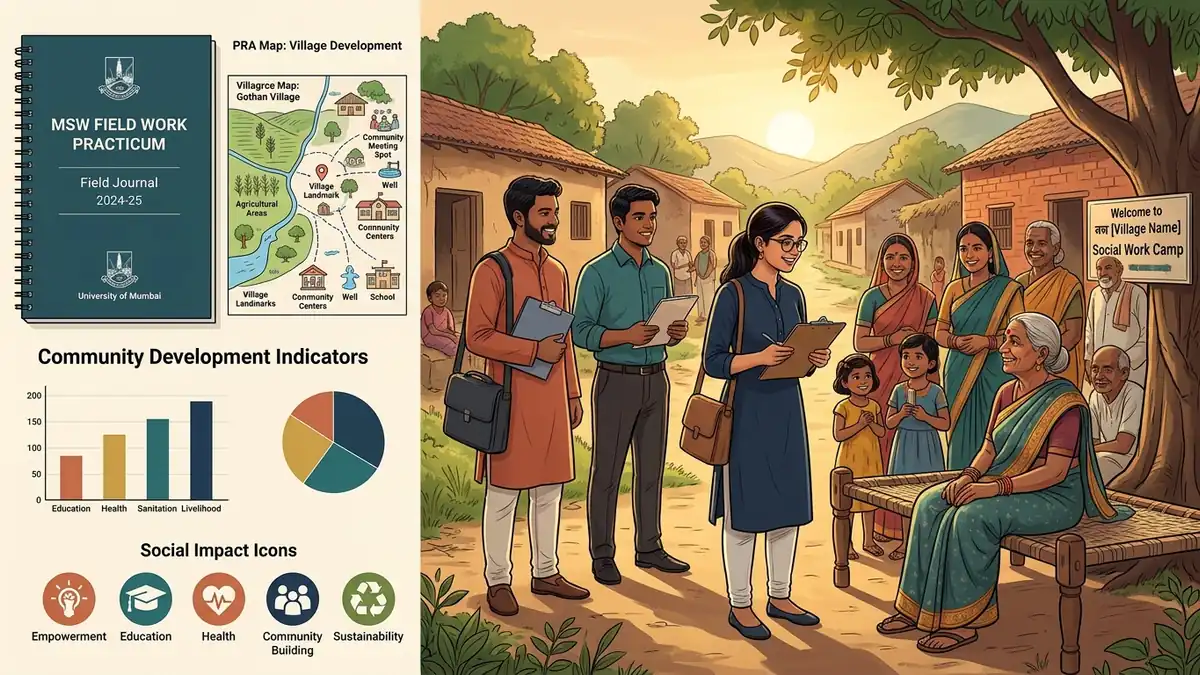
1. The Core of Social Work Education: Why Field Work Matters
In professional social work education across India, theoretical classroom instruction represents only half of the curriculum. The heart of the Master of Social Work (MSW) degree lies in the Field Work Practicum. Unlike observational internships in other disciplines, social work practicum is an experiential immersion designed to translate psychological theories, statutory acts, and sociological principles into tangible community empowerment.
The University Grants Commission (UGC) mandates that MSW candidates complete a minimum of 400 to 500 hours of supervised field work per academic year. Through this immersion, students develop the self-awareness, active listening, systemic analysis, and ethical fortitude required to address deep-rooted socio-economic inequities, domestic violence, child protection violations, health crises, and environmental distress across India.
Mastering this practicum directly shapes your professional prospects. As analyzed in our career guide on MSW Scope and Salary in India, organizations recruiting social work graduates: including UN agencies, CSR foundations, and premier non-profits: prioritize candidates with demonstrated fieldwork excellence over theoretical GPA scores.
2. Placement Typology: Concurrent, Block & Rural Camp
Indian universities (such as TISS, Delhi University, Karve Institute, and Nirmala Niketan) structure the MSW practicum across four interconnected operational modules:
- Orientation Visits (Semester 1): Introductory observational visits to 6 to 10 distinct institutional settings: prisons, child welfare committees (CWCs), psychiatric centers, family courts, and tribal development blocks: to familiarize students with social welfare systems.
- Concurrent Field Work (Semesters 1 to 4): Trainees dedicate 2 full days each week (typically Thursdays and Fridays, or 15 hours weekly) to an assigned non-profit organization or community setting, concurrently attending academic classes during the remaining days.
- Rural Study Camp (Semester 2): A mandatory 7 to 10 day residential immersion in a remote rural or tribal village. Students live communally, conduct Participatory Rural Appraisals, plan street plays (Nukkad Natak), and evaluate Panchayat-level welfare execution.
- Block Field Placement (Final Semester): A 30 to 45 day full-time intensive placement post-coursework where trainees operate as full-time probationary staff within advanced CSR departments, international NGOs, or hospital psychiatric wards.
3. Operationalizing Primary Methods in the Field
During your agency placement, your supervisor expects you to systematically implement the three primary methods of professional social work:
A. Social Case Work (Working with Individuals & Families)
Identify clients experiencing acute psycho-social distress. Execute formal intake interviews, draw family genograms, formulate multi-step intervention plans, and facilitate referral services while upholding strict confidentiality and non-judgmental acceptance.
B. Social Group Work (Working with Groups)
Form targeted peer groups (e.g., adolescent health clubs, de-addiction recovery cohorts, or self-help federations). Structure 6 to 8 purposeful sessions, facilitate group cohesion, address leadership conflicts, and evaluate group outcomes.
C. Community Organization (Macro Intervention)
Mobilize local community stakeholders around common challenges such as drinking water sanitation, school dropouts, or wage disparities. Review our comprehensive manual on Community Mobilization in Social Work for step-by-step facilitation techniques.
4. Mastering Grassroots PRA & Community Mapping Tools
Participatory Rural Appraisal (PRA) tools allow communities to analyze their own realities rather than serving as passive subjects of academic questionnaires. When deployed correctly, PRA builds immediate trust and surfaces grassroots dynamics that statistical surveys miss:
- Social & Resource Mapping: Facilitate villagers drawing their settlement on the ground using rangoli, chalk, and natural stones. Locate households by caste, drinking water wells, schools, and ration depots to map geographic disparities.
- Transect Walk: Walk systematically across the village terrain with local elders, observing agro-ecological zones, drainage patterns, soil erosion, and sanitation infrastructure.
- Venn / Chapati Diagram: Have community members draw circles of varying sizes representing local institutions (Gram Panchayat, Anganwadi, Primary Health Centre, Money Lenders) to visualize power, accessibility, and institutional trust.
- Seasonal Calendar: Map cyclical migration periods, disease outbreaks, agricultural labor shortages, and festival expenditures across 12 months.
5. Writing Flawless Concurrent Field Work Journals
Your concurrent fieldwork journal is a legal academic record subject to internal and external audit. Simply describing a chronological list of activities (e.g., “I arrived at 10 AM and talked to the staff”) guarantees poor evaluation. High-scoring fieldwork reports follow a disciplined structural anatomy:
Standard Academic Journal Structure:
- Header Information: Date, Day, Report Number, Agency Name, Field Supervisor, Agency Supervisor.
- Objectives for the Day: 2 to 3 specific, measurable objectives.
- Process Narrative: Detailed chronological breakdown of professional activities, case interviews, and observations.
- Methodological Analysis: Explicitly link field events to theoretical models (e.g., Carl Rogers client-centered therapy, systems theory, Paulo Freire conscientization).
- Self-Awareness & Professional Learning: Reflect on your personal biases, emotional triggers, communication hurdles, and ethical dilemmas encountered.
- Plan for the Next Field Day: Clear action points for the upcoming week.
6. Maximizing Individual (IC) & Group Conference (GC) Supervision
Supervision is the clinical cornerstone bridging field practice and academia. MSW students participate in two mandatory supervisory forums:
- Individual Conference (IC): A weekly 30 to 45 minute 1-on-1 session with your faculty fieldwork supervisor. Submit your written journal 24 hours in advance. Use this session to discuss sensitive client resistance, burnout, and field anxieties.
- Group Conference (GC): Bi-weekly peer presentations where 5 to 8 students placed in diverse settings (prisons, CSR, child protection, medical) present case studies. This develops peer-critique skills and exposes students to multi-sectoral realities.
7. Acing the External Viva Voce Examination
At the end of each academic year, students face an external viva voce panel comprising a senior social work professor from another university and an agency leader. To secure distinction:
- Master Agency Statutory Framework: Know whether your placement agency is a Trust, Society, or Section 8 Company, its 12A/80G status, and its founding charter. Review our comparison on Trust vs Society vs Section 8 Company in India.
- Defend Case Studies Rigorously: Be prepared to explain 2 primary casework interventions from intake to termination, justifying every referral choice.
- Cite Relevant Indian Legislation: Ground your field actions in statutory acts: such as the Juvenile Justice (Care and Protection of Children) Act, 2015; Protection of Women from Domestic Violence Act, 2005; or the Rights of Persons with Disabilities Act, 2016.
9. Frequently Asked Questions (FAQs)
Q1: How do I handle a fieldwork agency supervisor who assigns only clerical tasks?
Agency placement is an educational partnership, not unpaid administrative labor. If your placement assigns photocopying or data entry, raise this constructively during your weekly Individual Conference (IC) with your faculty supervisor. They will liaise with the agency field contact to realign tasks with social casework, group work, and community mobilization goals.
Q2: What should I do if a community resident demands direct financial aid during fieldwork?
Never give personal money to clients or community residents. Giving personal funds establishes dependency, breaks professional boundaries, and distorts the worker-client relationship. Instead, educate the individual on government welfare schemes, local NGO emergency support, or institutional medical subsidies.
Q3: How many words should a concurrent field work journal entry contain?
Most Indian social work departments expect a comprehensive concurrent journal entry to be approximately 1,200 to 1,800 words per field day. The report must provide sufficient room for chronological process recording, dialogue excerpts, and critical theoretical reflection.
Q4: Does field work performance impact UGC NET / JRF eligibility?
While UGC NET eligibility requires an aggregate of 55% marks in your master’s degree (inclusive of theory and fieldwork papers), external fieldwork vivas represent a major proportion of internal credits in all top universities. Furthermore, practical field insights give candidates an enormous advantage in Paper II subjective questions and subsequent assistant professorship interviews.