
Google Analytics 4 for NGOs in India: 2026 Measurement Guide
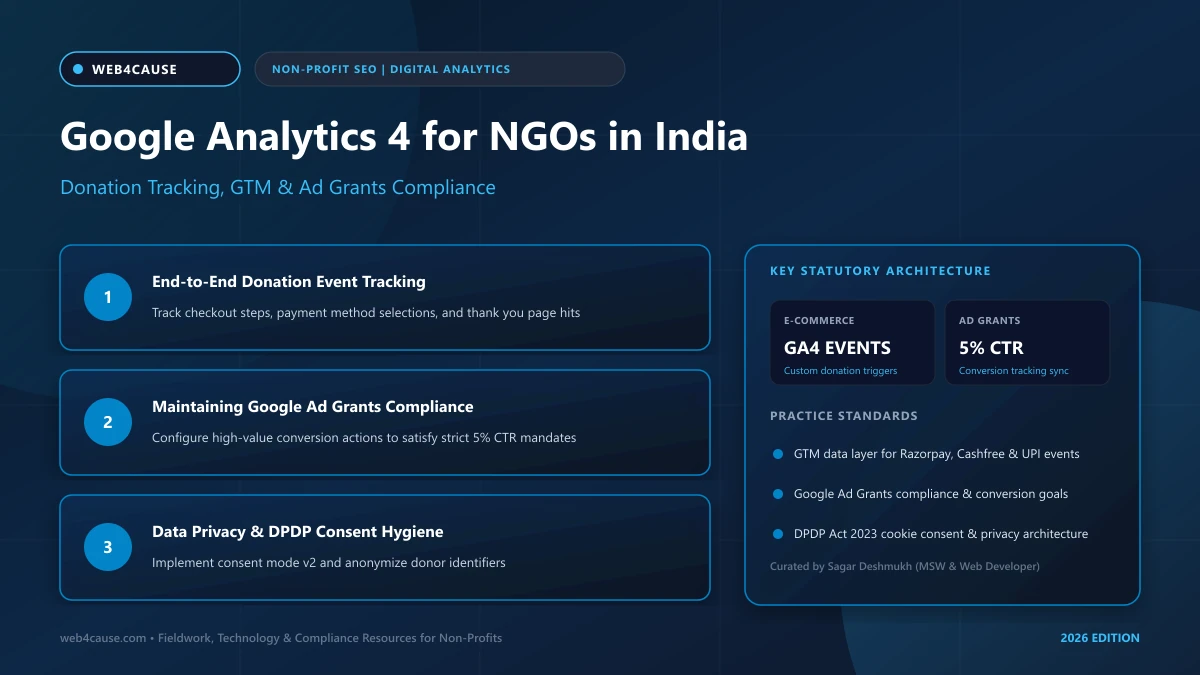
An exhaustive, engineering-grade measurement manual for Indian non-profits, charitable trusts, and Section 8 institutions transitioning to Google Analytics 4. Master custom event hierarchies, Google Tag Manager dataLayer push architectures, Razorpay and Cashfree UPI conversion attribution, Google Ad Grants compliance interlocking, and privacy protection under India's Digital Personal Data Protection Act 2023.
1. Why Legacy Web Analytics Fails Indian Non-Profits
For over a decade, Indian charitable trusts, societies, and Section 8 institutions evaluated their digital outreach through legacy Universal Analytics. That platform relied on a session-based data architecture developed for desktop e-commerce websites. In that traditional model, every interaction was bundled inside arbitrary thirty-minute operational windows. When midnight struck in the reporting time zone, or when a supporter switched browser tabs, sessions restarted, fragmenting user journeys and distorting conversion data.
The contemporary Indian digital ecosystem operates under radically different realities. More than eighty-five percent of traffic visiting Indian non-profit websites originates from mobile smartphones connected via cellular networks. A prospective donor browsing an environmental campaign on a commute encounters fluctuating mobile network towers, momentary signal drops, and intermittent network latency. Under Universal Analytics, a network disconnection often caused a donor visit to split into multiple disjointed sessions, obscuring the true acquisition channel.
Architectural Breakthrough: Google Analytics 4 replaces arbitrary session windows with an event-driven telemetry data model. Every interaction (a page view, a tier selection, a modal popup launch, or a payment confirmation) is recorded as a discrete, timestamped event enriched with custom parameters. This enables Indian non-profits to reconstruct continuous donor pathways across intermittent connections, separate devices, and complex payment gateway redirects.
Furthermore, legacy analytics suffered catastrophic attribution collapse during the checkout phase. When an Indian supporter clicks to donate using Unified Payments Interface (UPI), their mobile browser transfers control to external banking apps like PhonePe, Google Pay, Paytm, or BHIM. Universal Analytics frequently interpreted the return to the NGO confirmation page as a brand-new visit, crediting the conversion to payment gateway domains or direct traffic rather than the organic search article, social media drive, or Google Ad Grants campaign that inspired the gift.
Google Analytics 4 resolves these systemic distortions through unified user identity resolution, flexible measurement protocols, and persistent client-side event queuing. As examined in our comprehensive framework on Donation Page Optimization for Indian NGOs, measuring the exact micro-interactions of your visitors is the foundational prerequisite for sustainable institutional fundraising.
2. Architecture of GA4 for Non-Profit Fundraising
Deploying Google Analytics 4 for an Indian social work organization requires structuring a clean property architecture inside Google Analytics. A non-profit entity must establish a single comprehensive GA4 property containing a dedicated Web Data Stream. This data stream generates a unique Measurement ID formatted as G-XXXXXXXXXX, which serves as the destination key for all incoming telemetry packets.
While GA4 offers out-of-the-box Enhanced Measurement (automatically capturing scroll depth, outbound link clicks, site searches, and file downloads), relying solely on automated collection leaves an NGO blind to fundraising performance. Philanthropic fundraising requires implementing a tailored non-profit event taxonomy aligned with Google's recommended e-commerce schema, adapted specifically for charitable contributions:
1. view_donation_page
Fires when a visitor lands on the primary donation appeal or specific cause landing page. Captures the campaign title, programmatic theme (healthcare, education, rural livelihood), and referral channel.
2. select_donation_tier
Fires when a supporter clicks a predefined giving amount pill (for instance: 500, 1000, 2500, 5000 Indian Rupees) or enters an arbitrary custom sum into the contribution field.
3. begin_checkout
Fires when the donor completes essential form inputs and triggers the payment gateway modal or interface. Establishes the intent to transfer financial resources.
4. purchase (donation_complete)
Fires exclusively upon verified capture of funds. Carries monetary parameters including value in INR, unique receipt number, payment mode, and tax deduction eligibility.
| Event Name | Trigger Condition | Essential Parameters Passed | Role in Google Ad Grants |
|---|---|---|---|
| view_donation_page | Page path matches /donate/ | cause_category, campaign_id | Secondary (Audience only) |
| select_donation_tier | Amount pill clicked | value, tier_label, currency | Micro-conversion step |
| begin_checkout | Submit form to launch gateway | value, currency, donation_frequency | Secondary Conversion Goal |
| purchase | Payment gateway confirms capture | transaction_id, value, currency, payment_method | Primary Key Conversion Goal |
By framing donations within the recognized purchase event rather than arbitrary custom names, Indian non-profits automatically populate GA4 standard Monetization dashboards, Average Revenue Per Paying User (ARPPU) metrics, and Predictive Lifetime Value models without requiring manual reporting configuration.
3. Google Tag Manager (GTM) Implementation for Donation Portals
Hardcoding Google Analytics scripts directly into page templates or WordPress header files represents a fragile deployment methodology. Every layout update or theme change risks breaking conversion tracking. The modern gold standard for Indian social institutions is deploying via Google Tag Manager utilizing an architectural dataLayer pattern.
The dataLayer acts as an independent software abstraction layer positioned between your website front-end (HTML, CSS, JavaScript frameworks) and external third-party analytics endpoints. When a user interacts with a donation element, your web application pushes structured JavaScript objects into the window.dataLayer array. GTM listens for these specific pushes, extracts relevant values, and routes sanitized telemetry to Google Analytics 4.
Clean Code Rule: In compliance with modern web development hygiene, never use inline event handlers such as onclick inside HTML buttons. Instead, bind listeners via JavaScript files and ensure dataLayer pushes always execute before payment redirection occurs.
JavaScript DataLayer Push Snippets for Non-Profit Portals
The following production-ready scripts demonstrate how Indian non-profits configure dataLayer pushes for donation tier selection, checkout initialization, and final transaction capture:
window.dataLayer = window.dataLayer || [];
window.dataLayer.push({ ecommerce: null });
window.dataLayer.push({
event: "select_donation_tier",
ecommerce: {
currency: "INR",
value: 2500.00,
donation_tier: "Sponsor A Child Education",
donation_type: "one_time",
cause_program: "Tribal Literacy Mission"
}
});
window.dataLayer = window.dataLayer || [];
window.dataLayer.push({ ecommerce: null });
window.dataLayer.push({
event: "begin_checkout",
ecommerce: {
currency: "INR",
value: 2500.00,
items: [{
item_id: "DONATION-TLM-2500",
item_name: "Tribal Literacy Support",
item_category: "Education",
price: 2500.00,
quantity: 1
}],
donation_frequency: "one_time",
tax_exemption_80g: "requested"
}
});
window.dataLayer = window.dataLayer || [];
window.dataLayer.push({ ecommerce: null });
window.dataLayer.push({
event: "purchase",
ecommerce: {
transaction_id: "W4C-2026-TXN-88492",
value: 2500.00,
currency: "INR",
payment_type: "UPI_Intent",
gateway_provider: "Razorpay",
donation_frequency: "one_time",
tax_receipt_eligible: "yes_80g",
donor_state: "Maharashtra",
items: [{
item_id: "DONATION-TLM-2500",
item_name: "Tribal Literacy Support",
item_category: "Education",
price: 2500.00,
quantity: 1
}]
}
});
Notice the mandatory clearing command window.dataLayer.push({ ecommerce: null }); executed before every push. In single-page donation applications and multi-step forms, failing to reset the ecommerce object causes previous transaction metadata to persist in browser memory, leading to data pollution. For a deeper look at clean front-end architecture, explore our guide on NGO Website Design in India.
4. Integrating Payment Gateways with GA4: Solving the Attribution Crisis
Payment gateway integration represents the single most vulnerable junction in Indian non-profit analytics. Indian donors overwhelmingly prefer UPI, which according to the National Payments Corporation of India (NPCI) commands over seventy percent of all digital retail payments nationwide. However, this payment mode introduces two severe measurement challenges: gateway referral hijacking and the mobile redirect drop-off dilemma.
Challenge A: Eliminating Unwanted Gateway Referrals
When an NGO routes transactions through aggregators such as Razorpay, Cashfree, or PayU, the donor temporarily visits a secured domain (such as api.razorpay.com or checkout.cashfree.com) to authenticate their bank credentials. Upon completing payment, the gateway redirects the user back to the NGO confirmation page (for example: /donation-success/).
If GA4 is unconfigured, it interprets this incoming redirection as an external referral. The analytics dashboard credits the donation revenue to razorpay.com / referral instead of preserving the true campaign source. To prevent this attribution theft:
- Navigate to Admin > Data Streams > Web Stream Details > Configure Tag Settings.
- Select Show all > List unwanted referrals.
- Add exact match conditions for:
api.razorpay.com,checkout.cashfree.com,securegw.paytm.in, and your gateway's checkout URLs. - Enable cross-domain measurement if your donation system operates on a separate subdomain (such as
give.yourngo.org).
Challenge B: The UPI Redirect Drop-off Dilemma
In an Indian mobile environment, when a donor completes a UPI transaction inside PhonePe or Google Pay, their banking app displays a prominent green checkmark confirming fund transfer. Up to thirty percent of mobile users immediately swipe away or close their browser tab, never waiting for the automated five-second redirection back to your website confirmation page.
If your organization relies solely on a client-side purchase event triggered on the success page, nearly one-third of your verified donation volume vanishes from GA4 and Google Ads reports. To solve this, non-profits must implement a hybrid measurement architecture combining client-side modal listeners with backend server-side Measurement Protocol webhooks:
Hybrid Measurement Protocol Architecture
1. When the donation form initializes, capture the active GA4 client_id from the user's browser cookie (_ga) and store it in your database alongside the order record.
2. When Razorpay or Cashfree captures funds, their server sends a verified webhook (payment.captured) to your backend application or automated webhook listener.
3. If the user returns to the thank you page, fire the standard client-side purchase tag. If your backend detects that the client-side tag never executed within sixty seconds, your server dispatches an HTTP POST request to the GA4 Measurement Protocol endpoint (https://www.google-analytics.com/mp/collect) utilizing the preserved client_id and your Measurement Protocol API secret. This guarantees one hundred percent conversion accounting while preserving full attribution.
For complete technical instructions on setting up gateways and handling automated statutory receipts, consult our specialized guides on NGO Payment Gateway Integration in India and UPI AutoPay for NGO Recurring Donations in India.
5. Google Ad Grants Compliance Interlock
The Google Ad Grants program provides registered Indian charitable entities with ten thousand US Dollars per month in in-kind search advertising credits. However, operating within the program requires strict adherence to Google's compliance policies. The two most common grounds for immediate grant account suspension in India are failing to maintain an account-level five percent Click-Through Rate (CTR) and operating without valid, meaningful conversion tracking.
Critical Policy Prohibition: Google Ad Grants strictly prohibits setting up low-intent, superficial user actions as primary conversions. Counting pageviews of your homepage, visits to contact pages, or trivial video plays as conversions violates the Ad Grants Conversion Tracking Policy. Accounts engaging in this practice face automated account revocation.
To establish an unshakeable, audit-proof measurement interlock between GA4 and Google Ads, Indian non-profits must implement a disciplined conversion hierarchy:
Steps to Interlock GA4 and Google Ad Grants:
- Link Properties in GA4 Admin: Navigate to Admin > Product Links > Google Ads Links. Link your active Google Ad Grants customer account (CID) and enable auto-tagging.
-
Designate Key Events in GA4: Go to Admin > Data Display > Key Events. Toggle the switch to mark
purchaseas a primary Key Event. You may optionally designatebegin_checkoutandgenerate_lead(volunteer application submission) as secondary Key Events. -
Import Conversions into Google Ads: In your Google Ads dashboard, navigate to Goals > Conversions > Summary > New Conversion Action > Import > Google Analytics 4 properties > Web. Select your
purchaseevent. - Configure Conversion Value Mechanics: In the conversion settings, choose "Use different values for each conversion" and set the default currency to INR. Google Ads will read the exact donation amount passed in the GA4 purchase event parameters.
- Activate Value-Based Smart Bidding: Switch your Ad Grants campaigns from manual bidding to Maximise Conversions or Maximise Conversion Value. Because Ad Grants accounts using automated bidding are exempt from the standard two-dollar manual CPC bid cap, your ads can bid competitively for high-intent search queries across India.
For full strategic guidance on obtaining and scaling your grant, read our detailed guides on Google for Nonprofits Ad Grants India and our overarching guide on SEO for NGOs in India.
6. Custom Dimensions and Donor Audience Segmentation
Standard out-of-the-box GA4 reports provide broad aggregate figures like total sessions, users, and gross revenue. However, Indian philanthropic governance demands granular visibility into donor demographics, statutory tax preferences, and financial commitment levels. To unlock this intelligence, non-profits must configure custom dimensions inside the GA4 administration console.
There are two primary scopes of custom dimensions applicable to social work web platforms:
- Event-Scoped Dimensions: Describe specific attributes of an isolated user action (for instance, the payment method used in a transaction, or whether an 80G receipt was requested).
- User-Scoped Dimensions: Describe persistent characteristics of the supporter over time (for instance, whether they are a first-time donor, a sustaining monthly benefactor, or a corporate CSR partner).
| Dimension Name | Scope | Event Parameter Key | Strategic Analytical Purpose |
|---|---|---|---|
| donor_state | Event | donor_state | Identify high-performing Indian states (Maharashtra, Karnataka, NCR, etc.) |
| payment_method | Event | payment_type | Track distribution across UPI Intent, NetBanking, and Credit Cards |
| tax_receipt_requested | Event | tax_receipt_eligible | Forecast Form 10BD filing preparation loads |
| donation_frequency | Event | donation_frequency | Separate one-time contributions from recurring monthly commitments |
| donor_tier | User | donor_tier | Segment Micro (under 500 INR), Sustaining, and Major Philanthropists |
Actionable Donor Audience Archetypes
Once these custom dimensions are registered under Admin > Data Display > Custom Definitions, non-profit marketing teams can construct powerful audience segments:
-
High-Intent Cart Abandoners: Users who triggered
begin_checkoutwithin the past thirty days but possess zeropurchaseevents. Target this segment with remarketing search ads highlighting immediate tax deduction benefits under Section 80G. - One-Time to Recurring Conversion Candidates: Donors who completed two or more one-time gifts in the past six months using UPI. Build dedicated email or WhatsApp re-engagement flows encouraging them to activate monthly recurring mandates.
- Major Donor Prospects: Supporters who repeatedly download annual institutional impact reports, visit the board governance page, and spend more than five minutes reviewing program audits.
7. Exploration Reports and Funnel Analysis for Donation UX
Standard GA4 reporting dashboards display surface-level summaries. To diagnose why potential benefactors abandon your donation portal before paying, social work administrators must utilize Funnel Exploration Reports within the GA4 Explore module.
A closed funnel exploration inspects a strict sequential progression. By mapping each stage of your Indian fundraising flow, you pinpoint the exact friction points causing donor attrition:
The Five-Step Indian Non-Profit Donation Funnel
Diagnosing Common Indian Mobile Drop-Off Anomalies
When analyzing funnel exploration reports broken down by device category (Mobile vs Desktop) and operating system (Android vs iOS), Indian non-profits frequently discover distinct bottlenecks:
High Drop-off at Step 3 to Step 4
Symptom: Donors select a giving amount but abandon before clicking to proceed.
Field Diagnosis: Excessive form fields. Forcing donors to type their complete postal mailing address, date of birth, and occupation on small smartphone keyboards causes immediate fatigue. Strip optional fields and only collect statutory requirements.
High Drop-off at Step 4 to Step 5
Symptom: The payment gateway launches, but the purchase event never triggers.
Field Diagnosis: Gateway latency and missing UPI intent links. If your payment modal takes more than four seconds to initialize over mobile connections, donors cancel. Ensure SDK scripts are preloaded and UPI apps launch via intent rather than manual VPA entry.
8. Privacy and DPDP Act 2023 Compliance for Indian Non-Profits
Data privacy in India is governed by the statutory framework of the Ministry of Electronics and Information Technology (MeitY) under the Digital Personal Data Protection Act, 2023 (DPDP Act 2023). Under this legislation, non-profit institutions, charitable trusts, and Section 8 companies operate as Data Fiduciaries. Organizations face severe financial penalties (up to two hundred and fifty crore rupees) for unauthorized processing, insecure storage, or accidental leakage of personal data.
Zero PII Policy: Google Analytics Terms of Service strictly forbid collecting or passing Personally Identifiable Information (PII). Under no circumstances may an Indian non-profit pass donor Permanent Account Numbers (PAN), Aadhaar numbers, phone numbers, email addresses, or physical home addresses into GA4 event parameters or page URLs. Violating this rule results in permanent GA4 property suspension.
Statutory Architectural Safeguards in GA4:
-
Default IP Anonymization: Unlike legacy Universal Analytics where administrators had to explicitly enable
anonymizeIp, GA4 does not log or store individual IP addresses. IP addresses are processed temporarily to derive coarse geographic data (city and state level) and immediately discarded. -
Google Consent Mode v2 Implementation: Indian non-profits deploying advertising and measurement cookies must integrate Consent Mode v2. Default states for
ad_storage,ad_user_data,ad_personalization, andanalytics_storagemust be set todenieduntil the supporter grants explicit consent via an accessible cookie banner. -
URL Redaction and Sanitization: In custom donation forms, prevent form parameters from leaking into browser address bars (for example: avoiding
/[email protected]&pan=ABCDE1234F). In GA4 Admin, activate automatic Data Redaction to strip email query keys and numbers matching 10-digit PAN or mobile telephone patterns. - Extending Event Data Retention to 14 Months: By default, GA4 sets exploratory event data retention to just 2 months. Indian non-profits require year-over-year reporting for annual tax filing cycles and donor audits. In GA4 Admin, navigate to Data Settings > Data Retention and immediately switch the setting from 2 months to 14 months.
To master comprehensive cybersecurity architecture and DPDP compliance standards, review our specialized analysis on NGO Website Security and DPDP Compliance in India.
9. Ten-Point GA4 Pre-Launch and Audit Checklist for NGO Webmasters
Before declaring your non-profit measurement infrastructure live, execute this ten-point technical verification protocol:
G-XXXXXXXXXX tag is loaded via Google Tag Manager and no duplicate legacy tags exist in template headers.dataLayer.push resets the ecommerce object to null before transmitting transactions.donor_state, payment_type, donation_frequency) are registered as Custom Dimensions in Admin.purchase event is toggled as a primary Key Event, and imported as a primary conversion into Google Ads.10. Frequently Asked Questions (FAQs)
Why does Universal Analytics session count differ drastically from GA4 users and sessions for our NGO?
Universal Analytics counted a new session whenever thirty minutes elapsed or when a visitor arrived via a new campaign parameter, artificially inflating session numbers. In contrast, Google Analytics 4 utilizes an event-based data model and calculates sessions based on the session_start event without splitting visits across campaign source changes. Furthermore, GA4 focuses on Active Users (engaged visitors who remain on page for over ten seconds or complete a conversion), resulting in cleaner, more accurate audience metrics.
Does GA4 violate India's Digital Personal Data Protection Act (DPDP Act 2023) when tracking donors?
No, provided that your non-profit implements proper privacy engineering. GA4 does not log or store individual IP addresses and provides built-in IP masking by default. However, to maintain full compliance with the DPDP Act 2023, your organization must deploy Google Consent Mode v2, present an explicit consent banner for analytics cookies, and strictly prohibit transmitting Personally Identifiable Information (such as donor PAN numbers, mobile numbers, or email addresses) into GA4 parameters.
How do we prevent duplicate donation conversions when donors refresh the donation confirmation page?
Duplicate conversion counting happens when a thank-you page re-fires the purchase tag upon every browser refresh. To resolve this, pass a unique transaction_id with every purchase event. GA4 automatically deduplicates purchase events carrying identical transaction identifiers received within a forty-eight-hour window. Additionally, webmasters can configure a sessionStorage JavaScript flag in the browser to ensure the confirmation dataLayer push executes exactly once per unique donation session.
Can we track UPI QR code donations made outside the website using GA4?
Yes, via offline server-side event tracking utilizing the GA4 Measurement Protocol. When a donor scans a static physical QR code at a fundraising stall, bank reconciliation systems or payment aggregators receive the settlement alert. Using automated backend webhooks (such as n8n or Python scripts), the non-profit can dispatch an HTTP POST request to the GA4 Measurement Protocol endpoint, registering an offline purchase event with payment_type marked as UPI_Static_QR and currency in INR.
Why is our Google Ad Grants account warning us about invalid conversion tracking, and how does GA4 resolve this?
Google Ad Grants strictly prohibits tracking generic pageviews, duration-based goals, or unverified button clicks as primary conversions. Ad Grants policies require organizations to track meaningful, high-intent actions. By configuring verified purchase events in GA4 through a validated GTM dataLayer and importing that specific event into Google Ads as a primary conversion, you satisfy Ad Grants audit requirements and unlock smart bidding algorithms without risking account suspension.
What is the exact difference between client-side GTM tracking and server-side GA4 Measurement Protocol for Indian donation gateways?
Client-side GTM tracking operates inside the donor's web browser. It triggers tags instantly upon user actions but can fail if the donor closes their mobile browser immediately after an external UPI app confirmation. Server-side GA4 Measurement Protocol operates between your web server and Google's servers. When Razorpay or Cashfree fires a backend payment.captured webhook, your server transmits the purchase event directly to GA4, guaranteeing complete data capture even if the donor disconnected from the website.
Technical Implementation Advisory
Need Enterprise GA4 Measurement Architecture or Google Ad Grants Compliance for Your NGO?
Configuring bulletproof Google Analytics 4 pipelines, implementing robust GTM data layers across Razorpay or Cashfree checkout modals, and safeguarding Google Ad Grants compliance demands combining hands-on social work domain understanding with rigorous web engineering. Sagar Deshmukh bridges grassroot Master of Social Work field practice with full-stack web engineering to build high-converting, privacy-compliant digital telemetry systems for Indian charitable institutions.
Explore complete institutional web design, donation workflows, and digital compliance at Web4cause NGO Design Services.