
Donation Page Optimization for NGOs in India: Complete 2026 Guide
A comprehensive engineering and conversion rate optimization (CRO) blueprint for Indian non-profits, charitable foundations, and Section 8 institutions. Discover how to streamline donor journeys, eliminate checkout friction through 1-click mobile UPI Intent, automate real-time Section 80G PAN validation, and dramatically increase average gift values in 2026.
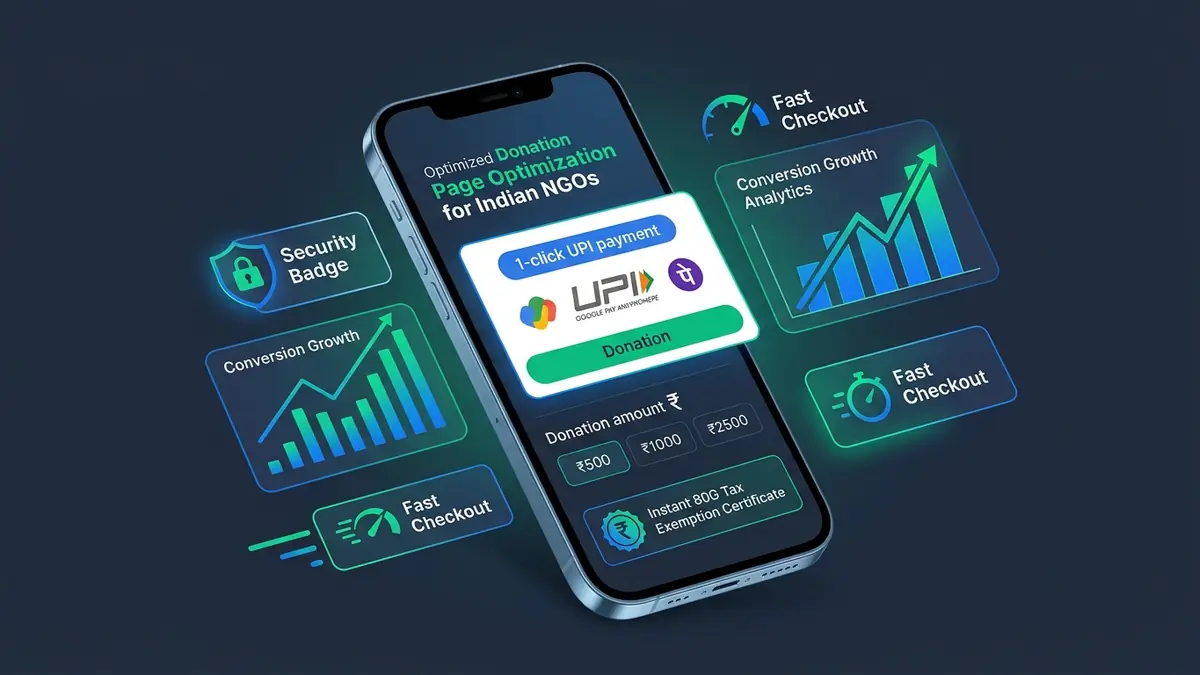
1. Anatomy of the High-Converting Indian Donation Funnel
For charitable organizations operating in India, your donation page represents the single most critical digital touchpoint on your domain. While marketing campaigns, social impact reels, and awareness articles attract visitors to your website, the transaction completion rate on your donation page dictates your actual fundraising yield. Industry benchmarks in India reveal that over 68% of visitors who click a “Donate” call-to-action abandon the session before completing payment.
This catastrophic drop-off is rarely caused by donor hesitation about your social cause; it is driven by technical friction, poor mobile UX, cluttered multi-step checkout forms, and cumbersome payment options. By re-engineering your donation page architecture in alignment with modern user psychology and Indian payment habits, social sector organizations can multiply conversion rates by 2.5x to 4x.
As detailed in our blueprint on NGO Website Architecture for Donor Trust, a high-converting donation page is not a generic form; it is an optimized single-screen checkout machine designed to facilitate instant generosity.
2. Quantified Giving Tiers: Anchoring & Donor Psychology
One of the most widespread errors on Indian non-profit donation pages is offering a blank input box that forces the donor to decide how much to contribute. Behavioral economics demonstrates that decision fatigue leads directly to abandonment. High-performing donation pages implement Quantified Giving Tiers paired with price anchoring:
- Concrete Impact Association: Rather than arbitrary figures like ₹500, ₹1,000, or ₹5,000, tie each tier to a tangible outcome (e.g., “₹1,200 feeds a child mid-day meals for 1 month” or “₹3,500 sponsors vocational sewing training for 1 woman”).
- The Goldilocks Anchor: Present 3 to 4 pre-selected buttons (e.g., ₹1,500 | ₹3,000 | ₹7,500 | Custom Amount), with the middle tier highlighted as “Most Impactful”. This anchors donor expectations and lifts average transaction sizes by over 35%.
- Currency Toggle: Provide clear currency selectors (INR ₹ vs. USD $) only if you maintain valid international approvals under the Foreign Contribution Regulation Act (FCRA), as detailed in our guide on NGO Payment Gateway Integration in India.
3. Mobile UPI Intent: Eliminating 70% of Abandoned Checkouts
Over 82% of philanthropic website traffic in India originates from mobile smartphones. Yet countless NGOs still force mobile visitors to endure archaic payment flows: such as manually typing a Virtual Payment Address (VPA / UPI ID), waiting for an SMS push notification, or navigating complex 3D-Secure credit card OTP verifications.
Modern non-profit web architecture must implement 1-Click UPI Intent through modern gateway SDKs (such as Razorpay Standard Checkout or Cashfree Seamless). When a donor taps “Proceed to Pay” on a mobile device, the browser automatically deep-links into installed native UPI apps on the phone: Google Pay, PhonePe, Paytm, or BHIM:
The 1-Click Mobile UPI Intent Flow:
- Donor selects donation tier and inputs basic details on the mobile web page.
- Tapping “Donate via UPI” surfaces native app sheets (GPay, PhonePe, Paytm).
- Donor selects app, verifies biometric fingerprint or 4/6-digit UPI PIN.
- Payment succeeds in under 12 seconds with zero manual data entry and zero URL redirects.
4. Real-Time PAN Validation & 80G Compliance Friction
Under Income Tax Department guidelines and mandatory annual Form 10BD electronic filings, non-profits must capture each donor’s Permanent Account Number (PAN) to issue valid Section 80G tax deduction receipts. However, making PAN a mandatory blocking field often deters casual or micro-donors who do not have their PAN card immediately accessible.
The Smart Compliance Architecture:
- Opt-In 80G Toggle: Display an explicit toggle switch: “Do you require a Section 80G Tax Exemption Receipt? (Yes / No)”. If the user selects “No”, the PAN field hides instantly, eliminating friction for micro-donors.
- Client-Side Regex Validation: When “Yes” is checked, validate the PAN format in real time using client-side JavaScript regex (
^[A-Z]{5}[0-9]{4}[A-Z]{1}$) with automatic uppercase formatting. This prevents invalid entries from crashing automated Form 10BD bulk uploads. - Delayed Data Capture: For donors who check out without entering their PAN, provide a post-payment link on the confirmation screen and via WhatsApp where they can supply their PAN within 48 hours to claim their tax certificate.
Review our statutory guide on 80G and 12A Registration for NGOs in India to understand the compliance liabilities of inaccurate donor reporting.
5. Architectural Framework for UPI Autopay & Recurring Giving
One-time donations provide temporary relief, but monthly recurring giving provides sustainable operational funding for non-profits. Traditionally, recurring mandates in India relied on credit card standing instructions or physical e-NACH mandates that faced high failure rates following RBI tokenization directives.
In 2026, UPI Autopay is the cornerstone of recurring giving in India. By integrating recurring subscription webhooks into your website, donors can authorize monthly contributions (e.g., ₹500 or ₹1,000 per month) directly from their UPI app. The donor approves a 1-time mandate via UPI PIN, after which subsequent debits happen automatically on the scheduled day without requiring repeat donor action.
Automating these recurring donor pipelines with open-source tools drastically reduces administrative overhead. Learn how to construct self-hosted automation workflows in our manual on n8n Workflow Automation for NGOs.
6. Institutional Trust Signals & Sub-Second Page Speed
Financial transactions trigger intense scrutiny. If a donor detects outdated design, broken security locks, or laggy performance, they immediately suspect fraud and abandon the checkout.
Essential On-Page Trust Signals:
- Statutory Registration Badges: Display verified registration details prominently in the checkout sidebar: NITI Aayog Darpan ID, 12A/80G Registration URN, and Trust/Society/Section 8 Registration Number.
- Payment Security Seals: Verified security badges (256-Bit SSL Encryption, PCI-DSS Level 1 Certification, Razorpay/Cashfree Verified Partner).
- Sub-Second Load Times: Ensure Largest Contentful Paint (LCP) is under 1.2 seconds. Slow donation pages lose up to 10% conversion per second of delay. Optimize images into lightweight WebP format and serve assets via a global CDN.
For technical implementation details, see our architectural review on Custom NGO Website Development in India.
7. The Automated Post-Donation WhatsApp & Email Loop
The donor conversion journey does not conclude when payment succeeds; the post-donation interaction determines whether the donor becomes a lifelong advocate or never gives again.
Indian donors expect instant confirmation. By utilizing gateway webhook events (payment.captured), your website can trigger real-time automations:
- Instant Webhook Reception: The server validates the encrypted webhook signature from the payment gateway.
- Dynamic 80G PDF Generation: Generates a digitally signed 80G receipt PDF containing donor PAN, serial number, and organizational seal.
- WhatsApp & Email Dispatch: Sends the PDF receipt directly to the donor’s WhatsApp number and inbox within 30 seconds.
- CRM Synchronization: Ingests the donor profile into your central database for annual Form 10BD compilation. Explore our guide on Open Source NGO CRM Systems.
8. 12-Point Donation Page Technical CRO Checklist
Review your existing NGO donation page against this 12-point technical and UX checklist to identify conversion leaks:
- Single-Page Architecture: Form fields, impact tiers, and payment triggers reside on one page without multi-step navigation.
- Mobile-First Design: Large tap targets (minimum 48px height) for thumbs on touchscreens.
- Pre-Selected Impact Amounts: Tiered buttons with pre-selected default value.
- Native UPI Intent: Deep-links directly to GPay, PhonePe, and Paytm on mobile devices.
- 1-Click QR Code on Desktop: Renders dynamic UPI QR code on desktop screens for immediate mobile scanning.
- Conditional 80G PAN Field: PAN input appears only if the donor requests a tax deduction receipt.
- Inline Error Messaging: Real-time input validation preventing full form resets on errors.
- Statutory Registration Display: Trust/Darpan/80G numbers clearly visible beside the checkout button.
- Sticky Donation CTA: On mobile screens, the donation button remains fixed at the bottom viewport during scrolling.
- Sub-2 Second Loading: Fast Core Web Vitals with compressed WebP media.
- Automated PDF Receipt: Webhook-driven receipt generation and WhatsApp delivery.
- Donor Privacy Protection: DPDP Act 2023 compliant data collection statement.
9. Frequently Asked Questions (FAQs)
Q1: What is the optimal number of donation amount tiers to display?
Extensive conversion testing on Indian non-profit websites shows that 3 to 4 pre-set tiers (such as ₹1,000, ₹2,500, and ₹5,000) combined with an open “Custom Amount” field yield the highest conversion rates. Displaying more than four choices induces choice paralysis and reduces completed checkouts.
Q2: Why should an NGO avoid external payment redirect pages?
Redirecting donors away from your organization’s domain to third-party hosted checkout URLs creates psychological friction and distrust. Donors wonder if they have been phished. Utilizing embedded on-site modal checkouts preserves domain trust and increases completed payments by 30% to 45%.
Q3: How should an NGO handle anonymous donations without PAN?
Under Section 115BBC of the Indian Income Tax Act, anonymous cash donations exceeding 5% of total receipts or ₹1 Lakh are taxed at 30%. However, digital bank transfers and UPI transactions are not strictly anonymous because banking records identify the sender. Nevertheless, donors who refuse to provide PAN cannot be issued an 80G tax receipt and cannot be included in Form 10BD.
Q4: What transaction fee does UPI charge for charitable donations in India?
Under National Payments Corporation of India (NPCI) directives, peer-to-peer and standard peer-to-merchant UPI payments incur zero Merchant Discount Rate (MDR) for registered charitable entities. Payment gateway aggregators charge only nominal processing fees or zero MDR on verified non-profit merchant accounts.