
FCRA 2010 Mandate
2026 Edition
FCRA Form FC-4 Filing in India: Complete 2026 Guide
•
Published: October 31, 2026
•
18 Min Read
•
Verified for Assessment Year 2026-2027
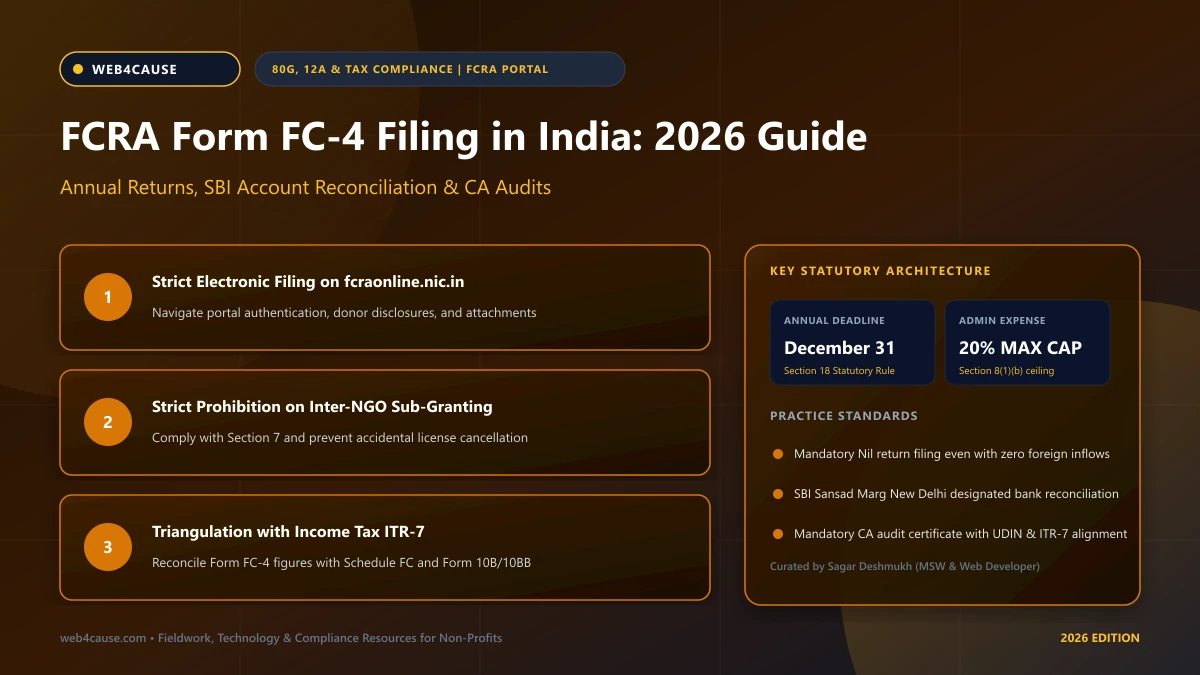
Master the complete statutory architecture of FCRA Form FC-4 annual returns under Section 18 of the Foreign Contribution (Regulation) Act, 2010 and Rule 17 of FCRR 2011. Navigate the non-negotiable December 31 statutory cutoff, State Bank of India New Delhi Main Branch account reconciliation, Chartered Accountant UDIN certification schedules, the strict Section 8(1)(b) 20% administrative expense ceiling, and the absolute prohibition on inter-organizational sub-granting in 2026.
1. The Statutory Framework of FCRA Form FC-4: Section 18 and Rule 17 Mandate
In Indian non-profit governance, managing foreign contributions represents the highest level of regulatory scrutiny. While domestic fundraising is governed by the Income Tax Act under Section 80G and Section 12A registration, any funds originating outside the sovereign boundaries of India fall under national security legislation: the Foreign Contribution (Regulation) Act, 2010 (FCRA 2010), administered directly by the Foreigners Division of the Ministry of Home Affairs (mha.gov.in).
The core mechanism through which the Central Government monitors foreign funding is the annual electronic return filed in Form FC-4. The statutory basis for this submission rests upon Section 18 of the Act, which mandates that every person or organization granted an FCRA registration certificate or prior permission shall intimate to the Central Government the exact amount of foreign contribution received, the source, the manner of receipt, and the specific purpose for which it was utilized.
This statutory command is operationalized through Rule 17 of the Foreign Contribution (Regulation) Rules, 2011 (FCRR 2011), as substantially amended by Act 33 of 2020. Under Rule 17(1), the annual return must be submitted in electronic form exclusively through the official web portal of the Ministry of Home Affairs (fcraonline.nic.in).
Statutory Filing Timeline for Financial Year Reporting
The reporting period covers the financial year beginning on April 1 and concluding on March 31. Under Rule 17, Form FC-4 must be filed within nine months following the closure of the relevant financial year. Therefore, the absolute statutory deadline is December 31. For Financial Year 2025-2026, the cutoff is strictly December 31, 2026.
Non-profit leaders must recognize that the Ministry of Home Affairs does not grant individual ad-hoc extensions. The December 31 cutoff is enforced algorithmically. Once midnight passes, unsubmitted drafts are locked, and the portal levies daily compounding late fees before permitting uploads. Understanding this framework is vital for charitable trusts, societies, and Section 8 institutions structured under our trust vs society vs Section 8 company comparison.
2. The Zero-Tolerance Mandate: Why Nil Returns Are Strictly Non-Negotiable
A widespread misconception among grassroots trustees is that filing Form FC-4 is optional if no foreign funds were received. Trustees often assume that having zero receipts and zero expenditures negates the need to report. This assumption is completely false and leads directly to regulatory cancellation.
The statutory obligation enacted under Section 18 and Rule 17 is attached to the status of holding an FCRA certificate, not to transaction volume. If an association holds an active FCRA registration certificate or an approved prior permission letter, it is legally bound to file Form FC-4 every single year, regardless of whether foreign receipts were fifty crore rupees or exactly zero rupees.
Statutory Warning: Rule 17(1) Nil Return Mandate
Under Rule 17(1) of FCRR 2011, filing a Nil return is compulsory. A Nil Form FC-4 requires submitting the electronic form with zero receipt entries, accompanied by certified bank statements from the State Bank of India New Delhi Main Branch verifying zero foreign credits, and an official Certificate from an independent practicing Chartered Accountant confirming that zero foreign funds were received, held, or disbursed.
Failing to file a Nil return by December 31 triggers an immediate administrative escalation chain:
- Algorithmic Scrutiny: On January 1, the portal flags the organization as defaulting and issues an automated notice under Section 13.
- Registration Suspension: Under Section 13(1), the Central Government may suspend FCRA registration for up to 180 days, extendable by an additional 180 days.
- Freezing of SBI Accounts: Under Section 13(2), an organization under suspension cannot receive or utilize foreign contribution without prior government approval. The Ministry instructs the State Bank of India to freeze debits immediately.
- Cancellation under Section 14: Under Section 14(1)(d), failure to submit statutory annual returns leads to permanent registration cancellation.
- Three-Year Debarment: Under Section 14(3), a cancelled association is debarred from applying for fresh registration or prior permission for three full years.
- Vesting of Assets under Section 15: Unutilized foreign contributions and assets acquired from foreign funds vest in the government authority.
Over ninety percent of FCRA cancellations over the past decade stemmed from procedural defaults where organizations neglected timely Nil filings.
3. Two-Tier Banking Architecture and Rigorous Account Reconciliation
The 2020 Amendment fundamentally reorganized non-profit banking by replacing decentralized bank accounts with a centralized two-tier banking architecture governed by Section 17.
Tier-1 Primary Designated FCRA Account (SBI NDMB)
Under Section 17(1), every non-profit receiving foreign contributions must maintain a primary designated account exclusively at:
Bank: State Bank of India (SBI)
Branch: New Delhi Main Branch (NDMB), 11, Sansad Marg, New Delhi 110001
Branch Code: 00691 | IFSC: SBIN0000691
All foreign inward remittances must land directly into this single branch. Commingling domestic funds in the SBI NDMB account is strictly illegal. No domestic donations, CSR contributions, or government grants may enter this account.
Tier-2 Secondary FCRA Utilization Bank Accounts
Under the second proviso to Section 17(1), non-profits can maintain secondary utilization bank accounts in any scheduled bank for disbursing project expenses. These accounts operate under closed-loop controls:
- Unidirectional Capital Flow: Funds flow solely from the SBI NDMB account into secondary utilization accounts. Utilization accounts cannot receive direct international wire transfers.
- Mandatory Ministry Intimation: Opening or modifying an account must be reported electronically in Form FC-6D within fifteen days.
- Zero Domestic Intermixing: Utilization accounts must remain strictly segregated from local operational bank ledgers.
| Reconciliation Component | Statutory Document | Verification Check in Form FC-4 |
|---|---|---|
| Inward Remittance Advice | FIRC / FIRA from SBI NDMB | Match donor legal name, country, foreign currency, converted INR, and credit date. |
| Bank Intermediary Charges | SBI NDMB Debit Advice | Report gross remittance received and classify intermediary deductions as bank charges. |
| Bank Interest Accrual | Savings & FD Certificates | Under Rule 11, interest earned on foreign deposits is legally foreign contribution and must be declared. |
| Closed-Loop Transfers | Inter-account NEFT records | Ensure transfers from SBI NDMB to utilization accounts net to zero in consolidated schedules. |
| Fixed Deposits (FDs) | FD Receipts from SBI | FDs must be unencumbered. Pledging FCRA fixed deposits for loans is strictly illegal. |
4. Strict Statutory Ceilings: Section 8(1)(b) 20% Cap and Section 7 Sub-Granting Ban
The 2020 amendments introduced two strict statutory restrictions designed to enforce direct programmatic accountability and eliminate intermediary grantmaking.
Section 8(1)(b): The 20% Administrative Expense Cap
Section 8(1)(b) limits administrative expenditures to a maximum of 20% of foreign contributions received during the financial year, down from 50%.
Under Rule 5 of FCRR 2011, administrative expenses include:
- Salaries, allowances, and benefits paid to trustees, governing council members, or central office staff.
- Rent, repairs, and lease expenses for central administrative offices and corporate premises.
- Utilities including office electricity, water, telephone, and internet connections.
- Professional retainers paid for legal counsel, accounting, secretarial, and audit services.
- Maintenance, fuel, and running expenses of vehicles assigned for administrative oversight.
- Travel, lodging, and conveyance incurred by trustees for governance and board meetings.
Field Social Work Exclusions from Administrative Cap
Salaries paid to front-line field staff such as social workers, clinic nurses, teachers in project schools, and community animators directly implementing programmes are classified as direct programme costs. They are excluded from the 20% ceiling. Explore our field methods guide for community mobilization techniques.
Administrative Ratio (%) = [Total Administrative Expenses / Total Foreign Contributions Received in FY] × 100 ≤ 20.00%
Exceeding 20% without prior written approval from the Central Government violates Section 8 and exposes the association to Section 41 compounding penalties or registration cancellation under Section 14.
Section 7: Total Prohibition on Sub-Granting and Fund Transfers
Section 7 of the Act establishes an absolute ban on sub-granting:
“No person who is registered and granted a certificate or has obtained prior permission under this Act shall transfer such foreign contribution to any other person.”
Because “person” includes trusts, societies, and Section 8 non-profits, an FCRA holder cannot transfer foreign funds to any other NGO, even if the recipient holds valid FCRA registration. The receiving entity must directly execute project activities. While non-profits may retain commercial vendors for supplies or transportation subject to statutory TDS under Section 194C or 194J, sub-granting under the guise of vendor contracts is treated as criminal fraud.
5. Step-by-Step Electronic Filing Walkthrough on fcraonline.nic.in
Filing Form FC-4 requires entering verified accounting schedules on the official portal (fcraonline.nic.in). Ensure your nodal officer holds portal credentials and an active DSC or Aadhaar OTP linkage.
Step 1: Portal Authentication and Profile Verification
Log into the FCRA Online portal and select “FC-4 Annual Return”. Confirm that the auto-populated FCRA registration number, address, PAN, and NITI Aayog Unique ID match your profile on the NITI Aayog NGO Darpan portal.
Step 2: Donor-Wise Inward Contribution Schedules
Under Part 2, record every foreign remittance received directly. Enter donor legal name, registered overseas address, country, category (Institutional, Individual, UN Agency), approved purpose (Cultural, Economic, Educational, Religious, Social), credit date in the SBI NDMB account, foreign currency amount, and converted INR value.
Step 3: Foreign Contribution from Local Sources and Bank Interest
Under Part 3 and Part 4, declare foreign contributions received from local sources under Rule 13. Declare all interest accrued during the financial year on the SBI NDMB savings account, secondary utilization balances, and fixed deposits created from foreign funds.
Step 4: Expenditure and Utilization Breakdown
Under Part 5, allocate foreign expenditures according to your approved charter. Itemize direct programmatic project costs, administrative overhead subject to the Section 8(1)(b) 20% limit, and capital asset purchases supported by an updated fixed asset register.
Step 5: Consolidated Financial Position & Bank Balances
Part 6 reconciles the fund position: Opening balance as of April 1, plus Total Receipts and Accrued Interest, minus Total Foreign Expenses, equaling Closing balance as of March 31. This must equal the combined balance across SBI NDMB, utilization accounts, and fixed deposits.
Step 6: Document Uploads, CA UDIN Verification, and Final Submission
Upload mandatory attachments in searchable PDF format (under 5 MB): (a) Audited standalone Balance Sheet, (b) Income and Expenditure Account, (c) Receipts and Payments Account, (d) Certified 12-month SBI NDMB statement, (e) Certified utilization account statements, and (f) Chartered Accountant Certificate with verified 18-digit UDIN. Sign via DSC or OTP and download the acknowledgement.
6. Mandatory Chartered Accountant Certification and UDIN Audit Schedules
Form FC-4 cannot be self-certified. Under Rule 17(5) of FCRR 2011, the return must be accompanied by an official Certificate issued by an independent practicing Chartered Accountant holding an active Certificate of Practice from the Institute of Chartered Accountants of India (icai.org).
Statutory Scope of the CA Certificate
The auditor certifies under professional seal that:
- Books of account and vouchers exclusively maintained for foreign contributions were examined for the financial year ending March 31.
- Separate accounts, ledgers, and voucher records were maintained in compliance with Section 19 and Rule 11.
- The Receipts and Payments Account, Income and Expenditure Account, and Balance Sheet reflect a true and fair view of foreign contribution transactions.
- Receipts and accrued interest match certified statements from SBI NDMB and utilization bank branches.
- Administrative expenses comply with the Section 8(1)(b) 20% limit, or prior Central Government sanction was obtained.
The Mandatory 18-Digit UDIN Protocol
The CA certificate must feature an 18-digit Unique Document Identification Number (UDIN) generated on udin.icai.org. The Ministry of Home Affairs cross-checks this identifier against ICAI active databases. Any certificate bearing an unverified or expired UDIN results in portal rejection.
Exclusivity of Standalone FCRA Financial Statements
Auditors must not upload consolidated statements that mix domestic 80G donations, CSR grants, and foreign funds. Uploaded schedules must represent standalone foreign contribution statements. The Receipts and Payments Account must trace every single foreign rupee from opening to closing balance.
7. Triangulation and Reconciliation: Form FC-4, ITR-7 (Schedule FC), and Form 10B/10BB
Under the Government of India integrated digital compliance architecture, the Central Board of Direct Taxes (incometax.gov.in) and the Ministry of Home Affairs exchange automated data feeds.
Disclosures in Form FC-4 are cross-matched against your income tax filings:
- ITR-7 Schedule FC: Foreign contribution receipts, interest, utilization, and unspent balances declared in Schedule FC of your ITR-7 return must align with Form FC-4.
- Form 10B / Form 10BB Audit Reports: Tax audit schedules submitted under Section 12A(1)(b)(ii) must reflect matching foreign grant totals.
- Form 10BD Statements: Foreign contributions must never be mixed with domestic donations reported under Form 10BD donation schedules.
Resolving the Cash vs Accrual Accounting Conflict
Cash Basis (FC-4) vs Accrual Basis (ITR-7)
Form FC-4 is strictly constructed on a Cash Accounting basis (Receipts and Payments). Expenses are recognized only upon bank debit. Conversely, ITR-7 returns and audited financial statements are frequently prepared on an Accrual basis, recognizing payables, accrued liabilities, and non-cash depreciation. Non-profits must maintain a formal Reconciliation Memorandum explaining these timing and accounting variances to prevent automated tax scrutiny notices.
8. Automated Scrutiny Triggers, Section 41 Compounding, and Enforcement Actions
The Ministry of Home Affairs deploys data analytics to flag filings for inspection and regulatory enforcement.
The Top 7 Scrutiny Triggers
- SBI NDMB Quarterly Mismatches: Discrepancies between quarterly inward remittances reported by SBI and annual totals in Form FC-4 trigger immediate notices.
- Administrative Ratio Above 20.00%: Portals compute overhead automatically; exceeding 20% without prior government sanction flags the return.
- Opening Balance Discrepancy: The April 1 opening balance must match the preceding March 31 closing balance to the exact rupee.
- High-Risk Foreign Remittances: Receipts originating from FATF monitored jurisdictions or unverified crowdfunding portals invite heightened inspection.
- Sub-Granting or Third-Party Disbursals: Entries reflecting fund transfers to other voluntary entities trigger Section 7 investigations.
- Unaccounted Bank Interest: Failing to report bank interest credited in the SBI NDMB statement violates Rule 11.
- Submissions After December 31: Late filing locks account functions and prompts compounding penalty orders under Section 41.
Compounding of Offenses under Section 41
Under Section 41 of FCRA 2010, procedural technical lapses can be compounded through monetary settlement without criminal prosecution:
| Statutory Violation | Legal Section | Standard Compounding Penalty Fee |
|---|---|---|
| Delay in Filing Form FC-4 (up to 3 months) | Section 18 & Rule 17 | ₹10,000 or 2% of foreign contribution received, whichever is higher. |
| Delay in Filing Form FC-4 (3 to 6 months) | Section 18 & Rule 17 | ₹20,000 or 3% of foreign contribution received, whichever is higher. |
| Delay in Filing Form FC-4 (beyond 6 months) | Section 18 & Rule 17 | ₹50,000 plus ₹500 per day of continuing default, or 5% of contribution. |
| Failure to Intimate Utilization Bank Account | Section 17 & Rule 17A | ₹10,000 per unnotified bank account. |
| Administrative Expense Exceeding 20% | Section 8(1)(b) | Discretionary compounding or Section 14 cancellation depending on gravity. |
Compounding applies solely to inadvertent administrative errors. Substantive violations like diversion of funds or unauthorized activities lead directly to criminal prosecution under Section 35 and permanent certificate cancellation under Section 14.
9. Trustee Pre-Filing Checklist: 10 Point Verification Protocol
Before the managing trustee or nodal officer completes the final electronic submission on fcraonline.nic.in, the governing board must complete this 10-point compliance audit:
| No. | Compliance Audit Checkpoint | Verification Standard & Threshold | Status |
|---|---|---|---|
| 01 | SBI NDMB Statement Reconciliation | Certified 12-month bank statement matches all declared foreign inward remittances rupee-for-rupee. | Verified |
| 02 | Utilization Account Closed-Loop Check | Zero domestic credits in secondary accounts; all incoming credits originate exclusively from SBI NDMB. | Verified |
| 03 | Administrative Expense Cap | Administrative costs strictly ≤ 20.00% of foreign contributions, verified using Rule 5 guidelines. | Verified |
| 04 | Zero Sub-Granting Audit | Zero funds transferred to any other non-profit or voluntary association, adhering strictly to Section 7. | Verified |
| 05 | Bank Interest & FD Ledger | All savings interest and fixed deposit earnings accounted for as foreign contribution under Rule 11. | Verified |
| 06 | Opening Balance Continuity | April 1 opening balance matches previous year Form FC-4 closing balance to the exact decimal rupee. | Verified |
| 07 | Standalone Audit Schedules | Audited Balance Sheet, Income & Expenditure, and Receipts & Payments isolated from domestic trust funds. | Verified |
| 08 | CA Certificate & Active UDIN | Practicing Chartered Accountant certificate uploaded with verified 18-digit UDIN validated on udin.icai.org. | Verified |
| 09 | ITR-7 Schedule FC Triangulation | Reconciliation Memorandum prepared harmonizing cash FC-4 figures with accrual figures in ITR-7 and Form 10B. | Verified |
| 10 | File Size & PDF Formatting | All document attachments scanned in clean, searchable PDF format under 5 MB with crisp textual legibility. | Verified |
10. Frequently Asked Questions (FAQ)
Q1: What is the exact statutory deadline for filing FCRA Form FC-4, and can an extension be granted?
Under Section 18 of the Foreign Contribution (Regulation) Act, 2010 read with Rule 17 of the Foreign Contribution (Regulation) Rules, 2011, every non-profit holding FCRA registration or prior permission must submit Form FC-4 within nine months following the closure of the financial year. The statutory deadline is December 31. While the Ministry of Home Affairs (MHA) has historically issued occasional public circulars extending the cutoff during national regulatory transitions, associations cannot apply for individual ad-hoc extensions. Missing December 31 triggers daily compounding late fees, risk of suspension, and account operational holds.
Q2: Is an NGO required to file Form FC-4 if zero foreign contribution was received or utilized during the financial year?
Yes. Nil returns are strictly mandatory under Rule 17(1). Even if an association received zero foreign funds, held zero foreign opening balance, and incurred zero expenditure, submitting Form FC-4 before December 31 remains a compulsory statutory requirement. The Nil filing must include certified statements from the designated SBI New Delhi Main Branch account showing zero foreign receipts alongside the Chartered Accountant certificate. Assuming that inactivity excuses an organization from filing is the leading procedural cause of FCRA registration cancellation under Section 14.
Q3: How is the 20% administrative expense ceiling under Section 8(1)(b) calculated, and what happens if an NGO exceeds it?
Following the FCRA Amendment Act of 2020, Section 8(1)(b) restricts administrative expenditures to a maximum of 20% of total foreign contributions received during the financial year. Administrative expenses under Rule 5 include executive salaries, office rent, utilities, audit charges, vehicle maintenance, and governance travel. Direct programme costs such as field social worker salaries, project medical supplies, and relief distribution are excluded. If an organization exceeds 20% without prior written approval from the Central Government, it constitutes a statutory breach punishable under Section 41 compounding penalties or registration cancellation under Section 14.
Q4: Can an FCRA registered non-profit transfer foreign funds to another FCRA registered trust to implement a project?
No. Under Section 7 of the amended Foreign Contribution (Regulation) Act, 2010, inter-organizational transfers and sub-granting of foreign contributions are completely prohibited. Even if both the grantor and grantee institutions possess valid, active FCRA registration certificates, foreign funds cannot be disbursed from one non-profit to another. The recipient entity must directly execute project activities and utilize 100% of the foreign contribution through direct procurement, staff employment, and commercial service contracts.
Q5: How is interest earned on fixed deposits or savings balances in the SBI NDMB account treated under FCRA?
Under Rule 11 of the Foreign Contribution (Regulation) Rules, 2011, any interest accrued on foreign contribution deposits held in savings accounts or short-term fixed deposits is legally deemed to be foreign contribution itself. Such interest income must be accounted for in the foreign cash book, reported explicitly in Form FC-4 under receipt schedules, and spent exclusively for the approved statutory objectives of the trust. Accrued interest cannot be transferred to domestic operational bank accounts or utilized for unauthorized administrative overhead.
Q6: How does the Ministry of Home Affairs cross-verify Form FC-4 data with Income Tax Return ITR-7 filings?
The Ministry of Home Affairs (MHA) shares integrated automated data pipelines with the Central Board of Direct Taxes (CBDT) and the Reserve Bank of India (RBI). When an NGO files Form FC-4, the portal algorithms cross-reference foreign receipts, bank interest, and closing balances with Schedule FC of Income Tax Return ITR-7, Form 10B/10BB audit reports, and quarterly bank intimations submitted by State Bank of India NDMB. Material discrepancies between cash-based FC-4 disclosures and accrual-based ITR-7 schedules trigger automated risk scrutiny flags and formal notices from both authorities.