
Viva Voce Manual
2026 Academic Edition
MSW Fieldwork Documentation and Viva Voce in India: 2026 Guide
•
Published: October 31, 2026
•
16 min read
•
Curriculum Reference Edition
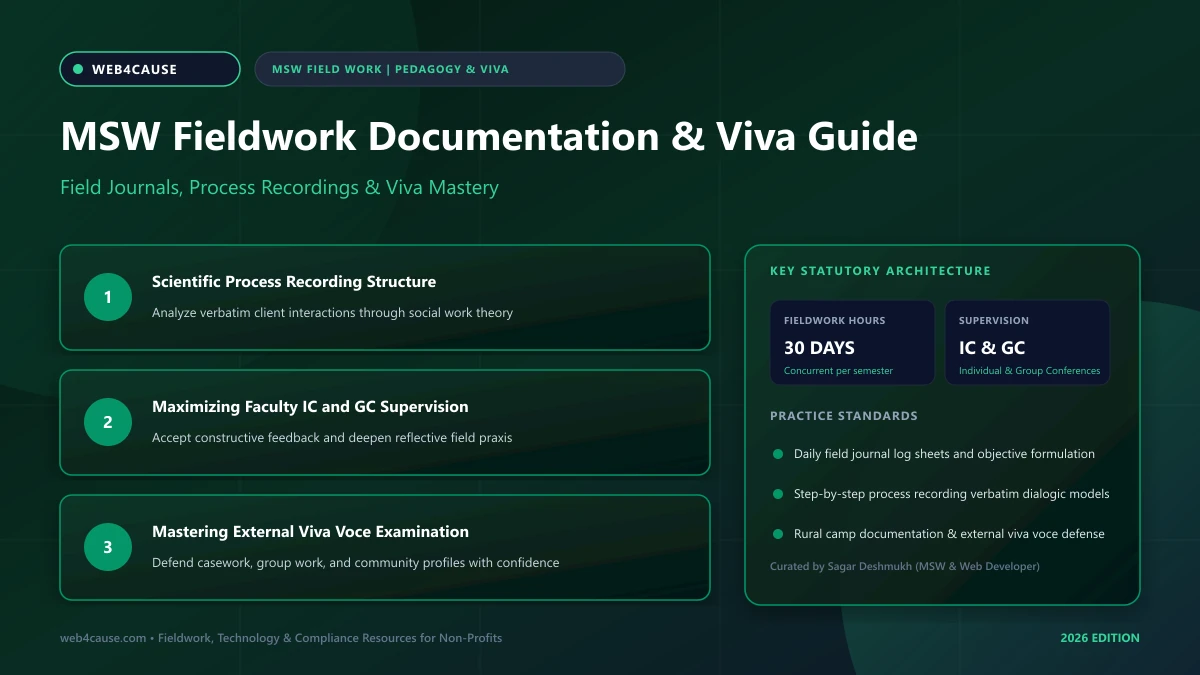
Executive Academic Summary: Documentation as the Spine of Social Work Practicum
Fieldwork practicum represents 30 to 40 percent of total credit weighting in Indian Master of Social Work (MSW) curricula. Professional documentation is neither a casual diary nor an emotional journal. It is an empirical and diagnostic instrument that validates clinical competence, ethical accountability, and systemic analysis. This manual provides students, faculty supervisors, and agency instructors with an academic blueprint covering day-wise log writing, verbatim process recording, supervision conferences, specialized community profiles, and external viva defense strategies.
In professional social work education across India, concurrent fieldwork documentation separates untrained volunteers from accredited social workers. Premier institutions like the Tata Institute of Social Sciences (TISS, Mumbai), the Delhi School of Social Work (DSSW), the Karve Institute of Social Service (Pune), Savitribai Phule Pune University, and the Madras School of Social Work (MSSW) follow guidelines set by the University Grants Commission (UGC). As outlined in our guide to MSW field work practicum in India, documentation makes the student’s inner analytical reasoning visible to supervisors and examiners. When evaluating interventions, examiners study why specific questions were asked, which theoretical frameworks guided decisions, how personal biases were managed, and how statutory entitlements were leveraged to resolve systemic barriers.
1. The Crucible of Professional Social Work: Amateur Charity vs Professional Documentation
Amateur volunteering relies on moral enthusiasm, personal sympathy, and uncoordinated material distribution. Professional social work, conversely, is an applied social science grounded in constitutional ethics, human rights law, and structured behavioral intervention. The written field journal represents the crucible where classroom theories regarding social stratification, group dynamics, psychopathology, and public administration confront rural poverty, urban displacement, and institutional gatekeeping.
| Dimension | Amateur Volunteer Field Diary | Professional MSW Evaluative Journal |
|---|---|---|
| Primary Stance | Paternalistic, pity-driven observation. | Analytical, rights-based, constitutional entitlements. |
| Recording Style | Vague impressions: “Visited slum, people are poor.” | Empirical precision: Demographics, ration status, water access. |
| Self-Awareness | Absent or focused on personal virtue. | Rigorous tracking of counter-transference and biases. |
| Theory Integration | Zero conceptual grounding; treats issues as bad luck. | Applies Biestek casework, Freirean dialogue, systems theory. |
| Intervention Goal | Ad-hoc material handouts (food packets, clothes). | Capacity building, collective agency, policy linkages. |
| Confidentiality | Casual disclosure of names and social media photos. | Strict DPDP anonymization, encrypted notes, consent. |
In recognized universities, concurrent fieldwork requires 15 contact hours weekly across two days, totaling 25 to 30 agency visits each semester. When students delay documentation, critical nuances disappear. Details such as an elder’s struggle with biometric pension authentication or subtle caste boundaries around community water sources become lost. Regular, disciplined documentation provides the only verifiable record of academic and clinical growth.
2. The Anatomy of a Flawless Field Journal: Day-Wise Log Structure
A professional field journal requires a standardized, logical format. Faculty supervisors reviewing numerous journals weekly expect clear structural markers rather than disorganized essays.
The Six Mandatory Elements of Every Daily Fieldwork Report
Date, semester day count, arrival time, departure time, total field hours, agency name, faculty supervisor, and agency instructor.
Specific, Measurable, Achievable, Relevant, and Time-bound educational objectives established prior to field entry, such as conducting intake interviews with adolescent school dropouts.
Chronological, factual documentation of activities, community meetings, home visits, and stakeholder dialogues without premature subjective conclusions.
Deconstruction of field realities using social science concepts: caste hierarchies, gender dynamics, bureaucratic bottlenecks, or resource maldistribution.
Candid examination of the worker’s emotional responses, moral discomfort, impatience, feelings of helplessness, or unrecognized social biases.
Operational steps for upcoming visits, planned institutional referrals, required policy reviews, and specific professional literature to consult.
A frequent issue in student journals is confusing factual reporting with analytical interpretation. While factual description records events, analytical assessment deconstructs systemic causality: showing how pipeline sewage infiltration reflects municipal negligence along settlement boundaries, and how resident helplessness highlights the need for collective representation under public health legislation.
3. Masterclass on Process Recording: The Clinical Core of Social Work
While daily log sheets capture broad activities, the Process Record is the specialized clinical tool of social work practice. Rooted in casework pedagogy and detailed in our manual on the social case work method in India, process recording reconstructs verbatim dialogue and interaction dynamics across six core sections: (1) Anonymized Face-Sheet and physical setting, (2) Stated Session Purpose, (3) Three-Column Verbatim Dialogue Matrix, (4) Diagnostic Evaluation applying Richmond and Biestek principles, (5) Interaction Dynamics tracking transference and resistance, and (6) Agreed Follow-Up Tasks.
Clinical Practice Standard: The Three-Column Dialogue Matrix
Professional Indian social work journals record verbatim dialogue in three columns: the first tracks dialogue and body language; the second records worker visceral feelings and biases; the third delivers theoretical analysis.
| Column 1: Verbatim Dialogue & Non-Verbal Cues | Column 2: Worker Visceral Feelings & Inner Biases | Column 3: Analytical Assessment & Theory Linkage |
|---|---|---|
|
Worker: “Namaste Shantabai. I came by as we agreed last Thursday to discuss your widow pension application.” (Worker sits on the door threshold upon invitation, maintaining an eye level below the client.) |
I felt anxious that she might have forgotten our appointment. I felt relief when she answered, but self-conscious of my clean clothes in her damp tenement. | Principle of Acceptance & Dominance Reversal: Sitting on the threshold minimizes social distance between an urban university student and an impoverished widow. |
| Client: (Looks downward, adjusts saree pallu with trembling hands, speaks softly) “What is the use, Saheb? The clerk at the Tehsil office said without my husband’s original death certificate, the file will be rejected.” | I felt anger toward the municipal clerk. I felt an impulse to say: “Do not worry, I will go and reprimand the clerk for you.” | Learned Helplessness & Paternalism: Client shows defeatism from bureaucratic exclusion. Worker experiences counter-transference, risking Biestek’s principle of Client Self-Determination. |
| Worker: “It is frustrating when officials turn you away without guidance. You have overcome many hardships since your husband passed away. What occurred when you checked at the civil hospital records room?” | I focused on staying calm and controlling my savior impulses. I wanted her to recognize her own strength rather than looking to me for total rescue. | Purposeful Expression of Feelings & Strengths Perspective: Validating frustration adheres to Biestek. Highlighting past survival activates latent capacity (Saleebey’s Strengths Perspective). |
| Client: (Looks up, posture straightens) “The records clerk said if I bring the municipal hospital discharge slip, they can trace the record in seven days. I have that slip stored in my trunk.” | I felt genuine encouragement seeing her shift from despair to constructive action. | Active Problem-Solving: Client exercises personal agency. The worker avoids taking over, agreeing to accompany her as an observer while she retrieves the document. |
Examiners evaluate this dialogue matrix closely. If Column 2 contains only casual notes like “I felt good”, examiners conclude the student lacks self-awareness. Social work supervision requires students to acknowledge difficult feelings: impatience, discomfort, moral judgments, or class biases. Documenting these reactions enables supervisors to guide trainees toward ethical, professional practice.
4. Supervision Protocols: Maximizing Individual and Group Conferences
Supervision is the central teaching method of social work practicum. Faculty members serve as clinical guides through two structured formats: Individual Conferences (IC) and Group Conferences (GC).
Individual Conference Protocols
Conducted weekly for 45 to 60 minutes between student and faculty supervisor. Journals must be submitted 48 hours prior. The conference focuses on critical review of process records, deconstructing emotional dilemmas, and planning upcoming field tasks.
Group Conference Protocols
Held bi-weekly with cohorts of 6 to 10 peers in varied placements (hospitals, schools, correctional facilities, rural NGOs). Students present case studies, debate institutional hurdles, and refine analytical communication skills.
The Four-Point Individual Conference Agenda
- Review of Past Feedback: Verification of supervisor comments from prior reports and updates on completed follow-up interventions.
- Clinical Examination of Process Records: Detailed critique of dialogue exchanges, identifying advice-giving tendencies or personal value impositions.
- Agency Administrative Dynamics: Addressing agency instructor expectations, field access limitations, or ethical tensions with organizational policies.
- Upcoming Educational Tasks: Formal approval for scheduled group sessions, community surveys, or advocacy initiatives planned for the next week.
5. Specialized Field Documentation: Community, Agency, and Camp Reports
In addition to daily logs and process records, MSW programs require three specialized field dossiers that form vital sections of the final examination portfolio.
A. The Community Profile Report
The Community Profile is an in-depth baseline assessment of the placement area. It investigates four dimensions: (1) Demographics, gender ratios, literacy levels, and caste settlement patterns; (2) Economic foundations, wage labor trends, informal credit reliance, and PDS coverage; (3) Public infrastructure, piped drinking water, sanitation facilities, and primary healthcare access; and (4) Power hierarchies, comparing elected Gram Panchayat or ward members against informal caste or community leaders, essential concepts detailed in our work on community mobilization in social work.
B. The Agency Organizational Profile
This institutional dossier documents the placement NGO’s legal registration (whether under the Societies Registration Act 1860, the Bombay Public Trusts Act 1950, or Section 8 of the Companies Act 2013). It examines governance structures, statutory tax compliance under Sections 12A and 80G, CSR funding, organograms, staff hierarchies, and community intake systems.
C. The Rural Winter Camp Documentation
The mandatory 7 to 10 day rural immersion camp requires participatory documentation rather than top-down reporting. As detailed in our guide to participatory rural appraisal PRA techniques in India, the camp dossier compiles participatory exercises created alongside villagers.
Rural Camp Dossier Essentials
A complete rural camp portfolio includes: (1) Transect walk matrices recording soil and ecological zones; (2) Social and resource maps drawn by local groups; (3) Gender-disaggregated daily routine charts; (4) Seasonal calendars mapping migration and debt; (5) Venn diagrams assessing local institutions; and (6) Committee minutes reviewing street plays, community mobilization, and student camp coordination.
6. Comprehensive Preparation for the External Viva Voce Examination
The final external viva voce examination evaluates two years of professional development. The panel consists of an external professor from another university, the student’s internal faculty supervisor, and an agency representative.
Structuring the Bound Portfolio
A clean, well-organized journal reflects professional discipline. The hardbound portfolio should follow this sequential order:
- Title Page & Declaration: Candidate registration number, university emblem, agency name, and academic year.
- Supervisory Certificates: Signed attendance confirmation from the agency executive director alongside the faculty supervisor clearance form.
- Index Table: Complete listing of field dates, process records, conference summaries, and special reports with exact page numbers.
- Agency & Community Profiles: Contextual dossiers positioned before daily entries.
- Chronological Daily Logs: Each field visit report paired with its supervisory conference notes and signature.
- Process Records & Group Work Dossiers: Dedicated tabbed section presenting verbatim casework and group work sessions.
- Rural Camp Portfolio: Field matrices, original community maps, street theatre analyses, and camp photos.
The Big Four Theoretical Traditions to Defend
Examiners expect candidates to link field experiences with core social work theories:
1. Mary Richmond (Social Diagnosis)
Applying person-in-environment analysis: evaluating how family dynamics, housing stress, and neighborhood factors produce clinical crises.
2. Felix Biestek (Casework Principles)
Operationalizing core principles: Individualization, Acceptance, Non-Judgmental Attitude, Client Self-Determination, and Confidentiality.
3. Paulo Freire (Conscientization)
Using dialogical problem-posing methods to enable marginalized groups to overcome fatalism and organize for structural reform.
4. Constitutional Rights
Grounding interventions in fundamental guarantees: Article 14 (Equality), Article 21 (Dignity), and Directive Principles under Articles 38 and 39.
Anticipating Examiner Cross-Examinations
Examiners often ask challenging questions to evaluate composure and ethical thinking. Consider these two realistic viva scenarios:
Viva Challenge 1: “You completed six months in this slum settlement, yet your records show only three families received pension benefits. Did you waste educational time?”
Model Response: “Social casework measures success by client capacity building rather than basic delivery metrics. Beyond the three approved pensions, forty-two women learned how to obtain duplicate records, use the municipal portal, and organize representations to the ward officer. When the student leaves, the community retains the procedural literacy to claim entitlements independently.”
Viva Challenge 2: “In your casework notes, a client described domestic abuse. Why did you not immediately take her to the police station for an FIR?”
Model Response: “Filing an immediate police complaint without the client’s consent violates Biestek’s principle of Client Self-Determination and Mary Richmond’s environmental diagnosis. Precipitate police reports can heighten physical danger and trigger eviction. My role was to assess immediate safety, provide supportive counseling, explain legal options under the Protection of Women from Domestic Violence Act 2005, and help her develop a self-directed safety plan.”
7. Digital Modernization and Data Privacy under Indian DPDP Principles
As non-profits and universities adopt electronic records, trainees must comply with data protection standards. Under the Digital Personal Data Protection Act 2023 (DPDP Act) and Ministry of Electronics and Information Technology (MeitY) guidelines, digital casework requires strict operational security.
Confidentiality Standards for Social Work Records
- Mandatory Pseudonyms: Never record real Aadhaar numbers, phone numbers, exact house plots, or legal names in digital notes. Use coded IDs (e.g., Client C-1, Household M-3).
- Facial Privacy: Photos in community mobilization reports must blur faces of minors, psychiatric patients, HIV-positive beneficiaries, and abuse survivors unless written consent exists.
- Secure Device Use: Laptops and tablets used for field documentation must employ disk encryption and password protection. Unprotected public cloud drives must not hold verbatim notes.
- Ethical Data Disposal: Digital casework notes must be archived or erased following the placement agency’s retention protocol at the end of the academic term.
For detailed operational standards on digital infrastructure for non-profits, review our guide to NGO website security and DPDP compliance in India. Demonstrating data privacy awareness during viva examinations highlights a student’s readiness for modern practice.
8. Frequently Asked Questions (FAQ)
Q1: What is the structural difference between a concurrent fieldwork log sheet and a full process record?
A concurrent fieldwork log sheet is an administrative summary of the field day, detailing hours spent, tasks completed, empirical community observations, systemic barriers, and upcoming action plans. In contrast, a process record is an intensive micro-analytical document focused on a single casework or group work session. It captures verbatim dialogue exchanges, non-verbal cues, worker visceral reactions, and explicit theoretical analysis using casework principles.
Q2: How should an MSW student record verbatim dialogue when note-taking during the actual client session is restricted?
Taking extensive notes during emotional casework sessions disrupts rapport and threatens client trust. The student should maintain full presence, noting only critical markers such as dates or official names. Immediately following the interview in a private area, the student reconstructs the dialogue chronologically from short-term memory into a pocket rough diary, capturing verbatim statements before transferring them into the formal three-column analytical journal.
Q3: How does an external examiner evaluate an MSW student during the final viva voce?
External examiners assess candidates across four key areas: theoretical literacy, evidence of reflective self-awareness, factual mastery of agency operations, and alignment with Indian constitutional ethics. Examiners challenge students to defend specific clinical decisions, explain how they managed counter-transference, demonstrate adherence to Biestek principles, and show how structural barriers were addressed.
Q4: What steps must a student take if an agency field instructor assigns administrative errands unrelated to social work learning goals?
When an agency assigns purely clerical tasks, the student should document the discrepancy between the academic learning agreement and assigned tasks. The student must present this record during the next Individual Conference with the faculty supervisor. The faculty member then initiates a formal tripartite meeting with the agency head to realign duties with University Grants Commission curricular standards.
Q5: How must client confidentiality be maintained in field journals under the Digital Personal Data Protection Act (DPDP Act)?
Fieldwork documentation must follow data minimization and identity anonymization. Under Indian DPDP principles and professional ethics, students must never record Aadhaar numbers, contact numbers, exact addresses, or real full names in journals. Consistent pseudonyms must be used. Photographs in portfolios must blur faces of vulnerable beneficiaries, particularly children and abuse survivors, unless written consent exists.
Q6: How do social work theorists like Paulo Freire and Felix Biestek apply directly to rural camp documentation?
In rural camp documentation, Paulo Freire’s conscientization framework validates participatory rural appraisal tools, demonstrating how villagers shift from passive fatalism to critical social awareness through dialogical reflection. Felix Biestek’s casework principles guide the management of interpersonal dynamics within village committees, ensuring non-judgmental attitudes, controlled emotional involvement, and client self-determination during community planning.
Academic Mentorship & Fieldwork Advisory
Need Expert Guidance on MSW Fieldwork Documentation, Research, or Viva Voce Preparation?
Managing concurrent fieldwork requirements, writing clinical process records, and preparing for external viva examinations can be demanding. Sagar Deshmukh combines professional social work education (MSW) and web engineering expertise to mentor postgraduate students, academic departments, and grassroots organizations across India. Whether you require thesis guidance, fieldwork journal review, or non-profit documentation systems, personalized advisory is available.
Connect directly on LinkedIn: Sagar Deshmukh (MSW & Web Developer) for academic collaborations, guest lectures, curriculum advisory, and non-profit digital solutions.