
Multilingual NGO Website Design: 2026 Guide
A comprehensive engineering and social work blueprint for building multilingual non-profit platforms across India. Discover how regional language architecture in Hindi, Marathi, Bengali, Tamil, Telugu, and Gujarati breaks the English-only divide, accelerates grassroots donor trust, stabilizes Indic typography without layout shift, and automates vernacular 80G tax receipt pipelines in 2026.
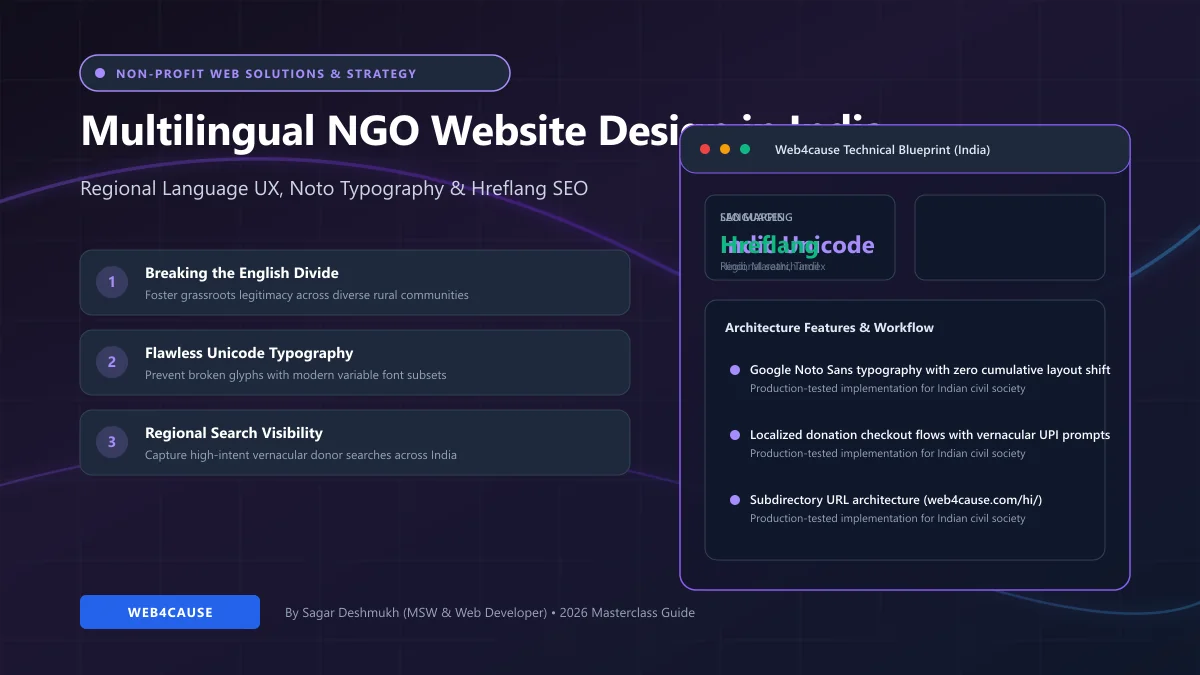
1. The Civil Society Imperative: Why English-Only Non-Profit Websites Fail India
For decades, the Indian non-profit sector has operated within an elite digital silo. The vast majority of charitable trusts, non-governmental organizations, and Section 8 companies maintain websites built exclusively in English. While this strategy satisfies institutional grantmakers, international philanthropies, and metropolitan corporate social responsibility (CSR) desk officers, it alienates the very people civil society exists to serve: rural communities, tribal collectives, grassroots volunteers, and emerging regional patrons.
According to linguistic demographic studies from the Census of India, fewer than twelve percent of Indian citizens read, write, or transact comfortably in English. In contrast, over ninety percent of active internet users consuming digital video, voice search, and mobile commerce across rural districts and tier-2 and tier-3 towns browse in Indic languages such as Hindi, Marathi, Bengali, Tamil, Telugu, Gujarati, and Kannada. When a rural community organizer, a village schoolteacher, or a regional business owner visits an English-only NGO portal, they encounter an impenetrable barrier of foreign legalisms and academic jargon.
From the perspective of professional social work, language access is not merely an optional marketing enhancement; it is an ethical imperative rooted in democratic rights and participatory development. In classical social action frameworks, such as Paulo Freire’s critical pedagogy and the community organizing methodologies explored in our guide on Community Mobilization in Social Work, communication must be dialogical and non-extractive. Furthermore, in Robert Chambers’ participatory rural appraisal methods detailed in our study on PRA Techniques in India, village communities must be recognized as active analysts rather than passive data sources. If an organization gathers field case studies and photos from village residents but publishes its project reports, budgets, and governance charters exclusively in English, the organization commits informational extraction. The community cannot read what has been recorded about them.
The Grassroots Truth: Trust in the Indian social sector is cultivated locally. A farmer in rural Kolhapur, a weaver collective leader in Varanasi, or a self-help group accountant in Warangal evaluates an organization by its physical presence and vernacular clarity. Presenting your mission, governance credentials, and audited reports in their native script instantly converts passive onlookers into lifelong allies and community donors.
Institutional accountability demands transparency. As documented in our deep-dive analysis of NGO Website Design in India, organizations that publish their registration certificates, statutory orders, and impact audits in regional languages witness significantly higher volunteer enlistment, lower community skepticism, and stronger compliance records during district administrative reviews.
2. Linguistic Geography of Indian Philanthropy: Mapping Languages to Giving
India’s retail philanthropic ecosystem is experiencing a historic transformation. The explosive proliferation of low-cost 4G and 5G mobile handsets, combined with ubiquitous Unified Payments Interface (UPI) penetration powered by the National Payments Corporation of India (NPCI), has decentralized retail giving. Wealth is no longer concentrated solely in metropolitan tier-1 corporate corridors. Rapid economic expansion across agricultural trade hubs, industrial corridors, and district centers supported by institutions like the National Bank for Agriculture and Rural Development (NABARD) has fostered an affluent class of regional merchants, agricultural entrepreneurs, doctors, and professionals who donate generously to social causes.
These regional donors possess immense cultural goodwill, known historically across India through traditions such as Daan, Zakat, Dasvandh, and Annadanam. However, their primary medium of daily communication is their mother tongue. Designing a multilingual NGO web platform requires strategic geographic mapping to align language versions with funding clusters:
- Hindi (Devanagari Script): Serves over 550 million speakers across the northern and central Hindi belt (Uttar Pradesh, Bihar, Madhya Pradesh, Rajasthan, Haryana, Jharkhand, and Delhi NCR). Vital for pan-India advocacy, disaster relief, and rural education initiatives.
- Marathi (Devanagari Script): Dominates Maharashtra’s agrarian heartlands (Vidarbha, Marathwada, Western Maharashtra) and urban philanthropic hubs like Pune, Nashik, and Nagpur. Crucial for farmer suicide prevention, watershed management, and drought resilience programs.
- Bengali (Eastern Nagari Script): Encompasses West Bengal, Tripura, and the wider delta region. Essential for coastal climate adaptation, anti-trafficking networks, and microfinance federation mobilization.
- Tamil (Tamil Script): Spans Tamil Nadu and the global Tamil diaspora in Singapore, Malaysia, and Sri Lanka. Highly responsive to medical relief, women’s empowerment, and heritage preservation causes.
- Telugu (Telugu Script): Reaches Andhra Pradesh and Telangana, two of India’s most digitally agile states with exceptionally high per-capita UPI adoption and technology sector philanthropic alumni.
- Gujarati (Gujarati Script): Reaches Gujarat and an influential global merchant diaspora renowned for institutional philanthropic endowments, hospital construction, and water harvesting trusts.
When an NGO pairs native language storytelling with verified tax-exempt credentials under Section 80G and 12A, regional supporters donate with enthusiastic confidence. They recognize that the organization honors their identity and respects their community roots.
3. Indic Web Typography and Font Engineering: Rendering Complex Scripts Without Layout Shift
Designing for Indian regional languages introduces technical web typography challenges that do not exist in Latin typography. Indic scripts belong to the Brahmic family, which relies on complex text rendering rules governed by the Unicode Standard. These scripts contain conjunct consonants (samyuktakshara), dependent vowel signs (matras) that attach above, below, before, or after base characters, and halant signs that suppress inherent vowels.
Incompetent font implementation causes severe visual breakage on budget Android devices. Common defects include broken conjuncts where characters disintegrate into disjointed glyphs, clipped matras where vowel signs above the baseline are severed by tight CSS line heights, and catastrophic Cumulative Layout Shift (CLS) when massive font files load lazily over fluctuating mobile connections.
The Indic Script Typography and Layout Matrix
| Language & Script | Recommended Web Font | Mandatory Line Height | Key Rendering Challenge |
|---|---|---|---|
| Hindi & Marathi (Devanagari) | Google Noto Sans Devanagari, Mukta, Hind | 1.70 to 1.85 | Top shirorekha (headline) alignment, vertical clipping of u-kaar and reph matras. |
| Bengali (Eastern Nagari) | Google Noto Sans Bengali, Galada, Tiro Bangla | 1.75 to 1.90 | Horizontal matras preceding base consonants (e-kaar) requiring complex OpenType GSUB tables. |
| Tamil (Tamil Script) | Google Noto Sans Tamil, Catamaran, Arima Madurai | 1.65 to 1.75 | Wide horizontal bounding boxes and distinct pulli (virama) dot positioning above letters. |
| Telugu (Telugu Script) | Google Noto Sans Telugu, Mandali, Ramabhadra | 1.80 to 2.00 | Intricate circular letterforms with complex sub-joined consonants (vattulu) requiring deep vertical space. |
| Gujarati (Gujarati Script) | Google Noto Sans Gujarati, Rasa, Fira Go | 1.70 to 1.80 | Absence of top horizontal headline bar; requires precise vertical ascender balance. |
To eliminate layout shifts and deliver sub-second loading over 4G connections, web developers must follow three non-negotiable font engineering principles:
- Aggressive Unicode Subsetting: A full Pan-Indic Unicode font file can exceed 1.5 megabytes, which paralyzes mobile performance. By utilizing tools like pyftsubset or Google Fonts regional subset parameters, strip unneeded glyphs and deliver clean WOFF2 files weighing between 35 KB and 45 KB per weight.
- Strict CSS Metric Overrides: Setting
font-display: swapprevents invisible text during font loading. However, if the fallback system font has a different x-height or ascender ratio than the Indic web font, swapping causes the entire page to jump, triggering high CLS penalties in Google Core Web Vitals. Using modern CSS descriptor properties (size-adjust,ascent-override, anddescent-override), developers match the fallback font geometry exactly to the web font. - Enforced Generous Line Heights: Standard Latin body text functions well at a line height of 1.4 to 1.5. In Indic scripts, setting line height below 1.65 causes vowel diacritics to collide with adjacent text lines or get sliced off by container boundaries. Always enforce minimum line heights of 1.70 to 1.85 across vernacular elements.
4. Information Architecture and URL Routing: Subdirectories vs Subdomains vs Parameters
When architecting a multilingual non-profit portal, selecting the appropriate URL structure is one of the most critical foundational decisions. Search engine webmaster guidelines and developer documentation from Google Search Central outline three primary patterns for structuring multilingual content. For Indian non-profits, the choice directly dictates domain authority, technical maintenance costs, and SEO crawling efficiency.
Technical Evaluation of Multilingual URL Architectures
| URL Architecture | Example URL Structure | Domain Authority & SEO | Operational Verdict for Indian NGOs |
|---|---|---|---|
| Subdirectories (Recommended) | web4cause.com/hi/web4cause.com/mr/ |
Consolidates all backlink equity and authority under the root domain. | Gold Standard. Single SSL certificate, unified Google Search Console property, lowest server overhead. |
| Subdomains | hi.web4cause.commr.web4cause.com |
Google treats subdomains as distinct entities, fragmenting backlink power. | Not Recommended. Multiplies DNS administration, requires wildcard SSL certificates, dilutes search ranking signals. |
| URL Query Parameters | web4cause.com/?lang=hiweb4cause.com/?lang=mr |
Poor crawlability; search bots frequently ignore parameter-based language pages. | Strictly Prohibited. Severely impedes organic ranking and creates duplicate content chaos. |
For over ninety-five percent of charitable trusts and social enterprises in India, the subdirectory model is unequivocally superior. It preserves total domain rating equity. When an esteemed academic institution or major foundation links to your English research whitepaper, that acquired authority directly benefits your Hindi, Marathi, and Tamil campaign pages under the same root domain.
Crucial UX Rule for Language Switchers: Never use national flags to represent languages (for instance, using an Indian tricolor for Hindi or a British flag for English). India has twenty-two officially recognized languages in the Eighth Schedule of the Constitution; a national flag does not represent any single language. Always display the language switcher using its native endonym in its native script: मराठी, हिंदी, বাংলা, தமிழ், తెలుగు, ગુજરાતી, and English.
To reinforce institutional trust, every language version must prominently link to statutory verification records, including the organization’s unique registration ID on the NITI Aayog NGO Darpan Portal. Follow our comprehensive tutorial on NITI Aayog NGO Darpan Registration in India to display verified government credentials across all localized footers.
Additionally, avoid forced automatic IP-based georedirection. If a Marathi speaker residing in Delhi accesses your website, an IP lookup might automatically redirect them to the Hindi version against their wishes. Forced redirects also disrupt Googlebot crawlers, which typically crawl from United States IP addresses. Always default to standard browser language header detection (Accept-Language) while allowing the user full manual control via a sticky, prominent language switcher.
5. International SEO and hreflang Tag Implementation for Indian Languages
Search engines must be explicitly instructed which language version corresponds to which URL. Without proper technical markup, search engine crawlers may perceive translated pages as duplicate content or struggle to serve the appropriate regional page to users searching in vernacular queries on mobile devices.
This is achieved through the rigorous implementation of hreflang annotations in the document head or within an XML sitemap. For Indian non-profits, the implementation must adhere to four strict technical mandates:
- Standard ISO Language Codes: Use lowercase two-letter ISO 639-1 language codes:
hifor Hindi,mrfor Marathi,bnfor Bengali,tafor Tamil,tefor Telugu,gufor Gujarati, andenfor English. - Bidirectional Linking: If the English page references the Hindi page via an hreflang tag, the Hindi page must reference the English page back. Missing reciprocal links cause Google to invalidate the entire hreflang cluster.
- Self-Referential Tags: Every page must include an hreflang tag pointing directly to its own URL alongside all alternate language versions.
- The Essential x-default Fallback: The
hreflang="x-default"tag directs unmatched international users or search bots to the global default landing page (typically the English version).
For organizations managing extensive publications or field archives, injecting these tags directly into the XML sitemap using the xhtml:link namespace prevents HTML document bloat and accelerates search engine indexation across regional keywords.
6. Translation Stack Comparison: Polylang vs WPML vs Headless Next.js (next-intl)
Choosing the content management and translation pipeline dictates your team’s ongoing editorial velocity. Non-profit teams cannot afford complicated developer-dependent workflows whenever a press release or field story requires updating. At the same time, the translation stack must maintain exceptional database efficiency.
Multilingual Translation Stack Comparative Matrix
| Solution | Database Architecture | Performance Impact | Cost & Ease of Use for Staff |
|---|---|---|---|
| Polylang Pro (WordPress) | Uses native WordPress taxonomies to link distinct post objects. Zero bloat. | Exceptional. Adds minimal SQL queries; pairs seamlessly with LiteSpeed Cache. | Low initial cost, highly intuitive side-by-side editing interface for non-technical field staff. |
| WPML (WordPress) | Creates extensive custom database tables for string translations and icl tables. | Moderate to Heavy. Requires dedicated Redis object caching to avoid high TTFB. | Higher annual subscription; comprehensive feature set but steeper learning curve for small NGOs. |
| Headless Next.js (next-intl / i18next) | Decoupled JSON locale bundles served via static site generation (SSG) or Edge ISR. | Unmatched. Zero runtime database load, sub-100ms global edge delivery via CDN. | Requires dedicated full-stack developers; non-technical staff require headless CMS integration (Strapi/Sanity). |
Beyond the software architecture lies the paramount question of translation fidelity. In commercial e-commerce, automated machine translation plugins may suffice for basic product specifications. In non-profit social work, however, uncurated machine translation is outright dangerous.
Social work content addresses sensitive human realities: child protection, gender-based violence, caste exclusion, palliative care, and legal aid. Automated algorithms routinely misinterpret idioms, botch statutory nuances under the Indian Penal Code or Juvenile Justice Act, or produce culturally offensive terminology. Indian non-profits can also leverage discounted enterprise productivity and translation tools through TechSoup to manage team collaboration safely.
The gold-standard enterprise approach for Indian non-profits is a hybrid translation pipeline:
- Automated First Draft: Utilize neural machine translation engines or the Government of India’s indigenous Bhashini Project API to produce baseline drafts rapidly.
- Field Social Worker Review: An MSW-qualified program officer or native regional speaker conducts mandatory editorial review, adjusting tone, cultural phrasing, and empathetic resonance.
- Statutory Verification: Legal disclosures, registration credentials, and tax deduction terminology are verified against official state government vocabularies.
7. Localized Donation Checkout UX: Vernacular UPI, QR Codes, and FCRA Safeguards
Donation drop-off rates on Indian non-profit websites frequently exceed seventy percent when donors transition from a vernacular campaign narrative to a jarring, English-only payment gateway screen. When a supporter reading an emotionally compelling Marathi story about rural girl-child education clicks “Donate” and is suddenly confronted with foreign banking prompts (“Cardholder Name”, “CVV”, “Billing Address” in English), anxiety peaks and conversions collapse.
To engineer a frictionless vernacular checkout experience, non-profit portals must implement localized payment modal workflows with native UPI integration:
The Vernacular UPI Advantage: Over eighty-five percent of domestic charitable donations in India are completed through mobile UPI applications (PhonePe, Google Pay, Paytm, and BHIM). Displaying dynamic on-screen QR codes on desktop viewports and initiating direct 1-click mobile UPI intent on smartphones with copy written in the donor’s regional language yields documented donation conversion increases of over forty percent.
For predictable monthly operational sustainability, non-profits should also implement recurring localized e-mandates as explained in our guide on UPI AutoPay for NGO Recurring Donations in India.
Crucially, the localized checkout interface must incorporate strict statutory safeguards regarding fund segregation under the Ministry of Corporate Affairs (MCA) guidelines and the Foreign Contribution Regulation Act, 2010 (FCRA):
- Strict Currency and Account Segregation: Under amended FCRA statutory provisions, charitable organizations must never commingle domestic INR contributions with foreign funds. All foreign currency contributions (USD, GBP, EUR) must be received exclusively through the designated State Bank of India, New Delhi Main Branch (NDMB) account.
- Dynamic IP and Currency Gateways: When visitors select regional language interfaces (Hindi, Marathi, Bengali, Tamil), the system defaults strictly to Indian Rupee (INR) domestic checkouts. If an international diaspora supporter switches to English or selects a foreign currency option, the system routes the transaction through an FCRA-approved gateway container with clear statutory declarations.
- Digital Personal Data Protection (DPDP) Act 2023 Compliance: India’s privacy legislation mandates that Data Fiduciaries collect donor personal details (such as phone numbers, email addresses, and PAN numbers) only after displaying clear, intelligible consent notices. Providing vernacular consent checkboxes ensures complete legal compliance.
For detailed integration architecture with Razorpay, Cashfree, and PayU, consult our specialized manual on NGO Payment Gateway Integration in India.
8. Automated Localized 80G Tax Receipts and Form 10BD Compliance Workflows
A common operational bottleneck for Indian non-profits entering multilingual operations is post-donation fulfillment. If a donor makes a contribution on a Marathi or Tamil cause page, they expect immediate acknowledgment in that language. However, issuing manual paper receipts or sending delayed English emails fractures the donor experience and generates administrative friction.
Under the Income Tax Department’s reformed reporting architecture, every tax-deductible contribution under Section 80G must be reconciled and submitted annually via Form 10BD Filing for NGOs on the official e-filing portal (incometax.gov.in).
The 4 Steps of the Automated Vernacular 80G Receipt Pipeline
- Client-Side Vernacular Form Validation: The checkout form collects donor name, address, email, mobile number, and Permanent Account Number (PAN). Localized helper tooltips explain clearly in Hindi or Marathi why PAN is legally mandatory under Rule 18AB for the tax deduction to reflect on the donor’s AIS (Annual Information Statement).
- Instant Webhook Trigger via Automation Engine: Upon successful transaction authorization, the payment gateway dispatches a secure webhook payload to a self-hosted automation engine like n8n Workflow Automation for NGOs.
- Bilingual Unicode PDF Rendering: A headless PDF rendering service (Puppeteer or Chromium) merges the transaction data into an official bilingual 80G certificate template. By embedding Google Noto Sans Devanagari or Tamil font files directly into the PDF rendering container, all donor details, serial numbers, trustee signatures, and statutory URNs render crisp and clean without missing glyphs or question marks.
- Multi-Channel WhatsApp & Email Dispatch: Within thirty seconds of payment, the donor receives an official WhatsApp message in their chosen language via the WhatsApp Business Cloud API containing their downloadable 80G PDF receipt, followed by a matching transactional email confirmation.
By automating this entire pipeline, non-profit teams save hundreds of administrative hours each fiscal quarter, eliminate typographical errors in donor PAN entries, and prepare seamless CSV ledgers ready for instant upload during May annual filing.
9. Step-by-Step Technical Implementation Roadmap and Code Blueprints
Deploying an enterprise-grade multilingual platform requires a disciplined engineering sequence. The following five-stage technical roadmap provides an end-to-end implementation pathway for development teams and trustees:
Phase-by-Phase Multilingual Rollout Blueprint
- Phase 1: Content Architecture and Key Terminology Glossaries: Audit existing website pages. Identify top ten high-impact landing pages (Home, About Governance, Causes, Financial Transparency, Donate, Contact). Develop a standardized institutional glossary of social work and legal terms to guarantee terminology consistency across languages.
- Phase 2: Font Subsetting and CSS Metric Configuration: Generate lightweight WOFF2 Indic font subsets for required scripts. Configure fallback font metric overrides in CSS to enforce zero Cumulative Layout Shift (CLS).
- Phase 3: Subdirectory Routing and hreflang Tag Assembly: Establish clean subdirectory structures on the web server. Configure bidirectional hreflang tags across all pages, generate multilingual XML sitemaps, and submit them to Google Search Console.
- Phase 4: Localized Donation Modal and Vernacular Checkout Embeds: Configure payment gateway SDKs to accept regional language parameters. Implement localized form validation for PAN, mobile numbers, and 80G consent checkboxes.
- Phase 5: Automated Bilingual 80G Receipt Engine and Quality Gate: Deploy headless Chromium PDF rendering scripts with embedded Indic fonts. Connect payment webhooks to automated WhatsApp Business Cloud API pipelines and conduct rigorous end-to-end test transactions.
Code Blueprint 1: Indic CSS Typography with Metric Overrides
Code Blueprint 2: Nginx Server Subdirectory Rewrite Configuration
Code Blueprint 3: Vernacular Donation Component Snippet (Marathi Interface)
10. Social Work Fieldwork Perspective: Sagar Deshmukh on Linguistic Justice and Dignity
During my Master of Social Work fieldwork across rural Maharashtra, from the drought-prone talukas of Marathwada to tribal settlements in the Western Ghats, I repeatedly witnessed a heartbreaking disconnect. Passionate grassroots trusts were conducting transformative work on the ground: digging watershed trenches, organizing women’s micro-credit federations, and defending tribal forest rights under the Forest Rights Act.
Yet, when I examined their digital presence, their websites were either nonexistent or consisted of an abandoned English template with broken placeholder text purchased from an overseas marketplace. Village sarpanches, community health volunteers (ASHAs), and local school headmasters who were the actual architects of the social change could not read a single line of their organization’s website.
This is why I view multilingual web development not as a luxury marketing exercise, but as an act of fundamental social justice. When we translate an organization’s mission into Marathi, Hindi, or Bengali with dignified, culturally respectful typography, we restore ownership to the community. We declare that a rural woman leader in Beed or a youth activist in Jalgaon has as much right to inspect an NGO’s audited balance sheet, read its governance bylaws, and contribute ₹500 via UPI as a corporate grantmaker in Nariman Point or Gurugram.
Bridging social work ethics with clean, modern web engineering is the founding philosophy of Web4cause. Technology must empower the marginalized, foster institutional dignity, and build enduring bridges of human trust.
11. Frequently Asked Questions (FAQs)
Q1: How does a multilingual website improve an NGO’s CSR funding prospects?
Corporate CSR committees and public sector undertaking (PSU) boards evaluate whether an implementation agency maintains genuine grassroots credibility. A multilingual website displaying audited financial reports, field narratives, and impact data in the regional language of the project location signals governance maturity, community accountability, and deep local engagement, which dramatically expedites institutional due diligence.
Q2: Which Indian regional languages should an NGO prioritize first?
Non-profits should prioritize languages based on their operational geography and donor demographics. For pan-India organizations, Hindi and English provide national reach. For regional organizations, prioritize the state mother tongue where project fieldwork occurs (such as Marathi for Maharashtra, Tamil for Tamil Nadu, or Bengali for West Bengal) alongside an English primary version for institutional compliance.
Q3: Can an NGO use automated Google Translate or AI translation instead of professional human translation?
Relying exclusively on automated machine translation is dangerous for social sector organizations. Uncurated machine translation routinely misinterprets statutory terminology, legal rights, and sensitive social work topics such as child welfare or domestic violence. Web4cause recommends a hybrid workflow: neural machine tools like the Bhashini API can generate initial drafts, but a human social worker or native editor must review and sign off on all public content.
Q4: How does multilingual architecture impact website loading speed and Core Web Vitals?
Improper font implementation can degrade performance because full Indic fonts are large. However, by subsetting fonts to essential Unicode character ranges, delivering compressed WOFF2 files (under 45 KB), and using CSS metric overrides (size-adjust, ascent-override) with font-display: swap, multilingual websites achieve sub-second page loads and zero Cumulative Layout Shift (CLS) on budget mobile devices.
Q5: How do we issue Section 80G receipts for vernacular donations while satisfying Income Tax Form 10BD requirements?
Modern donation platforms implement automated bilingual receipt pipelines. The donor receives an electronic certificate featuring bilingual headers (English alongside Hindi or Marathi) stamped with organizational seals and statutory URNs. The underlying transaction database captures donor PAN and address in structured fields, generating seamless CSV export files ready for electronic Form 10BD filing before May 31.
Q6: What is the ideal URL structure for a multilingual Indian non-profit website to avoid Google duplicate content penalties?
The subdirectory structure (e.g. web4cause.com/hi/ and web4cause.com/mr/) is the industry gold standard. It consolidates all domain authority under a single root domain, simplifies SSL certificate management, and avoids duplicate content penalties when combined with bidirectional hreflang tags, self-referential canonical URLs, and an x-default fallback tag.