
Clinical Case Work Manual
2026 Academic Edition
Social Case Work Process in India: Complete 2026 Practice Guide
•
Published: October 31, 2026
•
18 min read
•
UGC Curriculum & Field Practicum Reference
Executive Academic Summary: The Systematic Science of Individualized Helping
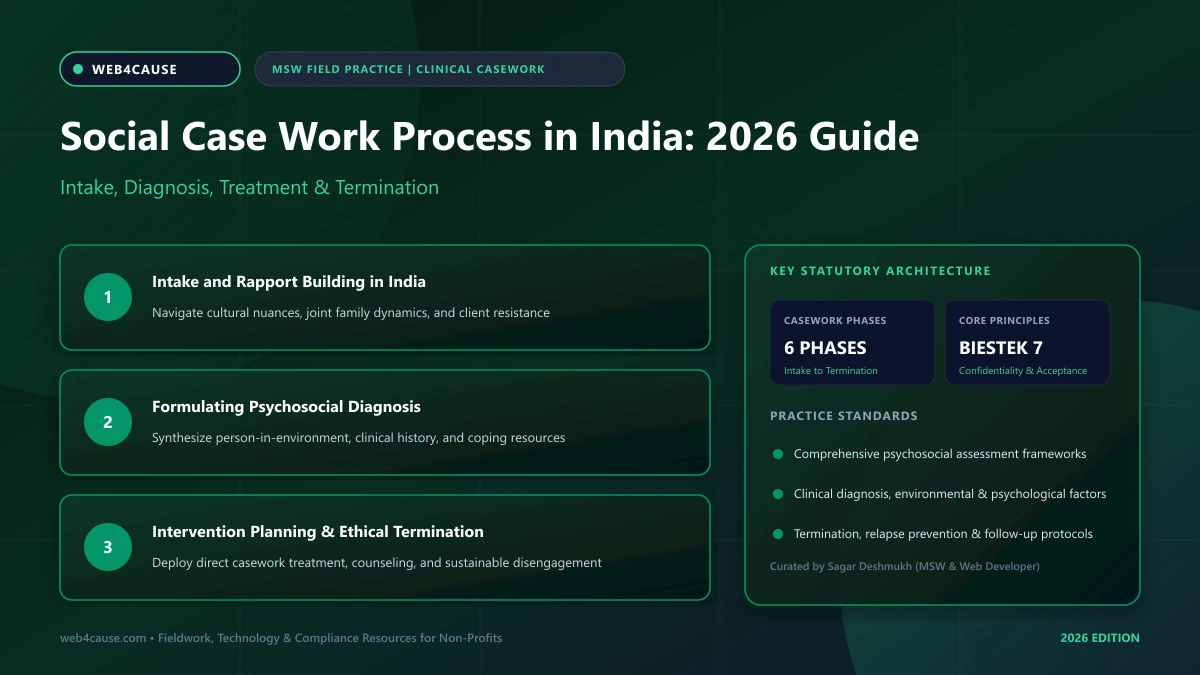
Social case work is the primary direct practice method of professional social work. It transforms intuitive human sympathy into an empirical, structured, and ethically governed helping relationship. In India, where individuals exist at the complex intersection of joint family expectations, caste dynamics, acute economic insecurity, and bureaucratic gatekeeping, case work is never an isolated counseling dialogue. It is an intensive problem-solving process that operates across six distinct phases: intake, psychosocial study, social diagnosis, intervention planning, evaluation, and ethical termination. This practice manual provides postgraduate students, faculty supervisors, medical social workers, and clinical practitioners with an authoritative blueprint for field execution in 2026.
Across Indian universities accredited by the University Grants Commission (UGC) and premier institutions such as the Tata Institute of Social Sciences (TISS), case work forms the pedagogical cornerstone of clinical practice. While our foundational overview of the social case work method in India outlines core theoretical paradigms, this guide examines the operational process step by step. Social workers do not simply talk with clients: they conduct systematic psychosocial investigations, draft analytical genograms, formulate dynamic diagnoses, negotiate institutional entitlements, and structure disengagement without creating chronic dependency.
1. The Core Philosophy and Theoretical Foundations of Social Case Work
At its core, social case work operates on the belief that every human being possesses inherent dignity, worth, and the capacity for personal growth. Unlike medical models that view people purely through pathology or judicial systems that view them through culpability, social work employs the Person-in-Environment (PIE) perspective. Human distress is rarely a product of intrapsychic dysfunction alone: it emerges from the friction between an individual coping capacity and the material, familial, and structural pressures of their immediate ecosystem.
The intellectual lineage of casework traces back to Mary Richmond, whose seminal texts Social Diagnosis (1917) and What is Social Case Work? (1922) liberated philanthropy from subjective moralizing. Richmond insisted that social assistance must be preceded by rigorous, empirical fact-gathering, collateral verification, and systematic social investigation. She established that human misery cannot be alleviated by casual handouts: it requires understanding the total web of social relationships surrounding the person.
Helen Harris Perlman Problem-Solving Framework (The 4 Ps)
In 1957, Helen Harris Perlman synthesized casework into four interdependent components: The Person (a biological, psychological, and social being experiencing stress), The Problem (a breakdown in social adjustment or unmet need that exceeds current coping resources), The Place (the social welfare agency or clinic authorized to deliver specific services), and The Process (the progressive therapeutic transaction through which the worker enables the client to regain autonomous problem-solving capacity).
Importing casework concepts directly into India without structural translation produces clinical failures. In Western contexts, casework often centers on individual autonomy, personal boundary delineation, and independent living. In contrast, Indian social reality is profoundly collectivist. An individual identity is inextricably tied to joint family hierarchies, caste norms, kinship networks, and gender roles. A rural woman experiencing marital distress cannot simply be told to assert individual independence if leaving her matrimonial home leads to immediate social destitution, loss of custody, or caste excommunication.
As detailed in our fieldwork manuals on MSW fieldwork documentation and viva preparation and community mobilization in social work, the Indian case worker operates simultaneously on psychological counseling and structural negotiation. The worker helps the client build inner resilience while actively confronting systemic deficits such as lack of healthcare coverage, missing land titles, denied ration cards, or hostile institutional gatekeepers.
| Dimension | Classical Western Casework Model | Adapted Indian Practice Reality |
|---|---|---|
| Client Conceptualization | Autonomous individual seeking self-actualization. | Person deeply embedded in family, caste, and kinship networks. |
| Decision-Making Unit | Individual self-determination takes absolute priority. | Negotiated consensus involving key family elders and community allies. |
| Nature of Problem | Often intrapsychic, emotional, or interpersonal conflict. | Intricate mix of acute poverty, structural exclusion, and psychological trauma. |
| Intervention Focus | Insight-oriented counseling, cognitive restructuring. | Direct emotional counseling balanced with material and statutory linkages. |
| Agency Role | Specialized clinic or counseling department. | Government hospital, grassroot NGO, shelter home, or legal aid clinic. |
2. The 6-Stage Casework Process Decoded for Indian Realities
The casework process is a dynamic, cyclical continuum. While textbooks divide it into neat chronological stages, in field practice these phases frequently overlap. A worker continues diagnostic assessment during treatment, and initial intake interactions already set the stage for therapeutic engagement. Below is the operational breakdown of each phase adapted for Indian clinical, community, and institutional realities.
2.1 Phase 1: Intake, Initial Engagement, and Therapeutic Contracting
The intake phase represents the gateway to the casework relationship. Clients enter the agency through four primary pathways: voluntary walk-ins, institutional transfers within hospitals or schools, court mandates via Child Welfare Committees or Family Courts, and community identification by grassroots field workers like ASHA or Anganwadi workers.
In Indian settings, particularly in rural villages and urban slums, the initial encounter is fraught with client suspicion. Marginalized individuals frequently associate formal offices with punitive state machinery: police interrogation, tax scrutiny, demolition notices, or child removal. A case worker must intentionally deconstruct this power asymmetry:
- Setting a Respectful Physical Climate: Ensuring privacy, offering water, providing seating without an imposing desk separating worker and client, and speaking in the client mother tongue.
- Managing Suspicion and Stigma: Clarifying that the agency is not a punitive authority and that visiting a counselor carries no social dishonor.
- Active Listening and Ventilation: Allowing the client to pour out their immediate anguish without premature interruption or moral lecturing.
- Establishing the Helping Contract: Explaining what the agency can deliver (e.g. counseling, legal referrals, hospital fee concessions) and what it cannot (e.g. cash handouts, instant court acquittals), establishing mutually agreed boundaries and visit schedules.
2.2 Phase 2: Psychosocial Study and Systematic Fact-Gathering
The psychosocial study is the investigative phase where the worker collects reliable facts about the client life history, immediate family environment, and broader social ecology. This is not casual interrogative questioning: it is an empathetic, structured inquiry into the client internal feelings and external realities.
To maintain empirical rigor, professional case workers in India employ three indispensable diagnostic tools:
- The Three-Generation Family Genogram: A standardized graphical map that visualizes the client extended family structure, patterns of intergenerational trauma, hereditary medical disorders, substance abuse, broken relationships, and hidden alliances.
- The Eco-Map: A diagrammatic representation of the client nuclear household at the center, surrounded by circles representing external social systems: schools, primary healthcare centers, ration shops, microfinance Self-Help Groups, religious places, police stations, and kinship networks. Solid lines indicate strong positive supports, dotted lines indicate tenuous linkages, and jagged lines denote high conflict.
- Collateral Contacts and Home Visits: Corroborating empirical data through discreet interviews with teachers, Anganwadi workers, village elders, and hospital staff. Home visits provide unvarnished insights into living space, sanitation, domestic interactions, and safety, which cannot be observed in a sterile counseling cubicle.
2.3 Phase 3: Social Diagnosis (Dynamic, Clinical, and Etiological Assessment)
Social diagnosis is the intellectual processing of collected facts into a coherent clinical formulation. A social worker does not merely label a person as “depressed” or “poor”. The worker analyzes how personality dynamics, physical health, and environmental oppressions intersect to create the present impasse. Mary Richmond formulated three diagnostic dimensions that remain foundational today:
1. Dynamic Diagnosis
Examines current psychological functioning: ego strength, emotional defense mechanisms (denial, projection, regression), interpersonal communication patterns, and present coping capacities under stress.
2. Clinical Diagnosis
Identifies underlying medical pathology, psychiatric disorders, physical disabilities, or cognitive deficits. In multidisciplinary hospital teams, this incorporates formal medical classifications such as ICD or DSM criteria.
3. Etiological Diagnosis
Traces the historical root causes: past childhood abandonment, domestic abuse, sudden death of the primary wage earner, agricultural crop failure, debt traps, or caste discrimination that triggered the current crisis.
Crucially, social diagnosis must incorporate Dennis Saleebey Strengths Perspective. Focusing solely on pathology demoralizes clients. The worker identifies untapped internal capacities (spiritual faith, resilience, humor, vocational artisan skills) and external community assets (supportive neighbors, local youth groups, community grain banks) to build an intervention platform.
2.4 Phase 4: Treatment and Intervention Planning (Direct vs Environmental Modification)
Treatment planning begins with collaborative goal formulation. Goals must be SMART: Specific, Measurable, Achievable, Relevant, and Time-bound. In Indian social work practice, treatment divides into two complementary tracks:
A. Direct Treatment (Psychological and Emotional Interventions)
- Catharsis and Ventilation: Creating a confidential, non-judgmental space where the client safely expresses deep-seated anger, grief, guilt, or terror.
- Ego Support and Psychological Reassurance: Restoring shattered self-esteem by validating the client inherent dignity and past coping successes.
- Cognitive Clarification: Assisting the client to dismantle distorted self-blame, fatalistic passivity, or irrational cognitive traps.
- Anticipatory Guidance: Role-playing difficult conversations, such as negotiating with an abusive spouse or speaking to an intimidating hospital specialist.
B. Indirect Treatment (Environmental Modification and Institutional Linkages)
In India, emotional counseling is ineffective if the client is starving or facing imminent eviction. Environmental modification addresses material and institutional barriers directly:
- Healthcare Financing: Linking indigent patients to Ayushman Bharat PM-JAY, State Chief Minister Relief Funds, or charitable hospital Poor Patient Funds.
- Food and Social Security: Expediting Antyodaya Anna Yojana (AAY) or BPL ration card issuance, widow pensions, and disability certificates via the local Tehsildar office.
- Educational Rehabilitation: Enrolling dropouts into government schools under Section 12(1)(c) of the Right to Education Act.
- Legal Aid Access: Connecting clients experiencing violence or wrongful arrest to the District Legal Services Authority (DLSA) for free representation under NALSA guidelines.
- Livelihood Integration: Connecting women to local Self-Help Groups (SHGs) under NABARD and National Rural Livelihoods Mission schemes.
2.5 Phase 5: Evaluation and Progress Monitoring
Evaluation is not an afterthought reserved for closing a file: it is a continuous monitoring mechanism conducted during every interaction. The worker and client measure empirical progress against the baseline goals established in Phase 3.
Evaluation examines three distinct markers:
- Symptom and Distress Reduction: Has the client panic, emotional paralysis, suicidal ideation, or substance consumption decreased?
- Functional Role Restoration: Has the client resumed daily vocational work, regular childcare, schooling, or constructive communication with family members?
- Growth in Autonomy: Is the client making independent decisions, attending hospital appointments alone, and managing household finances without leaning constantly on the case worker?
If evaluation reveals stagnation or symptom escalation, the worker revisits the dynamic diagnosis, re-examining hidden systemic barriers or unaddressed family conflicts, and recalibrates the treatment plan accordingly.
2.6 Phase 6: Termination, Follow-Up, and Disengagement
Termination is the planned, ethical conclusion of the casework relationship. In professional social work, termination begins conceptually on day one: the goal is always client self-sufficiency, never permanent emotional dependency.
Disengagement must be executed with clinical sensitivity, especially in Indian communities where clients may have experienced repeated abandonment:
- Managing Separation Anxiety: Clients often experience sudden flare-ups of minor symptoms as termination approaches, attempting to prolong worker attention. The worker validates these anxieties while reviewing the client demonstrated resilience and practical accomplishments.
- Gradual Session Tapering: Contact frequency is systematically reduced from weekly meetings to fortnightly check-ins, then monthly reviews, weaning the client off regular worker support.
- Scheduled Follow-Up Protocol: The worker schedules structured milestone reviews (at 1 month, 3 months, and 6 months) to verify that gains are sustained in the home environment.
- Emergency Re-entry Channel: The client is given clear, formal procedures on how to re-access agency support if an unforeseen catastrophic crisis arises.
3. Adapting Casework to Indian Institutional Settings
Social case work is practiced across diverse institutional fields in India, each imposing distinct statutory, clinical, and administrative requirements. A social worker in an oncology ward encounters vastly different operational realities than a worker in a prison welfare unit or an observation home:
3.1 Medical and Psychiatric Hospitals
As outlined in our guide on medical social worker careers in India, hospital caseworkers operate in fast-paced clinical environments. In palliative oncology units, the worker helps patients process death anxiety, facilitates family discussions on end-of-life care, and addresses caregiver exhaustion. In psychiatric wards and Opioid Agonist Therapy (OAT) centers, caseworkers conduct psychoeducation for families struggling with schizophrenia, bipolar disorder, or severe substance dependence, ensuring medication compliance and community reintegration. They also mobilize financial aid through hospital trust funds and governmental relief programs.
3.2 Family Counseling Centers and Crime Against Women Cells
Operating under the auspices of the Central Social Welfare Board, State Women Commissions, and Police Special Cells, caseworkers mediate domestic disputes under the Protection of Women from Domestic Violence Act 2005 (PWDVA) and the Dowry Prohibition Act 1961. The critical ethical challenge is balancing cultural pressures for family preservation with the woman physical safety. A skilled worker never forces reconciliation when domestic violence is ongoing. Interventions include individualized safety planning, emergency shelter referrals via One Stop Centers (Sakhi Centres) supported by the Ministry of Women and Child Development (MWCD), and securing maintenance under Section 125 of the Code of Criminal Procedure.
3.3 Child Guidance Clinics and Juvenile Justice Observation Homes
Casework with children is legally governed by the Juvenile Justice (Care and Protection of Children) Act 2015. For children in conflict with the law residing in observation homes, caseworkers draft comprehensive Social Investigation Reports (SIR) for Juvenile Justice Boards (JJBs), identifying peer dynamics, school dropout patterns, and family dysfunction rather than branding the minor as a hardened criminal. For children in need of care and protection (orphans, child labor survivors, runaway minors), caseworkers prepare Individual Care Plans (ICP) for Child Welfare Committees (CWCs), prioritizing family restoration, foster care linkages, and educational rehabilitation.
3.4 Correctional Institutions and Prison Welfare Units
Inside Central and District Jails, prison welfare officers utilize casework under the Model Prison Manual guidelines. Incarcerated individuals suffer from institutionalization, loss of self-worth, and extreme depression. Casework focuses on maintaining ties with outside family, coordinating legal aid for undertrials who cannot afford private advocates, facilitating vocational trade certification inside prison workshops, and structuring post-release reintegration to prevent recidivism.
4. Professional Ethics and Felix Biestek Principles in Action
In 1957, Father Felix Biestek formulated the seven core principles of the casework relationship in his landmark work The Casework Relationship. These principles are not theoretical platitudes: they represent binding ethical imperatives that safeguard client autonomy and clinical integrity.
1. Individualization
Recognizing each client as a unique human being with distinct biological, psychological, and sociocultural experiences, rather than viewing them as a generic stereotype of their caste, religion, gender, or criminal charge.
2. Purposeful Expression of Feelings
Actively encouraging the client to express deeply buried, negative emotions such as rage, shame, despair, and guilt without fear of rebuke, censure, or administrative retaliation.
3. Controlled Emotional Involvement
Providing genuine warmth and empathy while maintaining disciplined professional boundaries. The worker avoids cold detachment on one hand and over-identified rescue fantasies on the other, preventing counter-transference and burnout.
4. Acceptance
Meeting the client where they are, accepting their innate human dignity without demanding moral perfection. Acceptance does not mean endorsing destructive or illegal actions: it means separating the worth of the person from their behavior.
5. Non-Judgmental Attitude
Refraining from moralistic scolding, blame allocation, or condescending advice. The worker function is to understand the psychosocial forces that caused the crisis, not to sit as an arbitrator of personal righteousness.
6. Client Self-Determination
Empowering the client to make their own choices regarding life direction, treatment goals, and family resolutions. The worker facilitates exploration of options and consequences but never imposes unilateral decisions.
7. Strict Confidentiality and Legal Limits
Safeguarding all client disclosures against unauthorized release, complying with the Digital Personal Data Protection Act (DPDP Act) 2023. However, Indian caseworkers must understand statutory limits to confidentiality: mandatory reporting is legally enforced under Section 19 of the Protection of Children from Sexual Offences (POCSO) Act 2012, imminent threats of suicide or homicide, and Section 39 of the Code of Criminal Procedure regarding cognizable offenses.
5. Professional Case Recording Standards (Process, Summary, Diagnostic Notes)
Professional documentation is the backbone of clinical accountability, academic supervision, and multi-disciplinary collaboration. In social case work, an undocumented intervention is an incomplete intervention. Three distinct recording methodologies are employed across Indian agencies:
- Process Recording: An intensive, micro-analytical training tool primarily utilized by MSW students and clinical interns. It captures the verbatim dialogue of a session, non-verbal cues, worker visceral reactions, and explicit theoretical analysis.
- Summary Recording: A concise administrative and chronological overview maintained in hospital files, NGO archives, and statutory submissions to Child Welfare Committees or Family Courts. It summarizes dates, key interventions, environmental linkages, and progress metrics.
- Diagnostic Summary for Multidisciplinary Rounds: A focused clinical brief presented during hospital ward conferences alongside oncologists, psychiatrists, and clinical psychologists, highlighting psychosocial barriers to medical treatment adherence.
Exemplary Three-Column Verbatim Process Record
The following excerpt illustrates an actual verbatim process record from an Indian hospital setting, demonstrating the interplay between worker dialogue, client non-verbal presentation, and clinical analysis:
| Worker Dialogue & Actions | Client Dialogue & Non-Verbal Cues | Worker Feelings & Theoretical Analysis |
|---|---|---|
| “Namaste Sunita-ji. Please sit comfortably. I noticed you were waiting outside the oncology OPD for a long time. Would you like a glass of water?” | Client clutches her medical file tightly against her chest, looking down at the floor. Hands trembling visibly. (Whispers): “Doctor said tests show something bad. We have no money left.” |
Subjective: Felt a surge of pity but held professional composure. Analysis: Applying Biestek Acceptance and Purposeful Expression. Client displays acute shock and economic panic. Offered physiological grounding before factual questioning. |
| “I understand how frightening this news must be for you and your family. We will talk about treatment costs step by step, but first, take your time. Tell me what the doctor explained to you today.” | Client exhales deeply, shoulders drop slightly. Loosens grip on the file. Tears well up in her eyes. (Speaks): “He said third stage. My husband drinks and won’t believe it. Who will take care of my two girls?” |
Subjective: Conscious of counter-transference regarding alcohol-dependent families. Analysis: Emotional ventilation initiated. Client shifts from economic panic to maternal protective anxiety. Identified key systemic stressors: spouse addiction and child vulnerability. |
| “You are carrying so much responsibility on your shoulders alone. Your girls need you, and fighting this illness is our top priority. We have government schemes like Ayushman Bharat and trust funds that cover these costs completely. You do not have to fight this in isolation.” | Client looks directly into worker eyes for the first time. Wipes tears with saree pallu. (Voice steadying): “Is that true? The hospital will not turn us away?” |
Subjective: Felt relief as rapport solidified. Analysis: Direct ego support combined with environmental reassurance. Reducing acute cognitive catastrophe by introducing concrete statutory rights. Groundwork laid for Phase 2 psychosocial study. |
For organizations managing high caseloads and multi-disciplinary reporting, modern digital systems enhance efficiency. Explore our technical architecture for n8n workflow automation for NGOs to streamline client intake routing, appointments, and secure case record backups.
6. Frequently Asked Questions (FAQ)
Q1: What distinguishes the social case work process from psychiatric psychotherapy and informal family advice?
Social case work differs fundamentally from psychotherapy and informal advice through its person in environment (PIE) orientation and dual intervention focus. Psychotherapy concentrates primarily on intrapsychic conflicts, cognition, and neurobiology in clinical spaces. Informal advice relies on personal opinions without systematic assessment. In contrast, social case work combines internal psychological counseling with external environmental modification, linking clients directly to statutory welfare rights, hospital concessions, legal protection, and community livelihood systems.
Q2: How does a case worker handle client suspicion and resistance during the intake phase in an Indian rural community?
In rural Indian communities, initial suspicion often stems from fears of government surveillance, caste discrimination, or public shaming. A professional case worker overcomes resistance by demonstrating cultural humility, conducting initial interactions in neutral community spaces, clarifying the non-punitive nature of the agency, and using local linguistic idioms. The worker focuses on empathetic listening without taking premature notes, establishing transparent boundaries regarding confidentiality, and addressing immediate felt needs before probing deeper family matters.
Q3: What is the structural difference between a Dynamic Diagnosis and an Etiological Diagnosis in social case work?
Formulated initially by Mary Richmond, an etiological diagnosis investigates the historical root causes, past developmental traumas, and cumulative economic deprivations that led to the client current crisis. Conversely, a dynamic diagnosis evaluates the client present psychological functioning, interpersonal transactions, ego defense mechanisms, and immediate environmental stressors. While etiological assessment explains how the problem originated, dynamic assessment identifies what factors sustain the difficulty today and where intervention leverage exists.
Q4: How should a case worker navigate client self-determination when family elders insist on forced child marriage or school dropout?
In Indian social work practice, client self-determination is bounded by statutory law, child rights, and physical safety. When family elders attempt forced child marriage or withdrawal of a minor from schooling, these actions violate the Prohibition of Child Marriage Act 2006 and the Right to Education Act 2009. The case worker cannot remain passive under the guise of cultural relativism. The worker must counsel the family on legal consequences, mobilize community allies such as the School Management Committee, and if non-compliance persists, report the matter to the Child Welfare Committee under the Juvenile Justice Act.
Q5: What statutory frameworks govern case work interventions in Indian child care and observation homes?
Casework in child welfare institutions is strictly governed by the Juvenile Justice (Care and Protection of Children) Act 2015 and its Model Rules. For children in need of care and protection, case workers submit Social Investigation Reports (SIR) and Individual Care Plans (ICP) to the Child Welfare Committee (CWC). For children in conflict with the law residing in observation homes, case workers prepare diagnostic profiles for the Juvenile Justice Board (JJB), focusing on restorative justice, psychological counseling, education, and social reintegration.
Q6: How does the case worker systematically evaluate intervention success before initiating case termination?
Systematic evaluation requires measuring post-intervention outcomes against baseline indicators established during the psychosocial study. The case worker assesses symptom reduction, restoration of social roles, utilization of institutional entitlements, and growth in problem-solving autonomy. Crucially, the worker observes whether the client can navigate social systems independently without worker assistance. If goals are met, termination is scheduled through gradual session tapering rather than abrupt cessation.
Academic Mentorship & Clinical Casework Advisory
Master Social Case Work Process, Clinical Documentation, and Viva Defense
Navigating complex casework dynamics, constructing diagnostic genograms, recording verbatim process files, and preparing for external MSW viva examinations requires seasoned mentorship. Sagar Deshmukh bridges professional social work education (MSW) and web engineering to advise postgraduate students, non-profit institutions, and clinical departments across India. Whether you require casework portfolio audits, curriculum guidance, or secure digital case management infrastructure, personalized mentorship is available.
Connect directly on LinkedIn: Sagar Deshmukh (MSW & Web Developer) for academic guest lectures, clinical casework supervision, and institutional non-profit consulting.