
Donor Retention for NGOs: 2026 Strategy Guide
An actionable, field-tested donor relationship management manual for Indian non-profits, charitable trusts, and Section 8 companies. Discover how to halt donor attrition, transition retail supporters into recurring monthly givers via UPI Autopay, automate high-touch 90-day onboarding journeys, implement open-source CRM segmentation, and synchronize annual Section 80G tax compliance with Form 10BD filing.
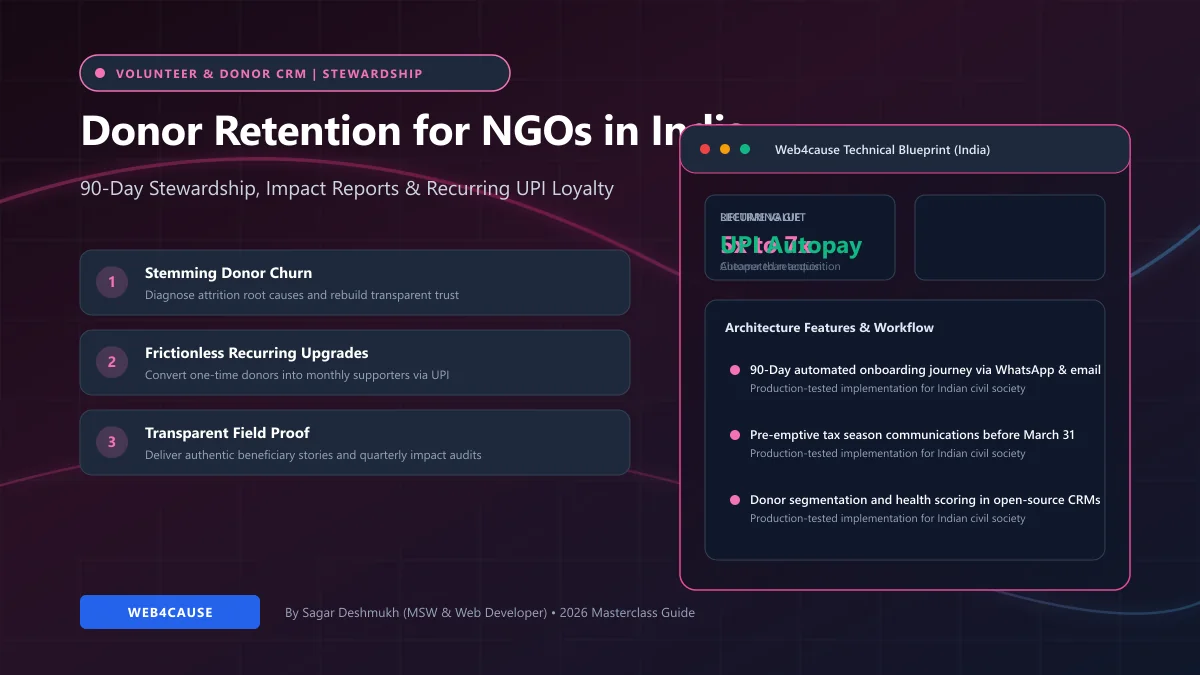
1. The Brutal Economics of Donor Attrition in India
Most Indian non-profit organizations remain trapped on an exhausting fundraising treadmill. Charitable trusts and Section 8 companies pour disproportionate human energy, agency fees, and advertising budgets into acquiring first-time retail donors during festival seasons like Daan Utsav or sudden humanitarian emergencies. Yet, across India, empirical fundraising benchmarks document that between 78 percent and 82 percent of one-time retail donors never contribute a second time.
This perpetual acquisition cycle represents severe financial misallocation. In modern Indian digital fundraising, the Customer Acquisition Cost (CAC) for an individual retail donor ranges from ₹1,500 to ₹3,500 when factoring in Meta advertising spend, Google Ad Grants management, creative production, and payment processing fees. Considering that the average entry-level retail donation in India ranges between ₹1,000 and ₹2,000, non-profits routinely post a negative net margin on a supporter first gift.
The Economic Reality: Research confirms that recruiting a brand new donor costs five to seven times more than retaining an existing supporter. A modest 10 percent improvement in annual donor retention expands institutional net revenue by more than 50 percent over a three-year period through compounding gifts, decreased marketing expenses, and elevated word-of-mouth advocacy.
When an organization suffers from chronic donor attrition, leadership remains locked in permanent survival mode. Program managers cannot commit to multi-year rural livelihood initiatives, clinical nutrition programs, or child scholarship cohorts because funding remains unpredictable. Transforming donor retention from an afterthought into the central operating philosophy of your non-profit provides the financial stability required to achieve lasting grassroots impact.
2. Top 5 Root Causes of Donor Churn in the Indian Context
Why do well-intentioned citizens who felt motivated to donate suddenly abandon a charitable organization? In the Indian social sector, donor churn is rarely caused by a donor loss of philanthropic desire. Instead, systematic operational breakdowns extinguish donor enthusiasm:
1. The Information Black Box (Lack of Fund Utilization Transparency)
The primary reason Indian donors disengage is the total absence of communication regarding fund utilization. A supporter contributes ₹2,500 toward child nutrition in rural Maharashtra, receives a sterile payment gateway transaction code, and hears nothing further. Without verifiable progress reports, donors conclude that their contribution was swallowed by administrative overhead.
2. Delayed or Missing Section 80G Receipts and Form 10BE Failure
Under official statutory frameworks governed by the Directorate of Income Tax (Systems), donors require a valid Form 10BE certificate to substantiate Section 80G deductions. When an NGO fails to capture donor PAN accurately, delays receipt generation, or misses annual Form 10BD electronic filing deadlines, donors face disallowed tax deductions, permanently breaking trust.
3. Cold, Robotic, and Impersonal Transactional Acknowledgements
Many non-profits rely on default system emails generated by aggregators like Razorpay or Cashfree that look identical to utility bills. Generosity is an emotional and ethical commitment. When greeted with bureaucratic coldness, the donor psychological connection to your social mission dissolves instantly.
4. Relentless Solicitations Without Impact Proof (The ATM Syndrome)
Treating donors like automated cash dispensers destroys goodwill. In this dysfunctional pattern, the non-profit maintains complete radio silence for months, only to abruptly bombard the donor with urgent appeals and aggressive telecalling whenever a festival or fiscal year-end approaches. When every interaction is an appeal for money rather than a presentation of progress, donors leave.
5. Digital Payment Friction and Fragmented Donor Records
Managing donor records in disconnected spreadsheets leads to data duplication and operational amnesia. Longtime supporters receive generic appeals addressed to Dear Friend. Furthermore, credit card recurring mandates suffer chronic drop-offs due to Reserve Bank of India tokenization rules and card expiration dates, creating accidental attrition that modern UPI e-mandates eliminate.
3. The 90-Day Donor Onboarding and Stewardship Journey
The first ninety days following a contribution represent the golden window of donor engagement. During this timeframe, a donor interest in your organization is at its peak. By implementing an automated, high-touch onboarding cadence, Indian non-profits can build profound trust and systematically elevate retention rates:
Day 1: Instant Compliance, Emotional Gratitude, and Video Welcome
Within sixty seconds of an online contribution, the system generates a digitally signed Section 80G tax receipt PDF and delivers it via WhatsApp and email. Review our guide on automated 80G tax receipt systems for PDF pipeline details. Simultaneously, the donor receives a forty-five-second WhatsApp video note recorded by the founder or a field coordinator, expressing heartfelt appreciation.
Day 7: The Founder Welcome Letter and Institutional Transparency Dossier
One week after the donation, the supporter receives a personalized letter from organizational leadership. This communication avoids any fundraising solicitation. Instead, it explains the theory of change, presents statutory credentials on the NITI Aayog NGO Darpan portal, and shares links to recent audited balance sheets published on your NGO website design architecture.
Day 30: The Grassroots Photo Essay (The Zero-Solicitation Rule)
At the thirty-day milestone, the donor receives a photo essay depicting ground progress: classroom benches installed, medical camps operating, or drinking water borewells active. This dispatch adheres strictly to the Zero-Solicitation Rule: there is no donate button, no bank account details, and no financial ask. It exists solely to prove operational integrity.
Day 60: Interactive Beneficiary Testimonial and Participatory Insights
Two months in, the non-profit shares an authentic beneficiary story centered on community dignity. Incorporating principles from Participatory Rural Appraisal (PRA) techniques and community mobilization in social work, local residents describe how interventions altered village health or livelihoods. Donors are also invited to an informal quarterly virtual briefing.
Day 90: The Strategic Invitation to Join the Monthly Recurring Giving Circle
Having experienced ninety days of prompt tax compliance, organizational transparency, grassroots field updates, and zero financial pressure, the donor now possesses profound confidence in your institutional integrity. Only now does the organization present a personalized invitation: “You witnessed the exact transformation achieved by your initial gift. To help us sustain this work with predictable stability, would you consider joining our monthly recurring circle at ₹500 or ₹1,000 per month via UPI Autopay?”
4. Converting One-Time Donors to Recurring Champions via UPI Autopay
The ultimate defense against donor attrition is shifting supporters from episodic one-time transactions into recurring monthly commitments. Historically, recurring giving in India was hampered by paper-based NACH mandates or credit card standing instructions that suffered high failure rates under Reserve Bank of India tokenization rules.
In 2026, the breakthrough technology powering non-profit donor retention across India is Unified Payments Interface (UPI) Autopay, developed by the National Payments Corporation of India (NPCI). UPI Autopay enables supporters to authorize recurring monthly pledges directly within applications like Google Pay, PhonePe, Paytm, or BHIM.
Consult our technical blueprint on UPI Autopay for NGO recurring donations for mandate architecture and gateway configurations. Crucial advantages include:
- Psychological Micro-Anchoring: While donors often hesitate to contribute ₹12,000 in a single lump sum, committing to ₹500 or ₹1,000 per month feels manageable, reducing donation decision friction.
- Elimination of Card Expiry Churn: Debit and credit cards expire every three to five years, breaking recurring mandates. UPI Autopay connects directly to the donor underlying bank account, preserving mandate continuity for years.
- Single-PIN Authorization: The supporter authenticates the mandate once with their UPI PIN. Subsequent monthly debits up to ₹15,000 execute automatically without requiring additional OTP entry, maintaining retention rates above 85 percent.
- Pre-Debit Notifications: In full compliance with RBI mandates, donors receive automated SMS notifications twenty-four to forty-eight hours prior to each debit, ensuring transparency and control.
Retention Benchmark: Across Indian social impact organizations, one-time retail donors exhibit an annual retention rate of roughly 21 percent. In contrast, donors enrolled in monthly UPI Autopay programs achieve annual retention rates exceeding 84 percent, producing an eightfold increase in lifetime funding value.
5. Donor Segmentation Architecture in Open-Source CRMs (RFM Modeling)
Effective retention requires treating distinct donor groups according to their history and capacity. Blasting an identical broadcast to a ₹500 first-time giver, an active monthly champion, and a ₹2,00,000 institutional CSR partner alienates all three audiences.
Rather than paying steep recurring subscription fees in foreign currency for proprietary software, Indian non-profits can implement self-hosted solutions. Read our practical evaluation of open-source NGO CRM systems in India to explore platforms like ERPNext and CiviCRM.
An institutional retention strategy organizes supporters through RFM (Recency, Frequency, Monetary) modeling:
| Donor Cohort | RFM Criteria | Stewardship Objective | Communication Protocol |
|---|---|---|---|
| First-Time Givers | Frequency = 1, Recency < 90 days | Build trust and validate institutional credibility | 90-day onboarding journey, zero early solicitation, founder video |
| Recurring Champions | Frequency >= 3, Active UPI Autopay mandate | Maintain long-term loyalty and prevent voluntary churn | Monthly photo reports, behind-the-scenes briefings, zero hard sells |
| Lapsed Supporters | Recency between 180 and 365 days, Frequency >= 1 | Reignite emotional affinity and reactivate giving | Impact celebration dispatches, tailored return surveys |
| Major Philanthropists | Monetary > ₹1,00,000 annually | Deep governance alignment and strategic advisory | Trustee direct calls, formal governance briefings, field site visits |
| Corporate CSR Partners | Grants under Section 135, Companies Act | Statutory CSR compliance and grant renewal | Utilization Certificates (UC), CSR-1 alignment, quarterly metrics |
Automated SQL RFM Segmentation for ERPNext and CiviCRM
Non-profits utilizing self-hosted open-source databases can run automated nightly queries to dynamically assign retention cohorts. Here is an optimized SQL query for donor classification:
/* Open-Source NGO CRM RFM Donor Segmentation Query */
SELECT
    donor_name,
    donor_email,
    donor_phone,
    donor_pan,
    DATEDIFF(CURRENT_DATE, MAX(donation_date)) AS recency_days,
    COUNT(transaction_id) AS donation_frequency,
    SUM(donation_amount) AS total_monetary_value,
    CASE
        WHEN DATEDIFF(CURRENT_DATE, MAX(donation_date)) <= 90 AND COUNT(transaction_id) >= 3 THEN 'Recurring Champion'
        WHEN DATEDIFF(CURRENT_DATE, MAX(donation_date)) <= 90 AND COUNT(transaction_id) = 1 THEN 'New Onboarding Cohort'
        WHEN DATEDIFF(CURRENT_DATE, MAX(donation_date)) BETWEEN 91 AND 270 THEN 'Active Nurturing Pool'
        WHEN DATEDIFF(CURRENT_DATE, MAX(donation_date)) > 270 THEN 'Lapsed Reactivation Target'
        ELSE 'General Supporter'
    END AS donor_retention_segment
FROM
    tabDonationRecord
WHERE
    payment_status = 'Success'
GROUP BY
    donor_id, donor_name, donor_email, donor_phone, donor_pan
ORDER BY
    total_monetary_value DESC;
6. Technical Automation Stack: n8n, Open-Source CRM, and WhatsApp API
Delivering personalized stewardship at scale becomes unsustainable if conducted manually by non-profit staff. When an organization handles hundreds of contributions monthly, manual spreadsheet tracking inevitably produces lost PAN numbers, late receipts, and zero follow-up.
By adopting self-hosted automation engines, charitable trusts achieve institutional-grade donor lifecycle workflows. Our guide to n8n workflow automation for NGOs illustrates how self-hosted n8n instances orchestrate payment webhooks, database ledgers, and messaging gateways:
The 5-Node Donor Retention Automation Pipeline:
- Payment Gateway Webhook: A successful transaction from your online giving form (Razorpay, Cashfree, or PayU) fires a real-time JSON payload containing donor identity, contact details, PAN, and contribution amount. Explore NGO payment gateway integration in India for webhook security protocols.
- n8n Ingestion and Sanitization: The n8n engine validates the PAN format, formats the mobile number with international dialing prefix +91, and matches against existing records in your open-source CRM.
- CRM Update and Ledger Recording: The system logs the contribution, updates the donor cumulative monetary total and recency score, and flags the contact for the 90-day onboarding journey.
- Automated PDF Generation: A headless rendering microservice generates a statutory Section 80G tax receipt PDF embedded with the non-profit 80G approval number, trust registration details, donor PAN, and digital signature.
- Multi-Channel WhatsApp and Email Dispatch: Using official WhatsApp Business API gateways (such as WATI or Gupshup), the system dispatches the 80G PDF accompanied by an interactive message and personal welcome video note within sixty seconds.
Interactive WhatsApp API Template Payload for Day 90 Recurring Invitation
Below is a compliant JSON payload structure for an interactive WhatsApp Business API template used to invite verified supporters to activate monthly recurring giving via UPI Autopay:
{
  "messaging_product": "whatsapp",
  "recipient_type": "individual",
  "to": "+919820098200",
  "type": "interactive",
  "interactive": {
    "type": "button",
    "header": {
      "type": "image",
      "image": {
        "link": "https://web4cause.com/assets/img/tribal-school-nutrition.webp"
      }
    },
    "body": {
      "text": "Namaste Rajesh ji, over the past 90 days, your support funded mid-day nutrition for 15 malnourished tribal children in Melghat. To help us ensure uninterrupted daily meals throughout the school year, join our Sahayog Monthly Circle via UPI Autopay."
    },
    "footer": {
      "text": "Authorized under Section 80G | Cancel anytime in UPI app"
    },
    "action": {
      "buttons": [
        {
          "type": "reply",
          "reply": {
            "id": "btn_pledge_500",
            "title": "Pledge ₹500/Month"
          }
        },
        {
          "type": "reply",
          "reply": {
            "id": "btn_pledge_1000",
            "title": "Pledge ₹1000/Month"
          }
        },
        {
          "type": "reply",
          "reply": {
            "id": "btn_learn_more",
            "title": "Read Impact Report"
          }
        }
      ]
    }
  }
}
7. Annual Tax Season Stewardship (January to March Compliance Pipeline)
The final quarter of the Indian financial year (January 1 through March 31) represents the premier window for donor retention. During this quarter, salaried individuals and corporate donors must furnish investment proofs to HR departments to prevent significant Tax Deducted at Source (TDS) salary deductions.
Non-profits that proactively assist supporters during this window build lasting loyalty. Review our detailed compliance walkthroughs on Form 10BD filing for NGOs in India and our breakdown of 80G and 12A registration for NGOs:
The 4-Step Tax Season Stewardship Protocol:
- January 15 (Proactive Data Audit): Dispatch a friendly verification message via WhatsApp: “Tax season is approaching! Please verify that your PAN and residential address on file match your Income Tax Department records so your Form 10BE certificate can be generated accurately.”
- February 1 (Consolidated Annual Giving Statement): Send a unified Annual Giving Statement compiling all donations made during the ongoing fiscal year into a single document. For recurring donors who gave monthly via UPI Autopay, this single statement saves them from sifting through twelve separate transaction receipts.
- March 1 to 31 (Fiscal Year-End Matching Campaign): Invite current donors to top up their annual contributions or initiate a new monthly recurring mandate before the March 31 financial year-end cutoff. Emphasize that donations made prior to midnight on March 31 qualify for 50 percent deduction from taxable income under Section 80G.
- April 15 to May 15 (Electronic Form 10BD Filing and 10BE Distribution): Complete electronic submission of Form 10BD on the Income Tax portal well before the statutory deadline of May 31. Immediately download official Form 10BE certificates and deliver them via automated WhatsApp and email pipelines. Donors will appreciate seeing their charitable deduction automatically populated in their Annual Information Statement (AIS) and Form 26AS.
8. Comparative Matrix: Retention Technology, Economics, and Timelines
To evaluate the transformative impact of disciplined donor retention, review these detailed comparative benchmarks across Indian non-profit operations:
Financial Comparison: One-Time Giving vs Recurring Giving Pipeline
| Economic Parameter | One-Time Retail Donor Model | Recurring UPI Autopay Supporter | 3-Year Cumulative Variance |
|---|---|---|---|
| Average Initial Contribution | ₹2,000 (Single transaction) | ₹1,000 / month (₹12,000 annual) | +500% annual value |
| Customer Acquisition Cost (CAC) | ₹1,800 per donor | ₹1,800 per donor | Equal upfront marketing spend |
| First Year Net Yield | ₹200 net contribution | ₹10,200 net contribution | 51x higher net operating yield |
| 12-Month Donor Retention Rate | 19% to 22% | 84% to 88% | +65 percentage points higher |
| 3-Year Cumulative Lifetime Value | ₹2,480 | ₹28,600 | 11.5x higher revenue per supporter |
Open-Source CRM Stack Comparison for Indian Non-Profits
| Platform | Ideal Non-Profit Scale | Self-Hosting Cost | Form 10BD & 80G Readiness | WhatsApp & n8n Compatibility |
|---|---|---|---|---|
| ERPNext (Non-Profit Module) | Mid to large trusts, Section 8 companies, FCRA holders | ₹800 to ₹2,000 / month (Cloud VPS) | High: Native Indian tax schemas and custom doctypes | Full REST API and Webhook event engine |
| CiviCRM (WordPress / Drupal) | Grassroots foundations, membership trusts, activist networks | ₹600 to ₹1,500 / month | Medium: Requires custom fields for PAN validation | Robust webhook extension support |
| SuiteCRM | Organizations with complex corporate CSR pipelines | ₹700 to ₹1,800 / month | Configurable via custom studio modules | Standard JSON REST endpoints |
9. 10-Point Technical and Operational Retention Audit Checklist
Before launching your next major fundraising drive, evaluate your non-profit digital stewardship readiness against this practical ten-point checklist:
- Instant Section 80G Receipt Latency: Are computerized tax receipts generated and delivered to WhatsApp and email within sixty seconds of transaction completion?
- Mandatory PAN Capture and Validation: Does your online donation checkout require and validate donor Permanent Account Numbers against official alphanumeric patterns (five letters, four numbers, one letter)?
- Automated 90-Day Welcome Sequence: Is there a functioning, multi-step drip workflow (Day 1 video, Day 7 governance, Day 30 photo essay, Day 60 beneficiary voice, Day 90 recurring ask) operating without manual intervention?
- Strict Zero-Solicitation Rule Adherence: Do mid-cycle communications (Day 30 and Day 60) completely omit financial requests, focusing entirely on community impact proof?
- UPI Autopay Recurring Giving Architecture: Does your donation page present recurring monthly contributions via UPI Autopay as the default giving option alongside one-time gifts?
- Centralized Open-Source CRM Database: Have you consolidated donor data out of scattered Google Sheets and Excel spreadsheets into a secure, self-hosted open-source CRM (ERPNext or CiviCRM)?
- Automated RFM Segmentation: Can your fundraising team instantly filter and export cohorts of First-Time Donors, Active Recurring Champions, and Lapsed Supporters (silent for 180+ days)?
- Proactive Tax Season Reconciliation: Do you initiate donor contact in January to reconcile PAN records, address details, and consolidated statements before corporate HR investment proof deadlines?
- Form 10BD and 10BE Compliance Pipeline: Does your CRM database export valid CSV files formatted to the Directorate of Income Tax upload schema, enabling fast Form 10BD submission prior to May 31?
- Donor Self-Service Portal: Can recurring donors manage their communication preferences, download past 80G receipts, and inspect their annual certificates through a frictionless mobile link?
10. Frequently Asked Questions (FAQs)
1. Why is donor retention more cost-effective than donor acquisition for Indian non-profits?
Acquiring a new individual donor in India through digital advertising, corporate partnerships, or street telefacing typically costs between ₹1,500 and ₹3,500. With first-time retail donations averaging ₹1,000 to ₹2,000, non-profits operate at an acquisition deficit. Retaining existing supporters costs a fraction of acquisition expenses because trust and tax verification already exist, leading to 5x higher lifetime contributions and predictable operational funding.
2. How does UPI Autopay dramatically reduce recurring donation drop-offs compared to credit cards?
Credit card mandates in India suffer from recurring failure rates of 30 to 45 percent caused by expiry dates, replacement card issuance, and strict Reserve Bank of India tokenization friction. In contrast, UPI Autopay connects directly to the donor savings account via the National Payments Corporation of India rail, eliminating card expiration churn and maintaining recurring debit success rates above 90 percent.
3. What is the biggest mistake Indian NGOs make during the first 30 days after receiving a donation?
The most destructive mistake is radio silence followed by an immediate secondary financial appeal. When a non-profit fails to deliver an instant Section 80G tax receipt and subsequently ignores the donor until another crisis arises, supporters feel exploited as mere transactions. The first 30 days must focus exclusively on gratitude, governance transparency, and tangible field impact without asking for another rupee.
4. How does timely Form 10BD filing and Form 10BE certificate distribution build donor loyalty?
Under Rule 18AB of the Income Tax Rules, donors can claim Section 80G deductions only if the non-profit files Form 10BD electronically and issues a valid Form 10BE certificate bearing the pre-printed acknowledgement number. When an NGO proactively sends Form 10BE in April before the May 31 statutory deadline, donors experience effortless income tax e-filing, reinforcing institutional credibility.
5. Can an Indian NGO implement a professional donor retention CRM without paying expensive software licensing fees?
Yes. Modern open-source platforms like ERPNext and CiviCRM provide enterprise non-profit functionality with zero licensing fees. These self-hosted solutions offer donor lifecycle tracking, RFM segmentation, Section 80G receipt automation, and Form 10BD CSV exports, complying fully with India Digital Personal Data Protection Act without recurring dollar-denominated subscription expenses.
6. What is the optimal frequency for communicating with donors without causing outreach fatigue?
Field data shows that one high-value monthly touchpoint delivers optimal engagement without causing communication fatigue. Non-profits should maintain a 3:1 value-to-ask ratio, delivering three transparent impact updates, beneficiary photo essays, or community governance letters for every single fundraising solicitation.