
FCRA 2010 Architecture
2026 Edition
FCRA Registration and Compliance for NGOs in India: 2026 Guide
•
Published: October 31, 2026
•
16 Min Read
•
Verified for MHA FCRA Portal Guidelines 2026
Master the statutory requirements of the Foreign Contribution (Regulation) Act, 2010, the Foreign Contribution (Regulation) Rules, 2011, and the rigorous 2020 Amendment Act standards. This definitive practitioner guide provides non-profit trustees, social work administrators, and legal advisors with an operational roadmap for securing Form FC-3A registration, executing Form FC-3B Prior Permission, navigating the mandatory State Bank of India Sansad Marg banking framework, surviving Intelligence Bureau field verifications, and safeguarding institutional governance in 2026.
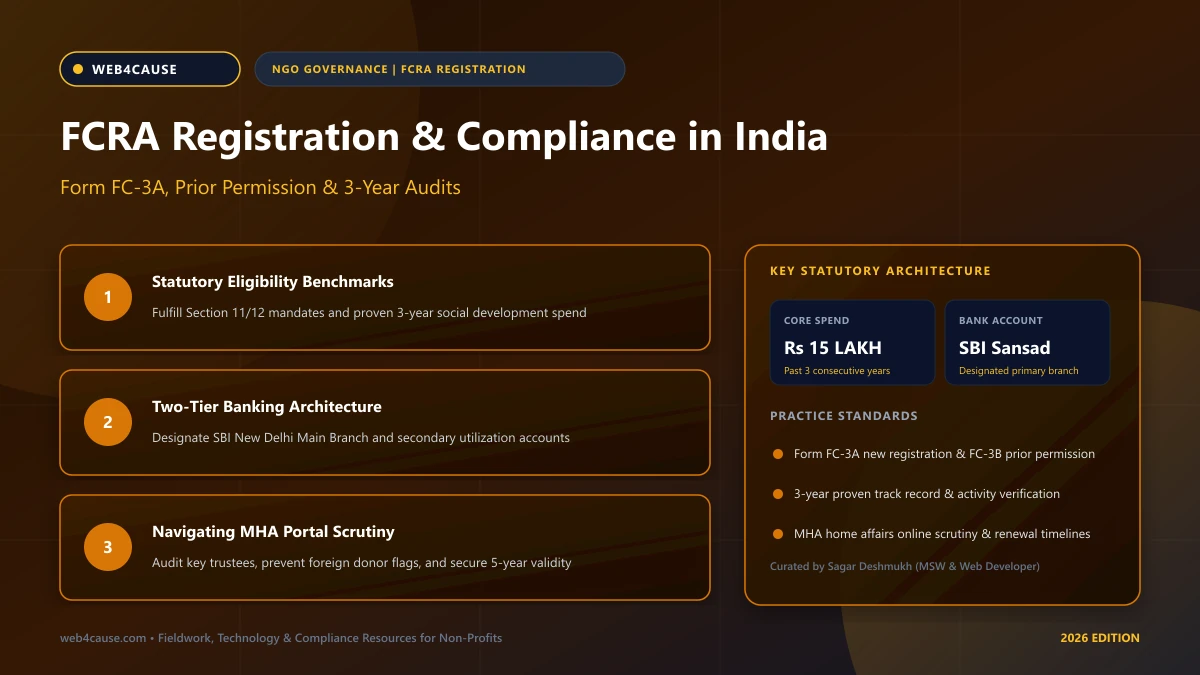
1. The Legal Architecture of Foreign Funding: FCRA 2010, FCRR 2011, and the 2020 Amendment
Foreign capital inflows into the Indian voluntary sector operate under the most stringent statutory regime in the nation. While domestic public donations and institutional CSR grants are regulated under the Indian Trusts Act, Societies Registration Act, Companies Act, and the Income Tax Act through Section 80G and 12A registration, all foreign funds fall squarely within the domain of the Ministry of Home Affairs (mha.gov.in) under national security considerations.
The foundational statute governing international resources is the Foreign Contribution (Regulation) Act, 2010 (FCRA 2010), read alongside the Foreign Contribution (Regulation) Rules, 2011 (FCRR 2011). The primary legislative intent of FCRA is to regulate the acceptance and utilization of foreign contributions or foreign hospitality by individuals, associations, or companies, and to prohibit such contributions for activities detrimental to national interest.
The regulatory landscape experienced an unprecedented transformation through the Foreign Contribution (Regulation) Amendment Act, 2020 (Act 33 of 2020), which took effect on September 29, 2020. This amendment instituted structural reforms across four critical pillars:
- Total Sub-Granting Prohibition: Section 7 was rewritten to completely prohibit the transfer of foreign contributions from one organization to another, regardless of whether both possess active FCRA registration certificates.
- Drastic Administrative Expense Compression: Section 8(1)(b) slashed the permissible ceiling for administrative expenditure from 50% of total foreign receipts down to a strict 20%.
- Centralized Banking Infrastructure: Section 17 mandated that all inbound foreign remittances must arrive solely through a single designated primary account at State Bank of India, New Delhi Main Branch (NDMB), Sansad Marg.
- Compulsory Executive Identification: Section 12(1A) made Aadhaar identification compulsory for all directors, trustees, and chief functionaries of an applicant association.
Under Section 11 of the Act, no organization possessing a definite cultural, economic, educational, religious, or social programme may accept any foreign contribution unless it receives a formal Certificate of Registration or secures Prior Permission from the Central Government. Operating outside this mandate triggers immediate confiscation of funds, severe compounding fines under Section 41, and criminal liability under Section 35 of the Act.
2. Form FC-3A (Regular Registration) vs Form FC-3B (Prior Permission): Comparative Framework
When an Indian non-profit decides to access international philanthropic grants, multilateral support, or foreign individual gifts, it must choose between two distinct legal gateways on the official MHA portal (fcraonline.nic.in): Form FC-3A for regular five-year registration, or Form FC-3B for project-specific Prior Permission.
Selecting the correct statutory vehicle determines application approval velocity. Submitting Form FC-3A without meeting the rigorous three-year operating threshold or minimum financial spending requirements results in immediate rejection and forfeiture of the statutory application fee.
| Compliance Dimension | Form FC-3A (Regular Registration) | Form FC-3B (Prior Permission) |
|---|---|---|
| Statutory Scope | Blanket five-year authorization to receive contributions from multiple legitimate foreign sources. | Restricted authorization for a single identified foreign donor, specific project, and fixed grant tranche. |
| Track Record Mandate | Mandatory three full financial years of active, verifiable non-profit operations. | Open to nascent institutions without three years of history, provided core legitimacy is established. |
| Minimum Spending Threshold | Minimum Rs 15,00,000 spent on core charitable activities over the preceding three financial years. | No historical financial spending threshold imposed; evaluated entirely on project viability. |
| Donor Commitment Proof | Not required at application stage; the entity seeks prospective unrestricted authorization. | Mandatory formal Donor Commitment Letter specifying grant amount, foreign currency, and project objectives. |
| Designated Banking | Mandatory primary designated account at SBI New Delhi Main Branch, Sansad Marg. | Mandatory primary designated account at SBI New Delhi Main Branch, Sansad Marg. |
| Statutory Portal Fee | Rs 10,000 paid electronically through the Bharatkosh Non-Tax Receipt Portal. | Rs 5,000 paid electronically through the Bharatkosh Non-Tax Receipt Portal. |
| Certificate Validity | Valid for five calendar years; renewable via Form FC-3C before expiration. | Valid exclusively until the designated grant tranche is fully received and exhausted. |
| Annual Reporting (FC-4) | Mandatory annual filing before December 31, including compulsory Nil returns. | Mandatory annual filing before December 31 for all years until project grant completion. |
For established organizations, Form FC-3A provides operational flexibility. For newly formed non-profits, Form FC-3B provides a viable entry point to receive their maiden international grant, establish project credentials, and build towards full registration. For detailed structural comparisons between foundational vehicles, review our analysis of Trust vs Society vs Section 8 Company models.
3. Eligibility Gateways: The Three-Year Track Record and Rs 15 Lakhs Core Spending Rule
The Ministry of Home Affairs evaluates Form FC-3A applications under an objective financial and operational matrix formulated in Rule 9 of the Foreign Contribution (Regulation) Rules, 2011. An association must prove beyond doubt that it is a bona fide, operating entity with deep community roots.
The Core Spending Mandate: Section 12 Read with Rule 9(1)(f)
An applicant association must have spent at least Rs 15,00,000 (Fifteen Lakhs Rupees) over the preceding three financial years on core non-administrative charitable activities. This expenditure must be certified by an independent Chartered Accountant in a dedicated statement with a verified Unique Document Identification Number (UDIN).
To satisfy the statutory spend threshold, the nature of the expenditure is subjected to strict administrative classification:
- Admissible Core Programmatic Spend: Direct field implementation costs, including grassroots mobilization drives, community health camps, teacher salaries in charitable schools, medical equipment utilized directly for beneficiaries, vocational training kits, and community mobilization based on participatory social work methodologies.
- Inadmissible Administrative Expenses: Executive director salaries, administrative staff compensation, legal retainers, general accounting fees, office rent, utilities, trustee travel allowances, and hospitality expenses. These cannot be counted toward the Rs 15 Lakhs threshold.
- Treatment of Capital Assets: Capital assets such as land, office buildings, or vehicles are generally excluded from the Rs 15 Lakhs calculation. However, if the applicant can demonstrate that a capital asset (such as an ambulance, dialysis machine, or community drinking water filtration unit) is directly utilized for charitable delivery, the Ministry may permit its inclusion upon rigorous documentation.
For social work administrators, field-level baseline documentation is essential. Projects designed using participatory rural appraisal approaches, as outlined in our manual on PRA techniques in social work, provide verifiable physical evidence during intelligence audits.
4. Mandatory State Bank of India Sansad Marg Banking Architecture
Before the 2020 Amendment, non-profits could receive foreign contributions in any scheduled commercial bank in India. The amendment radically replaced this decentralized model with a mandatory, single-window banking architecture under Section 17 of FCRA 2010.
Under Section 17(1), every association granted registration or prior permission must receive foreign contributions exclusively into a designated FCRA Account opened at:
Statutory Primary Inward Remittance Branch
Bank Name: State Bank of India (sbi.co.in)
Branch Name: New Delhi Main Branch (NDMB)
Address: 11, Sansad Marg, New Delhi, Pin Code: 110001
Branch Code: 00691 | IFSC Code: SBIN0000691
Account Nomenclature: "[Name of Association] – FCRA Account"
Operating Mechanism and Secondary Utilization Accounts
Trustees do not need to travel to New Delhi to open this account. The State Bank of India provides a decentralized onboarding protocol whereby the applicant association submits its KYC dossier, board resolutions, and registration certificates at its local SBI home branch. The local branch verifies the physical originals and transmits the authenticated dossier internally to SBI NDMB for account generation.
Once opened, the banking architecture functions across two closed-loop tiers:
- The Primary Designated Inward Account (SBI NDMB): Foreign donors can send cross-border remittances solely to this account. No domestic donations, Indian government grants, interest from domestic fixed deposits, or operational receipts may ever be deposited here. Inward foreign SWIFT transfers are validated directly by the Reserve Bank of India and MHA data gateways.
- Secondary Utilization Accounts: Under Section 17(2), an association may open one or more utilization accounts in any scheduled commercial bank convenient to its operational locations (such as HDFC, ICICI, Axis, or local SBI branches). Funds can be drawn from the SBI NDMB account into these utilization accounts to execute local vendor payments, payroll disbursements, and beneficiary interventions.
Strict Prohibition Against Fund Commingling
The transfer of funds from the SBI NDMB account to secondary utilization accounts is strictly a one-way pipeline. Secondary accounts must never receive funds from any source other than the primary SBI NDMB account. Commingling domestic rupees with foreign funds represents a non-bailable offense under Section 37, triggering immediate suspension under Section 13 and account freezing.
Furthermore, under Rule 11 of FCRR 2011, any interest accrued on savings balances or short-term fixed deposits within the FCRA banking network is legally classified as foreign contribution. It must be accounted for in the foreign cash book and reported in the annual FCRA Form FC-4 annual return.
5. Executive Identity Governance: NITI Aayog NGO Darpan and Section 12(1A) KYC
Transparency in non-profit executive leadership is a cornerstone of current FCRA regulation. Under the amended framework, an applicant organization must integrate its digital identity across multiple government portals before submitting an application.
Mandatory NITI Aayog NGO Darpan Integration
Every association applying for FCRA registration, prior permission, or five-year renewal must hold an active, verified registration on the NITI Aayog NGO Darpan portal (ngodarpan.gov.in). For step-by-step guidance on profile generation and trustee linkage, read our complete guide to NITI Aayog NGO Darpan registration in India.
When entering Form FC-3A or FC-3B on the MHA portal, the system requires the association DARPAN Unique ID. The portal automatically pulls governing body records from NITI Aayog. Any discrepancy in trustee names, father names, addresses, or PAN records between the DARPAN database and the FCRA portal blocks the electronic submission process.
Section 12(1A) Aadhaar Identification and Form FC-1 Affidavits
Enacted under the 2020 Amendment, Section 12(1A) makes Aadhaar-based identification mandatory for all key functionaries. Every individual serving as a trustee, governing council member, president, secretary, treasurer, or chief executive must fulfill the following statutory requirements:
- Aadhaar KYC: Submission of twelve-digit Aadhaar numbers with authenticated name spellings. For foreign nationals residing on governing boards, a certified copy of a valid passport and Overseas Citizen of India (OCI) card is accepted.
- Form FC-1 Affidavit: Each key functionary must individually execute an affidavit in prescribed Form FC-1 on non-judicial stamp paper, attested by a Notary Public or Oath Commissioner.
- Statutory Undertakings: The Form FC-1 affidavit requires each trustee to swear under oath that they have never been convicted of a criminal offense, have never been involved in communal disharmony or forced religious conversions, have not participated in seditious or subversive activities, and have never diverted philanthropic funds for personal gain.
If any board member changes after obtaining registration, the association must file Form FC-6E on the portal within 45 days. Failing to notify the Ministry of trustee resignations or appointments is a common trigger for cancellation notices.
6. Step-by-Step Electronic Application Walkthrough on fcraonline.nic.in
Physical applications have been entirely abolished. All filings are processed electronically through the MHA FCRA portal (fcraonline.nic.in). Follow this sequential workflow to assemble and lodge your application without procedural defaults:
Phase 1: Dossier Assembly and CA UDIN Certification
Before logging into the portal, assemble all digital assets into searchable PDF files (maximum 5 MB each, clear 300 DPI resolution):
- Certified Trust Deed, Society MOA with Registration Certificate, or Section 8 Company Certificate of Incorporation, Memorandum, and Articles of Association.
- Valid Section 12A / 12AB and Section 80G registration certificates issued by the Income Tax Department (incometax.gov.in).
- Audited financial statements for the past three financial years (Balance Sheet, Income & Expenditure Account, and Receipts & Payments Account) bearing Chartered Accountant seal and UDIN.
- Chartered Accountant Certificate verifying that the association spent at least Rs 15 Lakhs on core non-administrative charitable activities over the preceding three years.
- Detailed Activity Reports for the past three financial years detailing physical beneficiaries, geographical coverage, and dated field photographs.
- Notarized Form FC-1 affidavits from each trustee on non-judicial stamp paper.
- Certified Governing Body Resolution authorizing the FCRA application, appointing the authorized signatory, and sanctioning the SBI NDMB account setup.
- Official bank certificate from SBI confirming the designated FCRA Account at NDMB, Sansad Marg (Branch Code: 00691).
Phase 2: Portal Profile Setup and Data Entry
- User Authentication: Register on fcraonline.nic.in, create user credentials, and verify via registered mobile OTP and email.
- Service Selection: Navigate to "FCRA Services" and select "Application for FCRA Registration (Form FC-3A)" or "Application for Prior Permission (Form FC-3B)".
- DARPAN Verification: Enter the NITI Aayog DARPAN Unique ID to populate institutional parameters.
- Association Profiling: Fill in registered office address, nature of association (Cultural, Economic, Educational, Religious, or Social), and PAN details.
- Executive Listing: Input details for every trustee, director, and chief functionary, including Aadhaar numbers, occupation, residential address, and phone contacts.
- Banking Details: Enter the SBI NDMB primary designated account details (IFSC: SBIN0000691) along with any secondary utilization accounts.
Phase 3: Digital Document Upload and Payment
- Document Attachment: Upload all pre-assembled PDF documents to their respective portal upload slots.
- Final Review: Generate a draft PDF of Form FC-3A or FC-3B. Review spelling of trustee names, financial figures, and IFSC codes with extreme care.
- Bharatkosh Fee Payment: The portal redirects to the Bharatkosh Non-Tax Receipt Portal. Pay the non-refundable statutory fee: Rs 10,000 for Form FC-3A or Rs 5,000 for Form FC-3B.
- Acknowledgment Generation: Download and archive the signed final submission receipt containing the unique MHA File Number (e.g., II/21022/…).
7. Ministry of Home Affairs Field Scrutiny, Intelligence Bureau Verification, and Rejection Triggers
Lodging the electronic application is only the first step. The Ministry of Home Affairs subjects every FCRA submission to rigorous scrutiny that bridges administrative review with national security vetting.
The Multi-Tier Intelligence Verification Protocol
Once desk officers at the FCRA Division complete preliminary document checks, the application is referred to the Intelligence Bureau (IB) and local police Special Branches:
- Physical Office Inspection: Intelligence officers conduct unannounced physical visits to the registered office and branch locations. They verify physical signage, utility bills, tenancy agreements, and presence of regular operational staff. Shell addresses or virtual offices trigger immediate negative reports.
- Field Program Verification: Field officers visit actual project locations, such as schools, healthcare clinics, rural watersheds, or vocational centers. They interview local beneficiaries, community leaders, and panchayat members to confirm whether reported activities were actually executed.
- Trustee Background Scrutiny: Security agencies examine the personal profiles of all trustees, checking police records, political affiliations, media presence, and any history of communal tension or financial impropriety.
- Foreign Donor Vetting (For Prior Permission): In Form FC-3B cases, the Ministry scrutinizes the prospective foreign donor entity. If the foreign donor is red-flagged on international watchlists, suspected of political interference, or associated with proselytization, permission is denied.
Primary Statutory Grounds for Application Rejection
Under Section 12(4) of the Act, the Central Government possesses broad discretion to deny registration. The leading grounds for rejection include:
Common Rejection Triggers under Section 12(4)
- Failing the Rs 15 Lakhs Threshold: Inclusion of administrative overhead or unverifiable asset additions to artificially inflate charitable spending.
- Financial Discrepancies: Mismatches between Receipts & Payments figures, Balance Sheet disclosures, and Income Tax returns.
- Adverse Intelligence Reports: Negative findings by the Intelligence Bureau regarding office legitimacy, local community feedback, or political affiliations.
- Lapse in Clarification Response: Failing to furnish written clarifications or supplemental documents within the strict 30-day window following an MHA portal query.
- Defective Form FC-1 Affidavits: Submitting outdated affidavit text, improper stamp paper values, or un-notarized undertakings.
An application rejected under Section 12(4) imposes a statutory cooling-off barrier: the association cannot reapply for FCRA registration for a period of six months from the rejection order date.
8. Post-Registration Statutory Maintenance: Five-Year Renewal, Sub-Granting Ban, and Expense Caps
Securing an FCRA Certificate of Registration is only the initial hurdle. Maintaining it demands disciplined compliance management. A single procedural lapse can lead to immediate suspension or permanent cancellation under Section 14.
Five-Year Certificate Renewal via Form FC-3C
Under Section 16 of FCRA 2010 read with Rule 12 of FCRR 2011, every registration certificate remains valid for exactly five calendar years from its date of issuance.
- Mandatory Renewal Window: The renewal application must be lodged in Form FC-3C strictly within six months before the certificate expiration date.
- Consequence of Lapsed Certificate: If an organization fails to apply before expiration, the certificate automatically lapses. While an application may be entertained up to four months past expiry upon payment of late fees, the NGO cannot legally receive, credit, or spend foreign funds during the lapsed interval.
- Complete Re-Verification: The Ministry treats Form FC-3C renewal with the same rigorous scrutiny as a fresh registration, including fresh IB checks and scrutiny of five years of audited returns.
The Absolute Sub-Granting Ban (Section 7)
The 2020 Amendment introduced an absolute ban on sub-granting:
"No person who is registered and granted a certificate or has obtained prior permission under this Act shall transfer such foreign contribution to any other person."
Section 7, FCRA 2010 (As Amended by Act 33 of 2020)
Historically, large non-profits received foreign funding and disbursed grants to smaller grassroots NGOs across India. Today, this practice is illegal. Even if an implementing partner possesses an active FCRA certificate, no foreign money can be transferred to them. The primary recipient must execute 100% of the project directly, engaging field personnel on direct payroll and contracting suppliers through direct commercial procurement.
The 20% Administrative Expenditure Ceiling (Section 8)
Under Section 8(1)(b) of the Act, foreign contributions utilized for administrative expenses cannot exceed 20% of total foreign funds received during that financial year. Exceeding this cap without prior written sanction from the Ministry constitutes a statutory violation punishable under Section 41 compounding provisions.
Under Rule 5 of FCRR 2011, administrative expenses encompass executive salaries, office utilities, accounting and legal fees, vehicle running costs for administrative personnel, and governance expenses. Direct project personnel (such as community teachers, nurses, and field social workers) are excluded from this 20% ceiling, provided payroll and job descriptions document direct programmatic engagement.
Mandatory Quarterly Website Intimations (Rule 13)
Under Rule 13 of FCRR 2011, every registered association must publish a comprehensive quarterly disclosure of all foreign contributions received on its official public website within 15 days following the close of each calendar quarter. The disclosure must detail:
- Official name of the foreign donor entity or individual.
- Country of origin and official registered address of donor.
- Exact amount received in foreign currency and converted Indian Rupees.
- Date of credit into the SBI NDMB primary account and designated project purpose.
Non-profits must host these public disclosures on secure, professional web infrastructure. For standards on high-trust NGO websites, review our guide to NGO website design in India. Organizations accepting online domestic donations alongside foreign grants should also explore our guide on NGO payment gateway integration and recurring giving systems using UPI AutoPay recurring donations.
9. Practical Trustee Compliance Checklist and Risk Mitigation Audit Protocol
To safeguard your institution against regulatory scrutiny, trustees and executive management should implement this 10-point internal compliance audit protocol before filing Form FC-3A or during quarterly reviews:
The 10-Point Governance and Risk Verification Audit
- Three-Year Continuous Operation: Confirm the association has completed at least three full financial years from legal registration date with active operations.
- Audited Spending Threshold: Verify that the Chartered Accountant certified spend on core non-administrative charitable objectives exceeds Rs 15,00,000 across the past three financial years.
- CA Certificate with UDIN: Confirm that all financial certificates, balance sheets, and utilization statements carry an authentic UDIN verified on the ICAI portal.
- SBI NDMB Account Confirmation: Obtain the official bank certificate from State Bank of India, NDMB, Sansad Marg confirming active account generation with IFSC SBIN0000691.
- NGO Darpan Profile Synchronization: Ensure all trustee records, PAN numbers, registered addresses, and telephone contacts on ngodarpan.gov.in match official trust deed documents.
- Section 12(1A) Aadhaar Dossiers: Collect signed Form FC-1 affidavits on non-judicial stamp paper and Aadhaar copies from 100% of governing council members.
- Detailed Field Activity Reports: Compile quantitative field activity reports documenting direct community impact, beneficiary counts, and dated photographs.
- Segregated Accounting Infrastructure: Verify that foreign contribution accounts operate with a separate cash book, ledger, and bank book isolated from domestic funds.
- Administrative Expense Modeling: Audit international project budgets to ensure administrative expenditures remain strictly below the statutory 20% cap.
- Automated Annual Reporting Workflows: Establish automated accounting systems for Form FC-4 annual returns and Form 10BD donation filings using n8n workflow automation for NGOs.
10. Frequently Asked Questions (FAQ)
Q1: What is the primary difference between Form FC-3A and Form FC-3B under FCRA?
Form FC-3A is the statutory application for regular, long-term FCRA registration granting a five-year blanket authorization to receive foreign contributions from any legitimate foreign donor for approved organizational objectives. It requires a mandatory three-year institutional track record and an audited minimum core non-administrative spend of Rs 15 Lakhs. Conversely, Form FC-3B is for Prior Permission, enabling younger organizations or those lacking a three-year history to receive a specific foreign grant from an identified foreign donor for a designated project.
Q2: Why must every FCRA registered NGO open an account at State Bank of India, New Delhi Main Branch?
Under Section 17(1) of the Foreign Contribution (Regulation) Act, 2010 as amended by Act 33 of 2020, foreign contributions must be received exclusively through the primary designated FCRA account at State Bank of India, New Delhi Main Branch (NDMB), located at 11 Sansad Marg, New Delhi 110001 (IFSC: SBIN0000691). This statutory centralization gives the Ministry of Home Affairs and Reserve Bank of India an automated, real-time monitoring mechanism to verify inbound cross-border capital inflows.
Q3: How is the minimum audited core expenditure threshold of Rs 15 Lakhs verified for Form FC-3A?
Rule 9 of the Foreign Contribution (Regulation) Rules, 2011 mandates that an applicant association must have spent at least Rs 15,00,000 during the preceding three financial years on its core charitable objectives. This figure must represent direct programmatic interventions, such as educational tuition, medical relief, community development, and vocational training. It strictly excludes administrative expenses such as trustee allowances, head office rent, executive salaries, and speculative capital acquisitions.
Q4: Can an FCRA registered non-profit disburse foreign grants to other Indian NGOs for field implementation?
No. Under Section 7 of the amended Foreign Contribution (Regulation) Act, 2010, the transfer or sub-granting of foreign contributions to any other association, person, or non-profit is strictly prohibited. Even if the recipient organization holds a valid, active FCRA registration certificate, foreign funds cannot be transferred. The primary recipient entity must utilize every rupee directly through internal staff execution, vendor procurement, and direct programmatic service delivery.
Q5: What are the mandatory biometric and identity verification requirements under Section 12(1A)?
Section 12(1A) requires every trustee, governing council member, office bearer, and chief executive of the applying entity to provide their Aadhaar identification number alongside biometric or OTP verification. For foreign nationals serving on governing bodies, a copy of a valid passport and Overseas Citizen of India (OCI) registration must be furnished. Additionally, each member must submit a certified Form FC-1 affidavit on non-judicial stamp paper declaring non-conviction and absence of communal or religious conversion activities.
Q6: What happens if an organization misses the statutory six-month renewal window for Form FC-3C?
Under Section 16 of FCRA 2010 and Rule 12 of FCRR 2011, renewal applications via Form FC-3C must be submitted strictly within six months before the certificate expires. If an association fails to apply before expiry, the certificate lapses automatically. While a late application may be accepted up to four months after expiration upon payment of statutory compounding penalty fees, the organization cannot legally receive or utilize foreign contributions while the certificate is lapsed. If not renewed, all foreign operations must halt.
11. Professional FCRA Advisory and Technical Support from Web4cause
Navigating the intricate matrix of FCRA registration, prior permission, Intelligence Bureau inspections, and banking compliance requires specialized interdisciplinary expertise. At Web4cause, we unite professional Master of Social Work field experience with legal precision and full-stack digital infrastructure development.
Whether your organization requires pre-application financial audits to verify the Rs 15 Lakhs core programmatic spend, NITI Aayog NGO Darpan synchronization, assistance in opening the SBI NDMB primary account, or deployment of automated quarterly disclosure portals, our team delivers strategic guidance designed to protect your institutional standing.