
MCA V3 Portal Compliances
2026 Edition
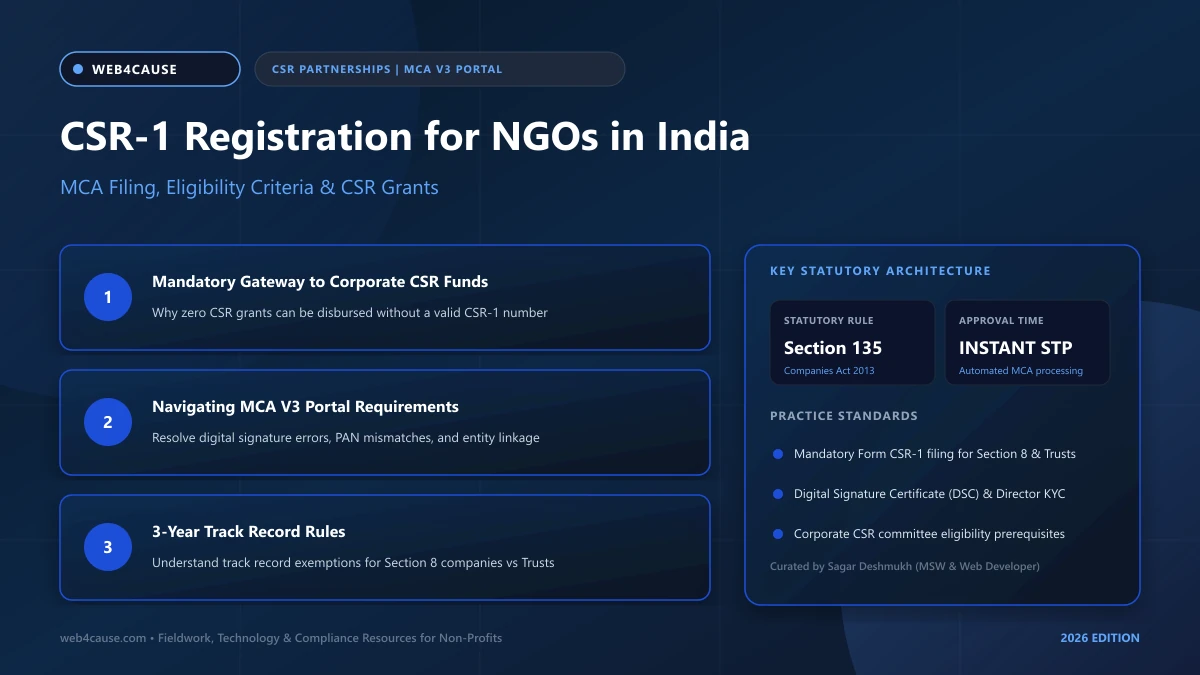
CSR-1 Registration for NGOs in India: Complete 2026 MCA Guide
•
Published: October 31, 2026
•
16 Min Read
•
Statutory Reference: Rule 4(2) Companies CSR Rules
Master the complete Ministry of Corporate Affairs (MCA) Form CSR-1 electronic filing workflow on the MCA V3 portal. Understand statutory mandates under Section 135 of the Companies Act 2013, decode the strict 3-year programmatic track record requirements, organize digital signatures and professional certifications from practicing Chartered Accountants, and secure your institutional 11-digit CSR Unique Registration Number to unlock corporate funding across India.
1. What is Form CSR-1? The Statutory Framework of MCA Rule 4(2)
In Indian corporate philanthropy, the passage of the Companies (Corporate Social Responsibility Policy) Amendment Rules, 2021 marked a definitive turning point. Effective April 1, 2021, the Ministry of Corporate Affairs (MCA) notified Rule 4(2), establishing that every entity intending to undertake any Corporate Social Responsibility (CSR) activity must register itself with the Central Government by filing Form CSR-1 electronically.
Before this statutory intervention, Indian corporates disbursed social development grants to non-governmental organizations, trusts, and societies with limited centralized oversight. This legacy system created compliance blind spots, duplicate accounting, and occasional fund diversion. Under the revised framework established pursuant to Section 135 of the Companies Act, 2013, Form CSR-1 acts as an institutional filter. It generates an unambiguous, publicly verifiable record of all entities authorized to receive corporate funds.
The statutory consequence of Rule 4(2) is non-negotiable: a corporate entity cannot legally disburse its CSR budget to any implementing agency that lacks an approved Form CSR-1 Unique Registration Number. Any corporate disbursement made to an unregistered entity is categorized as non-compliant CSR expenditure under MCA audit protocols. Such disqualified spending cannot be set off against the company statutory two percent net profit obligation. Consequently, obtaining Form CSR-1 registration is not merely a formality; it is an absolute commercial gateway for non-profit organizations seeking to tap into India multi-billion rupee corporate philanthropy ecosystem. For a complete understanding of how corporate funding budgets are allocated, read our comprehensive guide on CSR funding for NGOs in India.
Legal Provision: Sub-Rule (2) of Rule 4 of the Companies (CSR Policy) Rules
Every entity who intends to undertake any CSR activity shall register itself with the Central Government by filing the form CSR-1 electronically with the Registrar, with effect from the 1st day of April 2021. On the submission of the Form CSR-1 on the portal, a unique CSR Registration Number shall be generated by the system automatically.
2. Four Categories of Eligible Implementing Agencies Under Section 135
The Companies Act, 2013 strictly delimits the legal vehicles through which corporate CSR programs may be implemented. Under Rule 4(1) of the Companies (CSR Policy) Rules, a company may undertake CSR activities either directly through its internal personnel or through designated implementing agencies that fall into four distinct statutory categories:
Category A: Corporate-Established Non-Profits (Rule 4(1)(a))
A company established under Section 8 of the Act, or a registered public trust or a registered society, exempted under sub-clauses (iv), (v), (vi) or (via) of clause (23C) of Section 10 or registered under Section 12A and Section 80G of the Income Tax Act, 1961, established by the corporate company itself, either singly or along with any other company.
Category B: Independent Non-Profits with 3-Year Track Record (Rule 4(1)(b))
A company established under Section 8 of the Act, or a registered public trust or a registered society, exempted under sub-clauses (iv), (v), (vi) or (via) of clause (23C) of Section 10 or registered under Section 12A and Section 80G of the Income Tax Act, 1961, and having an established track record of at least three years in undertaking similar activities.
Category C: Statutory Bodies Under Legislative Acts (Rule 4(1)(c))
Any entity established under an Act of Parliament or a State Legislature, such as statutory universities, specialized research boards, or government development authorities created through formal statutes.
Category D: Government-Established Non-Profits (Rule 4(1)(d))
A company established under Section 8 of the Act, or a registered public trust or a registered society, established by the Central Government or a State Government.
For the vast majority of non-profit organizations operating in India, eligibility hinges on qualifying under Category B. Whether your organization is incorporated as a Section 8 non-profit company, constituted as a Public Charitable Trust under the Indian Trusts Act or state public trusts legislation, or registered as a Society under the Societies Registration Act, 1860, dual tax exemptions under Section 12A/12AB and Section 80G are universally required. To explore the institutional differences between these non-profit vehicles, review our comprehensive comparative analysis on Trust vs Society vs Section 8 Company in India.
| Entity Classification | Governing Statute | 12A and 80G Mandate | 3-Year Track Record | MCA Verification Authority |
|---|---|---|---|---|
| Section 8 Company (Independent) | Companies Act, 2013 | Mandatory | Mandatory (3 Years) | Registrar of Companies (ROC) |
| Public Charitable Trust | State Trust Act or Indian Trusts Act | Mandatory | Mandatory (3 Years) | Charity Commissioner / Sub-Registrar |
| Registered Society | Societies Registration Act, 1860 | Mandatory | Mandatory (3 Years) | Registrar of Societies |
| Corporate Foundation (Singly or Jointly) | Companies Act, 2013 / Trust Deed | Mandatory | Exempt from 3 Years | MCA / Corporate Board |
| Statutory Entity | Act of Parliament / State Legislature | Exempt | Exempt from 3 Years | Central / State Legislature |
3. The 3-Year Track Record Requirement Decoded: Exemptions vs. Mandates
Among all statutory prerequisites under Rule 4, the interpretation of the three-year established track record provokes the highest volume of audit queries, grant disqualifications, and confusion among social work leaders. The law draws a clear boundary between non-profits founded by the corporate company itself and independent non-profit organizations.
Why Independent Non-Profits Must Prove Three Active Years
Under Rule 4(1)(b), an independent non-profit must demonstrate an established track record of at least three financial years in undertaking similar charitable activities. The rationale of the Ministry of Corporate Affairs is straightforward: corporate CSR budgets represent public interest capital mandated by statute. Allowing nascent or untested shell organizations to execute large-scale CSR allocations creates unacceptable fiduciary risk. By mandating three complete operating cycles, the legislature ensures that the non-profit has:
- Established governance structures tested through multiple annual general meetings and statutory audits.
- Demonstrated real-world program delivery in specific thematic sectors recognized under Schedule VII of the Companies Act, such as education, healthcare, poverty alleviation, rural development, or vocational training.
- Submitted consecutive annual returns and audited financial reports to the Income Tax Department via Form ITR-7 and Form 10B or Form 10BB.
- Maintained continuous compliance without facing cancellations or tax revocations under Section 12AB.
The Specific Exemption for Corporate-Established Foundations
An important exception exists under Rule 4(1)(a). When a corporate company incorporates its own Section 8 non-profit company or creates its own dedicated charitable trust, it is legally permitted to fund this entity immediately upon incorporation. Such internal foundations are exempt from the three-year track record rule. Because the parent company exercises direct board governance, financial control, and strategic oversight over the foundation, the law does not require prior operating history.
However, independent grassroots non-profits cannot circumvent this rule through creative structuring. If an NGO was registered eighteen months ago, it cannot execute third-party corporate CSR projects under Rule 4(1)(b), even if it manages to submit Form CSR-1 on the portal. Corporate CSR committees and external grant auditors conduct thorough due diligence and will instantly reject partnerships if the non-profit financial statements do not reflect three full operating years. For deeper insights on navigating institutional grant timelines, consult our technical guide on NGO grant proposal writing in India.
4. Mandatory Pre-Requisites and Documentation Checklist for Filing
Before initiating the electronic submission on the MCA portal, the management of the non-profit must organize six core regulatory building blocks. Attempting to file Form CSR-1 without these verified assets will result in validation errors, rejected submissions, or digital signature verification failures.
The Complete Form CSR-1 Pre-Filing Dossier
The official registration order issued by the Principal Commissioner of Income Tax (Exemptions). The 16-character Unique Registration Number (URN) and exact date of issue must be entered accurately into the web form. Regular registration under Form 10AD is standard for Category B organizations. If your tax exemptions require regularisation, refer to our detailed walk-through on 80G and 12A registration for NGOs in India.
The formal approval order granting donor tax deductions under Section 80G of the Income Tax Act, 1961. The form requires the 80G URN, issue date, and issuing authority details.
A valid Class 3 signing DSC registered in the personal name of the authorized office bearer. For a Section 8 company, this is the Director with an active Director Identification Number (DIN). For a Trust or Society, this is the Managing Trustee, President, Secretary, or Chief Executive.
Form CSR-1 cannot be filed independently by an NGO without professional certification. The form must be digitally certified by a practicing Chartered Accountant holding membership with the Institute of Chartered Accountants of India (ICAI), a practicing Company Secretary holding membership with the ICSI, or a practicing Cost and Management Accountant holding membership with the ICMAI. The professional must possess a valid, active Certificate of Practice (COP).
Permanent Account Number (PAN) card of the non-profit. The legal name printed on the PAN card must match the non-profit constitution character for character. For Section 8 companies, the 21-digit Corporate Identity Number (CIN) is verified directly through MCA records.
A certified true copy of the resolution passed by the Board of Directors, Board of Trustees, or Governing Body authorizing a specific office bearer to execute, digitally sign, and file Form CSR-1 on the MCA portal.
| Required Document | Format and Specs | Mandatory Data Points | Filing Attachment Rules |
|---|---|---|---|
| Certificate of Registration | PDF (Max 2 MB, 200 DPI) | Registration Number, Registration Date | Mandatory for Trusts and Societies |
| 12A / 12AB Order | PDF (Max 2 MB, Text Searchable) | 16-Digit URN, Valid Assessment Years | Mandatory Attachment |
| 80G Approval Order | PDF (Max 2 MB, Text Searchable) | 80G URN, Date of Issue | Mandatory Attachment |
| Governing Body KYC Dossier | Structured Table in e-Form | PAN, DIN/DPIN/Aadhaar, Mobile, Email | Direct Data Entry in Portal Form |
| Board Authorization Resolution | PDF on Official NGO Letterhead | Meeting Date, Signatory Name, Role | Mandatory Attachment |
5. Step-by-Step Electronic Filing Guide on the MCA V3 Web Portal
The Ministry of Corporate Affairs fully transitioned from the legacy V2 downloadable PDF system to the modern, web-based MCA V3 portal architecture. Form CSR-1 is executed directly within the browser session, supported by real-time database lookups against the Central Board of Direct Taxes (CBDT) and the Registrar of Companies database.
Detailed Operational Filing Protocol on MCA V3
Visit mca.gov.in and register a Business User account. A standard Registered User account cannot execute company e-filings. If registering as a Director of a Section 8 company, select the Director category and link your valid Director Identification Number (DIN). If registering for a Trust or Society, select the Authorized Representative role, input your personal PAN, and complete mobile and email One-Time Password (OTP) verification.
Log into the MCA V3 workspace using your credentials. Navigate through: MCA Services > Company e-Filings > CSR Services > Form CSR-1 (Application for Registration of Entities for undertaking CSR Activities). The interactive web form opens.
In Field 1, select the precise nature of the entity from the radio buttons: Section 8 company, Registered Public Trust, or Registered Society. For Section 8 companies, enter the Corporate Identity Number (CIN) and click Pre-fill; the portal automatically populates the company name, registered office address, and email. For Trusts and Societies, enter the NGO registration number, registered address, official email, and non-profit PAN. Click the PAN Verification button to trigger live validation against the CBDT database.
Input the 16-character alphanumeric Unique Registration Number (URN) for Section 12A/12AB, along with the exact approval date. Enter the corresponding Section 80G URN and issue date. Select the appropriate approving tax authority, such as Principal Commissioner of Income Tax (Exemptions).
The portal requires granular details of all trustees, directors, or governing committee members. For each individual, input their full legal name, designation, DIN or DPIN (mandatory for directors of Section 8 companies), personal PAN, valid mobile number, and active email address. Ensure zero typographical errors in PANs or names.
Attach clean, high-resolution, text-searchable PDF files: (1) Copy of Registration Certificate or Trust Deed, (2) Copy of 12A/12AB Registration Order, (3) Copy of 80G Approval Order, and (4) Certified Board Resolution authorizing the signatory. Keep each attachment strictly below 2 MB to avoid session timeouts.
Once pre-scrutiny validates the form, proceed to the signing stage. Launch the MCA emSigner desktop utility. First, affix the Class 3 DSC of the NGO authorized representative (Director or Trustee). Next, affix the Class 3 DSC of the certifying Chartered Accountant, Company Secretary, or Cost Accountant, ensuring the professional active membership number and COP are recorded.
Click Submit. The MCA payment gateway opens showing a statutory fee of ₹0. Complete the zero-rupee transaction checkout. The portal instantly creates a Service Request Number (SRN), generating a timestamped filing receipt.
6. Straight-Through Processing (STP) and Certificate Generation
A key engineering innovation of Form CSR-1 on the MCA architecture is its reliance on Straight-Through Processing (STP). Unlike corporate restructuring petitions or complex statutory licenses that require discretionary review by human Registrar of Companies (ROC) inspectors, Form CSR-1 is processed algorithmically by backend MCA servers.
The Algorithmic Approval Engine
When the submission is finalized and the zero-rupee receipt is generated, the MCA system executes an automated verification routine:
- It checks the digital signature of the certifying professional against the professional institute database (ICAI, ICSI, or ICMAI) to confirm active membership and valid Certificate of Practice.
- It matches the authorized representative DSC against the registered MCA Business User profile.
- It confirms that mandatory PDF attachments are present and structurally uncorrupted.
- It validates that the entity PAN syntax conforms to the CBDT trust and company registry rules.
Format of the CSR Unique Registration Number
Upon successful STP validation, the portal issues an automated approval email containing the official Form CSR-1 Registration Letter. This document bears the digital signature of the Registrar of Companies and displays the organization 11-digit CSR Unique Registration Number.
CSR00012345
Comprises the fixed prefix ‘CSR’ followed by an 8-digit unique sequential numerical identifier.
The generated letter should be permanently archived in your organization statutory corporate records. This registration letter, along with your 12AB certificate and 80G order, forms the primary compliance triad required by every corporate CSR committee, institutional grant portal, and corporate foundation across India before signing grant agreements.
7. Common Rejection Reasons, MCA V3 Portal Glitches, and Practical Solutions
Although Form CSR-1 is an STP electronic form, thousands of non-profits encounter severe filing roadblocks, validation crashes, and procedural rejections on the MCA V3 portal. Understanding the underlying causes prevents weeks of wasted administrative effort.
Pitfall 1: Provisional vs. Permanent 12AB and 80G Registrations
Issue: Non-profits holding provisional registrations under Form 10AC sometimes input their provisional URNs for Category B applications. While the MCA algorithm may technically accept the 16-character string, corporate grant makers routinely reject the resulting CSR-1 certificate upon discovering that the non-profit lacks a regular registration under Form 10AD with three completed financial audit cycles.
Remedy: Complete the regular Section 12AB and 80G filing (Form 10AB) with the Income Tax Department to secure a permanent 5-year registration before applying for third-party corporate grants.
Pitfall 2: Entity Name Discrepancies Across PAN and MCA Records
Issue: Even minor character mismatches between the PAN card database, the registered Trust Deed, and the MCA Business User profile trigger automated pre-scrutiny failures. Common culprits include spaces in abbreviations or mismatched punctuation.
Remedy: Verify the exact legal name registered in the Income Tax e-filing master data prior to beginning Form CSR-1. Ensure identical spelling in every form field.
Pitfall 3: DSC Token Driver Conflicts and MCA emSigner Failures
Issue: The MCA V3 emSigner utility frequently fails with WebSocket connection errors, port binding conflicts (ports 8080 or 8085 occupied), or outdated Java Runtime Environments, preventing digital signature affixation.
Remedy: Install the latest emSigner build directly from mca.gov.in. Run emSigner as an Administrator, verify that your Class 3 cryptographic token drivers are updated, add the MCA URL to the trusted site list, and use an incognito browser window.
Pitfall 4: Practicing Professional Profile Not Registered on MCA V3
Issue: The certifying Chartered Accountant or Company Secretary has not registered their DSC under their MCA V3 Professional User profile. When the professional attempts to sign, the system throws an ‘Unregistered DSC’ validation error.
Remedy: Ensure your certifying CA, CS, or CMA has mapped their active Class 3 DSC on their own MCA V3 portal profile under the ‘Associate DSC’ module before attempting to certify your form.
8. Maintaining CSR Compliance Post-Registration: Darpan, UCs, and Escrows
Securing your Form CSR-1 Unique Registration Number is a critical milestone, but it represents the starting point of an ongoing institutional compliance journey. The Ministry of Corporate Affairs, the Ministry of Finance, and corporate CSR committees mandate ongoing operational transparency throughout the project lifecycle.
1. Mandatory Linking with NITI Aayog NGO Darpan
Under federal governance guidelines, all non-profits receiving corporate CSR allocations or government grants must maintain an active registration on the NITI Aayog NGO Darpan portal. Upon receiving your 11-digit CSR-1 number, log into your NGO Darpan dashboard and update your profile to link the CSR-1 URN with your Darpan Unique ID. Corporates and grant evaluators cross-check both portals during statutory vendor onboarding. If your NGO requires registration or profile updates on the federal portal, consult our definitive guide on NITI Aayog NGO Darpan registration in India.
2. Segregated CSR Project Bank Accounts and Financial Sub-Ledgers
Corporate CSR funds must never be commingled with general public donations, religious contributions, or administrative fee receipts. Best practices and institutional grant covenants require implementing agencies to maintain dedicated project-specific bank accounts or clean accounting sub-ledgers. This segregation ensures that interest accrued on unspent CSR balances is accurately tracked and credited back to the corporate donor or applied toward the project in compliance with Section 135(5) and Section 135(6). For corporate non-profits, ensuring meticulous corporate governance is vital; learn more in our detailed manual on Section 8 company annual compliance in India.
3. Statutory Fund Utilization Certificates (UC)
At the conclusion of each financial quarter or project milestone, the implementing agency must issue a formal Fund Utilization Certificate (UC) certified by an independent practicing Chartered Accountant. The UC confirms that grant funds were disbursed exclusively for approved activities listed in Schedule VII of the Companies Act, supported by programmatic vouchers, beneficiary muster rolls, and verified procurement receipts.
4. Annual Form 10BD and Form 10BE Compliance
Every corporate grant received by a non-profit holding Section 80G approval must be reported annually to the Income Tax Department through Form 10BD. The non-profit must submit the corporate donor PAN, full corporate legal name, registered address, and exact grant contribution amount on or before May 31 following the close of the financial year. Following submission, the NGO must download the official Form 10BE Certificate of Donation from the e-filing portal and transmit it to the corporate donor. Without Form 10BE, the corporate donor will be denied its tax deduction under Section 80G. Learn the complete statutory submission procedure in our technical guide on Form 10BD filing for NGOs in India and our guide on Form 10BE certificate generation for NGOs in India.
Independent Third-Party Impact Assessments Under Rule 8(3)
For corporate donors with an average CSR obligation of ₹10 Crore or more in the three immediately preceding financial years, projects with outlays of ₹1 Crore or more require mandatory independent third-party impact assessments. As an implementing agency, maintaining rigorous baseline data, output metrics, and digital documentation ensures your projects withstand comprehensive statutory evaluations.
9. Frequently Asked Questions (FAQ)
Q1: Is Form CSR-1 registration mandatory for every NGO in India seeking corporate CSR grants?
Yes. Under Rule 4(2) of the Companies (CSR Policy) Amendment Rules 2021, every implementing agency intending to undertake CSR activities funded by corporate companies must register with the Central Government by filing Form CSR-1 electronically on the MCA portal. Corporates are legally prohibited under Section 135 from releasing CSR funds to non-profits that lack a valid 11-digit CSR Unique Registration Number.
Q2: Can a newly established NGO without 3 years of audited programmatic history obtain Form CSR-1 registration?
An independent Public Charitable Trust, Registered Society, or Section 8 Company cannot undertake CSR implementations for third-party corporates without completing a 3-year established track record in similar social activities. However, a Section 8 company, registered public trust, or registered society established directly by the corporate company itself (or jointly with another corporate) is legally exempt from the 3-year track record mandate under Rule 4(1).
Q3: What is the official government filing fee for submitting Form CSR-1 on the MCA V3 portal?
The Ministry of Corporate Affairs charges zero statutory filing fee for submitting Form CSR-1. The government has kept the official filing fee at ₹0 to encourage grassroots non-profit compliance. However, non-profits must budget for professional certification fees paid to the practicing Chartered Accountant, Company Secretary, or Cost Accountant who verifies and digitally signs the form, as well as Class 3 Digital Signature Certificate costs.
Q4: Can an NGO file Form CSR-1 with only a provisional 12A or 80G registration order?
MCA V3 accepts the 16-character Unique Registration Number (URN) issued under provisional registrations (Form 10AC). However, corporate CSR committees and institutional grant makers routinely reject implementing agencies holding only provisional approval because provisional registration implies a newly formed entity that lacks the mandatory 3-year audited track record required under Rule 4(1)(b).
Q5: How long does the MCA take to approve Form CSR-1 and issue the CSR Unique Registration Number?
Form CSR-1 is processed through Straight-Through Processing (STP). The MCA backend automated system verifies PAN, entity details, and digital signatures without manual Registrar of Companies intervention. When all data validations succeed, the approval email and digitally signed registration letter containing the unique 11-digit number (format: CSRXXXXXXXX) are issued within minutes to a few hours of submission.
Q6: Does Form CSR-1 registration have an expiry date or require annual renewal with the MCA?
Form CSR-1 registration does not have an expiry date and does not require annual renewal. The CSR Unique Registration Number remains permanently valid for the entity. However, non-profits must keep their underlying 12AB and 80G registrations active with the Income Tax Department, maintain active Director Identification Numbers, renew expiring Digital Signature Certificates, and reflect their CSR-1 number on the NITI Aayog NGO Darpan portal.
10. Professional Assistance and MCA Filing Advisory from Web4cause
Navigating the technical landscape of MCA V3 Business User upgrades, Class 3 DSC token mappings, emSigner configuration, and practicing professional certification can be overwhelming for busy non-profit founders and trustees. Web4cause provides comprehensive end-to-end governance and MCA filing support for Section 8 companies, Public Charitable Trusts, and Registered Societies across India.
Complete verification of 12AB/80G validity, 3-year financial track record, and PAN database consistency.
Hassle-free setup of Business User accounts, role assignment, and Class 3 DSC driver configuration.
Coordination with certified practicing Chartered Accountants and Company Secretaries for swift form attestation.
Integration with NITI Aayog NGO Darpan, Form 10BD/10BE automation, and donor-ready web portals.