
MCA V3 Portal Compliances
2026 Edition
Section 8 Company Annual Compliance in India: Complete 2026 Guide
•
Published: October 31, 2026
•
14 Min Read
•
Verified for Assessment Year 2026-2027
Master the complete Ministry of Corporate Affairs (MCA) V3 filing calendar, Registrar of Companies (ROC) statutory returns, board governance mandates, and Income Tax Department interlocks for Section 8 non-profit companies in India. Protect your corporate non-profit license, prevent director disqualification under Section 164(2), avoid compounding daily late fees of ₹100 per form, and maintain institutional credibility with institutional funders and corporate donors.
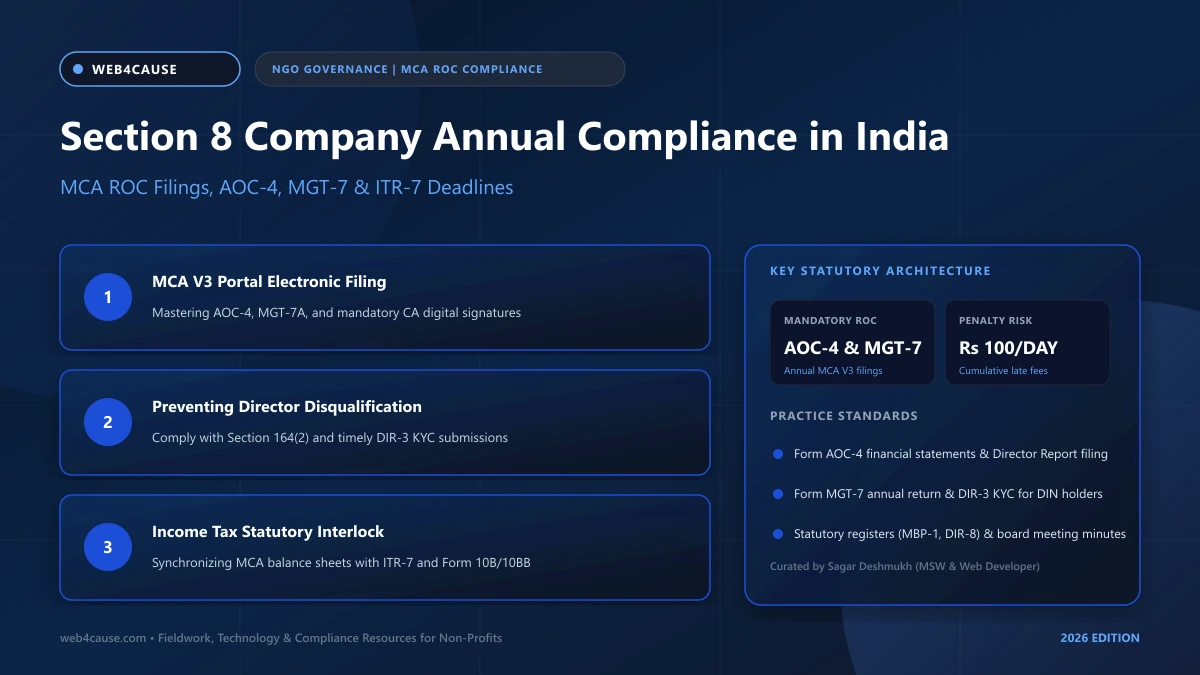
1. Legal Foundation of Section 8 Companies: Corporate Governance Under Companies Act, 2013
In the Indian non-profit sector, a Section 8 company represents the premier legal structure for social impact initiatives, corporate CSR partnerships, and institutional fundraising. Governed under Section 8 of the Companies Act, 2013, alongside rules administered by the Ministry of Corporate Affairs (MCA), this corporate entity unites limited liability with an irrevocable charitable purpose.
Unlike traditional trusts or societies formed under state laws, a Section 8 company operates with nationwide scope and computerized transparency on the MCA V3 portal. As outlined in our detailed analysis of Trust vs Society vs Section 8 Company in India, institutional philanthropies and corporate grant-makers favor Section 8 companies because of their rigorous corporate governance, auditable financial statements, and institutional continuity.
Core Statutory Pillars Under Section 8(1)
- Charitable Objectives: Formed to promote commerce, art, science, sports, education, research, social welfare, religion, charity, protection of environment, or other beneficial objects.
- Application of Profits: All income and operational surplus must be applied solely towards promoting the objects set forth in the Memorandum of Association.
- Prohibition of Dividends: Section 8(1)(c) strictly prohibits payment of any dividend or bonus to its members.
- Capital Structure: Can be incorporated with share capital or limited by guarantee without share capital.
Under MCA Notification GSR 466(E) dated June 5, 2015, and amendment GSR 584(E) dated June 13, 2017, the Central Government granted vital statutory exemptions to Section 8 entities. These include exemption from appointing independent directors under Section 149, relief from constituting Nomination and Remuneration Committees under Section 178, exemption from appointing a full-time Company Secretary under Section 203, relaxed AGM notice periods from 21 days to 14 clear days, and reduced board meeting frequencies.
2. Mandatory MCA V3 Annual Filings Calendar for 2026
The MCA21 Version 3 portal operates on user-specific role association and digital signature authentication. Non-profit directors must observe the statutory calendar following the close of the financial year on March 31.
| Form | Statutory Section | Prescribed Due Date | Purpose and Key Attachments |
|---|---|---|---|
| Form AOC-4 | Section 137(1) | Within 30 days of AGM (October 30) | Audited Balance Sheet, Income & Expenditure Account, Auditor Report, and Board of Directors Report. |
| Form MGT-7 | Section 92(4) | Within 60 days of AGM (November 29) | Annual Return disclosing members, directorship changes, board meeting dates, and attendance records. |
| DIR-3 KYC | Rule 12A | September 30 annually | Annual identity and contact verification for all DIN holders via web OTP or signed e-form. |
| Form ADT-1 | Section 139(1) | Within 15 days of AGM | Notice of appointment or reappointment of statutory auditor for a five-year tenure. |
Important: On the MCA V3 portal, directors must complete Business User registration and link their Class 3 Digital Signature Certificate (DSC) prior to initiating filings to prevent last-minute authentication errors.
3. Financial Statements and Board Reporting: Unpacking Form AOC-4
Under Section 137 of the Companies Act, 2013, every Section 8 company must file its audited financial statements via Form AOC-4 within 30 days of its Annual General Meeting.
Schedule III Structure for Non-Profit Accounts
Section 8 companies prepare an Income and Expenditure Account instead of a Profit and Loss Account, adhering to Schedule III principles and technical guidance from the Institute of Chartered Accountants of India (ICAI):
- Balance Sheet: Details corpus funds, earmarked project reserves, capital assets, project liabilities, and unspent grant balances.
- Income and Expenditure Statement: Reflects voluntary donations, institutional grants, CSR receipts, program disbursements, and operational overheads.
- Notes to Accounts: Discloses significant accounting policies, treatment of foreign contributions, revenue recognition, and related-party transactions.
- Cash Flow Statement: Under Section 2(40), small non-profits limited by guarantee with low turnover are generally exempt from mandatory cash flow reporting.
Auditor Report and CARO 2020 Exemption
The audit must be executed by a practicing Chartered Accountant pursuant to Section 143. Importantly, under Paragraph 1(2)(iii) of the Companies (Auditor Report) Order, 2020, Section 8 companies are completely exempt from CARO 2020. Auditors provide an independent opinion on the true and fair view of accounts without submitting the exhaustive 21-clause corporate checklist. Furthermore, Section 8 companies enjoy exemption from mandatory auditor rotation under Section 139(2).
Mandatory Board Report Disclosures (Section 134)
Form AOC-4 must include the Board of Directors Report signed by authorized directors. For Section 8 entities, mandatory disclosures include:
- Summary of operations, social welfare projects, and impact achievements.
- Total grants received, CSR contributions absorbed, and amounts transferred to corpus reserves.
- Record of board meetings held during the financial year.
- Directors Responsibility Statement affirming accounting standard compliance and internal control adequacy.
- Related-party contracts disclosed under Form AOC-2 pursuant to Section 188.
4. Annual Return Disclosure Architecture: Form MGT-7 vs. Form MGT-7A
Form MGT-7 constitutes the official Annual Return filed under Section 92 of the Companies Act, 2013, read with Rule 11 of the Companies (Management and Administration) Rules, 2014. It documents corporate ownership, directorship profiles, and secretarial governance.
Form MGT-7 vs. Form MGT-7A Applicability
While Form MGT-7A is an abridged annual return for Small Companies and One Person Companies, the proviso to Section 2(85) excludes Section 8 companies from the definition of a small company. Consequently, standard Section 8 companies must file the comprehensive Form MGT-7 on the MCA portal.
Core Disclosures in Form MGT-7
- Registered Office & Objects: Principal charitable activities mapped to National Industrial Classification (NIC) codes.
- Members Register: Full record of members, guarantee commitments, and membership transitions.
- Governance Meetings: Dates of board, committee, and general meetings alongside director attendance percentages.
- Director Remuneration: Mandatory reporting of all allowances or professional fees paid. Under Section 8, directors cannot receive profit shares or dividend yields; payments are restricted to legitimate professional fees approved by the board.
- Professional Certification: The return must be digitally signed by a director and certified by a practicing Company Secretary. Entities with paid-up capital of ₹10 crore or more, or turnover of ₹50 crore or more, require certification in Form MGT-8.
5. Director Identity and DIN Hygiene: DIR-3 KYC Requirements
Under Rule 12A of the Companies (Appointment and Qualification of Directors) Rules, 2014, every individual holding an active Director Identification Number (DIN) as on March 31 must submit annual KYC credentials on or before September 30.
DIR-3 KYC WEB Service
Used when director personal details (mobile, email, address) remain completely unchanged from the previous filing. Completed instantly via mobile and email OTPs without any statutory filing fee before September 30.
e-Form DIR-3 KYC (Full Form)
Mandatory for first-time DIN holders or when updating personal details. Requires self-attested PAN, Aadhaar, address proof, director Class 3 DSC, and certification by a practicing CA, CS, or CMA.
Penalty for Default: Non-filing by September 30 triggers automatic DIN deactivation. A deactivated DIN blocks the director from signing MCA forms, stalling corporate filings. Reactivation requires filing the complete e-form with a non-waivable statutory penalty of ₹5,000 per DIN.
6. Board Meetings, AGM Timelines, and Secretarial Governance
Section 8 companies benefit from key statutory concessions regarding board and general meetings, reducing administrative complexity while preserving corporate accountability.
Concessional Board Meeting Frequency
Under exemption notification GSR 466(E), Section 8 companies are not required to hold four board meetings annually. Instead, they must hold:
At least one Board Meeting within every six calendar months, with a minimum interval of 90 days between consecutive meetings.
Quorum: Under relaxed Section 174(1) provisions, board quorum is either eight members or twenty-five percent of total strength, whichever is less, subject to a minimum of two members. Boards must follow Secretarial Standard 1 (SS-1), issuing notices seven days in advance and recording minutes within 30 days.
Annual General Meeting (AGM) Guidelines Under Section 96
- Statutory Cutoff: The AGM must be convened within six months from financial year closure, on or before September 30. The gap between successive AGMs cannot exceed 15 months.
- Relaxed Notice: Section 8 companies can call an AGM with 14 clear days notice instead of 21 days under Section 101 exemptions.
- Ordinary Business: Consideration and adoption of financial statements, approval of the Directors Report, and appointment or ratification of statutory auditors.
- Extension Requests: If unavoidable circumstances prevent holding the AGM by September 30, the company must apply for an extension via Form GNL-1 with the ROC before the deadline.
7. Statutory Registers, MBP-1 Interest Disclosures, and DIR-8 Declarations
Section 8 companies must maintain updated statutory registers at their registered office and ensure annual disclosures from all serving directors.
Mandatory Statutory Registers
- Register of Members (Form MGT-1): Maintained under Section 88, recording names, addresses, admission dates, and guarantee amounts.
- Register of Directors and KMP: Maintained under Section 170, detailing directorship appointments, DINs, and residential records.
- Register of Loans & Investments (Form MBP-2): Documenting loans, security guarantees, or programmatic deposits under Section 186.
- Register of Related Party Contracts (Form MBP-4): Maintained under Section 189, recording transactions in which directors possess an interest.
- Minutes Books: Preserved under Section 118 for all board, committee, and general meetings.
Annual Director Disclosures
At the first board meeting of every financial year, each director must submit two vital declarations:
Form MBP-1 (Section 184(1)): General notice of interest disclosing concern or directorships in other companies, firms, trusts, or bodies corporate.
Form DIR-8 (Section 164(2)): Written declaration confirming the director is not disqualified from holding office due to three-year non-filing defaults in any corporate entity.
8. Income Tax Department Statutory Interlock: ITR-7, Form 10B/10BB, and Form 10BD
A Section 8 company operates under dual statutory oversight: the MCA regulates corporate standing, while the Income Tax Department administers charitable tax exemptions under Sections 11, 12, and 80G. Figures filed on the MCA portal must match Income Tax filings to prevent automated scrutiny notices.
| Tax Obligation | Section / Rule | Due Date | Key Compliance Function |
|---|---|---|---|
| Form 10BD | Rule 18AB | May 31 annually | Mandatory annual statement of donations. As explained in our guide to Form 10BD Filing for NGOs, late submissions attract a daily penalty of ₹200 under Section 234G. |
| Form 10BE | Rule 18AB(4) | May 31 annually | Donation certificates generated from the tax portal and furnished to donors. Read our manual on Form 10BE Certificate Generation. |
| Form 10B / 10BB | Rule 17B | September 30 annually | Statutory Tax Audit Report. Form 10B applies if income exceeds ₹5 crore, foreign contribution was received, or funds were applied abroad. Form 10BB applies to other entities up to ₹5 crore. |
| ITR-7 Return | Section 139(4A)/(4C) | October 31 annually | Income Tax Return for non-profit entities claiming Section 11/12 exemptions. All revenue figures must reconcile with MCA Form AOC-4 disclosures. |
Non-profits must also update their profile on NITI Aayog NGO Darpan with annual financials and project activities. See our guide to NITI Aayog NGO Darpan Registration, as well as our best practices for 80G and 12A Registration and NGO Payment Gateway Integration.
9. Severe Penalties, License Revocation, and Director Disqualification Risks
Failure to maintain timely MCA and Income Tax compliances exposes Section 8 organizations and their directors to serious financial, operational, and legal penalties.
1. Daily Late Filing Fees (₹100 Per Day Per Form)
Under Section 403, delayed filing of Form AOC-4 or Form MGT-7 attracts an automatic fee of ₹100 per day per form without any statutory upper limit. A 200-day delay across both forms results in an unavoidable late penalty of ₹40,000 over normal filing costs.
2. Director Disqualification Under Section 164(2)
If a Section 8 company fails to file financial statements (Form AOC-4) or annual returns (Form MGT-7) for three consecutive financial years, all directors face automatic disqualification for five years under Section 164(2)(a). Their DINs are deactivated, and under Section 167(1), they must immediately vacate office across all commercial and non-profit boards.
3. Revocation of License Under Section 8(6)
The Regional Director may revoke the Section 8 non-profit license if the company contravenes statutory terms, misapplies funds, or violates non-profit mandates. Upon revocation, the ROC adds Limited or Private Limited to the company name, converting it into a commercial entity, and may initiate winding up or amalgamation. Concurrently, the Income Tax Department cancels Section 12AB and Section 80G registrations.
4. Penalties Under Section 8(11) and Compounding Under Section 441
Violations of Section 8 provisions carry fines on the company from ₹10 lakh to ₹1 crore, while defaulting directors face imprisonment up to 3 years, fines from ₹25,000 to ₹25 lakh, or both. Procedural defaults without fraud must be regularized through formal compounding applications under Section 441 before the Regional Director or NCLT.
10. Step-by-Step Pre-Filing Compliance Checklist for Boards
To ensure seamless compliance and eliminate late penalties, non-profit boards should implement this structured annual operational workflow:
| Phase | Timeline | Key Action Items |
|---|---|---|
| Phase 1: Books Close | April 1 to May 15 | Reconcile bank accounts, finalize donation ledgers, collect project utilization certificates, and prepare trial balance. |
| Phase 2: Form 10BD | May 16 to May 31 | Upload donation statement in Form 10BD on the Income Tax portal and generate Form 10BE certificates for donors. |
| Phase 3: Statutory Audit | June 1 to August 15 | Submit accounts to statutory auditor. Finalize Schedule III Balance Sheet, Income & Expenditure Account, and Auditor Report. |
| Phase 4: Board Approval | August 16 to August 31 | Convene Board Meeting. Collect Form MBP-1 and Form DIR-8 from directors. Approve financial statements and Board Report. |
| Phase 5: AGM & KYC | September 1 to Sept 30 | Issue 14-day notice, hold AGM on or before September 30, complete DIR-3 KYC for all directors, and file Tax Audit Form 10B/10BB. |
| Phase 6: ROC Accounts | October 1 to October 30 | File Form AOC-4 with ROC within 30 days of AGM (by October 30). File ITR-7 on the tax portal by October 31. |
| Phase 7: Annual Return | November 1 to Nov 29 | File Form MGT-7 with ROC within 60 days of AGM (by November 29) with practicing CS certification. |
| Phase 8: Registers Archive | December 1 to Dec 15 | Update physical and electronic statutory registers (MGT-1, Section 170, minutes books) and archive filing challans. |
Complementing statutory compliance with transparent digital infrastructure reinforces donor trust. Review our strategies on NGO Website Design in India to showcase institutional governance achievements and audited reports online.
11. Frequently Asked Questions (FAQ)
Q1: Is a Section 8 company required to appoint a full-time Company Secretary in India?
Under Ministry of Corporate Affairs Notification GSR 466(E), Section 8 companies are exempted from the mandatory appointment of a whole-time Company Secretary under Section 203 of the Companies Act 2013, regardless of paid-up capital. However, many non-profits engage a practicing Company Secretary on a retainership basis to certify annual returns, draft resolutions, and ensure error-free secretarial filings on the MCA V3 portal.
Q2: What are the primary differences between Form AOC-4 and Form MGT-7 for a Section 8 company?
Form AOC-4 is used to file audited financial statements including the Balance Sheet, Income and Expenditure Account, Auditor Report, and Directors Report within 30 days of the AGM. In contrast, Form MGT-7 is the Annual Return filed within 60 days of the AGM, documenting non-financial governance data such as member registers, directorship changes, and board meeting attendance records.
Q3: Can a Section 8 company pay salaries or executive compensation to its directors?
Under Section 8(1), directors cannot receive dividends, profit distributions, or arbitrary sitting fees. However, a director may receive reasonable remuneration for actual professional services rendered, provided such remuneration is permitted by the company constitution, approved by the Board of Directors, and compliant with Central Government guidelines under Section 197 exemptions.
Q4: What statutory penalties apply if a Section 8 company fails to hold its Annual General Meeting by September 30?
Under Section 96 of the Companies Act 2013, an AGM must be held within six months from financial year closure. If a company fails to hold its AGM by September 30 without obtaining an extension from the ROC via Form GNL-1, the company and officers in default face penalties under Section 99 up to ₹1,00,000, plus ₹5,000 for each day of continued default.
Q5: Is the Companies Auditor Report Order, or CARO 2020, applicable to Section 8 companies?
Under Paragraph 1(2)(iii) of the Companies (Auditor’s Report) Order, 2020, Section 8 companies are specifically excluded from the application of CARO. The statutory auditor must conduct an audit under Section 143 of the Companies Act 2013 and express an opinion on true and fair presentation, but does not need to submit the detailed 21-clause CARO reporting schedule.
Q6: How does late filing of Form AOC-4 or MGT-7 affect Section 12AB and 80G registrations?
If a Section 8 company fails to file AOC-4 or MGT-7 for three consecutive years, directors face disqualification under Section 164(2), and the Regional Director may initiate license revocation under Section 8(6). Once the corporate non-profit license is revoked, the Income Tax Department cancels Section 12AB tax exemptions and Section 80G donor deduction status.