
NGO Campaign Landing Page Design in India: 2026 Guide
Masterclass architectural blueprint for designing high-conversion non-profit campaign landing pages in India. Discover how charitable trusts, foundations, and Section 8 institutions eliminate homepage bounce rates, engineer seamless mobile UPI checkout flows, structure dynamic social proof, satisfy Section 80G tax receipt compliance, and deploy rapid disaster appeals that convert empathetic visitors into active financial supporters.
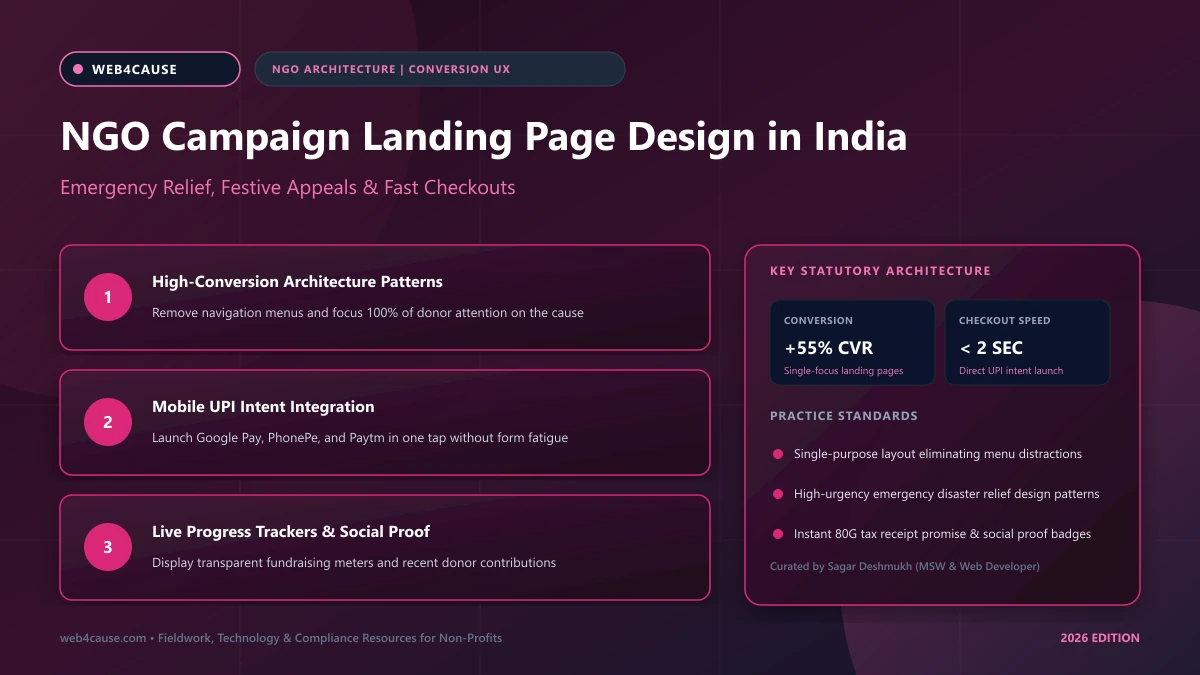
1. The Problem with Sending Campaign Traffic to Homepage: Navigation Paralysis
Across the Indian civil society ecosystem, non-profit institutions invest considerable capital and effort in public advocacy. Organizations execute targeted Meta ad campaigns on Instagram and Facebook, leverage subsidized Google Ad Grants, broadcast WhatsApp campaign updates, and mobilize corporate employee giving drives during marquee seasons like Daan Utsav (Joy of Giving Week) or urgent natural calamities. Yet, an overwhelming majority of these campaigns suffer catastrophic drop-offs due to a single structural flaw: directing incoming traffic to the organizational root homepage.
A standard non-profit homepage is built as a multi-stakeholder corporate portal. Its primary design objective is institutional representation, serving a dozen diverse personas simultaneously: grant evaluation committees, corporate CSR program heads, prospective board trustees, job applicants, media journalists, academic researchers, and statutory auditors examining NITI Aayog NGO Darpan records. Consequently, the homepage greets an empathetic visitor with twenty to forty distinct navigational links: “About Our Founders”, “Board of Trustees”, “Annual Reports 2024 to 2025”, “FCRA Audit Statements”, “Photo Gallery”, “Careers”, “Internships”, and multiple distinct thematic program tabs.
When an emotional supporter clicks a social media advertisement showing flood relief efforts in Assam or malnutrition interventions in Maharashtra, they arrive with focused, high-intensity empathy. Forcing that supporter to navigate through complex drop-down menus, decode generic institutional mission statements, and search for a small donation button triggers severe cognitive overload. According to Hick’s Law, the time required to make a decision increases logarithmically with the number and complexity of choices presented. Confronted with navigational paralysis, over 65 to 78 percent of mobile visitors bounce within twelve seconds.
The Advertising Waste Factor: Consider an Indian non-profit spending Rs 1,00,000 on digital acquisition driving traffic to its generic homepage. At a 72 percent mobile bounce rate and an average homepage conversion rate of 0.8 percent, the campaign yields barely Rs 60,000 in gross contributions, representing a net loss. Routing that exact same traffic to an engineered, single-focus campaign landing page raises conversion rates to 7.5 to 12.0 percent, generating Rs 3,50,000 to Rs 5,00,000 in immediate contributions. Learn foundational website planning in our guide on NGO Website Design in India and examine checkout mechanics in Donation Page Optimization for Indian NGOs.
The institutional mandate is clear: paid campaign traffic, festive appeals, and emergency relief drives must never land on a homepage. They require a bespoke, single-focus landing page engineered solely for emotional connection, statutory clarity, and frictionless financial contribution.
2. Anatomy of a High-Conversion Dedicated Campaign Landing Page
A dedicated non-profit campaign landing page operates under a strict architectural principle known as the “isolated conversion funnel”. Unlike exploratory corporate websites, an isolated campaign page eliminates every visual or navigational element that does not directly advance the campaign goal or substantiate donor trust.
Field testing conducted across Indian charitable trusts confirms that high-converting campaign landing pages share four non-negotiable architectural layers:
- Strict Header Stripping (Zero Exit Leaks): The primary website navigation header, containing links to other organization pages, is completely removed. The only persistent header elements are the official non-profit logo, a visible Section 80G tax benefit badge, and an emergency donor assistance telephone link. There are no secondary navigation tabs to distract or siphon away empathetic traffic.
- Culturally Authentic, Dignified Hero Section: In Indian social work practice, visual storytelling must uphold human dignity. Exploitative visual tropes (often termed poverty pornography) damage organizational reputation and violate social work ethics. Instead, the hero section pairs authentic, high-resolution photography of real community participants and field social workers with an unambiguous, action-oriented headline. For example: “Protect 1,200 Flood-Affected Families in Majuli: Provide Emergency Clean Water and Nutrition Today”.
- Above-the-Fold Donation Card: On both desktop displays and mobile touchscreens, the primary donation interface must be partially or fully visible within the initial viewport. Mobile users should not have to scroll past 800 pixels of text to discover how to contribute. The donation card must sit directly adjacent to or immediately beneath the core emotional problem statement.
- Verified Ground Realities and Field Updates: Rather than vague generalities, the narrative must detail the exact intervention: targeted village panchayats, specific district names, implementation methodologies (such as grassroots volunteer brigades), and verified logistics partnerships. Review our professional guidelines on Community Mobilization in Social Work to learn how authentic field engagement strengthens public credibility.
Visual Hierarchy Rules for Indian Non-Profit Hero Sections
Ensure the primary call-to-action button uses high-contrast accessibility colors (such as vibrant royal blue #2563EB or deep emerald green #059669 on crisp white backgrounds). Text contrast must exceed WCAG 2.1 AA standards (minimum 4.5:1 ratio). All headline typography must remain legible under direct sunlight on budget smartphone displays across semi-urban and rural India.
3. Tangible Outcome Tiers and Dynamic Social Proof Engine
One of the most persistent errors on Indian donation pages is presenting arbitrary, abstract round figures such as “Rs 500, Rs 1000, Rs 2000, Rs 5000” without linking those amounts to concrete field outcomes. An abstract number forces the donor to evaluate the financial loss from their personal bank balance. By contrast, a tangible outcome tier shifts the donor mindset from an expense calculation to an act of direct social sponsorship.
Empirical fundraising data demonstrates that structuring donation tiers around specific unit costs lifts average donation size by 34 to 48 percent. When a donor sees that Rs 1,500 provides thirty days of clinical nutrition kits for an undernourished child, while Rs 3,000 sponsors two children, the psychological anchor anchors upward.
| Giving Tier | Sponsorship Target | Tangible Field Deliverables | Donor Psychology Trigger |
|---|---|---|---|
| Rs 750 | Emergency Warmth | Two heavy fleece blankets and woollen cap kits for pavement dwellers | Low-friction impulse entry tier for first-time donors |
| Rs 1,500 | Child Nutrition Kit | One month high-protein fortified ration, multi-vitamins, and deworming | Default pre-selected middle tier balancing affordability and impact |
| Rs 3,500 | Digital Learning Kit | Solar study lamp, regional language textbooks, and learning tablet access | Aspirations for long-term generational educational mobility |
| Rs 8,000 | Community Water Filter | Gravity-based ceramic bio-sand water filter serving sixty rural school students | High-value tier designed for HNIs and festive family contributions |
Equally vital is dynamic social proof. Human beings look to the actions of others to validate their choices, particularly in digital transactions where trust must be established in seconds. A high-converting campaign page incorporates three dynamic social proof mechanics:
- Live Fundraising Progress Meter: A clean progress bar displaying the exact amount raised versus the declared campaign budget (for example: “Rs 4,85,000 raised of Rs 6,00,000 target: 81 percent funded”). Reaching at least 25 percent funding triggers psychological bandwagons, reassuring new visitors that the cause is actively supported.
- Remaining Days and Target Urgency Counter: Setting an explicit deadline (such as “Campaign concludes in 4 days” or “Only 42 nutrition kits remaining to reach target”) creates legitimate, ethical urgency without false scarcity.
- Real-Time Donor Activity Stream: A discreet visual feed updating with verified recent donations (such as “Arun V. from Pune contributed Rs 1,500 two minutes ago; Priya S. from Hyderabad contributed Rs 3,500 seven minutes ago”). Donor privacy is preserved by abbreviating surnames while demonstrating active peer momentum.
For organizations seeking sustainable recurring contributions beyond one-off appeals, examine our architectural guide on UPI AutoPay for NGO Recurring Donations in India.
4. The Frictionless Mobile UPI Checkout Experience: Intent Links and Dynamic QR
In India, digital payment patterns are fundamentally unique. According to statistics published by the National Payments Corporation of India (NPCI), over 85 percent of retail digital transactions occur across the Unified Payments Interface (UPI). For charitable giving, this proportion is even higher: over 88 percent of individual non-profit donations under Rs 10,000 originate from mobile UPI applications.
Subjecting an Indian mobile donor to traditional payment gateway forms that demand 16-digit debit or credit card numbers, expiry dates, CVVs, and waiting for SMS One-Time Passwords (OTPs) is fatal to conversion. OTP delivery across Indian cellular carriers frequently experiences latency of 30 to 90 seconds, causing immediate donor abandonment.
UPI Mobile Intent URI Deep-Linking Protocol
On smartphones, the donation interface must invoke native UPI Intent links. When a supporter taps their desired contribution amount and provides essential contact information, the checkout button triggers a standardized UPI deep link:
upi://pay?pa=web4cause.trust@icici&pn=Web4causeFoundation&am=1500.00&cu=INR&tn=DisasterReliefMajuli&tr=TXN202610319842The smartphone operating system immediately detects the registered protocol and presents an app picker displaying installed UPI applications: Google Pay, PhonePe, Paytm, BHIM, and Cred. The donor authenticates using their biometric fingerprint or secure UPI PIN, completing the entire transaction in under 15 seconds without leaving their phone’s native security environment.
For desktop visitors (representing approximately 20 to 25 percent of traffic, typically corporate employees or older donors on office workstations), the landing page must automatically generate a dynamic on-screen QR code. By integrating payment APIs like Razorpay or Cashfree (see our comprehensive implementation guide on NGO Payment Gateway Integration in India), the desktop page presents a crisp QR code pre-configured with the selected donation amount.
The donor opens their phone camera or any UPI app, scans the desktop screen, and confirms payment. Through background WebSockets or webhook polling, the desktop screen detects the successful payment callback within 800 milliseconds and instantly transitions to the celebratory receipt screen.
5. Pre-Filling 80G Tax Receipt Details via Intuitive Two-Step Micro-Forms
While optimizing for lightning-fast checkout, Indian non-profits face a strict statutory hurdle: mandatory donor reporting under the Income-tax Act, 1961. Following amendments to Section 80G and the introduction of Rule 18AB, every charitable trust and institution must upload an annual Statement of Donations in Form 10BD to the Income Tax Department e-Filing Portal.
Form 10BD requires five compulsory donor identifiers: Permanent Account Number (PAN) or Aadhaar number, full legal name, complete residential address with postal pincode, mobile number, and email address. Without an authentic PAN, the Income Tax Department will not generate a Form 10BE certificate, and the donor will be legally unable to claim their 50 percent tax deduction. For complete compliance filing requirements, refer to our operational manual on Form 10BD Filing for NGOs in India and our guide on 80G and 12A Registration for Indian NGOs.
Herein lies the classic non-profit UX tension: donors desire a 1-tap checkout, but tax compliance demands detailed demographic information. Presenting a twelve-field registration form on mobile causes instant abandonment. The solution is an engineered two-step progressive disclosure micro-form.
Two-Step Progressive Disclosure Micro-Form Blueprint
Step 1: Impact Selection and Basic Identity
- Selection chips for outcome tiers (Rs 750, Rs 1,500, Rs 3,500, or custom amount).
- Donor Full Name (pre-filled from browser autofill).
- WhatsApp Mobile Number (used for instant receipt delivery).
Step 2: Section 80G Tax Exemption Toggle (Optional Reveal)
- A clear checkbox: “I require a 50% Section 80G Tax Exemption Receipt” (checked by default).
- Checking the box smoothly slides down two essential fields: Permanent Account Number (PAN) and Postal Pincode.
- Client-side regex validation immediately verifies PAN formatting:
^[A-Z]{5}[0-9]{4}[A-Z]{1}$. - Entering the 6-digit Pincode triggers an asynchronous lookup to automatically populate City and State, sparing the donor four tedious manual inputs.
Engineering Result: The donor enters their name, mobile, and PAN, while city, state, and address metadata populate automatically in under 20 seconds.
6. Designing for High-Urgency Campaigns: Disaster Relief vs Festive Appeals
Non-profit campaign landing pages fall into two distinct operational paradigms: unpredictable humanitarian emergencies and scheduled cultural or seasonal appeals. Each demands a specialized design architecture and deployment cadence.
Disaster Relief Appeals: The 24-Hour Rapid Deployment Architecture
When severe climate hazards strike, such as catastrophic floods in Assam, cyclones across coastal Odisha and Andhra Pradesh, or landslides in Kerala, public attention peaks within the first 48 to 72 hours. Organizations that take weeks to coordinate graphic designers and web agencies squander the critical window of public willingness to help.
A high-readiness non-profit maintains a pre-configured disaster relief landing page template stored in its content management repository. When an emergency strikes, field communications officers can update the copy, configure campaign-specific payment tracking parameters, and deploy a live landing page within two hours. Essential components of an emergency disaster page include:
- Geolocation Alert Banner: A prominent top notification bar identifying affected administrative revenue blocks, talukas, and district collectorate emergency bulletins.
- Real-Time Field Dispatch Ticker: Unedited ground photographs, date-stamped relief supply logs, and volunteer distribution tallies (such as “3,400 water purification sachets dispatched from Guwahati hub at 06:00 IST”).
- Explicit Relief Kit Breakdowns: Clarifying that emergency contributions are converted directly into life-saving supplies: chlorine tablets, tarpaulins, dry rations, sanitary pads, and ORS packets.
Festive and Seasonal Appeals: Cultural Resonance and Matching Grants
In contrast to disaster response, festive giving campaigns follow predictable annual milestones: Daan Utsav (October 2 to 8), Diwali food-sharing appeals, winter warm clothing distributions across North India (November to January), and Ramzan Zakat initiatives.
Festive landing page architecture emphasizes celebration, solidarity, and community empowerment. Key conversion techniques include:
- Corporate Matching Multipliers: Highlighting corporate CSR or philanthropic foundation matching grants (for example: “Every Rupee you contribute this Diwali is matched 1:1 by our CSR partner, doubling your impact for rural schools”).
- Culturally Harmonious Color Palettes: Utilizing deep marigold golds, warm terracotta tones, and festive design motifs that evoke celebration while preserving clean whitespace and readability.
- Dedication and Gifting Capabilities: Enabling supporters to make a donation in honor of their parents, children, or colleagues, with an automated celebratory e-certificate delivered to the honoree via WhatsApp and email.
To ground your campaign narratives in verified grassroots needs assessment methodologies, explore our technical guide on Participatory Rural Appraisal (PRA) Techniques in India.
7. Building Trust and Institutional Credibility: Badges and Financial Clarity
The primary friction point preventing digital visitors from completing a charitable gift in India is institutional trust. With thousands of non-profits soliciting funds across social media, prospective contributors harbor justifiable anxieties: “Is this organization genuine?”, “Will my donation reach beneficiaries or disappear into administrative overhead?”, “Will I actually receive a tax exemption certificate?”.
An institutional-grade campaign landing page defuses skepticism through concrete, verifiable evidence placed strategically throughout the donor journey:
| Institutional Trust Element | Statutory Issuing Authority | Public Verification Method | Landing Page Placement |
|---|---|---|---|
| Section 80G Approval Number | Income Tax Department of India | Unique Registration Number (URN) verified on incometax.gov.in | Directly beneath the primary donation amount chips |
| Section 12A Registration | Income Tax Department of India | Charitable Trust statutory tax exemption determination order | In the statutory compliance footer grid |
| NGO Darpan Unique ID | NITI Aayog, Government of India | Searchable public profile on ngodarpan.gov.in | Trust badge bar with direct link to official portal |
| MCA Form CSR-1 Registration | Ministry of Corporate Affairs (MCA) | CSR Registration Number for corporate compliance | Essential for CSR committee review and corporate donors |
| Accreditation Seals | GuideStar India or Credibility Alliance | Third-party transparency audit evaluation badges | Positioned alongside bank-grade 256-bit SSL badges |
Beyond compliance seals, high-converting landing pages provide explicit financial allocation transparency. Showing a clear financial split, such as 88 percent direct grassroots project delivery, 7 percent field monitoring and logistics, and 5 percent administrative and statutory auditing, reassures contributors that their funds are not squandered on marketing overhead. Adding an explicit anti-commission guarantee (“Zero percentage paid to third-party telecallers or commission-based fundraising agencies”) cements institutional credibility.
Finally, embed a real-time WhatsApp query widget. A hesitant donor wondering whether their location qualifies for tax deductions or wishing to schedule a field visit can tap the widget to immediately chat with a dedicated social worker, bridging the gap between digital interface and human trust.
8. Technical Performance Optimization: Sub-2-Second Mobile Loads on Indian Networks
Digital fundraising in India takes place across a complex network landscape. While urban donors in Mumbai, Delhi, and Bengaluru may access high-speed 5G or fiber broadband, over 65 percent of campaign clicks originate across tier-2 cities, district towns, and rural talukas over congested 4G mobile networks with severe latency and packet loss.
According to research published by Google on web.dev, when mobile page load times increase from 1 second to 3 seconds, the probability of a visitor bouncing increases by 32 percent. For donation landing pages, every single second of mobile latency translates directly to an 18 to 22 percent decline in completed payments.
To achieve sub-2-second visual interactivity on mid-tier Android smartphones, the technical architecture of your campaign landing page must enforce strict engineering hygiene:
- Next-Generation WebP Image Compression: All campaign photography must be converted to WebP or AVIF formats and compressed to under 45 KB per image. Heavy uncompressed 4 MB JPEG images from professional cameras instantly choke mobile data pipelines. Explicit
width,height, andfetchpriority="high"attributes must be declared on hero images to prevent Cumulative Layout Shift (CLS). - Inlining Critical Path CSS: Rather than forcing the mobile browser to download multiple bulky CSS stylesheets (such as Bootstrap, FontAwesome, or heavy WordPress page builder themes), inline critical styling (under 12 KB) directly into the HTML
<head>. This renders the hero section and donation card in the initial TCP packet transmission. - Zero Render-Blocking Scripts: Eliminate all non-essential JavaScript libraries including jQuery, bulky carousel sliders, and complex animation frameworks. Pure CSS flexbox and grid layouts achieve fluid responsiveness with zero main-thread CPU overhead.
- Deferral of Third-Party Tracking Pixels: Third-party tracking scripts, including Meta Pixel and Google Tag Manager, must be loaded with the
deferattribute or triggered only after the donor initiates their initial touch event. This prevents external scripts from monopolizing the smartphone processor during critical initial paint phases. - Edge Caching with Local Indian Points of Presence (PoPs): Route campaign traffic through content delivery networks with dense edge server clusters in Mumbai, Chennai, Delhi, and Bengaluru. This delivers static assets in under 35 milliseconds nationwide. For in-depth server acceleration configurations, explore our comprehensive technical guide on NGO Website Speed Optimization in India.
9. Post-Donation Conversion Funnel: Instant 80G Receipts and WhatsApp Loops
The moment immediately following a successful donation is the point of highest emotional engagement and trust in the entire donor lifecycle. Yet, most non-profits squander this goodwill by displaying a bland, static thank-you note: “Thank you for your payment. Your receipt will be emailed within 7 to 10 working days.”
Delays in delivering 80G receipts generate anxious customer service inquiries and donor remorse. A high-conversion campaign architecture treats the post-donation screen as an active stewardship engine comprising three integrated pipelines:
The Three-Pillar Post-Donation Retention Engine
1. Instant On-Screen 80G Tax Receipt Download: The confirmation callback immediately renders a personalized PDF receipt complete with the non-profit’s 80G registration order, donor PAN, transaction hash, and authorized trustee digital signature. Donors download their tax receipt in one click, eliminating waiting periods entirely.
2. Automated WhatsApp Confirmation Pipeline: Utilizing workflow automation tools like n8n or Make, the platform triggers an automated WhatsApp message within five seconds of payment confirmation. The message contains a warm gratitude note from the field director and a direct PDF download link, ensuring the donor has a permanent record in their messaging app.
3. One-Click Social Sharing Prompts: A pre-composed, inspiring WhatsApp status and LinkedIn update button allows supporters to share their impact with one tap: “I just joined hands with [NGO Name] to sponsor emergency nutrition for flood-affected children. Join me in making a difference: [Campaign Link]”. This organic peer endorsement drives low-cost secondary donor acquisition.
Additionally, the thank-you screen presents a gentle invitation to convert this one-time emergency gift into an automated monthly contribution via UPI AutoPay, securing reliable operating capital for long-term grassroots programs.
10. Architectural Comparison: Generic Homepage vs Dedicated Campaign Landing Page
To help trustees, fundraising directors, and web designers evaluate their fundraising infrastructure, the following matrix compares the architectural specifications and operational performance of generic non-profit homepages against dedicated campaign landing pages:
| Architectural Dimension | Generic NGO Homepage | Dedicated Campaign Landing Page |
|---|---|---|
| Core Architectural Objective | Multi-stakeholder corporate institutional representation | Single-focus conversion on one specific social intervention |
| Navigation Structure | Complex multi-level menus, 20+ links, footer directory | Strictly zero navigation menus; isolated conversion path |
| Mobile Bounce Rate | 68 to 82 percent average mobile abandonment | Sub-32 percent bounce rate with focused narrative |
| Average Donation Conversion Rate | 0.6 to 1.4 percent of unique visitors | 6.8 to 14.5 percent conversion rate |
| Mobile Payment Architecture | Generic gateway redirect; manual card or net-banking inputs | Direct UPI Intent deep-linking (Google Pay, PhonePe, Paytm) |
| Section 80G Tax Compliance UX | Exhaustive 12-field registration form causing drop-offs | Two-step progressive micro-form with automated Pincode lookup |
| Ad Spend Efficiency (ROAS) | Negative or break-even return on ad spend | 3.5x to 5.2x return on digital acquisition budgets |
11. Frequently Asked Questions (FAQs)
1. Why does directing digital advertising traffic to an NGO homepage cause such high bounce rates compared to dedicated landing pages?
Homepages serve multiple audiences simultaneously: trustees, corporate partners, volunteers, job seekers, and auditors. They feature thirty or more navigational links and conflicting calls to action. When an empathetic visitor clicks an ad regarding an urgent crisis, arriving on an unfocused homepage creates cognitive fatigue. The visitor must hunt for the donation link, causing 65 to 80 percent of users to abandon the site. Dedicated landing pages eliminate all navigation menus, focusing 100 percent of attention on the specific cause and immediate action.
2. How does native UPI intent deep-linking improve mobile donation completion rates for Indian non-profits?
Over 85 percent of digital donations in India originate on smartphones. Traditional gateway forms requiring 16-digit card numbers, CVVs, and waiting for SMS One-Time Passwords suffer from massive drop-offs due to carrier SMS delays. Native UPI Intent deep links (using the upi://pay protocol) launch installed UPI apps like Google Pay, PhonePe, or Paytm directly on the phone. The donor authenticates with their biometric fingerprint or PIN, completing their gift in under 15 seconds with zero SMS wait times.
3. How can an NGO collect mandatory PAN and address details for Form 10BD without driving away mobile donors?
Non-profits must comply with Income Tax Rule 18AB to report donor PANs on Form 10BD for valid 80G tax deductions. To avoid overwhelming users, implement a two-step progressive disclosure micro-form. Step 1 collects only the donation amount, donor name, and WhatsApp number. Step 2 presents an optional checkbox: “I require 80G tax exemption”, which expands PAN and Pincode inputs. Entering the 6-digit Pincode automatically populates city and state via asynchronous API lookup, reducing manual typing while ensuring complete statutory compliance.
4. How quickly can an Indian NGO deploy an emergency disaster relief campaign landing page during sudden floods or cyclones?
Organizations that build from scratch during a disaster take weeks to launch, missing the critical 72-hour window of public empathy. High-readiness non-profits keep pre-built, modular disaster landing page templates stored in their web framework. When a crisis occurs, communications staff only need to update the location banner, upload ground photos, specify relief kit deliverables, and link the payment gateway. With proper architecture, a fully compliant disaster page can go live in under two hours.
5. What statutory compliance trust badges must appear on an Indian campaign page to overcome donor skepticism?
To dispel concerns regarding fraudulent charities, landing pages must display five verifiable trust seals: Section 80G Approval Number with validity details, Section 12A registration code, NITI Aayog NGO Darpan Unique Identification Number, Ministry of Corporate Affairs CSR-1 registration, and third-party accreditation seals like GuideStar India or Credibility Alliance. Positioning these seals directly beside the checkout interface reassures donors that their contributions are fully legal, tax-deductible, and publicly audited.
6. Can an NGO build high-speed, sub-2-second campaign landing pages inside an existing WordPress website?
Yes. While heavy page builder plugins like Elementor or Divi inject significant DOM bloat, an NGO can construct custom, blank-canvas WordPress page templates that completely dequeue header, footer, and unused plugin stylesheets. By inlining critical CSS, converting campaign photos to WebP under 45 KB, and serving the page via edge caching on Cloudflare or LiteSpeed cache, a WordPress-hosted campaign page achieves sub-2-second mobile load times and 95+ PageSpeed scores on Indian mobile networks.