
Non-Profit Digital Transformation in India: Complete 2026 Guide
An end-to-end architectural and operational guide for Indian charitable trusts, societies, and Section 8 non-profits modernizing their mission infrastructure. Learn how to migrate away from fragmented paper logs and expensive proprietary SaaS to sovereign open-source stacks, automated UPI 2.0 fundraising, instant Form 10BD/80G tax receipt pipelines, offline-first mobile field surveys, and audit-grade CSR dashboards in 2026.
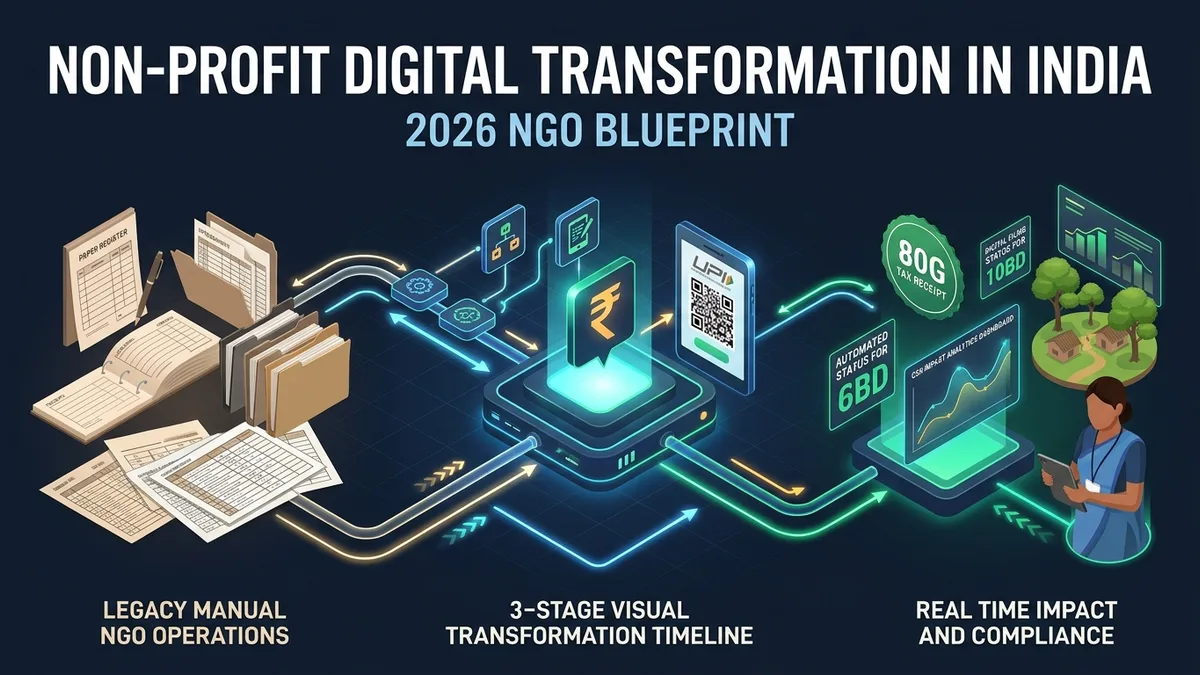
1. The Digital Transformation Crisis in the Indian Social Sector
Across India, over 3.2 million registered non-governmental organizations, charitable trusts, and Section 8 institutions stand on the frontline of human development. They build schools in tribal talukas, provide critical medical relief in urban slums, and empower women through self-help groups (SHGs). Yet, behind this monumental grassroots dedication lies a silent operational crisis: administrative technological paralysis.
A startling percentage of Indian non-profits still conduct their daily operations through an agonizing patchwork of physical paper registers, unencrypted WhatsApp groups, disconnected Excel spreadsheets, and manual cheque runs. When a corporate CSR foundation requests impact verification, program coordinators spend weeks manually cross-referencing handwritten sign-in sheets. When individual philanthropists make a UPI contribution, they often wait days or even weeks to receive an 80G tax receipt, leading to donor frustration and eroded trust.
This technological debt is no longer just an administrative nuisance; it is an existential threat to institutional survival. Recent legislative reforms, including mandatory annual Form 10BD electronic donor filings by the Central Board of Direct Taxes (CBDT), stringent CSR-1 registration mandates under the Companies Act 2013, tighter FCRA compliance protocols, and the strict consent requirements of the Digital Personal Data Protection (DPDP) Act 2023, have made digital modernization mandatory. NGOs that fail to digitize their core systems risk statutory penalties, donor churn, and disqualification from corporate funding.
The Real Cost of Operational Inertia
Studies across the Indian development sector indicate that program managers spend up to 35% of their working hours on administrative data entry and manual reconciliation. Digital transformation is not about buying expensive Silicon Valley software; it is about reclaiming thousands of field hours to directly serve communities in need.
2. The 4-Tier Non-Profit Digital Maturity Index
Digital transformation is not a single software purchase; it is a progressive institutional journey. Before selecting tools or rebuilding workflows, NGO leadership must evaluate where their organization currently stands along the 4-Tier Non-Profit Digital Maturity Index:
Level 1: Ad-Hoc / Paper-Bound
Paper registers, physical carbon-copy donation receipts, offline accounts, static one-page brochure website updated once every two years. High risk of data loss and compliance delinquency.
Level 2: Fragmented Digital
Google Sheets or Excel for donor lists, Google Forms for surveys, separate Tally for accounting, basic payment button without automated receipt generation. High duplication of effort.
Level 3: Integrated & Automated
WordPress CMS integrated with open-source automation (n8n), instant UPI donation verification, automated 80G PDF receipt generation via WhatsApp/email, and structured donor CRM database.
Level 4: Sovereign & Intelligent
Self-hosted open-source infrastructure, offline-first mobile survey sync, real-time live CSR impact dashboards, automated Form 10BD reconciliation, and privacy-first beneficiary data encryption.
Most grassroots Indian NGOs currently oscillate between Levels 1 and 2. The primary objective of the Web4Cause digital transformation blueprint is safely bridging organizations into Level 3 and Level 4 without inflating operational budgets.
3. Sovereign Open-Source Architecture vs. Proprietary SaaS Lock-In
When non-profits embark on digitization, they are often approached by enterprise software vendors offering proprietary cloud solutions (such as Salesforce Nonprofit Cloud, Blackbaud, or customized commercial CRMs). While these platforms possess impressive feature sets, they introduce crippling vulnerabilities for Indian charities:
- Exorbitant Recurring Per-Seat Licensing: Initial discount periods expire, leaving non-profits facing renewal bills running into hundreds of thousands of rupees annually.
- Vendor Lock-in & Data Hostage Risks: If grant funding diminishes and the subscription lapses, the NGO risks losing administrative access to historical donor databases and beneficiary files.
- Data Sovereignty & Offshore Hosting: Many global SaaS platforms store data in foreign jurisdictions, complicating compliance with India’s DPDP Act 2023 and FCRA auditing mandates.
At Web4Cause, we advocate for Sovereign Open-Source Architecture. By deploying hardened open-source solutions hosted on local, sovereign Indian cloud infrastructure (or affordable virtual private servers), the organization retains 100% data ownership, zero recurring software license fees, and complete freedom to customize workflows.
The Web4Cause Sovereign Non-Profit Tech Stack
- CMS & Web Layer: Lightweight WordPress core with semantic HTML, custom post types, and headless-ready REST endpoints. Read our architectural breakdown in Custom NGO Website Development in India.
- Automation Engine: Self-hosted n8n Workflow Automation to orchestrate webhook payloads between payment gateways, databases, and communication APIs.
- Donor & Volunteer Database: Self-hosted PostgreSQL or Supabase paired with Open Source NGO CRM systems (such as SuiteCRM or CiviCRM).
- Field Data Collection: KoboToolbox / ODK (Open Data Kit) for offline-first, GPS-enabled mobile survey workflows.
4. UPI 2.0, Instant QR & Automated 80G Tax Receipt Pipelines
India’s digital payments infrastructure is the most advanced in the world. Unified Payments Interface (UPI) handles billions of monthly transactions, yet many non-profits still publish static, unverified personal QR codes that fail to capture vital donor metadata required for tax compliance.
Under CBDT regulations, to grant tax deduction benefits under Section 80G, the non-profit must submit the donor’s Permanent Account Number (PAN), full legal name, contact address, and transaction identifier in the annual Form 10BD electronic return. If an anonymous donor scans a static personal UPI QR code without an accompanying digital form, the NGO cannot legally issue a valid 80G receipt or file Form 10BD, creating widespread audit failures.
The Automated 4-Step 80G Pipeline:
- Pre-Payment Metadata Capture: The donor selects a giving tier on an optimized checkout page (as detailed in Donation Page Optimization for NGOs) and inputs their PAN, email, mobile number, and tax address.
- Dynamic UPI Intent Generation: The system invokes the payment gateway API (Razorpay, Cashfree, or Easebuzz) to generate a dynamic UPI QR code or intent link populated with the exact donation amount and unique order ID. Learn more in our NGO Payment Gateway Integration Guide.
- Webhook Trigger & PDF Rendering: Upon bank settlement, a secure server-to-server webhook fires an n8n workflow. A PDF generation engine renders an official, digitally signed 80G donation receipt containing the trust’s 12A/80G registration numbers, unique serial number, and donor PAN.
- Multichannel Instant Delivery: Within 15 seconds of payment confirmation, the donor receives the 80G PDF receipt via automated email and official WhatsApp Business API, accompanied by a personalized impact video link.
5. Offline-First Field Data Collection & Real-Time M&E Workflows
True social transformation does not occur in air-conditioned Mumbai or Bangalore offices; it takes place in drought-prone villages in Vidarbha, remote mountain hamlets in Himachal Pradesh, and dense informal settlements. In these grassroots environments, reliable 4G/5G cellular connectivity is never guaranteed.
A common failure mode of conventional enterprise systems is requiring continuous internet access. Field social workers attempting to submit beneficiary surveys face loading spinners, connection timeouts, and catastrophic data loss.
Grassroots Field Architecture: Offline-First Deployment
By deploying KoboToolbox or Open Data Kit (ODK) on field workers’ smartphones, surveys are conducted entirely offline. Enumerators capture geotagged GPS coordinates, biometric signatures, and photographic proof of intervention. As soon as the device connects to Wi-Fi at the field office or encounters a cellular signal, all queued submissions synchronize automatically to the central database without human intervention.
This architecture cuts monitoring and evaluation (M&E) survey processing cycles from six weeks down to a matter of minutes, granting leadership real-time visibility into program efficacy.
6. Live CSR Impact Dashboards & Statutory Compliance Transparency
Corporate Social Responsibility in India has shifted permanently from informal charity to rigorous corporate governance. Under Section 135 of the Companies Act 2013 and CSR Amendment Rules, corporate donors and CSR boards demand auditable verification of fund utilization, impact metrics, and statutory adherence.
Forward-thinking non-profits transform this reporting burden into an institutional competitive advantage by embedding Live CSR Transparency Dashboards:
- Schedule VII Alignment: Disaggregate programmatic expenditures by specific national development goals (healthcare, education, rural sanitation, environmental sustainability). Explore our analysis on CSR Funding for NGOs in India.
- Real-Time Fund Tracking: Interactive charts illustrating grant allocation, tranche disbursements, and remaining capital balances.
- Audited Beneficiary Reach: Live counter metrics verified by field survey submissions, ensuring corporate grant makers can review progress directly during board meetings.
- Statutory Repository Hub: Instant public download links for 12A/80G certificates, Form 10BD filings, NITI Aayog NGO Darpan unique IDs, and audited annual balance sheets.
7. Data Dignity, Beneficiary Privacy & the DPDP Act 2023
Digital transformation is not merely a technical upgrade; it is an ethical mandate. Historically, non-profits have inadvertently compromised beneficiary dignity by sharing unredacted photographs, medical records, and Aadhaar numbers across unencrypted messaging apps or public promotional materials.
The enactment of the Digital Personal Data Protection (DPDP) Act 2023 establishes strict statutory penalties for unauthorized processing of personal data. Indian non-profits act as Data Fiduciaries and must enforce the following safeguards:
- Informed Multilingual Consent: Beneficiary consent forms must be presented in local vernacular languages (e.g., Marathi, Hindi, Tamil) with explicit audio-visual explanations for non-literate participants before collecting photographs or demographic details.
- Role-Based Access Control (RBAC): Field volunteers must only see the data required for their specific assignments. Medical case histories and financial records must remain restricted to authorized senior social workers.
- Aadhaar & Biometric Redaction: When storing identity documents for government scheme linkages, automated scripts must mask the first eight digits of the Aadhaar number in accordance with UIDAI and Supreme Court directives.
8. Grassroots Change Management & MSW Staff Digital Enablement
The most common reason digital transformation initiatives fail in the social sector is not software malfunction; it is human friction and organizational resistance. Field caseworkers and grassroots coordinators are frequently intimidated by complex, English-only enterprise dashboards that feel disconnected from community realities.
A successful digital transformation roadmap treats technology as an extension of community social work values:
- Vernacular UI Design: Ensure all field applications and dashboard labels are translated into regional languages with intuitive visual iconography.
- Hands-On Practicum Training: Bridge social work theory with digital tools through experiential simulation sessions, as detailed in our guide on MSW Field Work Practicum in India.
- Empowerment Over Surveillance: Position digital logging tools not as punitive management oversight, but as time-saving mechanisms that eliminate hours of boring manual paperwork.
9. Legacy Operations vs. Web4Cause Sovereign Digital Architecture
Review how standard manual non-profit operations compare against a modern, sovereign open-source digital infrastructure:
10. Frequently Asked Questions (FAQs)
Q1: How much does a complete non-profit digital transformation cost for an Indian NGO?
By utilizing sovereign open-source technologies (WordPress, n8n, Supabase, and KoboToolbox), Indian non-profits can eliminate ongoing per-seat software licensing fees entirely. A typical deployment requires an initial architectural engineering setup and staff training investment, followed by minimal recurring cloud hosting fees (typically ₹1,500 to ₹3,500 per month on reputable Indian cloud servers).
Q2: How does automated 80G receipt generation simplify Form 10BD filing?
Under Income Tax rules, every NGO must submit an annual Form 10BD detailing donor identity, PAN, and donation amounts by May 31st each year. An automated digital pipeline validates donor PAN formats at the exact moment of payment and stores all transactions in a structured, audit-ready database. When filing time arrives, administrators can export an exact CBDT-compliant Form 10BD CSV file with a single click.
Q3: Can our field staff use mobile survey tools in remote villages with zero internet connectivity?
Yes. By deploying offline-first platforms like KoboToolbox or ODK, field caseworkers can conduct comprehensive household interviews, take geotagged photos, and record signatures without any active cellular signal. All survey responses remain encrypted locally on the mobile device and automatically synchronize to the server once the worker returns to a connected area.
Q4: What are the primary requirements of the DPDP Act 2023 for Indian charities?
The Digital Personal Data Protection (DPDP) Act 2023 mandates that non-profits obtain clear, affirmative multilingual consent before capturing beneficiary photographs, medical records, or identity numbers. Organizations must implement role-based access control (RBAC), encrypt personal data at rest and in transit, and redact Aadhaar numbers to avoid severe statutory non-compliance fines.
Q5: What is the fastest way to begin digital transformation without overwhelming our staff?
The most effective approach is a phased, modular implementation. Begin by modernizing your online donation checkout and automated 80G receipt pipeline to immediately eliminate manual receipting. Once donor operations are automated, proceed to digitize field survey workflows, followed by donor CRM integration and real-time CSR dashboards.