
Social Stock Exchange for NGOs in India: Complete 2026 Guide
An exhaustive statutory, financial, and technical masterclass for non-profit trustees, institutional directors, and social entrepreneurs navigating the Social Stock Exchange (SSE) in India. Learn the regulatory architecture under SEBI ICDR and LODR regulations, the issuance mechanics of Zero Coupon Zero Principal (ZCZP) instruments, Demat workflows on CDSL and NSDL, ASBA subscription routes, mandatory social audit standards under the Institute of Social Auditors of India (ISAI), and strategic corporate CSR integration under Section 135 in 2026.
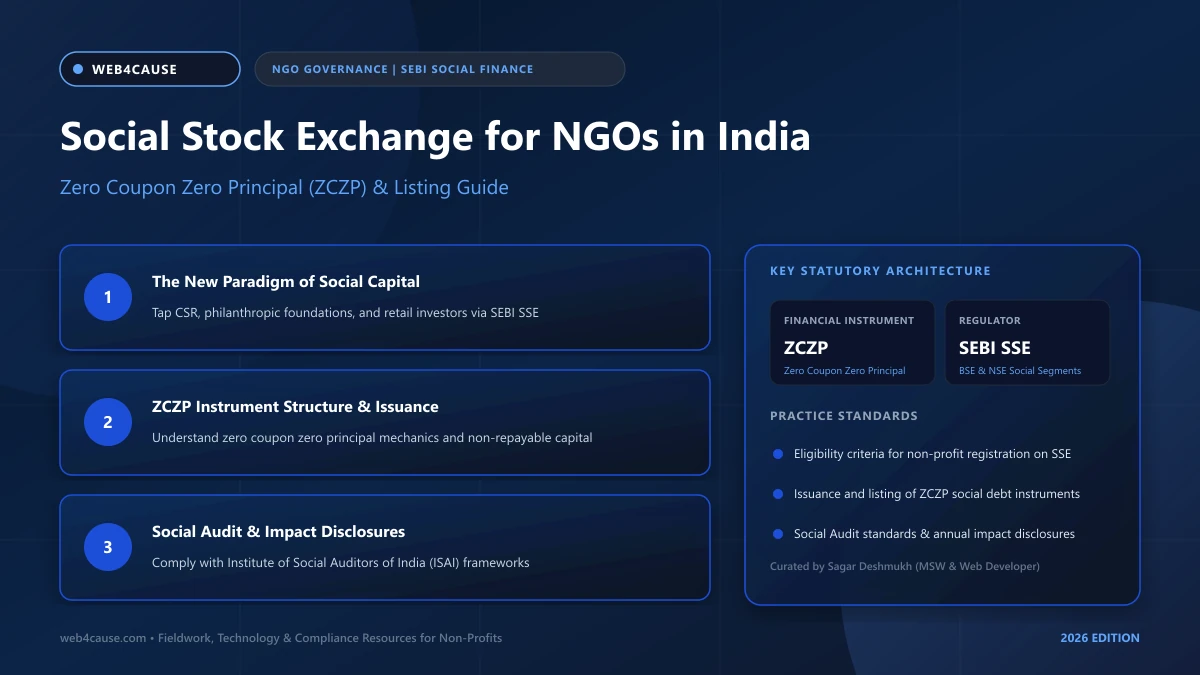
1. Genesis and Regulatory Mandate of the Social Stock Exchange (SSE)
For decades, the Indian non-profit sector has operated within a fragmented, volatile funding ecosystem. Grassroots organizations, charitable trusts, and pioneering welfare societies have traditionally relied on short-term discretionary donations, unpredictable annual grants, and cumbersome corporate social responsibility outreach. This unpredictability created operational bottlenecks, prevented long-term strategic investments in human capital, and forced social workers to dedicate disproportionate administrative energy to perpetual fundraising rather than grassroots intervention.
To address this structural deficit, the Government of India envisioned an institutional capital market solution. The conceptual foundation was formally unveiled during the Union Budget 2019 speech, proposing the creation of a regulated marketplace where social enterprises and voluntary organizations could tap into broader pools of domestic and global philanthropic capital. Following extensive sector consultations, the Securities and Exchange Board of India (SEBI) constituted a High-Powered Expert Committee chaired by Ishaat Hussain in 2020, followed by a Technical Working Group chaired by Harsh Kumar Bhanwala in 2021.
Statutory Enactment: SEBI notified the landmark regulatory architecture on July 25, 2022, introducing Chapter X-A into the SEBI (Issue of Capital and Disclosure Requirements) Regulations, 2018 (ICDR Regulations) and Chapter IX-A into the SEBI (Listing Obligations and Disclosure Requirements) Regulations, 2015 (LODR Regulations). Concurrently, the Ministry of Finance issued notification S.O. 3253(E) declaring Zero Coupon Zero Principal instruments as formal securities under Section 2(h) of the Securities Contracts (Regulation) Act, 1956.
Today, the Social Stock Exchange functions as an independent operational segment on India’s premier national bourses: the BSE Social Stock Exchange and the NSE Social Stock Exchange. Unlike conventional commercial exchanges where equity shares and debentures are traded for capital appreciation or dividend yields, the SSE is engineered exclusively to channel risk capital, philanthropic donations, and institutional CSR budgets into verified non-profit organizations (NPOs) and for-profit social enterprises (FPSEs) focused on quantifiable social development.
By bringing civil society institutions under regulated stock exchange scrutiny, the SSE introduces institutional credibility, standardization of impact disclosures, and automated clearing systems. As we emphasize throughout our guide on Trust vs Society vs Section 8 Company in India, the future of civil society funding belongs to institutions that embrace rigorous statutory transparency, auditable field metrics, and institutional governance.
2. Decoding Zero Coupon Zero Principal (ZCZP) Securities
The cornerstone financial instrument powering non-profit fundraising on the Social Stock Exchange is the Zero Coupon Zero Principal (ZCZP) instrument. Traditional corporate securities represent either ownership (equity) or debt obligations requiring periodic interest payments and eventual repayment of capital. Because charitable trusts, societies, and Section 8 institutions are barred from distributing commercial profits, classical financial instruments cannot function within the non-profit sector.
To bridge this legal and structural gap, SEBI conceived the ZCZP instrument: a specialized debt security governed by clean, non-commercial mechanics:
Zero Coupon (No Interest Yield)
The issuing non-profit carries zero liability to pay periodic interest, dividends, or yield to the investor. Capital is provided strictly on a philanthropic basis.
Zero Principal (Non-Repayable)
The invested principal amount is entirely non-refundable. The non-profit utilizes one hundred percent of the subscription proceeds toward the approved social development project.
Demat-Only Issuance
ZCZP instruments are issued exclusively in dematerialized form via Central Depository Services (India) Limited (CDSL) and National Securities Depository Limited (NSDL).
When an investor or corporate donor subscribes to a ZCZP issue, they are not purchasing a commercial financial asset in anticipation of monetary appreciation. Instead, they are acquiring a securitized philanthropic instrument. Each distinct social development initiative launched by an NPO receives its own unique International Securities Identification Number (ISIN) from the depositories. Upon successful allotment, electronic units are credited directly to the investor’s Demat account.
Critical Regulatory Evolution: In its December 2023 board meeting, SEBI enacted historic amendments to make the Social Stock Exchange accessible to mid-size non-profits. The minimum issue size for a public ZCZP offering was slashed from the prohibitive initial benchmark of Rs 1 Crore down to Rs 50 Lakhs. Simultaneously, the minimum application threshold for retail investors was reduced from Rs 2 Lakhs down to Rs 10,000, democratizing civic participation across India.
Lifecycle and Extinguishment of ZCZP Securities
The tenure of a ZCZP instrument is strictly co-terminus with the duration of the underlying project specified in the non-profit’s Draft Information Document (DID). For example, if an NGO raises Rs 75 Lakhs to build and operate five rural telemedicine centers across Maharashtra over a 24-month horizon, the ZCZP securities carry a statutory tenure of exactly 24 months.
Throughout this period, the non-profit must submit quarterly utilization certificates and annual impact evaluations. Upon completion of the project and verification by an accredited Social Auditor, the non-profit files a formal project completion certificate with the stock exchange. The depositories (CDSL and NSDL) then execute an electronic corporate action extinguishing the ZCZP instruments from the investors’ Demat holdings, bringing the securitized transaction to an orderly close.
3. Institutional Eligibility and Disqualification Framework for Non-Profits
SEBI maintains rigorous prudential gateways to ensure that fly-by-night operators or shell entities cannot exploit the Social Stock Exchange. To register on an exchange segment (a prerequisite before issuing ZCZP instruments), a Non-Profit Organization (NPO) must satisfy detailed statutory, financial, and track-record criteria set forth under Regulation 292E of the SEBI ICDR Regulations.
| Prudential Parameter | Statutory Requirement | Verification Authority & Document |
|---|---|---|
| Legal Constitution | Public Charitable Trust, Registered Society, or Section 8 Company | Registered Trust Deed, Society Certificate, or MCA Incorporation Certificate |
| Operational Track Record | Minimum 3 continuous years of lawful, active operation | Certificate of Registration and 3 consecutive years of annual activity reports |
| Income Tax Status | Active registration under Section 12A / 12AB and Section 80G | Final 5-year registration orders issued in Form 10AC or Form 10AD |
| NITI Aayog Recognition | Active registration on NGO Darpan portal with unique DARPAN ID | Valid DARPAN registration certificate from NITI Aayog portal |
| Annual Spending Threshold | Minimum Rs 50 Lakhs spent on core charitable activities in previous FY | Audited Income and Expenditure Account verified by a Chartered Accountant |
| Annual Funding Inflow | Minimum Rs 10 Lakhs in legitimate philanthropic or grant receipts in previous FY | Audited Receipts and Payments Account and ITR-7 acknowledgment |
For institutions that hold provisional tax approvals, completing the permanent registration pathway is non-negotiable. Explore our statutory guidance on 80G and 12A Registration for NGOs in India to ensure your organization holds definitive 5-year registration orders before attempting SSE onboarding. Additionally, maintaining an updated unique profile on the Central Government registry is essential, as detailed in our guide on NITI Aayog NGO Darpan Registration in India.
Permissible Thematic Focus Areas
An NPO must demonstrate that its primary intent is dedicated to at least one of the 17 social sectors recognized under Regulation 292E(2). These activities mirror the development priorities of the nation and the United Nations Sustainable Development Goals (SDGs):
- Eradicating hunger, poverty, malnutrition, and inequality.
- Promoting healthcare, mental healthcare, sanitation, and provision of safe drinking water.
- Promoting education, employability, and livelihoods through vocational skills.
- Promoting gender equality, empowerment of women, and LGBTQIA+ community welfare.
- Ensuring environmental sustainability, climate change mitigation, and conservation of natural resources.
- Protection of national heritage, art, and culture.
- Training to promote rural sports, nationally recognized sports, and Paralympic sports.
- Supporting incubators of social enterprises and bridging rural digital divides.
- Slum area development, affordable housing, and disaster management relief.
Statutory Disqualification Criteria
SEBI expressly bars certain classes of institutions from registering on the Social Stock Exchange regardless of their non-profit status:
Explicit Disqualifications: Corporate entities operating for private gain, political parties, political organizations, religious trusts whose predominant expenditures are dedicated to sectarian rites, trade unions, housing societies, and mutual benefit organizations are strictly ineligible. Furthermore, any organization whose trustees or directors have been barred by SEBI, convicted of economic offenses, or placed on the Ministry of Home Affairs FCRA prior permission blacklist cannot be listed.
4. Step-by-Step Registration and Listing Workflow on BSE and NSE
Transitioning an Indian non-profit into a listed entity on the BSE or NSE Social Stock Exchange requires a disciplined, multi-stage compliance roadmap. Non-profit trustees must differentiate between two distinct milestones: (a) Registration on SSE (institutional onboarding) and (b) Listing of ZCZP Instruments (project-specific capital mobilization).
Phase 1: Institutional Onboarding & Pre-Listing Registration
1. Trustee Board Resolution: The Board of Trustees or Governing Body passes a formal resolution approving registration on the Social Stock Exchange segment of BSE or NSE.
2. Legal Entity Identifier (LEI): The NPO obtains a 20-digit Legal Entity Identifier from Legal Entity Identifier India Limited (LEIL), a prerequisite for institutional financial reporting.
3. Depository Participant (DP) Account: The non-profit opens an institutional Demat account with an accredited Depository Participant registered with CDSL or NSDL.
4. Exchange Portal Submission: The institution registers on the BSE or NSE SSE onboarding portal, uploading audited financials, trustee KYCs, 12AB orders, 80G certificates, and DARPAN filings. Upon successful review, the exchange issues an In-Principle Registration Certificate.
Phase 2: Project Formulation & Draft Information Document (DID)
1. Project Identification: The NPO designs a targeted social intervention with clearly quantified outputs, verifiable timelines, and a minimum budget of Rs 50 Lakhs.
2. Appointment of Lead Manager: The NPO engages a SEBI-registered Merchant Banker or accredited Social Impact Advisor to structure the offering and perform statutory due diligence.
3. Drafting the Information Document: In accordance with Schedule XX of ICDR Regulations, the DID must comprehensively detail institutional background, governance practices, program milestones, risk factors, financial management protocols, and specific Key Performance Indicators (KPIs).
Phase 3: Public Comment Window & Exchange In-Principle Approval
1. Filing and Web Hosting: The non-profit files the DID with the exchange and hosts the full document prominently on its official website for a mandatory 21-day public observation period.
2. Clarifications and Redrafting: The NPO and Lead Manager address formal queries raised by the exchange, social auditors, and the public, submitting point-by-point clarifications.
3. Filing Final Information Document (FID): The exchange issues formal In-Principle Approval, after which the Final Information Document is registered with the exchange and SEBI.
Phase 4: Bidding Window, ASBA Subscription & Demat Credit
1. Offer Window: The public issue opens for bidding across a window of 5 to 10 trading days. Retail impact donors, high-net-worth philanthropists, and corporate CSR departments submit bids.
2. ASBA Architecture: Subscriptions are processed exclusively through Application Supported by Blocked Amount (ASBA). Investor funds remain safely locked within their own commercial bank accounts and are never transferred to intermediary broker accounts.
3. The 75% Minimum Subscription Threshold: If the offering secures at least 75% of the declared issue size, the issuance is deemed successful. If the issue fails to cross the 75% mark, all blocked bank amounts are automatically unblocked and released to investors within two business days.
4. Allotment & Escrow Transfer: Upon achieving successful subscription, the depositories credit ZCZP securities directly into investor Demat accounts. Simultaneously, subscribed capital is unblocked and transferred directly into the NPO’s project-specific bank escrow account.
6. Corporate CSR and Philanthropic Integration Under Section 135
Under Section 135 of the Companies Act, 2013 and the Companies (Corporate Social Responsibility Policy) Rules, 2014, Indian companies meeting statutory net worth, turnover, or profitability thresholds must deploy at least 2% of their average net profits toward eligible Schedule VII developmental activities. While corporate foundations and CSR committees traditionally executed grants through bilateral memorandums of understanding (MoUs), the Social Stock Exchange provides an institutional, capital-market mechanism for corporate CSR deployment.
Statutory CSR Alignment: The Ministry of Corporate Affairs (MCA) and SEBI have established seamless regulatory synergy. When a corporate entity subscribes to ZCZP instruments issued by an eligible NPO listed on the SSE, the investment is recognized as valid Corporate Social Responsibility expenditure under Section 135, provided the underlying project falls within the ambit of Schedule VII and the non-profit maintains active Form CSR-1 registration.
To participate in this capital-market funding flow, non-profits must hold a valid CSR-1 unique registration number issued by the Registrar of Companies. Review our practical step-by-step walkthrough on CSR-1 Registration for NGOs in India to establish statutory eligibility.
Why Corporate CSR Committees Prefer ZCZP Subscriptions
Corporate CSR heads face mounting statutory pressures, including mandatory impact assessments under Rule 8(3), severe penal consequences for unspent CSR balances, and intense board scrutiny over project slippages. Subscribing to ZCZP instruments resolves these operational headaches:
Demat Audit Proof
Digital ZCZP securities credited directly to the company’s corporate Demat account provide tamper-proof, auditable proof of statutory fund deployment for statutory corporate auditors.
Elimination of Monitoring Overhead
The mandatory Social Audit conducted by ISAI-certified professionals provides institutional verification, saving companies the substantial expense of hiring private third-party monitoring agencies.
Protection from Unspent Penalities
By subscribing to a multi-year ZCZP project, the company legally commits capital to an ongoing project, preventing mandatory transfers to government funds under Section 135(5).
For a complete perspective on institutional fundraising trends, corporate pitch strategies, and Schedule VII thematic mapping, review our detailed manual on CSR Funding for NGOs in India.
7. Strategic Comparison: SSE vs Bank Grants vs Crowdfunding Platforms
Non-profit leaders often ask whether pursuing an SSE listing is superior to traditional institutional grant seeking or retail crowdfunding. In reality, these channels serve complementary functions within an organization’s resource mobilization matrix. The following high-contrast comparative analysis outlines key distinctions across governance, legal, and operational parameters:
| Strategic Dimension | Social Stock Exchange (SSE) | Institutional Bank / CSR Grants | Digital Crowdfunding Portals |
|---|---|---|---|
| Governing Regulatory Body | SEBI, BSE, and NSE | Ministry of Corporate Affairs (MCA) | MeitY / Unregulated FinTech Platforms |
| Financial Instrument | Dematerialized ZCZP Securities | Bilateral Contractual Grant Agreements | Non-Securitized Direct Digital Donations |
| Minimum Capital Threshold | Rs 50 Lakhs issue size | Varies per donor RFP (Rs 10L to 5Cr+) | No minimum threshold (Micro-donations) |
| Investor / Donor Security | Demat Holding with Allocated ISIN | Formal Grant Sanction Letter | Payment Gateway Email Receipt |
| Audit & Verification Rigor | Mandatory ISAI Social Audit & AIR | Periodic Grant Utilization Certificates | Voluntary self-reported website updates |
| Platform Processing Fees | Subsidized exchange onboarding fees | Zero platform fees (Direct bank transfer) | 3% to 8% platform deduction plus PG fee |
| Public Transparency Level | Highest (Public exchange disclosures) | Private (Confidential donor reporting) | Moderate (Public campaign dashboard) |
| Ideal Organizational Use Case | Large-scale, multi-year developmental projects | Structured institutional program partnerships | Emergency medical relief & disaster aid |
For non-profits pursuing daily retail donations alongside long-term capital listing, integrating modern recurring payment rails is critical. Explore our technical guide on UPI AutoPay for Recurring NGO Donations in India to build sustainable monthly giving pipelines.
8. Technical Infrastructure: Demat Setup, Open Ledgers, and Web Transparency
Listing on the Social Stock Exchange is not merely a legal exercise; it demands significant digital readiness from the non-profit’s administrative team. Under SEBI LODR Regulation 91E, every listed entity must maintain a fully functional, publicly accessible web portal featuring an explicit Social Stock Exchange / Investor Relations section.
Depository Participant Integration (CDSL & NSDL)
To issue securities, the NPO must enter into a tripartite agreement with both depositories: Central Depository Services (India) Limited (CDSL) and National Securities Depository Limited (NSDL), alongside a registered Registrar and Transfer Agent (RTA). The RTA maintains the master electronic register of ZCZP debenture holders, validates investor Demat account credentials, and coordinates with self-certified syndicate banks for ASBA allotment reconciliations.
Automated Data Collection and Open Ledger Architecture
Preparing for annual ISAI social audits requires continuous field documentation rather than frantic year-end paperwork. Progressive non-profits integrate open-source digital tools to create tamper-proof audit trails:
- GPS-Tagged Field Surveys: Deploying open-source survey applications to record real-time beneficiary interactions with timestamped geographic coordinates and photographic verification.
- Automated Ledger Workflows: Utilizing automated workflow engines (such as n8n) to sync project expenditure vouchers directly from accounting software into an open-data transparency dashboard. Review our technical guide on n8n Workflow Automation for NGOs to deploy these workflows.
- Statutory Tax Receipt Automation: Ensuring every individual donor receives compliant Section 80G tax receipts and Form 10BE certificates automatically, as detailed in our blueprint on Form 10BD Filing for NGOs in India.
Semantic HTML Component for SSE Investor Disclosures
To comply with SEBI disclosure mandates, non-profit web portals must host structured public disclosures. Below is an enterprise-grade HTML implementation designed by Web4cause for an NGO’s official website:
<h3 style=”color: #0F172A; margin-top: 0; font-size: 20px;”>Social Stock Exchange (SSE) Statutory Disclosures</h3>
<p style=”color: #64748B; font-size: 14px;”>Listed on BSE SSE Segment | Security: Zero Coupon Zero Principal (ZCZP)</p>
<div class=”sse-grid” style=”display: grid; grid-template-columns: repeat(auto-fit, minmax(240px, 1fr)); gap: 16px; margin-top: 20px;”>
<div style=”background: #F8FAFC; padding: 16px; border-radius: 8px; border: 1px solid #E2E8F0;”>
<span style=”font-size: 12px; color: #64748B; font-weight: 600;”>ISIN Identifier</span>
<div style=”font-size: 16px; font-weight: 700; color: #0F172A;”>INZ000123456</div>
</div>
<div style=”background: #F8FAFC; padding: 16px; border-radius: 8px; border: 1px solid #E2E8F0;”>
<span style=”font-size: 12px; color: #64748B; font-weight: 600;”>SEBI Project Status</span>
<div style=”font-size: 16px; font-weight: 700; color: #16A34A;”>Active / In Implementation</div>
</div>
<div style=”background: #F8FAFC; padding: 16px; border-radius: 8px; border: 1px solid #E2E8F0;”>
<span style=”font-size: 12px; color: #64748B; font-weight: 600;”>Certified Social Auditor</span>
<div style=”font-size: 16px; font-weight: 700; color: #0F172A;”>ISAI Reg. No. SA-2026-089</div>
</div>
</div>
<div style=”margin-top: 24px; display: flex; flex-wrap: wrap; gap: 12px;”>
<a href=”/downloads/draft-information-document.pdf” style=”background: #2563EB; color: #FFFFFF; padding: 10px 18px; border-radius: 6px; text-decoration: none; font-size: 14px; font-weight: 600;”>Download DID (Schedule XX)</a>
<a href=”/downloads/annual-impact-report-2026.pdf” style=”background: #F1F5F9; color: #334155; border: 1px solid #CBD5E1; padding: 10px 18px; border-radius: 6px; text-decoration: none; font-size: 14px; font-weight: 600;”>Download Annual Impact Report (AIR)</a>
<a href=”/downloads/social-audit-report-2026.pdf” style=”background: #F1F5F9; color: #334155; border: 1px solid #CBD5E1; padding: 10px 18px; border-radius: 6px; text-decoration: none; font-size: 14px; font-weight: 600;”>Download ISAI Social Audit Report</a>
</div>
</section>
A high-performance institutional website is fundamental to maintaining investor credibility. Learn how to architect an accessible, high-speed digital presence in our guide to NGO Website Design in India.
9. Non-Profit Trustee Pre-Listing Governance Checklist
Before initiating engagement with merchant bankers or filing registration papers with the stock exchange, the Board of Trustees must complete a thorough internal governance audit. Ensure your organization satisfies every statutory item on this ten-point checklist:
-
✓
3-Year Clean Registration: The trust, society, or Section 8 entity has completed a minimum of three full continuous financial years of operation from its official registration date. -
✓
Final 12AB and 80G Orders: The institution holds final, regular 5-year registration orders under Section 12AB (Form 10AC/10AD) and Section 80G(5). Provisional approvals are not sufficient. -
✓
Active NITI Aayog NGO Darpan Profile: The entity’s DARPAN profile is fully updated, linking all current trustees, PAN details, bank accounts, and mobile contact numbers. -
✓
Financial Expenditure Benchmark: Core charitable spending in the preceding financial year exceeded Rs 50 Lakhs, verified by audited Income and Expenditure statements. -
✓
Philanthropic Funding Inflow: Legitimate grant and donation receipts in the preceding financial year exceeded Rs 10 Lakhs, verified by audited Receipts and Payments statements. -
✓
Form CSR-1 Registration: The non-profit holds an active CSR-1 unique registration number issued by the Ministry of Corporate Affairs, enabling corporate CSR participation. -
✓
Unqualified Audit Reports: Independent statutory audit reports for the past three fiscal years contain no adverse qualifications, disclaimers, or material fraud disclosures. -
✓
Trustee and Director KYC Sanity: All trustees, governing council members, and authorized signatories possess valid PAN, Aadhaar, and clean regulatory track records without SEBI debarment. -
✓
Discrete Project Architecture: The planned intervention has a standalone bank escrow plan, clear beneficiary milestones, a budget of at least Rs 50 Lakhs, and identified ISAI standards. -
✓
Digital Transparency Readiness: The organization’s web portal is prepared to host the DID, quarter-by-quarter progress notes, and annual social audit reports.
10. Frequently Asked Questions (FAQs)
Can retail individual donors buy ZCZP instruments on the Social Stock Exchange?
Yes. Following the December 2023 regulatory amendments enacted by SEBI, the minimum application threshold for retail investors was reduced from Rs 2 Lakhs to Rs 10,000. Any individual who maintains an active Demat account with CDSL or NSDL and an ASBA-supported bank account can participate in public ZCZP offerings launched by listed non-profits.
What tax benefits do investors receive when purchasing ZCZP securities?
Because the issuing Non-Profit Organization must hold an active Section 80G approval order from the Income Tax Department, subscriptions to ZCZP instruments qualify as eligible charitable donations under Section 80G of the Income Tax Act, 1961. Investors receive standard 50% tax deduction benefits, and the non-profit reports the subscription in its annual Form 10BD filing, generating a formal Form 10BE certificate for the investor.
Is listing on the Social Stock Exchange mandatory for all registered NGOs in India?
No. Registering and listing on the Social Stock Exchange is entirely voluntary. Indian non-profits can continue to operate and raise philanthropic donations through traditional channels: direct bank transfers, UPI payment gateways, offline cheques, and bilateral CSR memorandums. Listing on the SSE is a strategic choice for scaling institutions seeking access to large-scale institutional impact capital.
Can an NGO raise funds for general operational overheads through ZCZP issuance?
No. Under SEBI ICDR Regulations, ZCZP instruments must be issued for a specific, identifiable social development project with defined physical targets, beneficiary demographics, and an implementation schedule. The proceeds cannot be utilized for untied general corpus additions or unstructured administrative endowments. General management overheads directly allocable to project execution are permissible within statutory limits declared in the DID.
What happens if a ZCZP public issue fails to achieve the 75% minimum subscription mark?
Under SEBI ICDR Regulation 292K, if the total subscription received does not reach at least 75% of the total issue size within the specified bidding window, the public offering is deemed to have failed. All blocked amounts in the bank accounts of applying investors are unblocked within two business days through the ASBA mechanism. No securities are minted, and no funds are transferred to the non-profit.
How does a non-profit select and appoint a certified Social Auditor under ISAI guidelines?
The non-profit must engage an independent professional or social audit firm registered with the Institute of Social Auditors of India (ISAI) or an equivalent SEBI-recognized Self-Regulatory Organization. The auditor must hold a valid NISM Series XXIII certification. To maintain statutory independence, the Social Auditor cannot have served as the statutory financial auditor, internal accountant, or trustee of the non-profit during the preceding three financial years.
Social Finance & Governance Advisory
Preparing Your Non-Profit for Social Stock Exchange Registration and ZCZP Issuance?
Navigating SEBI regulatory mandates, drafting compliant Information Documents (Schedule XX), structuring Demat depository connectivity, and aligning field interventions with ISAI Social Audit Standards requires deep statutory mastery paired with genuine social work fieldwork acumen. Sagar Deshmukh bridges professional Master of Social Work (MSW) field experience with enterprise web engineering to guide Indian non-profits through SSE onboarding, statutory digital disclosures, and institutional scaling.
Chat on WhatsApp (+91 8080309570)
Direct Call: +91 8080309570
Explore full-stack institutional web development, donation systems, and digital compliance at Web4cause NGO Design Services.