
ITR-7 Filing for NGOs in India: Complete 2026 Tax Guide
A comprehensive statutory handbook, computational roadmap, and technical filing manual for Indian public charitable trusts, registered societies, Section 8 companies, and educational institutions. Master electronic filing of Income Tax Return 7 (ITR-7), interlocking schedules with Form 10B and Form 10BB audit reports, Form 10BD donation cross-reconciliations, Form 9A deemed applications, Section 11(2) Form 10 accumulations, and defensive compliance against CPC Bengaluru automated defect notices.
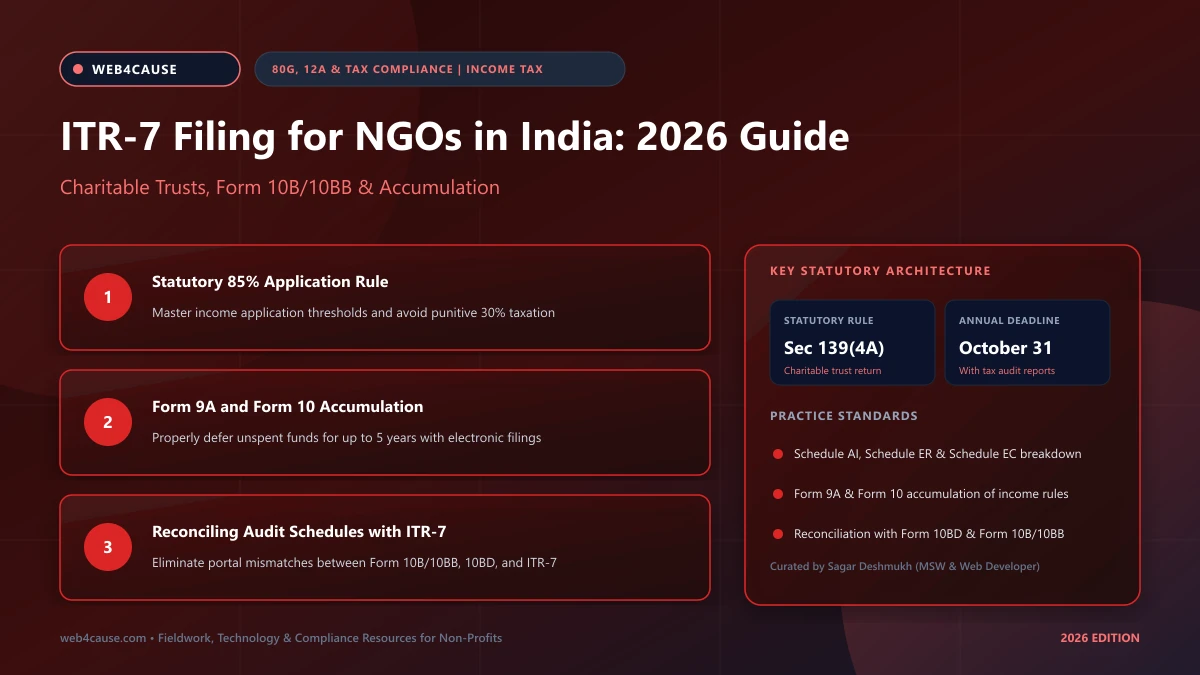
1. The Statutory Framework of ITR-7: Who Must File Under Section 139(4A) to 139(4D)
Under the Indian Income Tax Act 1961, tax exemption is never an automatic entitlement. While commercial enterprises, proprietary firms, and individuals file standard returns such as ITR-1 through ITR-6, charitable and religious entities are governed by a specialized compliance instrument: Form ITR-7. Filing ITR-7 is the mandatory statutory gateway through which an organization claims exemption under Section 11, Section 12, or Section 10(23C).
Every non-profit organization whose total income, computed before giving effect to the provisions of Section 11 and Section 12, exceeds the basic exemption limit (currently Rs 2,50,000 under the old tax regime) is statutorily mandated to file ITR-7. This requirement applies regardless of whether the organization ultimately owes zero tax after applying its receipts to charitable purposes. The statutory obligation to submit ITR-7 arises under specific subsections of Section 139:
Section 139(4A): Charitable and Religious Trusts
Mandates filing for every person in receipt of income derived from property held under trust or other legal obligation wholly or partly for charitable or religious purposes, claiming exemption under Section 11 and Section 12. This encompasses public charitable trusts, registered societies, and Section 8 non-profit companies.
Section 139(4B): Political Parties
Governs political parties registered under Section 29A of the Representation of the People Act 1951, claiming exemption under Section 13A. The chief executive officer must furnish ITR-7 if gross income exceeds the basic exemption limit.
Section 139(4C): Specified Statutory Institutions
Covers entities claiming exemption under clauses of Section 10, including scientific research associations under Section 10(21), news agencies under Section 10(22B), professional associations under Section 10(23A), institutions under Section 10(23B), hospitals and universities under Section 10(23C), and mutual funds under Section 10(23D).
Section 139(4D): Universities and Colleges
Applies to every university, college, or other institution referred to in Section 35(1)(ii) and Section 35(1)(iii), which is not required to furnish a return of income or loss under any other provision of Section 139.
A common structural mistake observed across small and mid-sized non-profits is assuming that because an entity is incorporated as a company under the Companies Act 2013, it should file ITR-6. If a Section 8 company holds registration under Section 12A, Section 12AA, or Section 12AB, or operates under Section 10(23C), filing ITR-6 will cause an automated rejection of all charitable exemptions, treating the company as a commercial for-profit corporation. We analyzed this legal structure in depth in our comparative review on Trust vs Society vs Section 8 Company in India. Every organization registered under Section 12AB must file Form ITR-7.
Statutory Caveat on Gross Receipts: Even if an NGO incurred an operational deficit or spent 100 percent of its donations on charitable relief work, it must compute its return without deducting charitable expenditures. If voluntary contributions plus investment income exceed Rs 2,50,000, filing ITR-7 on the official portal (incometax.gov.in) is legally mandatory.
2. Statutory Deadlines, E-Verification, and Catastrophic Penalties for Late Filing
In non-profit taxation, statutory deadlines operate as strict jurisdictional boundaries. For organizations requiring a tax audit under Section 12A(1)(b) or Section 10(23C), the annual compliance calendar contains two interconnected statutory dates:
- September 30 (Audit Report Due Date): The Chartered Accountant audit report in Form 10B or Form 10BB must be filed electronically on the Income Tax e-filing portal at least one month prior to the return due date. Filing Form 10B/10BB on October 1 or later invalidates the audit report for timely exemption purposes.
- October 31 (ITR-7 Return Due Date): The institution must submit its complete Form ITR-7 on or before October 31 of the Assessment Year. For organizations not subject to tax audit (whose gross receipts before exemption do not exceed the basic exemption limit), the due date is July 31.
Mandatory Electronic Verification: DSC vs EVC
ITR-7 cannot be submitted in paper format. Filing must be completed digitally on the Income Tax e-filing portal. The mode of electronic verification is strictly regulated:
- Section 8 Companies and Audited Trusts: Must verify the return exclusively using a Class 3 Digital Signature Certificate (DSC) of the Principal Officer, Managing Trustee, or Director registered on the portal. Electronic Verification Code (EVC) via Aadhaar OTP is invalid for entities liable to tax audit.
- Non-Audited Charitable Trusts and Societies: May verify either through Class 3 DSC or via EVC generated through Aadhaar OTP, net banking, or verified bank account credentials.
The Three Brutal Consequences of Missing October 31
Under Section 12A(1)(ba), introduced by the Finance Act and reinforced through Section 143(1)(a) automated processing, timely filing of ITR-7 within the due date prescribed under Section 139(1) or Section 139(4) is a mandatory condition precedent for claiming exemption under Section 11 and Section 12. Missing the deadline triggers immediate statutory penalties:
- Total Loss of Tax Exemption: All claims under Section 11 and 12 are summarily disallowed by the Central Processing Centre (CPC) Bengaluru during prima facie adjustment under Section 143(1)(a).
- Taxation of Gross Receipts at 30 Percent under Section 115BBI: Income accumulated or applied without valid return filing is taxed as specified income under Section 115BBI at a flat 30 percent plus 25 percent surcharge and 4 percent health and education cess, resulting in an effective tax rate of 39 percent on gross turnover.
- Late Filing Fees and Interest: Mandatory late filing fee under Section 234F (Rs 5,000 for total income over Rs 5 Lakh; Rs 1,000 for smaller entities), plus simple interest at 1 percent per month under Section 234A, 234B, and 234C.
A delay of even 24 hours can transform a completely compliant charitable trust with zero commercial surplus into an assessee facing tax demands reaching millions of rupees. In worst-case scenarios involving continuous non-compliance or failure to renew registration, the department can invoke the accreted wealth tax covered in our detailed analysis of Section 115TD for NGOs in India.
3. The 85 Percent Application Rule, Form 9A Deemed Application, and Form 10 Accumulation
The cornerstone of non-profit income tax jurisprudence is Section 11(1)(a), which establishes the 85 percent application rule:
When an institution applies 85 percent or more of its gross receipts towards charitable or religious objects within India during the financial year, the entire income is exempt from taxation. However, real-world non-profit operations frequently encounter donor disbursements received on March 28, multi-year institutional grant tranches, or legal disputes delaying capital deployments. The Income Tax Act provides two legal mechanisms to protect tax exemptions in such circumstances:
3.1 Deemed Application Under Explanation 1 to Section 11(1): Form 9A
When an NGO cannot spend 85 percent of its income during the financial year because either:
- The income was not received during the financial year (Clause 1 of Explanation 1); or
- The income was received late in the year, such as in the final weeks of March, leaving insufficient time to apply it (Clause 2 of Explanation 1);
The trustees can exercise an option by submitting Form 9A electronically on the Income Tax portal. By filing Form 9A, the shortfall is deemed to have been applied towards charitable purposes during the financial year in which it was earned. However, the accumulated funds must be spent during the subsequent financial year, or in the year of actual receipt.
Critical Procedural Rule for Form 9A: Following recent amendments, Form 9A must be filed at least two months prior to the due date for furnishing the return of income under Section 139(1), or on or before the audit report deadline (September 30). Filing Form 9A alongside the return on October 31 is invalid and results in automated rejection of deemed application claims.
3.2 Specific Purpose Accumulation Under Section 11(2): Form 10
When an institution wishes to accumulate income beyond the unconditional 15 percent limit for a specific multi-year capital or operational purpose, such as constructing a community hospital, acquiring land for a school, or funding an endowment, it can utilize Section 11(2) by filing Form 10.
- Statutory Accumulation Window: Funds can be accumulated for a maximum duration of 5 years.
- Mandatory Form 10 Filing: Must be filed electronically at least two months prior to the ITR-7 due date, detailing concrete, tangible objects. Generic declarations such as “charitable objects” are rejected by assessing authorities and appellate courts.
- Mandatory Investment in Section 11(5) Modes: Accumulated funds must be held strictly in approved modes under Section 11(5), including scheduled commercial bank deposits, government securities, public sector bonds, post office savings, and units of the Unit Trust of India. Parking accumulated reserves in unapproved mutual funds or private shares violates Section 13(1)(d).
- Absolute Ban on Granting Accumulated Funds: Under the explanation to Section 11(2), accumulated funds cannot be donated or granted to any other charitable trust or institution, even if that institution has identical objects. Accumulated funds must be spent directly by the accumulating entity.
3.3 Inter-Charity Donation Restrictions Under Section 11
The Finance Act enacted substantial restrictions on inter-trust grant funding. When Trust A makes a grant to Trust B, only 85 percent of the eligible donation qualifies as charitable application in the hands of Trust A. Furthermore, if the grant is made towards the corpus of Trust B, or if it is paid out of accumulated funds under Section 11(2), zero percent qualifies as application. Non-profits running intermediary grant-making programs must account for this 15 percent statutory hair-cut in their financial models.
5. Interlocking ITR-7 with Form 10B and Form 10BB Audit Reports
One of the most consequential reforms introduced by the Central Board of Direct Taxes (CBDT) is the complete restructuring of tax audit reports for charitable entities under Rule 17B and Rule 16CC. The audit report must be prepared and electronically signed by a practicing Chartered Accountant registered with the Institute of Chartered Accountants of India (icai.org).
5.1 Choosing Between Form 10B and Form 10BB
Selecting the wrong audit form results in an immediate defect notice under Section 139(9), and if not corrected within fifteen days, causes the return to be treated as invalid. The statutory thresholds are clear:
Critical FCRA Warning: If your NGO received even Rs 10,000 in foreign contributions during the financial year, you are statutorily disqualified from filing Form 10BB. You must file Form 10B, even if your total income is below Rs 10 Lakh. Failing to recognize this trigger invalidates your audit filing.
5.2 Automated CPC Bengaluru Section 143(1)(a) Mismatch Notices
The CPC Bengaluru system employs algorithmic data parsing that reconciles entries in Form 10B/10BB with the corresponding cells in ITR-7. Any numerical discrepancy generates an automated intimation under Section 143(1)(a) proposing adjustments:
- Voluntary Contributions Mismatch: Voluntary contributions stated in clause 16 of Form 10B must match Schedule AI Line 1 of ITR-7 to the single rupee.
- Corpus Grants: Additions to corpus reported in the CA audit report must agree with Schedule AI Line 2.
- Revenue and Capital Application: Programmatic expenses in Schedule ER and capital asset additions in Schedule EC must reconcile precisely with the auditor’s certificate in Form 10B/10BB.
6. Reconciliation with Form 10BD Statement of Donations and 10BE Certificates
Under Section 80G(5)(viii) and Section 35(1A), all institutions approved under Section 80G must file an annual statement of donations in Form 10BD on or before May 31 immediately following the end of the financial year. Filing Form 10BD enables the generation of individual donation certificates in Form 10BE, which pre-fill into donors’ Annual Information Statements (AIS) and ITR forms.
When preparing Schedule AI of ITR-7, the non-profit’s accounts team must perform a three-way reconciliation across:
- Books of Account: Total domestic voluntary contributions recorded in the audited general ledger.
- Form 10BD Filing: Total aggregate donations reported on May 31 on the income tax portal. For full technical schema rules, review our tutorial on Form 10BD CSV Schema & PAN Validation.
- Form 10BE Certificates: Unique certificate serial numbers generated for individual and corporate donors. Explore our automated issuance architecture in Form 10BE Certificate Generation for NGOs.
Resolving Donation Reconciliation Variances
If donations in the audited financial statements exceed the amount filed in Form 10BD (due to late-discovered donor receipts or missing donor PAN records), the non-profit must file a revised Form 10BD before finalizing ITR-7. If voluntary contributions in Schedule AI remain unexplained or lack donor identity verification, assessing officers can recharacterize the unexplained surplus as anonymous donations under Section 115BBC. Learn how to prevent these errors with an Automated 80G Tax Receipt System.
7. Corpus Donations and Anonymous Donations Under Section 115BBC
Understanding the statutory boundaries of corpus receipts and anonymous contributions is essential to avoiding severe penal tax liabilities in ITR-7:
7.1 Corpus Donations Under Section 11(1)(d)
Corpus donations are voluntary contributions made with a specific written direction from the donor that they shall form part of the trust’s corpus. Under Section 11(1)(d), these receipts are excluded from gross income and are exempt without requiring the institution to spend 85 percent of the amount. However, strict statutory conditions apply:
- Mandatory Written Donor Letter: The institution must preserve a contemporaneous written letter from the donor explicitly directing the funds to corpus. Oral instructions or trustee resolutions cannot establish corpus character.
- Mandatory Investment in Section 11(5) Modes: Under amendments enacted by the Finance Act 2021, corpus donations are exempt only if invested or deposited in approved modes specified under Section 11(5) maintained specifically for such corpus. If corpus funds are kept in a current account or spent on operational overheads, they lose their exemption and become taxable income.
7.2 Anonymous Donations Under Section 115BBC
Under Section 115BBC, an anonymous donation is defined as any voluntary contribution where the receiving entity fails to maintain records containing the identity, name, address, and Permanent Account Number (PAN) or official proof of the contributor.
The Statutory Exemption Formula for Anonymous Donations
For wholly charitable institutions, anonymous donations are not entirely taxable. The law provides an exemption threshold calculated as the higher of:
- 5 percent of total donations received by the institution during the year; or
- Rs 1,00,000 (Rupees One Lakh).
Any anonymous donation exceeding this threshold is taxed at a flat rate of 30 percent under Section 115BBC plus applicable surcharge and cess, reported in Schedule 115BBI of ITR-7. Institutions established wholly for religious purposes (such as temples, mosques, churches, or gurudwaras) are exempt from Section 115BBC.
8. Step-by-Step Electronic Pre-Filing Checklist for Non-Profit Leadership
Before clicking the final submit button on Form ITR-7, managing trustees, financial officers, and executive directors should systematically verify each of the following operational checkpoints:
9. ITR-7 Statutory Schedules and Audit Form Comparison Matrix
This statutory matrix provides a quick reference guide to the core elements of non-profit income tax compliance under the Indian Income Tax Act 1961:
10. Frequently Asked Questions (FAQs)
Can an NGO file a belated ITR-7 return after October 31 and still preserve its Section 11 tax exemption?
No. Following the insertion of clause (ba) in Section 12A(1), timely filing of the return of income on or before the due date specified under Section 139(1) or Section 139(4) is a mandatory statutory prerequisite. If an NGO files a belated return under Section 139(4), CPC Bengaluru automatically disallows exemptions under Section 11 and Section 12 during Section 143(1)(a) processing, subjecting gross receipts to tax at 30 percent under Section 115BBI. The only available remedy is filing a condonation petition before the CBDT under Section 119(2)(b) establishing genuine hardship.
What is the difference between Form 10B and Form 10BB audit reports for Indian charitable trusts?
Form 10BB is the condensed audit report applicable exclusively to charitable entities whose total income does not exceed Rs 5 Crore during the previous year, provided the entity has received zero foreign contributions and has not applied any income outside India. Form 10B is the comprehensive 49-clause audit report required if total income exceeds Rs 5 Crore, or if the entity received any foreign contribution, or applied any income overseas under Section 11(1)(c).
How should an NGO report corpus donations in ITR-7 to ensure they are not treated as taxable income?
Corpus donations must be entered in Schedule AI under Line 2 (Corpus donations). To qualify for statutory exemption under Section 11(1)(d), the non-profit must possess a specific written direction letter from each donor and must have invested the entire corpus donation amount in specified investment modes under Section 11(5) maintained exclusively for corpus. If invested properly, corpus donations are excluded from the 85 percent charitable application requirement.
Can capital expenditure on land, building, or vehicles be claimed as charitable application in Schedule EC?
Yes. Capital expenditure incurred out of current year income for acquiring assets that advance the charitable purposes of the trust qualifies as application under Section 11. However, under Section 11(6), once an asset is claimed as charitable application in Schedule EC, no depreciation can be claimed on that asset in current or future assessment years. Furthermore, if the asset was acquired using borrowed loans, it cannot be claimed as application until the principal loan amount is repaid out of current income.
What happens if voluntary contributions reported in Schedule AI do not match Form 10BD donation filings?
A discrepancy between Schedule AI and Form 10BD triggers automated scrutiny through the income tax department’s risk management algorithms. If voluntary contributions in the return exceed the total reported in Form 10BD, assessing officers may suspect that unidentified donations represent anonymous contributions under Section 115BBC. Trustees must reconcile all receipts before filing ITR-7 and submit a corrected or supplementary Form 10BD if genuine donations were inadvertently omitted.
Is filing an ITR-7 mandatory for non-profit entities whose entire income is below taxable limits?
Yes, if total receipts computed before claiming exemption under Section 11 and Section 12 exceed the maximum amount not chargeable to tax (Rs 2,50,000). The statutory threshold under Section 139(4A) is evaluated based on gross receipts before applying expenditure or charitable deductions. If an NGO received Rs 15 Lakh in donations and spent Rs 15 Lakh on charitable work, resulting in zero net surplus, filing Form ITR-7 remains legally mandatory to claim and maintain tax exemption.
Direct Statutory Tax Advisory
Need Professional Guidance on ITR-7 Filing, Form 10B/10BB Audits, or CPC Defect Notices?
Navigating ITR-7 schedules, reconciling Form 10BD donation records, drafting Form 9A and Form 10 accumulation resolutions, and responding to Section 143(1)(a) mismatch notices demands rigorous statutory expertise paired with practical non-profit operational knowledge. Sagar Deshmukh combines professional social work field experience with web engineering and tax workflow automation to help charitable trusts, societies, and Section 8 institutions protect tax exemptions, automate compliance, and streamline accounting.
Explore complete institutional web design, donation workflows, and digital compliance at Web4cause NGO Design Services.