
Social Administration
2026 Practice Manual
Social Welfare Administration in India: Complete 2026 Practice Guide
•
Published: October 31, 2026
•
24 min read
•
Executive Social Work Masterclass
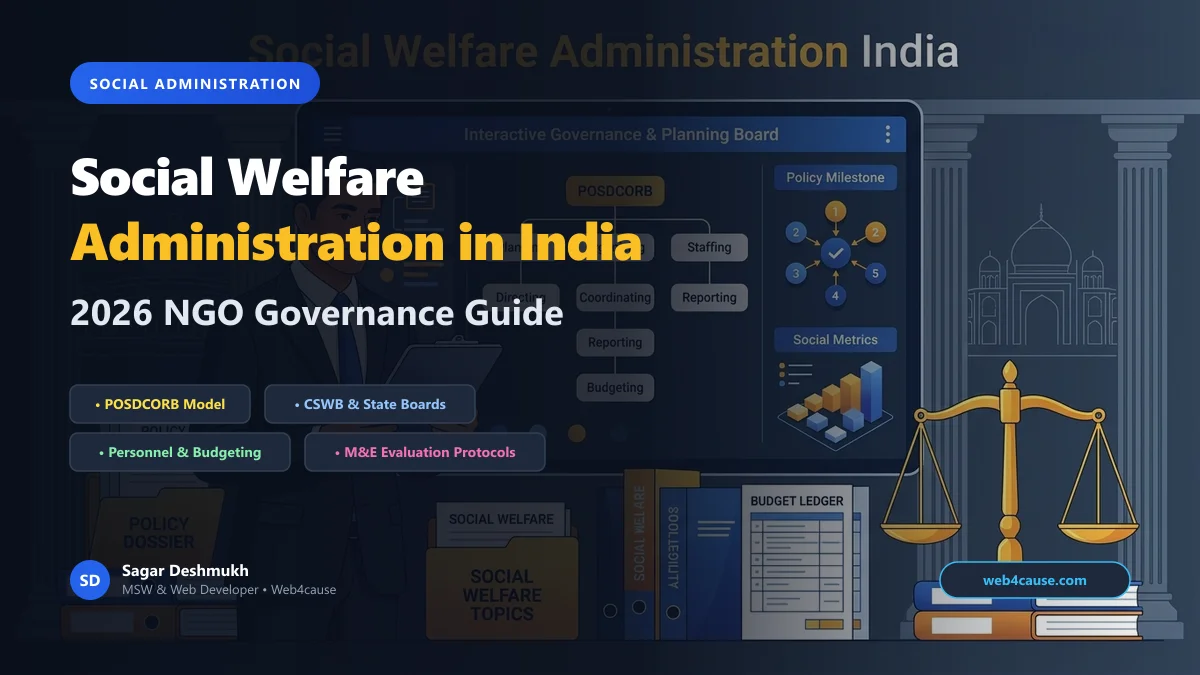
Executive Practice Summary: Administration as an Enabling Method of Social Justice
Social Welfare Administration operates as a vital secondary, enabling method of professional social work. It provides the institutional machinery, regulatory discipline, and strategic leadership required to transform constitutional mandates, legislative statutes, and donor funding into dignified, impactful human services. In the Indian voluntary landscape, where grassroots agencies must balance community empowerment against intense statutory oversight from the Ministry of Finance, Ministry of Corporate Affairs, and Ministry of Home Affairs, professional administration is no longer an auxiliary clerical activity. It is the core operational competency that ensures organizational survival, fiduciary integrity, staff well-being, and transformative grassroots change.
The landscape of non-profit management across India has undergone a historic paradigm shift over the past decade. The era of informal, unmonitored philanthropy conducted on paper registers has ended permanently. Today, voluntary organizations, charitable trusts, and non-governmental organizations (NGOs) navigate an interconnected digital compliance ecosystem governed by faceless income tax assessments, mandatory filing of donor tax exemption records under Form 10BD filing for NGOs, tight foreign funding scrutiny under FCRA registration and compliance, and unified identity validation on the NITI Aayog NGO Darpan registration portal.
For Master of Social Work (MSW) graduates, university researchers, non-profit trustees, and civil society executives, mastering Social Welfare Administration is essential. While primary methods of professional social work such as social case work in India, social group work method, and community organization in social work intervene directly with individuals, small groups, and geographical populations, Social Welfare Administration serves as the overarching institutional conduit. Without effective administration, field interventions collapse due to resource exhaustion, regulatory de-registration, or operational paralysis.
1. Epistemological Roots, Epistemic Nature, and Classical Definitions
In the formal taxonomy of social work methodology, methods are bifurcated into two mutually supportive categories: primary (or direct) methods and secondary (or indirect and enabling) methods. Primary methods involve direct interpersonal engagement between the practitioner and the client system. Secondary methods function at the systemic, institutional, and policy levels to create the structural conditions under which direct social work can successfully take place.
Social Welfare Administration is specifically defined as the systematic process of translating social policy into concrete social services, accompanied by the critical evaluation and modification of those services to ensure social justice. Numerous seminal theorists have established its conceptual boundaries:
Authoritative Theoretical Definitions
- Arthur Dunham (1962): Conceptualized social welfare administration as “the process of applying social work principles and methods to the administration of social agencies.” Dunham emphasized that administration in social work is not merely clerical maintenance; it is an active professional process that harmonizes agency resources with community needs while upholding democratic values.
- John C. Kidneigh (1950): Articulated the classic formulation: “Social work administration is the process of translating social policy into social services and the study of that process.” Kidneigh highlighted a two-way dynamic: policy is converted into specific programs, while field experience gathered during program execution is fed back to reshape legislative and organizational policy.
- Walter A. Friedlander (1958): Defined it as “the administration of public and private social agencies which is designed to organize and direct the social services, programs, and facilities in order to meet the needs of individuals, families, groups, and communities.”
- Harleigh B. Trecker (1971): Defined it as “a process of working with people in ways that release and stimulate their individual and collective abilities, so that they can utilize agency resources to achieve desired social outcomes.” Trecker insisted that democratic participation must exist within the administrative hierarchy itself.
- Rosemary Sarri (1971) & David Austin (1988): Formulated human service administration frameworks emphasizing that social agencies deal with human beings whose moral, emotional, and constitutional rights must dictate administrative decisions, setting it sharply apart from industrial manufacturing management.
What makes Social Welfare Administration unique in comparison to General Public Administration or Corporate Business Administration? The distinction lies in its ultimate purpose and client relationship. Corporate management seeks profit maximization, market dominance, and shareholder value. Public administration enforces state authority, regulatory compliance, and bureaucratic continuity. In contrast, Social Welfare Administration evaluates success through human dignity, social equity, capability enhancement, and the reduction of vulnerability. The recipient of a welfare service is neither a commercial customer to be monetized nor a passive subject of state discipline. The recipient is a citizen exercising fundamental rights.
2. Luther Gulick POSDCORB Model: Grassroots Indian Adaptation
In 1937, Luther Gulick and Lyndall Urwick synthesized classical administrative principles into the famous acronym POSDCORB: Planning, Organizing, Staffing, Directing, Coordinating, Reporting, and Budgeting. While originally conceived for governmental bureaucracies, this operational matrix provides a robust structural backbone for Indian social sector agencies when adapted to grassroots realities.
P: Planning (Strategic, Operational, and Participatory Convergence)
In social welfare agencies, planning is not an ivory-tower exercise conducted solely by board members. Effective non-profit planning operates at three distinct levels:
- Strategic Planning (3 to 5 Years): Articulating the organizational vision, mission, Theory of Change (ToC), and sectoral focus areas aligning with national Sustainable Development Goals (SDGs).
- Operational Planning (Annual Action Plans): Translating strategic goals into concrete programmatic milestones, quarterly targets, field activity calendars, and resource commitments.
- Participatory Village Convergence: Aligning NGO grassroots initiatives with statutory Gram Panchayat Development Plans (GPDP) through participatory rural appraisal PRA techniques to prevent duplicate community expenditure.
O: Organizing (Structural Division, Departmentalization, and Line-Staff Synergy)
Organizing establishes the formal structure of authority through which work subdivisions are arranged, defined, and coordinated. In Indian non-profits:
- Fiduciary vs Operational Division: Clear legal separation between the non-executive Board of Trustees (fiduciary custodians) and the Executive Director with professional program staff (operational implementation).
- Functional Departmentalization: Grouping activities into specialized units: Program Operations, Monitoring and Evaluation (M&E), Finance and Accounts, Human Resources, and Communications.
- Span of Control: Ensuring field supervisors manage realistic team sizes (typically 5 to 7 field mobilizers) to maintain high-quality fieldwork supervision.
S: Staffing (Competency Recruitment, POSH Mandates, and Child Protection)
Staffing in social work administration encompasses the entire human resource life cycle, requiring balanced integration of professional expertise with social empathy:
- Professional Social Work Recruitment: Hiring qualified MSW/BSW professionals with contextual competencies in community organization, case documentation, and local vernacular fluency.
- POSH Compliance: Mandatory establishment of an Internal Committee (IC) under the Sexual Harassment of Women at Workplace (Prevention, Prohibition and Redressal) Act 2013 for every organization with ten or more employees, including external NGO member appointment and annual filing with the District Officer.
- Child Protection Policy (CPP): Stringent background checks, police verification, and signed adherence to child safeguarding protocols aligning with the Protection of Children from Sexual Offences (POCSO) Act 2012.
D: Directing (Participatory Leadership, Motivation, and Crisis Management)
Directing involves the continuous responsibility of making decisions, issuing guidance, and providing motivational leadership. Unlike commercial organizations that rely on monetary bonuses, social welfare direction relies heavily on value-based, transformative, and servant leadership:
- Participatory Decision-Making: Involving grassroots animators and field officers in project design, fostering deep personal ownership over outcomes.
- Field Crisis Protocols: Guiding staff through communal tensions, administrative hostility, natural disasters, or community resistance with ethical clarity.
- Delegation with Mentorship: Empowering cluster coordinators with budgetary and operational discretion while providing supportive supervisory backstopping.
CO: Coordinating (Inter-Departmental Synergy and Institutional Networking)
Coordinating is the vital duty of interrelating the various parts of the agency to prevent institutional friction and organizational silos:
- Internal Program-Finance Synergy: Bridging the perpetual friction between field mobilizers seeking rapid community expenditure and accounting staff enforcing voucher compliance.
- Inter-Agency Networking: Active participation in District Task Forces, block-level convergence meetings with Block Development Officers (BDOs), and Child Development Project Officers (CDPOs).
- Coalition Building: Forming alliances with fellow civil society organizations for policy advocacy and emergency disaster responses.
R: Reporting (Management Information Systems and Statutory Disclosures)
Reporting keeps executive executives, boards, donors, communities, and state authorities informed about institutional progress, challenges, and fiscal realities:
- Digital MIS Dashboards: Deploying real-time field data collection using platforms like KoboToolbox for NGOs in India and automated workflows with n8n workflow automation.
- Donor Narrative and Financial Reports: Delivering rigorous, indicator-based reporting aligned with agreed project LogFrames.
- Statutory Disclosures: Submitting annual audited reports to the Charity Commissioner or Registrar of Societies, filing Form 10BD with the Income Tax Department, and publishing open annual reports on institutional websites designed via modern NGO website design standards.
B: Budgeting (Fiscal Prudence, Zero-Based Planning, and Statutory Limits)
Budgeting encompasses financial planning, accounting, internal audit controls, and strict compliance with statutory Indian fiscal parameters:
- Zero-Based Budgeting (ZBB): Requiring every project activity to be justified from scratch each fiscal cycle rather than inflating historical expenditures.
- 85 Percent Application Rule: Strictly tracking and applying at least 85 percent of gross institutional receipts towards approved charitable objectives under Section 11(1)(a) of the Income Tax Act 1961.
- FCRA Financial Segregation: Maintaining complete, inviolable segregation of foreign contributions from domestic donations, while strictly observing the twenty percent administrative expenditure cap under amended Section 8 of the FCRA.
3. Apex Institutional Architecture: CSWB, Ministries, and Statutory Bodies
The institutional infrastructure of social welfare in independent India is the historical product of intentional state planning, democratic decentralization, and statutory evolution. Understanding the apex administrative architecture is essential for any practitioner navigating grant approvals, departmental convergence, or national social schemes.
The Central Social Welfare Board (CSWB): History, Legacy, and Structural Transition
In August 1953, the Government of India, through an executive resolution of the Ministry of Education, established the Central Social Welfare Board (CSWB). The creation of the CSWB was an innovative administrative experiment designed to foster voluntary social work without suffocating civil society beneath bureaucratic red tape.
The visionary architect and founding Chairperson of the CSWB was Dr. Durgabai Deshmukh, a stalwart freedom fighter, member of the Constituent Assembly, and pioneer of professional social work in India. Dr. Deshmukh recognized that while the state possessed financial resources, voluntary social workers possessed the personal dedication, community intimacy, and human sensitivity necessary to implement welfare programs effectively.
Landmark Schemes Pioneered by the CSWB:
- Grants-in-Aid Programme: Provided direct financial assistance to thousands of voluntary organizations to stabilize institutional budgets and expand creches, orphanages, and widow shelters.
- Welfare Extension Projects (WEPs): Launched rural multi-purpose welfare centers providing maternity assistance, craft training, balwadis, and health education in uncovered rural areas.
- Condensed Courses of Education for Adult Women: Empowered drop-out and widowed women between ages 18 and 30 to complete secondary schooling and obtain vocational certifications in teaching, nursing, and sewing.
- Socio-Economic Units: Established production units and ancillary workshops attached to social welfare agencies, providing living wages to destitute women.
- Short Stay Homes: Provided temporary shelter, counseling, medical care, and legal aid to women facing domestic violence, marital discord, and social ostracization.
Modern Restructuring under MWCD: To bridge central planning with regional implementation, State Social Welfare Advisory Boards (SSWABs) were created across all Indian states and Union Territories. Over successive decades, as governance modernized and Panchayati Raj institutions expanded under the 73rd and 74th Constitutional Amendments, the standalone administrative utility of the CSWB evolved. In recent years, the administrative machinery of the CSWB has been rationalized and integrated directly under the Ministry of Women and Child Development (MWCD). The historical standalone grant programs have been folded into comprehensive national flagship umbrella missions: Mission Shakti (comprising Sambal for women protection and Samarthya for women empowerment), Mission Vatsalya (child protection services and institutional care), and Saksham Anganwadi & Poshan 2.0.
Ministry of Social Justice and Empowerment (MoSJE)
The Ministry of Social Justice and Empowerment stands as the nodal central authority responsible for welfare, social justice, and empowerment of disadvantaged and marginalized sections of Indian society. The Ministry operates through two dedicated departments:
- Department of Social Justice and Empowerment: Focuses on Scheduled Castes (SC), Other Backward Classes (OBC), Economically Backward Classes (EBC), Senior Citizens, Transgender persons, and victims of substance abuse. Major initiatives include the Atal Vayo Abhyuday Yojana (AVYAY) for elder welfare, the SMILE scheme for comprehensive rehabilitation of beggars and transgender individuals, and the National Action Plan for Drug Demand Reduction (NAPDDR).
- Department of Empowerment of Persons with Disabilities (DEPwD): Oversees the statutory enforcement of the Rights of Persons with Disabilities (RPwD) Act 2016, the Accessible India Campaign (Sugamya Bharat Abhiyan), the Assistance to Disabled Persons for Purchase/Fitting of Aids and Appliances (ADIP) scheme, and national specialized institutes like NIEPVD and AYJNISHD.
Non-profits applying for central grant-in-aid schemes under MoSJE must utilize the dedicated e-Anudaan Portal, requiring complete digital validation of project proposals, physical site verification by district authorities, and verifiable beneficiary Aadhaar linkages.
NITI Aayog NGO Darpan: The National Non-Profit Portal
Maintained by NITI Aayog, the NGO Darpan system functions as the unified national database for all civil society organizations operating in India. Registration generates a unique Darpan Identification Number, which has become a mandatory statutory prerequisite across the central government:
- Mandatory Grant Prerequisite: No central ministry, department, or apex welfare board can sanction a grant-in-aid to an NGO without an active, verified NGO Darpan ID.
- Identity Verification of Trustees: Requires the PAN and Aadhaar authentication of every member of the Governing Body or Board of Trustees, eliminating shell societies and duplicate board seats.
- FCRA and CSR Interoperability: Both the Ministry of Home Affairs (for FCRA applications) and the Ministry of Corporate Affairs (for CSR-1 registration) cross-verify institutional credentials against the live NGO Darpan repository. For step-by-step guidance on registration protocols, see our guide on NGO Darpan registration in India.
4. Organizational Hierarchy, Leadership Tiers, and RACI Governance
A persistent vulnerability among Indian welfare organizations is administrative ambiguity: blurring the boundaries between governance (the Board) and management (the Executive Director and Program Staff). When board members interfere in day-to-day fieldwork, or when field mobilizers lack structured supervision, institutional breakdown inevitably follows.
The Three-Tier Organizational Hierarchy in Welfare Agencies
Composed of elected or nominated trustees, president, secretary, and treasurer. Holds ultimate legal, ethical, and fiduciary responsibility for the organization. Formulates broad organizational policies, approves annual budgets, appoints the Executive Director, ensures adherence to statutory filings, and guards the trust deed or memorandum of association against mission drift. Trustees must serve in a non-remunerative capacity to prevent tax violations under Section 13(1)(c) of the Income Tax Act 1961.
The chief salaried executive officer who reports directly to the Board of Trustees. Translates policy decisions into operational strategies, manages senior leadership across departments, represents the agency before institutional donors, state authorities, and CSR partners, oversees institutional fundraising, and ensures statutory compliance across all operations.
The functional fieldwork apparatus structured into specialized roles:
• Program Managers: Lead thematic portfolios (health, education, livelihood) and manage multi-village clusters.
• Monitoring & Evaluation (M&E) Officers: Design indicators, oversee field surveys, maintain digital MIS platforms, and aggregate empirical impact metrics.
• Finance and Compliance Officers: Manage day-to-day bookkeeping, vendor verification, payroll processing, statutory deductions (TDS, PF, PT), and audit schedules.
• Frontline Social Workers & Community Mobilizers: Qualified BSW/MSW practitioners and local village animators conducting daily community dialogues, SHG meetings, casework home visits, and village Gram Sabha facilitation.
To eliminate operational role confusion and establish clear accountability across these tiers, well-managed welfare agencies implement the RACI Matrix model:
Note: Responsible (R) = The doer of the task. Accountable (A) = The sole individual with decision veto. Consulted (C) = Two-way input providers. Informed (I) = One-way status recipients.
5. Financial Administration, Statutory Tax Laws, and Audit Protocols
Financial management in a social welfare agency differs fundamentally from commercial corporate accounting. In commercial business, income minus expenditure equals profit, which belongs to equity owners. In charitable organizations, unspent funds do not represent profit; they represent restricted or unrestricted trust assets held for public benefit, strictly governed by statutory application rules. Failure to master these rules results in severe punitive taxation under the Income Tax Act 1961.
Critical Statutory Mandate: The 85 Percent Application Rule
Under Section 11(1)(a) of the Income Tax Act 1961, a registered charitable trust or institution is legally exempt from income tax only if it applies at least 85 percent of its gross total income directly towards its approved charitable objects within the relevant financial year. An unconditional accumulation of up to 15 percent is permitted to be carried forward indefinitely into capital reserves without attracting tax liability.
Handling Unspent Charitable Income: Form 9A and Form 10
When an NGO cannot spend 85 percent of its receipts before March 31 due to late donor disbursements or multi-year project cycles, the administrator must execute statutory accumulation procedures before the due date for filing the income tax return:
- Form 9A (Deemed Application): Invoked when income has not been received during the previous year, or was received late in the fourth quarter. The organization files Form 9A electronically, declaring that the shortfall will be applied towards charitable purposes during the immediately following financial year.
- Form 10 (Specific Accumulation under Section 11(2)): Invoked when the organization wishes to accumulate funds for up to five financial years to execute a designated capital or long-term objective (such as constructing a rural hospital, building a vocational training center, or establishing a community school). The accumulated funds must be invested strictly in approved financial modes specified under Section 11(5) (such as scheduled bank fixed deposits, government securities, or post office savings).
Warning: If Form 9A or Form 10 is not submitted electronically before the statutory deadline, the entire unspent balance is treated as commercial income and taxed at the Maximum Marginal Rate (MMR) exceeding 30 percent plus applicable surcharges!
Mandatory Annual Audit and Return Framework
The non-profit financial governance calendar requires rigorous synchronization between chartered accountants and administrative personnel:
- Form 10BD & Form 10BE: The annual electronic statement of donations under Section 80G(5)(viii). The administrator must report every donor PAN, Aadhaar, full address, and donation amount before May 31 each year. Individual certificates in Form 10BE must be downloaded from the tax portal and issued to donors, without which donors cannot claim tax deductions. Explore our complete technical walkthrough on Form 10BD CSV schema and PAN validation.
- Audit Reports in Form 10B / Form 10BB: Every registered non-profit with total income exceeding the maximum amount not chargeable to tax must have its accounts audited. Form 10B applies to institutions with total income exceeding Rs 5 Crore or receiving foreign contributions, while Form 10BB applies to smaller domestic institutions. The audit report must be uploaded by the Chartered Accountant by September 30.
- Income Tax Return ITR-7: The mandatory annual return for charitable institutions, filed electronically by October 31 of each assessment year.
- FCRA Statutory Constraints: Under the 2020 amendments to the Foreign Contribution Regulation Act, foreign contributions can only be received into the designated account at the State Bank of India, New Delhi Main Branch (NDMB). Sub-granting foreign funds to other Indian non-profits is prohibited under Section 7. Furthermore, administrative expenditure funded through foreign contributions is legally capped at 20 percent under Section 8, requiring precise line-item cost allocation. For detailed filing guidance, review Form FC-4 filing for NGOs in India.
6. Human Resource Administration, Kadushin Supervision, and Staff Safeguards
The primary asset of any social welfare organization is its human capital: professional social workers, project managers, community health workers, and grassroots mobilizers. Managing personnel in the social sector requires balancing organizational accountability against the emotional labor inherent in grassroots interventions.
The Alfred Kadushin Tripartite Model of Social Work Supervision
Formulated by Alfred Kadushin in 1976 and refined over successive decades, the classic supervision framework identifies three essential, simultaneous functions that an administrator or senior supervisor must deliver to frontline social workers:
1. Administrative Supervision (Normative Function)
Focuses on organizational context, accountability, and quality assurance. The supervisor ensures that workers understand agency mandates, adhere to project timelines, maintain objective case records, manage assigned caseloads, comply with working hours, and respect statutory reporting requirements. It guarantees that client services meet institutional standards.
2. Educational Supervision (Formative Function)
Focuses on professional capacity building, knowledge translation, and clinical skill refinement. Frontline workers frequently confront complex ethical dilemmas, caste conflicts, or domestic violence crises that cannot be resolved through textbook formulas. The supervisor acts as a teacher and mentor, helping the worker apply casework interviewing techniques, group work facilitation, and PRA diagnostic mapping to dynamic field situations.
3. Supportive Supervision (Restorative Function)
Focuses on psychological well-being, morale, and emotional resilience. Grassroots social workers regularly absorb vicarious trauma when supporting victims of violence, severe child malnutrition, or catastrophic disasters. Without supportive debriefing, workers succumb to emotional exhaustion and high staff turnover. Supportive supervision creates a confidential space to validate feelings, debrief distressing encounters, and prevent worker burnout.
Operationalizing Supervisory Conferences
Professional supervision is operationalized through structured, predictable supervisory conferences rather than random casual chats:
- Individual Conferences (Bi-Weekly or Monthly): Dedicated 45 to 60 minute one-on-one sessions between the field worker and their designated supervisor. An explicit agenda is co-created covering: review of case records, progress against project indicators, discussion of complex cases, identification of training needs, and emotional check-in.
- Group Supervisory Conferences: Monthly cluster meetings where 6 to 10 frontline workers gather to present challenging community cases, share peer-tested mobilization techniques, review aggregate MIS dashboards, and conduct role-playing simulations for upcoming village negotiations.
Statutory Workplace Policies and Safeguards
Social welfare administration must maintain institutional integrity by enforcing mandatory human resource safeguards:
- POSH Act 2013 Compliance: Every NGO with ten or more employees must formally constitute an Internal Committee (IC) headed by a senior woman employee, comprising at least two other staff members and one independent external member from a registered NGO or legal background. The IC must conduct annual gender-sensitization workshops and submit an annual compliance report to the District Officer.
- Child Protection Policy (CPP): Organizations working with children must institutionalize zero-tolerance child safeguarding policies. All staff, volunteers, and visiting donors must sign the CPP, submit police clearance certificates, and adhere to strict behavioral guidelines preventing unaccompanied adult-child interactions in accordance with the POCSO Act 2012 and Juvenile Justice Act 2015.
- Whistleblower and Anti-Retaliation Policy: Establishing secure, confidential channels through which employees or beneficiaries can report financial misappropriation, sexual misconduct, or nepotism without fear of reprisal.
7. Monitoring, Evaluation, and Social Accountability (M&E)
In modern development practice, social welfare programs are evaluated not by goodwill or activity volume, but by measurable outcomes and verified impact. Social administrators must design and execute robust Monitoring and Evaluation (M&E) systems grounded in Results-Based Management (RBM) and the Logical Framework Approach (LogFrame).
Community Accountability and Social Audits
Social welfare administration rejects closed, bureaucratic evaluations in favor of participatory community accountability mechanisms:
- Gram Sabha Social Audits: Presenting project expenditure, beneficiary muster rolls, and physical asset inventories before the open village assembly (Gram Sabha), allowing villagers to verify whether delivered services match official claims.
- Jan Sunwai (Public Hearings): Organizing structured public hearings where community members directly query agency executives, local government officials, and contractors regarding program shortcomings or delayed entitlements.
- Community Scorecards (CSC): Facilitating separate focus group scoring sessions between service providers (e.g., Primary Health Centre staff) and community users, followed by an interface meeting to agree on joint corrective action plans.
8. Statutory Non-Profit Governance Frameworks in India
In India, social welfare agencies operate under one of three primary legal forms: a Public Charitable Trust, a Registered Society, or a Section 8 Non-Profit Company. Understanding their statutory distinctions is fundamental for non-profit administrators and trustees:
For a comprehensive legal and structural comparison between these three entities, review our detailed guide on Trust vs Society vs Section 8 Company in India and ongoing regulatory obligations in NGO statutory compliance in India.
9. Real-World Case Study: Turnaround of a Distressed Grassroots Welfare Organization
Case Study: Administrative Restructuring of “Jan Jagriti Seva Sanstha” (Marathwada, Maharashtra)
Baseline Crisis Context: Jan Jagriti Seva Sanstha, a 14-year-old registered public charitable trust operating across 38 drought-prone villages in Marathwada, reached near collapse in 2024. The organization faced multiple concurrent failures:
- Failure to apply 85 percent of funds under Section 11(1)(a) without filing Form 9A/Form 10, resulting in a Rs 18 Lakh tax demand notice.
- Rejection of donor 80G tax claims due to delayed submission of Form 10BD statements.
- High annual turnover of frontline field staff (over 55 percent) caused by erratic compensation and complete absence of supportive supervision.
- Near-loss of institutional CSR funding due to non-standardized field data collection and inaccurate indicator reporting.
The Social Welfare Administrative Intervention:
In late 2024, a qualified MSW administrative specialist was appointed as Executive Director to execute an emergency institutional restructuring using the POSDCORB and Kadushin frameworks:
- Financial and Legal Stabilization: Collaborated with a non-profit specialized Chartered Accountant to file pending rectification applications under Section 154, regularized Form 10BD filings, and instituted a rolling Zero-Based Budgeting protocol across all project verticals to guarantee monthly tracking of the 85 percent application threshold.
- Institutionalizing Kadushin Supervision: Replaced punitive administrative inspections with bi-weekly structured supervisory conferences. Cluster managers were trained in supportive debriefing techniques, while field workers received coaching on participatory rural appraisal and digital survey administration.
- Human Resource Safeguards: Formally constituted an Internal Committee (IC) under the POSH Act with an independent external woman advocate, conducted mandatory gender workshops, and instituted a comprehensive Child Protection Policy adhering to POCSO guidelines.
- Digital Transformation and M&E Overhaul: Eliminated manual paper registers by introducing cloud-based survey tools on Android mobile devices using KoboToolbox, paired with an integrated open-source administrative dashboard tracking beneficiary attendance, water tank desiltation metrics, and SHG credit linkage in real time.
Measurable Results After 18 Months:
• Income Tax demands nullified with full restoration of 12AB and 80G tax-exempt status.
• 100 percent timely generation and distribution of Form 10BE certificates to over 450 individual and corporate donors.
• Staff turnover plummeted from 55 percent to 8 percent, with 94 percent of workers reporting improved psychological safety.
• Secured two multi-year CSR grant partnerships totaling Rs 1.8 Crore based on audited digital LogFrame impact verification.
10. UGC NET Social Work & University MSW Examination Masterclass
Social Welfare Administration carries substantial weight in postgraduate Master of Social Work (MSW) university curriculums and the UGC NET Social Work examination. The following analytical frameworks and viva voce response blueprints represent high-yield preparation material:
High-Yield UGC NET Conceptual Targets
- Gulick & Urwick (1937): POSDCORB formulation (Planning, Organizing, Staffing, Directing, Coordinating, Reporting, Budgeting) and Papers on the Science of Administration.
- Arthur Dunham (1958, 1962): Three goals of social work administration: task accomplishment, process achievement, and relationship integration.
- John C. Kidneigh (1950): Two-way translation definition: social policy into social services, and field experience back into policy formulation.
- Alfred Kadushin (1976): Tripartite supervisory model: Administrative (Normative), Educational (Formative), and Supportive (Restorative) supervision.
- Dr. Durgabai Deshmukh & CSWB (1953): Establishment of the Central Social Welfare Board under the Ministry of Education, evolution of Grants-in-Aid, and restructuring under MWCD.
- Statutory Indian Non-Profit Provisions: Section 11(1)(a) eighty-five percent application rule, Section 11(2) Form 10 five-year accumulation, Form 10BD donation reporting, and FCRA 2020 twenty percent administrative overhead limitation.
Masterclass MSW Viva Voce Defense Scenarios
Examiner Question: “Why is Social Welfare Administration categorized as a Secondary Method rather than a Primary Method of Social Work?”
Ideal Response: Articulate that primary methods (Case Work, Group Work, Community Organization) deal directly and interactively with client systems (individuals, small groups, and geographical communities) to resolve immediate psychosocial problems. In contrast, Social Welfare Administration operates indirectly at the institutional and organizational level. It does not treat the client directly; rather, it creates, finances, organizes, and safeguards the agency infrastructure through which primary social workers can practice effectively. Hence, it functions as an enabling and secondary method.
Examiner Question: “If an NGO spends only 60 percent of its receipts on charitable programs in a financial year, will it automatically lose its tax exemption?”
Ideal Response: State clearly that it will not automatically lose exemption if the administrator takes timely statutory action. Explain that while Section 11(1)(a) requires 85 percent application, the Income Tax Act provides legal relief mechanisms: 15 percent can be accumulated unconditionally without tax; for the remaining unspent 25 percent shortfall, the NGO must file Form 9A (if income was received late or not yet realized) or Form 10 (if accumulating funds for a specific capital objective up to 5 years). As long as these electronic forms are submitted before the statutory due date for filing the ITR-7, the tax exemption remains fully protected.
Examiner Question: “In your fieldwork agency, how did your supervisor demonstrate Kadushin Supportive function as opposed to Administrative oversight?”
Ideal Response: Differentiate clearly between checking compliance and providing emotional debriefing. Explain that while administrative supervision involved checking your field work attendance registers, reviewing case recording files, and tracking survey quotas, supportive supervision took place during dedicated one-on-one conferences where the supervisor helped you process emotional distress, debriefed traumatic encounters with destitute clients, validated your feelings, and provided coping strategies to prevent burnout and compassion fatigue.
For broader fieldwork documentation frameworks, detailed journal recording formats, and viva presentation advice, review our dedicated guide on MSW fieldwork documentation and viva preparation and academic planning in UGC NET Social Work preparation strategies.
11. Frequently Asked Questions (FAQ)
Q1: What makes Social Welfare Administration distinct from General Public Administration and Corporate Business Management?
Social Welfare Administration is distinguished by its value orientation, institutional objectives, and ethical commitments. While corporate business administration prioritizes capital accumulation, cost minimization, and shareholder profit, and public administration focuses on sovereign policy execution, statutory enforcement, and bureaucratic stability, social welfare administration exists specifically to translate social policy into humanizing, social justice oriented services. It operates on social work ethics: upholding client dignity, encouraging participatory self-determination, fostering non-discriminatory service delivery, and enabling marginalized populations to achieve sustainable empowerment. Furthermore, the client in social welfare administration is a rights-bearing participant rather than a commercial consumer or a passive subject.
Q2: How is Luther Gulick POSDCORB framework adapted to grassroots Indian NGOs and welfare societies?
Luther Gulick POSDCORB model (Planning, Organizing, Staffing, Directing, Coordinating, Reporting, Budgeting) is adapted in Indian non-profits by infusing democratic social work principles into operational management. Planning incorporates participatory rural appraisal and village Gram Sabha priorities rather than rigid top-down targets. Organizing structures democratic trusts and Section 8 non-profits with clear divisions between fiduciary trustees and operational program staff. Staffing ensures meritocratic recruitment of professional social workers (MSW/BSW) alongside mandatory compliance with the POSH Act 2013 and POCSO aligned Child Protection Policies. Directing emphasizes servant and transformative leadership instead of authoritarian control. Coordinating unifies field mobilization with statutory line departments like the Block Development Office and Child Development Project Office. Reporting maintains transparent MIS dashboards, donor accountability, and statutory submissions on NITI Aayog NGO Darpan. Budgeting enforces strict compliance with Section 11(1)(a) eighty-five percent statutory application rules, FCRA expense caps, and zero-based project allocation.
Q3: What was the historical mandate of the Central Social Welfare Board (CSWB) and how has it evolved in modern Indian welfare governance?
Established in August 1953 under the pioneering leadership of legendary social worker Dr. Durgabai Deshmukh, the Central Social Welfare Board (CSWB) served as India apex statutory catalyst bridging state financial resources with voluntary social sector vitality. The CSWB institutionalized nationwide grants-in-aid, launched Family and Child Welfare Projects, initiated Condensed Courses of Education for Adult Women, funded working women hostels, and established State Social Welfare Advisory Boards across every federal territory. In modern welfare governance, the operational functions of the CSWB have been restructured and integrated directly under the Ministry of Women and Child Development (MWCD), consolidating welfare delivery into centralized flagship umbrella schemes including Mission Shakti, Mission Vatsalya, and Mission Saksham Anganwadi.
Q4: How does the Alfred Kadushin supervisory model function in non-profit social work administration?
The Alfred Kadushin supervisory framework categorizes professional social work supervision into three interdependent dimensions: Administrative, Educational, and Supportive. Administrative supervision focuses on organizational accountability, project timelines, adherence to statutory guidelines, caseload monitoring, and performance evaluation. Educational supervision targets professional capacity building, enabling frontline social workers to deepen their knowledge, refine intervention skills, navigate ethical dilemmas, and apply casework, group work, and community organization principles. Supportive supervision safeguards the psychological well-being of practitioners by alleviating compassion fatigue, preventing secondary traumatic stress, addressing workplace burnout, and fostering emotional resilience during difficult grassroots fieldwork.
Q5: What are the mandatory statutory financial compliances governing non-profit social welfare organizations in India?
Non-profit social welfare organizations registered as Public Charitable Trusts, Societies, or Section 8 Companies must satisfy rigorous statutory mandates under the Income Tax Act 1961 and allied laws. Primary compliances include: maintaining valid five-year registrations under Section 12AB and Section 80G; ensuring minimum application of 85 percent of total annual income directly towards charitable objects under Section 11(1)(a); filing Form 9A or Form 10 electronically before the statutory deadline if income application falls below 85 percent; submitting annual donor statements in Form 10BD and issuing Form 10BE tax certificates by May 31; filing audited financial reports in Form 10B or Form 10BB with the Income Tax Department; submitting Income Tax Return ITR-7; updating trustee details on NITI Aayog NGO Darpan; and, if holding foreign registration, complying with the FCRA 2020 twenty percent administrative expense ceiling and filing Form FC-4 annually.
Q6: What are the high-yield topics from Social Welfare Administration tested in University MSW examinations and UGC NET Social Work?
High-yield topics frequently tested in university MSW semester papers and the UGC NET Social Work examination include: 1) Classification of social work methods contrasting primary micro and macro methods with secondary enabling methods; 2) The precise operational expansion and critique of Gulick and Urwick POSDCORB formulation; 3) The historical contribution of Dr. Durgabai Deshmukh and the establishment of CSWB in 1953; 4) Alfred Kadushin three functions of supervision (Administrative, Educational, Supportive); 5) Arthur Dunham three goals of community and administrative work (task accomplishment, process achievement, relationship integration); 6) The Logical Framework Analysis (LogFrame) matrix and Results-Based Management (RBM); and 7) Core statutory provisions including Section 11, Section 12AB, Section 80G of the Income Tax Act 1961, and the FCRA 2020 amendments regarding administrative overhead limitations.
Expert Welfare Administration Consultation
Need Professional Social Welfare Administration, Statutory Compliance, or Academic Guidance?
Navigating complex non-profit statutory governance, designing results-based M&E frameworks, restructuring grassroots supervisory hierarchies, and optimizing 80G/12A/FCRA tax compliance requires a rare blend of professional social work field experience (MSW) and modern digital systems architecture. Sagar Deshmukh provides comprehensive administrative advisory, compliance audits, and university guest lectures for non-profits, CSR foundations, and social work institutions across India.
Connect directly on LinkedIn: Sagar Deshmukh (MSW & Web Developer) for institutional partnerships, supervisory curriculum design, or administrative turnaround consultation. Explore our related practice manuals on Social Case Work method in India and Community Organization method in social work.