
Website Compliance Checklist
2026 Statutory Guide
NGO Website Compliance Checklist in India: Complete 2026 Statutory Guide
•
Published: October 31, 2026
•
26 Min Read
•
Verified for Assessment Year 2026 to 2027
An Indian non-profit website in 2026 is no longer a simple digital brochure. It is a legally recognized public disclosure document monitored by the Income Tax Department, the Ministry of Corporate Affairs, the Ministry of Home Affairs, NITI Aayog, and data protection regulators. Operating an incomplete or non-compliant website risks the revocation of 80G and 12A registrations, immediate freezing of payment gateway merchant accounts, FCRA regulatory audit notices, and crippling financial penalties under the Digital Personal Data Protection Act 2023.
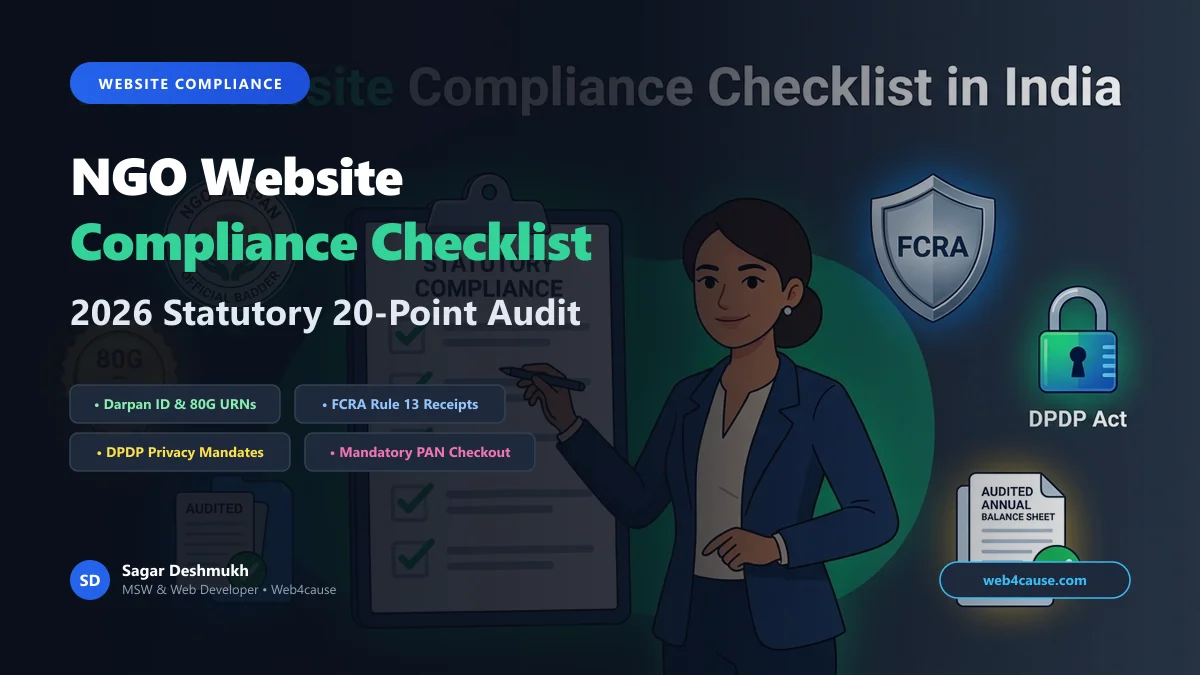
1. The Digital Legal Paradigm: Why an NGO Website is a Statutory Public Record in 2026
The regulatory architecture governing the voluntary sector in India has undergone a profound structural transformation over the past five years. Historically, non-governmental organizations, registered societies, and public charitable trusts operated in decentralized environments. Institutional compliance was primarily demonstrated through physical files submitted to the local Charity Commissioner, the state Registrar of Societies, or the jurisdictional Income Tax assessing officer.
In 2026, this fragmented paper-driven environment has been replaced by an interconnected digital surveillance apparatus. Under current Indian law, an organization web domain is not merely a promotional portal or a digital outreach instrument. The moment a non-profit publishes fundraising appeals, displays tax exemption credentials, accepts financial contributions through payment gateways, or documents social programs, the website becomes an evidentiary legal instrument. It is treated as a public representation subject to legal scrutiny under Section 63 of the Bharatiya Sakshya Adhiniyam 2023 (formerly Section 65B of the Indian Evidence Act 1872), the Information Technology Act 2000, and the Consumer Protection Act 2019.
Legal Definition of Public Web Representations
When an NGO invites public donations by claiming tax relief under Section 80G, states that contributions are utilized for specific charitable causes, or publishes organizational audit highlights, these statements constitute actionable contractual representations. Any material discrepancy between what is published on the website and what is filed in statutory returns (such as Form 10BD, Form 10B audit reports, or MHA FCRA Form FC-4) empowers regulators to initiate misrepresentation inquiries, suspend tax privileges, and freeze merchant payment collections.
Furthermore, the operational reliance on financial technology has created private regulatory enforcement. Merchant payment aggregators such as Razorpay, Cashfree, PayU, and CCAvenue are governed strictly by the Reserve Bank of India (RBI) Master Directions on Payment Aggregators and Payment Gateways. These financial institutions operate automated web crawling systems that periodically audit merchant websites. If an NGO website lacks a registered office address, verifiable contact numbers, clear refund policies, data privacy disclosures, or valid registration certificates, the payment gateway risk algorithm automatically freezes settlement payouts. Donations collected online remain trapped in intermediary escrow accounts, starving critical social development programs of necessary cash flow.
Simultaneously, institutional Corporate Social Responsibility (CSR) donors and foreign grantmakers conduct comprehensive digital due diligence before issuing grant sanction letters. CSR committees, bound by Section 135 of the Companies Act 2013 and the Companies (CSR Policy) Rules 2014, review the non-profit website to verify its MCA Form CSR-1 registration, inspect three consecutive years of audited balance sheets, and review governing board compositions. A non-compliant, outdated, or legally ambiguous website immediately disqualifies the organization from high-value CSR partnerships.
Consequently, institutional web development for Indian non-profits requires a synthesis of software engineering, cyber security, and statutory compliance. Navigating this landscape demands adherence to technical design principles that build public credibility while satisfying statutory mandates, as detailed in our guide on strategic NGO website design in India.
2. Regulatory Matrix: The Seven Government Portals Monitoring Non-Profit Websites
An Indian non-profit does not operate under a single supervisor. Depending on its institutional form, geographic scope, and funding sources, an NGO interfaces with multiple federal ministries and statutory bodies. Each authority maintains online portals that cross-verify data points against the claims published on the non-profit official website.
| Regulatory Authority | Official Portal | Primary Monitored Website Disclosures | Statutory Risk of Discrepancy |
|---|---|---|---|
| Income Tax Department (Exemptions) | incometax.gov.in | 16-character 12A and 80G URNs, Form 10BD donor PAN collection notices, audited Form 10B/10BB reports | Disallowance of 80G deductions, Section 115BBC anonymous donation tax (60%), cancellation of 12AB status |
| NITI Aayog (NGO Darpan) | ngodarpan.gov.in | Darpan Unique Identification Number, trustee roster synchronization, PAN linkages | Immediate blacklisting from Central Government grants, FCRA renewal rejections, PSU CSR disqualification |
| Ministry of Corporate Affairs (MCA) | mca.gov.in | Form CSR-1 registration number, Corporate Identification Number (CIN), Director Identification Numbers (DIN) | Ineligibility to receive corporate CSR funds under Section 135, ROC penal notices for non-disclosure |
| Ministry of Home Affairs (FCRA Unit) | fcraonline.nic.in | FCRA Rule 13 quarterly foreign contribution receipts log, designated SBI NDMB account disclosure | Suspension of FCRA registration under Section 14, criminal prosecution for unauthorized foreign funds |
| Data Protection Board of India / MeitY | meity.gov.in | DPDP Act 2023 privacy notice, affirmative consent mechanisms, Grievance Redressal Officer contact details | Financial penalties up to 250 crore rupees for security breaches, up to 200 crore rupees for child privacy breaches |
| National Payments Corporation of India (NPCI) | npci.org.in | Verified Merchant Dynamic UPI QR code matching institutional legal name, UPI AutoPay recurring consent | Freezing of merchant virtual payment addresses (VPAs), blocking of incoming UPI donor payments |
| State Charity Commissioners / ROC | State Specific Portals | Registered legal trust or society deed number, registered office address, governing body roster | Suspension of trustees, rejection of change reports, inquiry into unauthorized public solicitations |
Because these regulatory oversight portals operate automated risk scoring engines, maintaining an updated, fully compliant website is an existential requirement. Below is the comprehensive 20-point checklist that every non-profit trustee, director, and webmaster must implement to maintain flawless statutory hygiene.
3. The Master 20-Point Statutory Website Disclosure Checklist (Detailed Analysis)
This master checklist serves as an operational compliance framework for founders, trustees, chief executive officers, finance managers, and web developers managing Indian non-profit digital platforms. Each requirement outlines the exact statutory citation, display location, technical implementation, and consequences of omission.
Point 1: NITI Aayog NGO Darpan Unique Identifier & Public Profile Verification
Mandatory for All NGOs
Statutory Authority: NITI Aayog guidelines and Government of India grant disbursement directives.
Required Placement: Website primary footer, About Us legal profile page, and institutional CSR partnership documentation.
Exact Format: Alphanumeric Unique ID formatted as XX/YYYY/0123456 (e.g., MH/2021/0284719) accompanied by an active, clickable hyperlink directing visitors to the organization public profile on https://ngodarpan.gov.in/.
Common Trap: Registering on NGO Darpan years ago but failing to update the portal when board members change, or displaying the ID as plain text without linking to the official live verification record.
Point 2: Income Tax Section 12A / 12AB Permanent Unique Registration Number (URN)
Tax Exemption Prerequisite
Statutory Authority: Section 12A(1)(ac) and Section 12AB of the Income Tax Act 1961, read with Rule 17A of the Income Tax Rules 1962.
Required Placement: Website primary footer, Legal Transparency page, and Donor Frequently Asked Questions.
Exact Format: 16-character alphanumeric Unique Registration Number (URN), Date of the Registration Order, Approving CIT (Exemptions) Authority, and Statutory Validity Period (such as Assessment Year 2022-2023 to Assessment Year 2026-2027).
Common Trap: Displaying an old manual registration number issued in the 1990s or 2000s without stating the contemporary 16-character URN issued on the Income Tax Department e-filing portal.
Point 3: Section 80G Approval URN, Validity Timeline, and Deduction Terms
Critical for Online Fundraising
Statutory Authority: Section 80G(5) of the Income Tax Act 1961, read with Rule 11AA of the Income Tax Rules 1962.
Required Placement: Donation checkout modal, dynamic donation landing pages, header banner, and tax receipt confirmation emails.
Exact Format: 16-character alphanumeric 80G URN, Order Date, Nature of Registration (Regular 5-Year or Provisional 3-Year), and an explicit statutory disclosure explaining that donations grant a 50 percent tax deduction under Section 80G to eligible Indian tax residents.
Common Trap: Promising Section 80G benefits to non-resident Indian or foreign donors who pay through foreign currency cards without clarifying that Indian 80G certificates only provide tax relief against income taxed in India.
Point 4: MCA Form CSR-1 Registration Number & Corporate Affairs Validation
Mandatory for CSR Partnerships
Statutory Authority: Rule 4(2) of the Companies (Corporate Social Responsibility Policy) Rules 2014 as amended by the Ministry of Corporate Affairs.
Required Placement: Institutional CSR Partnership page, Corporate Governance section, and Website Footer.
Exact Format: 11-digit alphanumeric CSR Registration Number formatted as CSR000XXXXX, Date of Approval by the Registrar of Companies, and direct link to the MCA21 portal verification tool on https://www.mca.gov.in/.
Common Trap: Claiming CSR eligibility on the website without actually having submitted Form CSR-1 digitally signed by a practicing Chartered Accountant, Company Secretary, or Cost Accountant on the MCA21 V3 portal.
Point 5: Mandatory Three Consecutive Years of Audited Financial Statements
Institutional Trust Pillar
Statutory Authority: CSR Due Diligence norms, General Financial Rules (GFR) 2017 for government grants, and non-profit governance standards.
Required Placement: Dedicated Financial Transparency or Reports page, easily accessible from the main navigation menu.
Exact Format: High-resolution, downloadable PDF documents comprising the independent Auditor Report, Audited Balance Sheet, Income and Expenditure Account, Receipts and Payments Statement, and Notes on Accounts for the last three consecutive financial years.
Common Trap: Uploading incomplete one-page summary balance sheets that lack the independent Chartered Accountant signature, Firm Registration Number, and statutory accounting schedule notes.
Point 6: Statutory Audit Certifications (Form 10B vs Form 10BB Audit Disclosures)
Income Tax Audit Mandate
Statutory Authority: Section 12A(1)(b) of the Income Tax Act 1961, read with Rule 17B and notification updates governing Form 10B and Form 10BB.
Required Placement: Financial Transparency section and statutory audit repository.
Exact Format: Public statement identifying which audit report format the organization files (Form 10B or Form 10BB), filing acknowledgment number, date of electronic submission, and Chartered Accountant UDIN (Unique Document Identification Number).
Common Trap: Failing to obtain the mandatory 18-digit UDIN from the statutory auditor or assuming that smaller branch audits waive the unified electronic Form 10B/10BB filing mandate.
Point 7: FCRA Rule 13 Foreign Contribution Quarterly Public Receipts Register
Strict Statutory Mandate
Statutory Authority: Rule 13(a) and Rule 13(b) of the Foreign Contribution (Regulation) Rules 2011 (FCRR 2011) as notified by the Ministry of Home Affairs (MHA).
Required Placement: Dedicated public web page named “FCRA Quarterly Disclosures” directly reachable via header navigation or footer.
Exact Format: Filterable table updated within 15 days following the conclusion of each financial quarter, listing: (1) Name of Foreign Donor, (2) Institutional Address and Country, (3) Amount in Indian Rupees, (4) Equivalent Foreign Currency, (5) Date of Receipt, and (6) Specific Project/Purpose (Economic, Educational, Religious, Social, or Cultural).
Common Trap: Leaving the FCRA quarterly page blank during quarters with no receipts instead of publishing an explicit NIL declaration statement signed by the authorized secretary or chief functionary.
Point 8: DPDP Act 2023 Compliant Institutional Privacy Policy
Data Fiduciary Compliance
Statutory Authority: Section 4, Section 5, and Section 8 of the Digital Personal Data Protection Act 2023 (Act No. 22 of 2023).
Required Placement: Universal footer link present on every single web page, checkout screen, newsletter subscription modal, and volunteer onboarding form.
Exact Format: Plain-language, unambiguous document describing categories of digital personal data collected (names, phone numbers, email addresses, permanent account numbers, billing addresses, device fingerprints), precise purposes for processing (statutory 80G tax reporting, newsletter dispatches, program invitations), data storage and encryption protocols, third-party data processor disclosures (payment gateways, CRM providers), retention windows, and explicit instructions for exercising data principal rights.
Common Trap: Stating in the privacy policy that donor data will never be shared with any third party, which directly contradicts the non-profit statutory obligation to transmit donor PAN and donation amounts to the Income Tax Department.
Point 9: Multilingual Data Fiduciary Consent Architecture & Granular Checkboxes
Affirmative Consent Mandate
Statutory Authority: Section 5(1) and Section 6(1) of the Digital Personal Data Protection Act 2023.
Required Placement: Every web form capturing personal details (donation checkout, volunteer application, field case study submission, contact inquiries).
Exact Format: Unbundled, unchecked affirmative opt-in checkboxes accompanied by an itemized notice explaining the specific purpose of data collection. Consent notices must be available in English and accessible in any of the 22 languages specified in the Eighth Schedule of the Constitution of India upon user request.
Common Trap: Deploying pre-checked consent boxes on donation forms that automatically subscribe donors to promotional SMS and promotional WhatsApp marketing broadcasts without separate consent.
Point 10: Grievance Redressal Officer (GRO) Statutory Contact Details & SLA
Statutory Enforcement Officer
Statutory Authority: Section 13 of the Digital Personal Data Protection Act 2023 and Information Technology (Intermediary Guidelines) Rules.
Required Placement: Prominently displayed within the official Privacy Policy and in the website footer contact section.
Exact Format: Full legal name of the appointed Grievance Redressal Officer, official job title, dedicated institutional email address (e.g., [email protected]), direct telephone contact number, physical office address, and published Service Level Agreement (SLA) committing to acknowledge complaints within 48 hours and achieve final resolution within 30 calendar days.
Common Trap: Listing a generic, unmanned email inbox such as [email protected] without naming the designated individual officer responsible for grievance management.
Point 11: Verifiable Parental Consent & Child Data Protection Safeguards
Zero Tolerance Area
Statutory Authority: Section 9 of the Digital Personal Data Protection Act 2023.
Required Placement: Child welfare campaign pages, orphan care sponsorship sections, field story archives, and child volunteer enrollment forms.
Exact Format: Public declaration confirming that no digital personal data, identification papers, medical case records, or identifiable photographs of any child under eighteen years of age are published without documented, verifiable consent from a parent or lawful guardian.
Common Trap: Publishing photographs and names of children in sponsorship appeals to solicit online donations without having physical or digital signed consent from their legal guardians on file.
Point 12: Mandatory Donor PAN Collection Protocols for Section 80G(5D) & Form 10BD
Tax Deductibility Engine
Statutory Authority: Section 80G(5)(viii) and Section 80G(5D) of the Income Tax Act 1961, read with Rule 18AB and Form 10BD electronic filing specifications.
Required Placement: Donation checkout forms, donation amount selection pages, and payment confirmation screens.
Exact Format: Mandatory input field for the ten-character alphanumeric Permanent Account Number (PAN) with real-time format validation (regular expression: ^[A-Z]{5}[0-9]{4}[A-Z]{1}$) and explicit statutory notice: “In accordance with Income Tax Department regulations, submission of a valid PAN is mandatory to issue Certificate of Donation Form 10BE and claim 80G tax deductions. Donations submitted without PAN cannot be uploaded to Form 10BD and will not appear in your Annual Information Statement (AIS).”
Common Trap: Making the PAN field optional on the donation form, resulting in hundreds of unidentifiable contributions that generate angry donor support calls during tax filing season.
Point 13: Terms of Service, Legal Jurisdiction, and Merchant Transaction Disclaimers
Contractual Safeguard
Statutory Authority: Indian Contract Act 1872, Information Technology Act 2000, and Consumer Protection (E-Commerce) Rules 2020.
Required Placement: Universal website footer link and clickable checkout acceptance checkbox.
Exact Format: Formal legal agreement establishing terms of website usage, intellectual property ownership of research content, limitation of liability, donor warranties regarding legitimate sources of donated funds, force majeure provisions, and designated exclusive court jurisdiction (e.g., “Any disputes arising from transactions on this platform shall be subject to the exclusive jurisdiction of the competent courts in Pune, Maharashtra”).
Common Trap: Copying terms from commercial software companies containing clauses regarding software warranties and product returns that make zero sense for a charitable non-profit organization.
Point 14: Comprehensive Donation Refund, Cancellation, and Chargeback Policy
Mandatory for Payment Gateways
Statutory Authority: Reserve Bank of India Master Directions on Payment Aggregators and Consumer Protection (E-Commerce) Rules 2020.
Required Placement: Universal footer, donation checkout modal, and automated receipt emails.
Exact Format: Clear, unambiguous refund terms specifying: (1) Circumstances under which donation refunds are processed (e.g., unintended duplicate debit, technical payment gateway error, unauthorized account usage), (2) Timeframe for reporting refund requests (typically 7 to 14 calendar days from transaction date), (3) Required verification documents (bank debit proof, transaction reference number), (4) Processing window (typically 5 to 7 business days credited back to the original source account), and (5) Crucial statutory clause: “If a Section 80G tax receipt has already been generated prior to the refund request, that receipt is rendered legally null and void, and the refund will be reported accordingly to tax authorities.”
Common Trap: Writing “Donations once made cannot be refunded under any circumstances” which violates payment aggregator guidelines and prevents resolving honest technical double-billing glitches.
Point 15: Statutory Registered Office Address, CIN / Trust Number & Contact Channels
Corporate Legal Identity
Statutory Authority: Section 12 of the Companies Act 2013 (for Section 8 Companies) and State Public Trust / Society Registration Acts.
Required Placement: Universal website footer and official Contact Us page.
Exact Format: Full legal entity name matching the official registration certificate and bank account, complete registered physical office address with postal pincode, state jurisdiction, operational field office addresses (if distinct), verified institutional telephone numbers, official domain-based email address (e.g., [email protected]), and constitutional registration number (Trust Registration Number, Society Registration Number, or Corporate Identification Number CIN).
Common Trap: Relying on a free generic Gmail or Yahoo email address in the website footer instead of an authenticated institutional email domain, which triggers immediate skepticism from institutional donors.
Point 16: Complete Governing Board Roster (Trustees, Directors, DIN & Designations)
Governance Transparency
Statutory Authority: NITI Aayog NGO Darpan guidelines, MCA Director Disclosures, and Income Tax governance standards.
Required Placement: Leadership, Governance, or About Us section.
Exact Format: Complete list of all active Trustees, Governing Council members, or Directors, detailing: (1) Full Legal Name, (2) Board Designation (e.g., President, Managing Trustee, General Secretary, Treasurer, Independent Director), (3) Director Identification Number (DIN for Section 8 companies), (4) Professional background and social work credentials, and (5) Statutory compensation statement confirming whether trustees serve in an honorary voluntary capacity or receive sitting fees.
Common Trap: Leaving deceased or retired trustees on the website leadership page, or neglecting to update the roster after submitting change reports to the Charity Commissioner or ROC.
Point 17: Programmatic Annual Activity Reports & Social Impact Metrics
Impact Accountability
Statutory Authority: Companies Act 2013 Schedule VII CSR alignment and Income Tax Section 11 application of income proof.
Required Placement: Annual Reports page and program impact sections.
Exact Format: Downloadable annual impact reports detailing: (1) Quantitative and qualitative programmatic outcomes, (2) Direct and indirect beneficiary counts broken down by demographic indicators, (3) Geographic intervention districts and village clusters, (4) Alignment with UN Sustainable Development Goals (SDGs), and (5) Ratio of programmatic program expenditure versus administrative overheads.
Common Trap: Publishing purely qualitative promotional stories without publishing verified quantitative metrics or empirical field data that prove genuine community transformation.
Point 18: Payment Gateway Security Seals, SSL/TLS Encryption & PCI-DSS Disclosures
Cyber Security & Trust
Statutory Authority: Information Technology (Reasonable Security Practices and Procedures) Rules 2011 and RBI Card Storage / Tokenization Directives.
Required Placement: Donation checkout footer, payment confirmation modals, and security trust badges.
Exact Format: Visual security badges confirming 256-bit SSL/TLS end-to-end encryption, Payment Card Industry Data Security Standard (PCI-DSS) Level 1 certified processing via approved aggregators, and explicit confirmation that the NGO does not store credit card numbers, CVV codes, or net banking passwords on its web servers.
Common Trap: Embedding static, unverified security badge images downloaded from internet image searches without having an active SSL/TLS certificate configured on the web server.
Point 19: NPCI Compliant Dynamic UPI QR Identity & Bank Account Name Synchronization
Banking Integrity
Statutory Authority: National Payments Corporation of India (NPCI) circulars on merchant acquiring and RBI Master Directions on digital payment transactions.
Required Placement: Direct donation pages, scan-and-pay campaign sections, and fundraising flyers.
Exact Format: Dynamic or verified merchant UPI QR code where the Virtual Payment Address (VPA) and payee display name perfectly match the legal entity name as registered in the bank account and Income Tax PAN database.
Common Trap: Publishing a static screenshot of a personal Google Pay or PhonePe QR code that displays an individual name when scanned by donors.
Point 20: Governance Policies (POSH Internal Committee, Whistleblower, Conflict of Interest)
Institutional Integrity
Statutory Authority: Section 4 of the Sexual Harassment of Women at Workplace (Prevention, Prohibition and Redressal) Act 2013 (POSH Act), Income Tax Section 13(1)(c), and Rights of Persons with Disabilities Act 2016.
Required Placement: Institutional Governance repository, Careers portal, and About Us menu.
Exact Format: Publicly accessible, downloadable PDF policy documents covering: (1) Constitution of the Internal Complaints Committee (ICC) with presiding officer contact details under the POSH Act, (2) Whistleblower Protection Policy ensuring anonymous reporting channels, (3) Conflict of Interest & Related Party Transaction Policy preventing private inurement under Section 13(1)(c), and (4) Equal Opportunity & Non-Discrimination Policy under the Rights of Persons with Disabilities Act 2016.
Common Trap: Treating the POSH Act as applicable only to corporate software firms, ignoring that charitable non-profits face identical statutory liabilities and potential license cancellations for non-compliance.
4. Comparative Compliance Matrix by Entity Type (Trust vs Society vs Section 8 Company)
While the overarching regulatory framework applies broadly across the voluntary sector, the exact disclosure obligations differ depending on the statutory form under which the non-profit was incorporated. A Section 8 Company operates under the rigorous corporate disclosure rules of the Companies Act 2013, whereas a Public Charitable Trust is governed by state-specific public trust legislation.
| Disclosure Requirement | Public Charitable Trust | Registered Society | Section 8 Company |
|---|---|---|---|
| Primary Statutory Identifier | Trust Registration Number & Sub-Registrar / Charity Commissioner Seal | Society Registration Number under Societies Registration Act 1860 | 21-Digit Corporate Identification Number (CIN) mandated under Section 12(3)(c) |
| Governing Body Identification | Board of Trustees roster with designations and professional bios | Governing Body / Managing Council roster with designations | Board of Directors roster with verified Director Identification Numbers (DIN) |
| Income Tax Section 12AB & 80G URNs | Mandatory (16-Character URNs) | Mandatory (16-Character URNs) | Mandatory (16-Character URNs) |
| NITI Aayog NGO Darpan Display | Mandatory with Live Link | Mandatory with Live Link | Mandatory with Live Link |
| MCA Form CSR-1 Registration | Mandatory for CSR Partnerships | Mandatory for CSR Partnerships | Mandatory for CSR Partnerships |
| Statutory Corporate Filings (AOC-4 & MGT-7) | Not Applicable (State Trust Returns apply) | Not Applicable (State Society Returns apply) | Recommended disclosure of Form AOC-4 and MGT-7 filing receipts |
| FCRA Rule 13 Quarterly Web Logs | Mandatory if holding FCRA registration | Mandatory if holding FCRA registration | Mandatory if holding FCRA registration |
| DPDP Act 2023 & Grievance Officer | Universal Mandatory Mandate | Universal Mandatory Mandate | Universal Mandatory Mandate |
Founders and executive leaders evaluating organizational restructuring or incorporating new vehicles can gain deeper operational insights from our comparative structural analysis on Trust versus Society versus Section 8 Company in India, as well as our statutory roadmap on Section 8 company annual corporate compliance.
5. Technical Implementation Guide: Ready-to-Deploy Code Snippets for NGO Webmasters
Translating statutory mandates into robust, production-grade website components requires clean code. Below are four ready-to-deploy technical templates designed specifically for web development agencies and non-profit IT teams.
A. Responsive, Accessible Footer Compliance Architecture (HTML and CSS)
This production component organizes all twenty mandatory disclosures into a structured four-column grid. It incorporates responsive CSS breakpoints and accessible high-contrast design.
<footer class="ngo-statutory-footer" style="background: #0F172A; color: #E2E8F0; padding: 48px 24px; font-size: 14px; line-height: 1.7;">
  <div style="max-width: 1200px; margin: 0 auto; display: grid; grid-template-columns: repeat(auto-fit, minmax(250px, 1fr)); gap: 32px;">


    <div>
      <h4 style="color: #60A5FA; font-size: 16px; margin-bottom: 14px; text-transform: uppercase; letter-spacing: 0.5px;">Legal Identity</h4>
      <p style="margin: 0 0 8px 0; font-weight: 700; color: #FFFFFF;">Gramin Vikas Social Foundation</p>
      <p style="margin: 0 0 6px 0;">CIN: U85300MH2021NPL356789</p>
      <p style="margin: 0 0 6px 0;">Registered Office: Plot 42, Social Impact Tower, Shivaji Nagar, Pune, Maharashtra 411005</p>
      <p style="margin: 0 0 6px 0;">Phone: +91 8080309570</p>
      <p style="margin: 0 0 6px 0;">Email: [email protected]</p>
    </div>


    <div>
      <h4 style="color: #60A5FA; font-size: 16px; margin-bottom: 14px; text-transform: uppercase; letter-spacing: 0.5px;">Tax & Regulatory</h4>
      <p style="margin: 0 0 6px 0;">12A URN: AABTG1234FE20214</p>
      <p style="margin: 0 0 6px 0;">80G URN: AABTG1234FF20219</p>
      <p style="margin: 0 0 6px 0;">MCA CSR-1 Reg: CSR00018492</p>
      <p style="margin: 0 0 6px 0;">NITI Aayog Darpan: <a href="https://ngodarpan.gov.in/" target="_blank" rel="noopener noreferrer" style="color: #93C5FD; text-decoration: underline;">MH/2021/0284719</a></p>
      <p style="margin: 0 0 6px 0;">FCRA Reg No: 083781234 (Delhi SBI Main)</p>
    </div>


    <div>
      <h4 style="color: #60A5FA; font-size: 16px; margin-bottom: 14px; text-transform: uppercase; letter-spacing: 0.5px;">Governance & DPDP</h4>
      <ul style="list-style: none; padding: 0; margin: 0;">
        <li style="margin-bottom: 6px;"><a href="/privacy-policy/" style="color: #E2E8F0; text-decoration: none;">Privacy Policy (DPDP 2023)</a></li>
        <li style="margin-bottom: 6px;"><a href="/terms-of-service/" style="color: #E2E8F0; text-decoration: none;">Terms of Service</a></li>
        <li style="margin-bottom: 6px;"><a href="/refund-policy/" style="color: #E2E8F0; text-decoration: none;">Refund & Cancellation Policy</a></li>
        <li style="margin-bottom: 6px;"><a href="/posh-policy/" style="color: #E2E8F0; text-decoration: none;">POSH Internal Committee (ICC)</a></li>
        <li style="margin-bottom: 6px;"><a href="/whistleblower-policy/" style="color: #E2E8F0; text-decoration: none;">Whistleblower Policy</a></li>
      </ul>
    </div>


    <div>
      <h4 style="color: #60A5FA; font-size: 16px; margin-bottom: 14px; text-transform: uppercase; letter-spacing: 0.5px;">Audits & Redressal</h4>
      <p style="margin: 0 0 6px 0;"><a href="/financial-reports/" style="color: #93C5FD; text-decoration: underline;">3-Year Audited Balance Sheets</a></p>
      <p style="margin: 0 0 6px 0;"><a href="/fcra-quarterly/" style="color: #93C5FD; text-decoration: underline;">FCRA Rule 13 Quarterly Receipts</a></p>
      <p style="margin: 0 0 6px 0; font-size: 13px; color: #CBD5E1;">
        <strong>Grievance Officer:</strong> Rajesh Sharma<br>
        Email: [email protected]<br>
        Response SLA: 48 Hours | Resolution: 30 Days
      </p>
    </div>

  </div>
  <div style="max-width: 1200px; margin: 32px auto 0 auto; padding-top: 20px; border-top: 1px solid #334155; text-align: center; font-size: 13px; color: #94A3B8;">
    © 2026 Gramin Vikas Social Foundation. Donations are 50% tax exempt under Section 80G of the Income Tax Act 1961. PCI-DSS Level 1 Encrypted.
  </div>
</footer>
B. Compliant Donation Checkout Snippet with Real-Time PAN Validation & DPDP Consent
Capturing Indian PAN numbers requires strict real-time validation to eliminate typographical mistakes before data transmission. This form features dynamic format checking and unbundled consent checkboxes compliant with DPDP Act 2023.
<form id="ngoDonationForm" style="max-width: 520px; background: #FFFFFF; border: 1px solid #CBD5E1; border-radius: 12px; padding: 24px; box-shadow: 0 10px 25px rgba(0,0,0,0.06);">

  <h3 style="margin-top: 0; color: #0F172A; font-size: 20px;">Support Our Grassroots Mission</h3>
  <p style="font-size: 13.5px; color: #64748B; margin-bottom: 18px;">Eligible for 50% Tax Relief under Section 80G. Form 10BE certificate issued automatically.</p>


  <div style="margin-bottom: 16px;">
    <label style="display: block; font-size: 14px; font-weight: 600; color: #334155; margin-bottom: 6px;">Contribution Amount (INR)</label>
    <input type="number" id="donationAmount" min="100" required placeholder="e.g. 5000" style="width: 100%; padding: 10px 12px; border: 1px solid #CBD5E1; border-radius: 6px; font-size: 16px;">
  </div>


  <div style="margin-bottom: 16px;">
    <label style="display: block; font-size: 14px; font-weight: 600; color: #334155; margin-bottom: 6px;">Donor Full Legal Name (As on PAN)</label>
    <input type="text" id="donorName" required placeholder="Full Name as printed on PAN card" style="width: 100%; padding: 10px 12px; border: 1px solid #CBD5E1; border-radius: 6px; font-size: 15px;">
  </div>


  <div style="margin-bottom: 16px;">
    <label style="display: block; font-size: 14px; font-weight: 600; color: #334155; margin-bottom: 6px;">Permanent Account Number (PAN)</label>
    <input type="text" id="donorPan" maxlength="10" required placeholder="ABCDE1234F" style="width: 100%; padding: 10px 12px; border: 1px solid #CBD5E1; border-radius: 6px; font-size: 16px; text-transform: uppercase;">
    <div id="panErrorNotice" style="color: #DC2626; font-size: 12.5px; margin-top: 4px; display: none;">Please enter a valid 10-character Indian PAN (5 letters, 4 numbers, 1 letter).</div>
    <p style="font-size: 12px; color: #64748B; margin-top: 4px; margin-bottom: 0;">
      Statutory Notice: Under Section 80G(5D) and Rule 18AB, valid PAN is mandatory to upload your donation to Income Tax Form 10BD and generate your Form 10BE certificate.
    </p>
  </div>


  <div style="display: flex; gap: 12px; margin-bottom: 16px;">
    <div style="flex: 1;">
      <label style="display: block; font-size: 14px; font-weight: 600; color: #334155; margin-bottom: 6px;">Mobile Number</label>
      <input type="tel" id="donorPhone" required pattern="[6-9][0-9]{9}" placeholder="9876543210" style="width: 100%; padding: 10px 12px; border: 1px solid #CBD5E1; border-radius: 6px; font-size: 15px;">
    </div>
    <div style="flex: 1;">
      <label style="display: block; font-size: 14px; font-weight: 600; color: #334155; margin-bottom: 6px;">Email Address</label>
      <input type="email" id="donorEmail" required placeholder="[email protected]" style="width: 100%; padding: 10px 12px; border: 1px solid #CBD5E1; border-radius: 6px; font-size: 15px;">
    </div>
  </div>


  <div style="margin-bottom: 20px; font-size: 13px; color: #475569;">
    <label style="display: flex; align-items: flex-start; gap: 8px; cursor: pointer;">
      <input type="checkbox" id="dpdpConsent" required style="margin-top: 3px;">
      <span>I consent to the collection and processing of my personal details and PAN strictly for issuing my 80G tax receipt and statutory Form 10BD reporting as outlined in the <a href="/privacy-policy/" target="_blank" style="color: #2563EB; text-decoration: underline;">Privacy Policy</a>.</span>
    </label>
  </div>

  <button type="submit" style="width: 100%; background: #2563EB; color: #FFFFFF; font-weight: 700; padding: 12px; border: none; border-radius: 6px; font-size: 16px; cursor: pointer; transition: background 0.2s;">
    Proceed to Secure Payment
  </button>
</form>

<script>
  const panInput = document.getElementById('donorPan');
  const panError = document.getElementById('panErrorNotice');
  const panRegex = /^[A-Z]{5}[0-9]{4}[A-Z]{1}$/;

  panInput.addEventListener('input', function() {
    this.value = this.value.toUpperCase();
    if (this.value.length === 10) {
      if (!panRegex.test(this.value)) {
        panError.style.display = 'block';
      } else {
        panError.style.display = 'none';
      }
    } else {
      panError.style.display = 'none';
    }
  });

  document.getElementById('ngoDonationForm').addEventListener('submit', function(e) {
    if (!panRegex.test(panInput.value)) {
      e.preventDefault();
      panError.style.display = 'block';
      panInput.focus();
    }
  });
</script>
C. FCRA Rule 13 Quarterly Foreign Contribution Disclosure Table Template
Under Rule 13 of the Foreign Contribution (Regulation) Rules 2011, foreign contribution receipts must be published within 15 days of quarter end. This template provides a compliant, filterable HTML structure.
<div class="fcra-disclosure-container" style="margin: 20px 0; overflow-x: auto;">
  <h4 style="color: #0F172A; font-size: 18px; margin-bottom: 8px;">Quarterly Foreign Contributions Received: Financial Year 2026-2027 (Quarter 1: April to June 2026)</h4>
  <p style="font-size: 13.5px; color: #64748B; margin-bottom: 14px;">Published in strict compliance with Rule 13 of the Foreign Contribution (Regulation) Rules 2011.</p>

  <table style="width: 100%; border-collapse: collapse; font-size: 14px; text-align: left; background: #FFFFFF; border: 1px solid #CBD5E1;">
    <thead>
      <tr style="background: #F1F5F9; color: #0F172A; border-bottom: 2px solid #CBD5E1;">
        <th style="padding: 10px 12px;">Sr.</th>
        <th style="padding: 10px 12px;">Name of Foreign Donor</th>
        <th style="padding: 10px 12px;">Institutional Address & Country</th>
        <th style="padding: 10px 12px;">Amount (INR)</th>
        <th style="padding: 10px 12px;">Date of Credit</th>
        <th style="padding: 10px 12px;">Statutory Purpose</th>
      </tr>
    </thead>
    <tbody>
      <tr style="border-bottom: 1px solid #E2E8F0;">
        <td style="padding: 10px 12px;">1</td>
        <td style="padding: 10px 12px; font-weight: 600;">Global Health Foundation Inc.</td>
        <td style="padding: 10px 12px;">450 Lexington Ave, New York, NY 10017, USA</td>
        <td style="padding: 10px 12px; font-weight: 700; color: #047857;">₹ 24,50,000</td>
        <td style="padding: 10px 12px;">14-May-2026</td>
        <td style="padding: 10px 12px;">Social (Maternal Health Clinics)</td>
      </tr>
      <tr style="border-bottom: 1px solid #E2E8F0; background: #F8FAFC;">
        <td style="padding: 10px 12px;">2</td>
        <td style="padding: 10px 12px; font-weight: 600;">Clean Water International Trust</td>
        <td style="padding: 10px 12px;">12 Victoria Street, London, SW1H 0EX, UK</td>
        <td style="padding: 10px 12px; font-weight: 700; color: #047857;">₹ 18,25,000</td>
        <td style="padding: 10px 12px;">08-June-2026</td>
        <td style="padding: 10px 12px;">Educational & Water Sanitation</td>
      </tr>
    </tbody>
  </table>
</div>
D. Structured Data Schema Template for Non-Profit Legal Identity (JSON-LD)
Deploying linked data schemas allows search engines and algorithmic due diligence bots to immediately verify the non-profit legal entity, tax numbers, and official regulatory profiles.
<script type="application/ld+json">
{
  "@context": "https://schema.org",
  "@type": "NGO",
  "@id": "https://graminvikas.org/#organization",
  "name": "Gramin Vikas Social Foundation",
  "legalName": "Gramin Vikas Social Foundation",
  "url": "https://graminvikas.org",
  "logo": "https://graminvikas.org/assets/logo.webp",
  "taxID": "AABTG1234F",
  "vatID": "CSR00018492",
  "address": {
    "@type": "PostalAddress",
    "streetAddress": "Plot 42, Social Impact Tower, Shivaji Nagar",
    "addressLocality": "Pune",
    "addressRegion": "Maharashtra",
    "postalCode": "411005",
    "addressCountry": "IN"
  },
  "contactPoint": [
    {
      "@type": "ContactPoint",
      "telephone": "+91-8080309570",
      "contactType": "Grievance Redressal Officer",
      "email": "[email protected]",
      "availableLanguage": ["English", "Hindi", "Marathi"]
    }
  ],
  "sameAs": [
    "https://ngodarpan.gov.in/",
    "https://in.linkedin.com/company/gramin-vikas",
    "https://facebook.com/graminvikas"
  ]
}
</script>
6. Statutory Violations and Regulatory Penalty Landscape in 2026
Treating an NGO website as an informal marketing sandbox rather than a statutory disclosure document creates immense legal and financial liabilities. Indian regulatory agencies now operate integrated data-matching systems that cross-examine digital claims against statutory filings. Below is the statutory penalty framework governing non-profit digital omissions in Assessment Year 2026 to 2027.
DPDP Act Financial Penalties
Under the Schedule to Section 33 of the Digital Personal Data Protection Act 2023, failure to adopt reasonable security safeguards to prevent personal data breaches attracts penalties up to 250 crore rupees. Breaching Section 9 child privacy mandates carries fines up to 200 crore rupees, while general data fiduciary violations can reach 50 crore rupees.
Section 115TD Accreted Exit Tax
If an NGO fails to maintain timely Form 10AB renewals or if its 12AB registration is cancelled due to non-compliant public representations, Section 115TD levies exit tax at the Maximum Marginal Rate of 34.944 percent on the fair market value of all net organizational assets.
Section 115BBC Anonymous Donation Tax
Online donations collected without capturing donor PAN and residential addresses are categorized as anonymous donations under Section 115BBC. Amounts exceeding five percent of total donations or one lakh rupees are taxed at a punitive flat rate of 60 percent plus surcharge and cess, eliminating charitable exemptions.
Form 10BD & 10BE Late Filing Fees
Under Section 234G of the Income Tax Act, failing to submit the electronic Form 10BD donation statement by May 31 incurs a mandatory fee of 200 rupees per day of delay. Furthermore, Section 271K empowers assessing officers to levy discretionary financial penalties ranging from 10,000 rupees to 1,00,000 rupees.
In addition to statutory fines, operational penalties can paralyze an organization immediately. When payment gateway risk algorithms detect missing legal policies or unverified bank accounts, merchant accounts are frozen instantly. Pending donation settlements are withheld in rolling reserves for up to 180 days, disrupting payroll for field social workers and forcing the postponement of community interventions.
7. Trustee and Webmaster Pre-Audit Protocol: 10-Minute Rapid Diagnostic
To safeguard your organization against regulatory scrutiny and payment gateway freezes, execute this rapid 10-minute audit diagnostic. Each verified item awards 5 points, yielding a comprehensive compliance score out of 100 points.
The 100-Point Website Compliance Audit Scorecard
5 Points
5 Points
5 Points
5 Points
5 Points
5 Points
5 Points
5 Points
5 Points
5 Points
5 Points
5 Points
5 Points
5 Points
5 Points
5 Points
5 Points
5 Points
5 Points
5 Points
Diagnostic Score Interpretation:
- 90 to 100 Points: Flawless Institutional Compliance. Ready for corporate CSR audits and international grants.
- 70 to 89 Points: Moderate Vulnerability. Several disclosures missing; high risk of payment gateway freezes during routine reviews.
- Below 70 Points: Critical Non-Compliance Hazard. Immediate intervention required to prevent statutory notices and regulatory penalties.
8. Frequently Asked Questions (FAQ) on NGO Website Statutory Compliance
Q1: Is an Indian NGO legally required by statute to maintain an official website in 2026?
While foundational registration acts like the Indian Trusts Act or Societies Registration Act do not explicitly order an organization to launch a website, possessing contemporary statutory privileges makes digital disclosure an absolute necessity. Rule 13 of the Foreign Contribution Regulation Rules 2011 explicitly mandates that associations receiving foreign funds must publish quarterly receipts on their public website within 15 days of quarter end. Furthermore, institutional CSR committees, NITI Aayog NGO Darpan verification protocols, and Reserve Bank of India payment gateway aggregators require verified online disclosure of legal certificates, audited statements, and privacy policies before approving funding or granting merchant payment processing facilities.
Q2: What are the statutory consequences under the DPDP Act 2023 if an NGO donation form collects donor phone numbers and PAN without explicit consent?
Under Section 6 and Section 8 of the Digital Personal Data Protection Act 2023, collecting personal data without prior, granular notice and unbundled affirmative consent is a serious legal violation. If an NGO fails to deploy an explicit opt-in mechanism, omits the contact details of a designated Grievance Redressal Officer, or suffers a donor data leak due to inadequate technical safeguards, the Data Protection Board of India can impose severe financial penalties of up to 250 crore rupees for security breaches and up to 50 crore rupees for non-compliance with data fiduciary duties.
Q3: How does the Income Tax Department verify Form 10BD donations against website online payment collections?
The Income Tax Department utilizes computerized data triangulation between the NGO Form 10BD electronic statement, the payment aggregator Annual Information Return, the donor Permanent Account Number, and the NGO audited Form 10B or 10BB report. If an NGO collects donations via its website without capturing valid donor PAN cards, it cannot legally report those transactions in Form 10BD. Unreported donations risk being treated as anonymous donations under Section 115BBC of the Income Tax Act, which are subject to a punitive tax rate of 60 percent plus applicable surcharge and cess on amounts exceeding five percent of total donations or one lakh rupees, whichever is higher.
Q4: Can an NGO display its old 12A or 80G registration number on its website instead of the 16-character URN?
No. Following the sweeping amendments introduced by the Finance Act 2020 and effective from April 1, 2021, all historical registration certificates issued prior to April 2021 became completely invalid. Every charitable trust, society, and Section 8 company was required to re-register and obtain a new 16-character alphanumeric Unique Registration Number (URN) via Form 10AC or Form 10AD. Publishing obsolete registration numbers misleads donors, leads to automated rejection of their Section 80G deductions during tax return processing, and damages institutional trust.
Q5: What specific information must be published under FCRA Rule 13 on the quarterly foreign contribution disclosure page?
Under Rule 13 of the Foreign Contribution Regulation Rules 2011 as amended, an NGO holding an active FCRA registration or prior permission must publish quarterly foreign donation logs within 15 days following the conclusion of each quarter. The disclosure table must explicitly record: (1) Name of the foreign donor institution or individual, (2) Official institutional address and country of origin, (3) Exact amount received in Indian Rupees and original foreign currency, (4) Date of receipt into the designated State Bank of India New Delhi Main Branch account, and (5) Specific statutory purpose (economic, educational, religious, social, or cultural). Failing to maintain this quarterly log constitutes an actionable ground for MHA inspection and suspension of FCRA registration under Section 14.
Q6: Why must the dynamic UPI QR code on an NGO website strictly match the legal name registered with the bank?
Under National Payments Corporation of India (NPCI) guidelines and Reserve Bank of India merchant acquirer regulations, every merchant UPI QR code must be bound to a verified institutional current account. If an NGO displays a personal UPI QR code or a generic handle registered under an individual trustee name, the funds bypass official non-profit audit trails. Such transactions violate payment aggregator merchant terms, trigger immediate payment freezing, and invite Income Tax scrutiny under Section 13(1)(c) for diversion of charitable income to interested persons, risking total cancellation of tax exemption status.